


Growth Equity
Table of Contents
Navigating Growth Equity Opportunities
In today’s competitive business landscape, companies often face the challenge of scaling operations without relinquishing full control. Growth Equity emerges as a pivotal financing mechanism, providing minority equity investments to profitable businesses poised for expansion. This form of scaling equity financing bridges the gap between early-stage funding and mature private equity, enabling sustainable growth while preserving entrepreneurial leadership.
At Zaidwood Capital, we specialize in equity advisory, leveraging our extensive network of over 4,000 investors and a remarkable $24.4 billion in transaction volume to connect clients with premier growth equity firms. According to insights from the USPEC’s comprehensive overview, growth equity plays a central role in the US economy, supporting established companies with proven revenue–typically starting at $10 million annually–to accelerate market presence and innovation. These expansion-stage investments fund key initiatives like product development and geographic reach, offering strategic guidance alongside capital.
A key distinction lies in growth equity vs venture capital: while venture capital targets high-risk startups, growth equity focuses on lower-risk, revenue-generating entities seeking to optimize operations. This approach ensures financial flexibility and long-term partnerships. In this guide, we explore definitions, benefits, the investment process, and best practices to equip business leaders with the knowledge to navigate these opportunities effectively.
As your trusted advisor, we at Zaidwood Capital are committed to demystifying Growth Equity Investment, helping you make informed decisions for your company’s future.
Defining Growth Equity and Its Key Differences
At Zaidwood Capital, we specialize in guiding clients through various forms of equity advisory, including What Is Growth Equity. This section explores its definition, contrasts with other investment types, and qualification pathways, helping businesses evaluate scaling options effectively.
Core Characteristics of Growth Equity
Growth Equity represents minority stakes in established companies that already generate significant revenue, typically exceeding $10 million annually, to fuel expansion without relinquishing full control. We at Zaidwood observe that these investments target proven business models in scalable sectors, focusing on accelerating growth through operational enhancements rather than early-stage ideation. Investment structures often involve structured equity infusions that align with the company’s maturity stage, providing capital for market expansion, product development, or acquisitions while preserving founder ownership.
In the US tech sector, for instance, growth equity enables firms to scale software platforms or enter new geographies efficiently. This approach differs from traditional debt by offering flexibility in repayment tied to performance milestones. Our team supports clients by structuring these deals to optimize value creation over 3-7 year horizons, as noted in private equity overviews from Harvard Business School. Transitioning to comparisons, understanding these traits highlights why growth equity suits companies beyond startup phases.
Growth Equity vs Venture Capital: Key Distinctions
Growth equity vs venture capital lies in their targeted stages and risk profiles: growth equity invests in revenue-proven entities with lower risk due to existing traction, while venture capital funds high-risk, pre-revenue startups seeking disruptive innovation. We emphasize that VC typically deploys smaller checks with majority control to mentor early ideas, often in rapid 3-6 month rounds, whereas growth equity involves larger, minority investments over 6-12 months, prioritizing sustainable scaling.
Risk is notably lower in growth equity, as companies demonstrate market fit and predictable cash flows, contrasting VC’s speculative nature where failure rates exceed 70%. Exit strategies also diverge: growth equity favors strategic sales or IPOs after proven growth, while VC aims for quick multiples through acquisitions. Drawing from HBS insights on private equity types, these distinctions underscore growth equity’s focus on maturity-stage equity for established players.
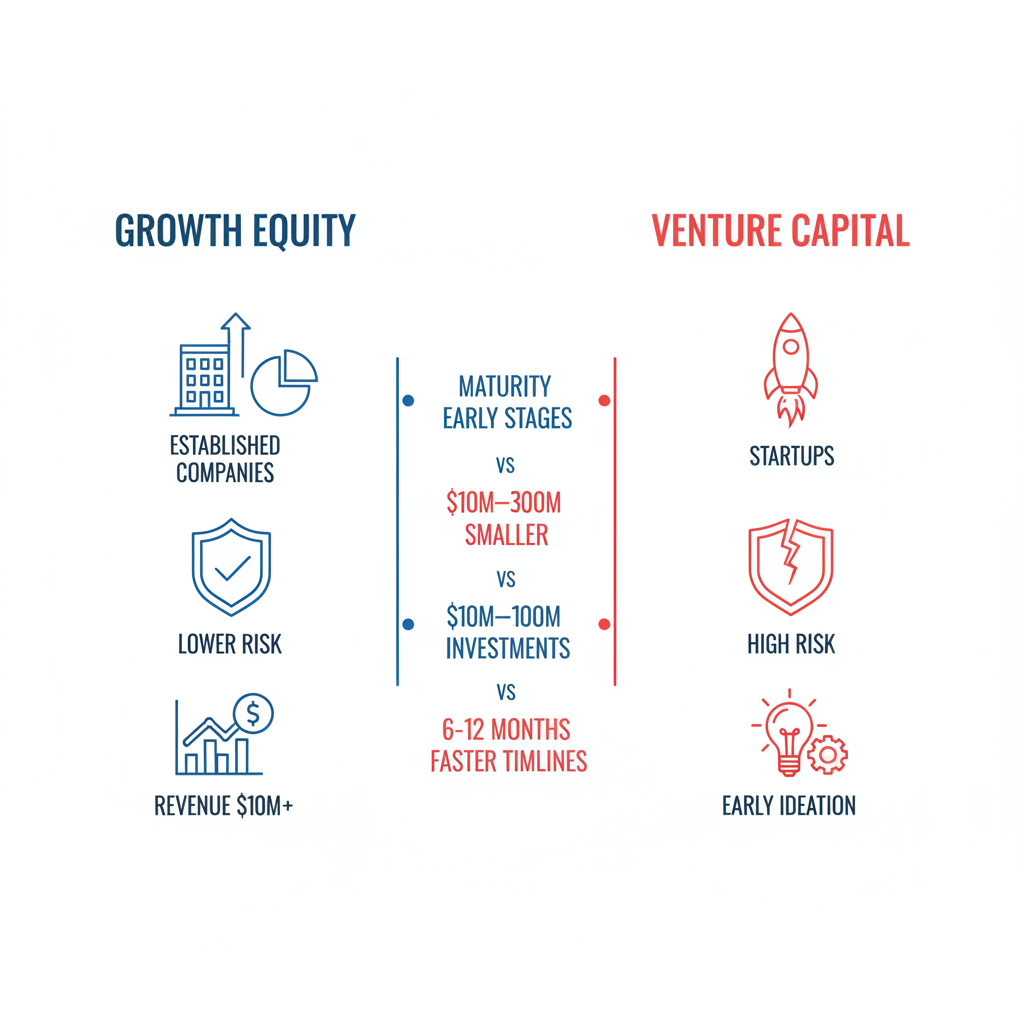
Visual comparison of growth equity versus venture capital key features and differences.
This visual aid reinforces how these approaches serve different lifecycle needs, informing strategic decisions for our clients.
Qualification Criteria for Growth Equity
Companies seeking growth equity must exhibit sustainable profitability, robust management teams, and operations in expansive markets like the US tech sector, where demand for expansion capital infusions remains strong. We at Zaidwood assist in due diligence to verify these elements, ensuring alignment with investor expectations for scalable revenue models and defensible competitive edges.
Key requirements include at least $10 million in annual recurring revenue, a clear growth trajectory (e.g., 20-30% YoY), and minimal debt burdens to accommodate equity infusions. Strong leadership with industry expertise is crucial, as investors value teams capable of executing post-investment plans. In tech examples, platforms with user bases in the millions often qualify by demonstrating product-market fit without needing majority dilution.
Our advisory role extends to structuring deals that meet these criteria, facilitating introductions to our network of over 4,000 investors. This positions qualified firms for transformative growth, bridging to broader benefits in subsequent sections.
Key Benefits of Growth Equity Financing
Growth equity financing stands out as a powerful tool for businesses poised for expansion, offering a blend of capital infusion and strategic partnership. Unlike more aggressive funding models, it enables companies to scale operations while retaining significant control. At Zaidwood Capital, we specialize in guiding clients through this landscape to unlock these advantages effectively.
Access to Substantial Capital for Scaling
Growth Equity provides access to substantial capital specifically designed for companies in their scaling phase, typically ranging from $10 million to over $100 million for US tech firms. This funding comes through minority stakes, allowing businesses to fuel growth initiatives like market expansion, product development, or talent acquisition without the full dilution associated with venture capital. The structure preserves founder control and aligns investor interests with long-term success, enabling non-dilutive expansion that supports sustained revenue growth. According to SBA guidelines on equity financing, such investments empower businesses to leverage capital for strategic advancements, enhancing competitiveness in dynamic markets.
Consider a mid-stage software company in Silicon Valley seeking to double its user base. By securing $50 million in growth equity, it invests in infrastructure upgrades and international marketing, achieving 40% year-over-year growth while maintaining leadership autonomy.
Through our equity advisory services, we streamline access to these scaling capital partnerships, connecting clients to our $15 billion network of deployable capital.
Strategic Support from Experienced Investors
Beyond pure funding, growth equity firms deliver invaluable strategic support, including board guidance, operational enhancements, and introductions to expansive networks. These investors, often with deep industry expertise, help refine business models, optimize supply chains, and navigate regulatory hurdles, accelerating path-to-profitability. This value-added approach contrasts with traditional loans by integrating hands-on involvement that drives measurable improvements in efficiency and market positioning.
For instance, a healthcare technology provider partners with a growth equity firm to refine its go-to-market strategy. Leveraging investor connections, it secures key distribution deals, boosting revenue by 35% within 18 months.
We at Zaidwood Capital enhance this support by facilitating advisory tie-ins, ensuring clients maximize investor networks for comprehensive growth.
Alignment with Business Maturity
Growth equity aligns seamlessly with the maturity of established companies, particularly those generating $5 million or more in EBITDA, offering maturity-focused funding that suits profitable operations over seed-stage risks. It differs from growth equity vs venture capital by demanding less equity in exchange for capital, ideal for firms with proven traction seeking to professionalize without upheaval. The fundraising process typically spans 9 to 18 months, allowing thorough preparation that SBA resources highlight as key to successful equity raises for scaling entities.
Take a manufacturing firm with steady cash flows aiming to acquire complementary assets. A $75 million growth equity infusion funds the deal, integrating operations smoothly and elevating valuation for future liquidity events.
Our team expedites this alignment through tailored equity advisory services, leveraging our 24.4 billion USD transaction experience to match clients with fitting investors.
The Growth Equity Investment Process
Securing growth equity represents a pivotal step for scaling technology companies, bridging the gap between early-stage funding and more mature financing options. This process demands meticulous preparation and strategic execution to attract the right investors. At Zaidwood Capital, we guide clients through every phase, leveraging our expertise in equity advisory to optimize outcomes.
Preparing for Growth Equity Fundraising
Growth Equity fundraising begins with a thorough assessment of your company’s readiness. This involves crafting compelling pitch decks that highlight market potential, competitive advantages, and scalable business models tailored for tech sectors. Simultaneously, prepare pro forma financials projecting revenue growth, cash flow, and key performance metrics to demonstrate viability. Ensuring due diligence readiness means organizing legal documents, intellectual property records, and operational data in advance, as investors scrutinize these closely.
Key considerations include aligning your fundraising goals with current market conditions, such as investor appetite for tech innovations. Timing is crucial; companies with proven revenue streams, often exceeding $1 million annually, are prime candidates for this stage, distinguishing growth equity vs venture capital approaches where maturity drives valuation.
We facilitate this by streamlining documentation through our capital advisory services, ensuring a polished presentation that accelerates investor interest.
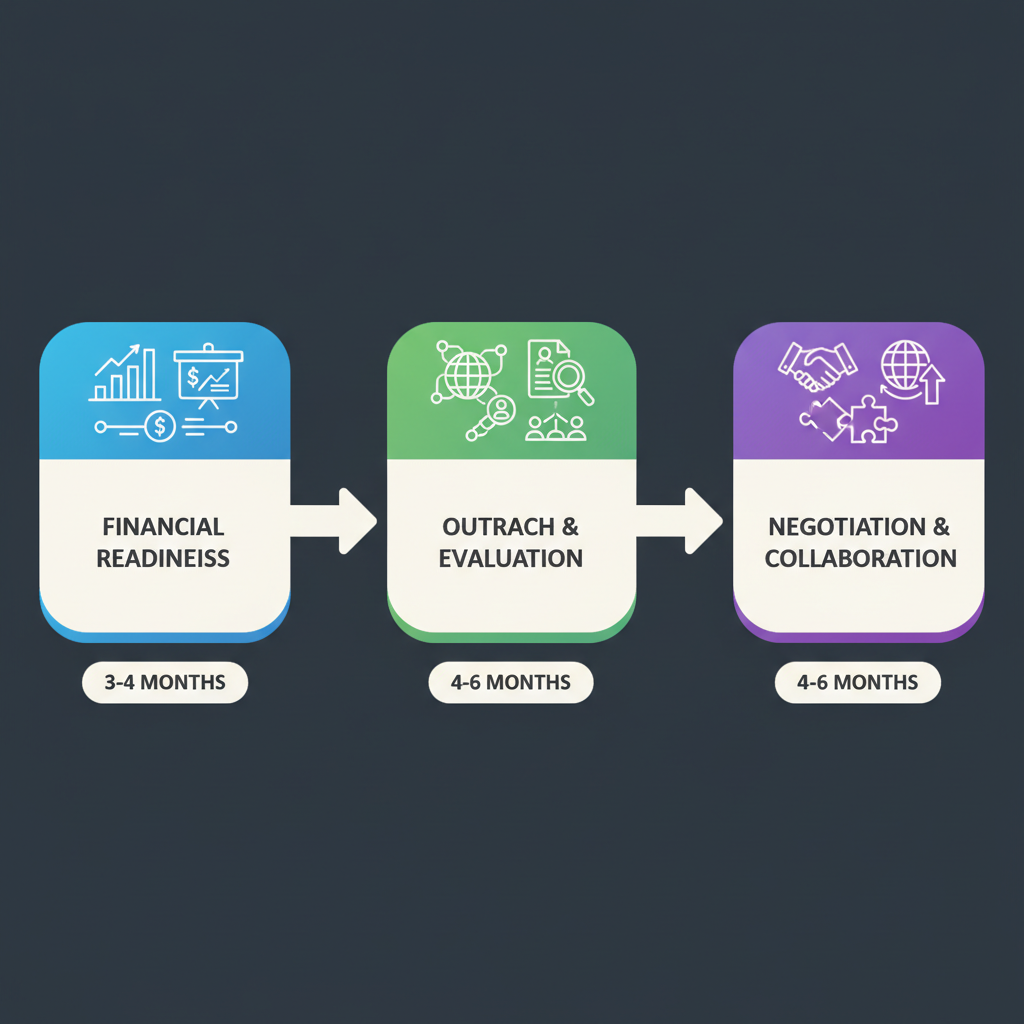
Overview of Zaidwood Capital’s three-stage growth equity investment process
This foundational preparation sets the tone for successful investor engagement, allowing companies to present a cohesive narrative that resonates with potential partners.
Engaging Investors and Due Diligence
Once prepared, outreach to growth equity firms becomes the focus, utilizing established networks to connect with firms in the US specializing in technology investments. We initiate investor engagement protocols by identifying aligned partners through our extensive rolodex of over 4,000 institutional contacts, targeting those with deployable capital exceeding $15 billion. This targeted approach answers queries on how to find suitable growth equity firms, emphasizing personalized introductions over broad solicitations.
The due diligence phase follows, a rigorous evaluation drawing from standard private equity practices as outlined by Investor.gov. Investors conduct financial audits, operational reviews, and market analyses, often spanning 60-90 days. Prepare for inquiries into revenue sustainability and growth scalability, providing transparent data to build trust.
Our role includes coordinating these interactions, offering full-cycle due diligence support to mitigate risks and expedite evaluations.
Closing the Deal and Post-Investment
Negotiation commences upon interest, centering on term sheets that outline valuation, equity stakes, and governance rights. Capital deal structuring requires balancing investor protections with founder autonomy, often involving board seats and milestone-based funding. According to Investor.gov, closing typically occurs 3-6 months post-term sheet, involving legal finalization and regulatory compliance.
Post-investment, the partnership evolves into active collaboration, where investors provide strategic guidance to accelerate expansion. This ongoing support addresses how the process fits mature tech firms seeking growth without full control dilution, unlike venture capital’s higher risk profile.
We enhance this by negotiating favorable terms and fostering long-term relationships, ensuring seamless integration of capital into your growth trajectory.
Best Practices for Securing Growth Equity
At Zaidwood Capital, we have guided numerous clients through the complexities of capital raises, drawing on our extensive network and transaction experience to deliver targeted strategies. This section outlines key practices for securing growth equity, emphasizing preparation that aligns with investor expectations for scalable operations.
Building a Compelling Investment Case
Growth Equity represents a pivotal funding stage for established companies aiming to accelerate expansion without relinquishing full control. To attract investors, craft a narrative that highlights your proven track record, market opportunities, and scalable growth projections. Focus on financial storytelling that demonstrates realistic revenue trajectories and operational efficiencies, supported by detailed models showing potential returns.
Incorporate data-driven projections, such as anticipated 20-30% annual growth rates, benchmarked against industry standards from sources like the USPEC overview on growth equity applications. This approach not only showcases your business’s potential for market expansion and innovation but also addresses ROI expectations for 2025, where investors typically seek 3-5x multiples over a 3-7 year horizon.
We recommend validating your projections through third-party audits to enhance credibility. As an experienced M&A advisory firm, we assist in refining pitch decks and pro forma financials to resonate with growth-focused investors, ensuring your case stands out in competitive landscapes.
Navigating Firm Selection and Networks
Selecting the right growth equity firms requires a clear understanding of alignment with your business stage and sector. Unlike venture capital, which targets early-stage risks, growth equity vs venture capital differs in focusing on mature companies with established revenues seeking minority stakes for strategic acceleration. Prioritize firms experienced in your industry, such as those emphasizing tech scalability, to leverage their operational expertise and networks.
Begin by evaluating firm portfolios for synergies, using criteria like investment size (typically $10-50 million) and sector focus, as outlined in HBS insights on private equity stages. Leverage professional connections to identify suitable partners; our access to over 4,000 institutional investors facilitates warm introductions that expedite the process.
Target firms with strong 2025 performance benchmarks, including consistent deal flow and value-add support. We integrate our Velocity Matrix to streamline these connections, helping clients navigate selections efficiently and position for optimal investor alignment.
Mitigating Risks in the Process
Effective strategic capital pursuit involves proactive risk management during due diligence and negotiations. Prepare comprehensive data rooms with financial, legal, and operational documents to facilitate smooth reviews, minimizing delays that could undermine deal momentum. Emphasize valuation realism by grounding expectations in comparable transactions and market data, avoiding overoptimism that might deter investors.
Implement investor alignment tactics such as early legal consultations to address potential red flags, drawing from HBS strategies on equity risk mitigation. This includes stress-testing financial models for various scenarios and securing preliminary term sheets that balance control retention with growth incentives.
Anticipate 2025 benchmarks like heightened scrutiny on sustainability metrics. Through our full-cycle due diligence services, we provide expert guidance on documentation and negotiations, empowering clients to close deals with confidence while preserving strategic autonomy.
Unlocking Growth Through Strategic Equity
Growth Equity represents a pivotal financing mechanism for businesses poised for expansion, bridging the gap between early-stage funding and mature operations. Unlike traditional loans, it involves investors taking minority stakes to fuel scalable growth without relinquishing full control. Key benefits include accelerated revenue growth, enhanced market positioning, and access to expert guidance. The process typically spans qualification assessments, due diligence, term negotiations, and closing, often taking 3-6 months depending on deal complexity. Best practices emphasize clear financial projections and alignment with investor theses.
In comparing growth equity vs venture capital, the former targets established companies with proven models, prioritizing sustainable scaling over high-risk innovation. At Zaidwood Capital, our role as a boutique capital advisory firm underscores the value of specialized networks and rigorous due diligence to connect clients with growth equity firms. We facilitate introductions to institutional investors, ensuring tailored matches that mitigate risks and optimize outcomes.
We invite you to explore equity-driven expansion options thoughtfully, consulting advisors to align with your strategic goals. As outlined by the Small Business Administration, diverse funding strategies like these empower informed decisions. Looking ahead, 2025 promises robust opportunities in the US tech sector for capital scaling strategies, driving innovation and economic impact.
Resources


