


Business Acquisition Financing
Table of Contents
Understanding Business Acquisition Financing for Growth-Stage Companies
Business acquisition financing uses debt, equity, or hybrid instruments to fund the purchase of an existing business, especially for growth-stage companies with $5 million to $50 million in revenue. For a comprehensive walkthrough, see our guide on How To Finance Buying A Business. Companies in West Palm Beach and across the U.S. rely on these structures to accelerate expansion.
According to the U.S. Small Business Administration (SBA), SBA 7(a) loans are government-backed term loans with down payments as low as 10 percent, terms up to 10 years (25 years for real estate), and a maximum lending limit of $5 million. These loans require rigorous eligibility criteria including demonstrated cash flow, collateral, and personal guarantees. For growth-stage companies seeking acquisition capital, the SBA 7(a) program offers a lower equity contribution compared to conventional bank financing, making it an attractive entry point.
Mezzanine financing is a subordinated debt instrument that often includes equity-linked features such as warrants or conversion rights. It bridges the gap when senior bank debt is insufficient, offering flexible repayment schedules and faster execution in exchange for higher return expectations and equity participation. SIFMA data reflects strong private credit market activity, which has expanded the availability of mezzanine capital for growth-stage acquisitions.
As a Boutique M&A and Capital Advisory Firm, Zaidwood Capital guides clients through the full spectrum of acquisition financing options–from SBA-backed loans to mezzanine structures–tailoring solutions to each transaction’s unique profile. This information is for educational purposes only and does not constitute a commitment to lend or invest.
Core Sources of Capital for Business Acquisition Financing
Business acquisition financing is a critical element in securing the right deal structure and ensuring long-term success. Understanding the full landscape of acquisition funding – from senior debt to equity – empowers buyers to match the financing to their company’s cash flow, collateral, and growth stage. Several capital sources are available; the table below compares the most common options.
| Source | Typical Cost | Collateral Required | Best For |
|---|---|---|---|
| Traditional bank loans | 6%-9% APR | Yes (hard collateral) | Established, cash-flow-rich businesses |
| SBA 7(a) loans | Prime + 2.25%-4.75% | Yes (business assets + personal guarantee) | Growth-stage companies with limited collateral |
| Seller financing | Negotiable (often 6%-10%) | No (note from seller) | Deals where seller is motivated |
| Mezzanine debt | 12%-18% (cash pay + PIK + warrants) | Subordinated position | Bridging equity gap with flexible repayment |
| Equity financing | 25%-40%+ IRR expectation | No (ownership dilution) | High-growth, high-risk acquisitions |
| Asset-based lending | Prime + 1%-3% | Yes (specific assets) | Acquisitions with strong receivables/inventory |
When structuring business acquisition financing, buyers often begin with traditional bank loans, which feature 6%-9% APR and require hard collateral. These loans are best for established, cash-flow-rich businesses with substantial assets. Strong credit and collateral are prerequisites. For mature companies, this route remains a cost-effective choice.
According to the U.S. Small Business Administration, SBA 7(a) loans offer longer terms and lower down payments at Prime + 2.25%-4.75%. They require business assets and a personal guarantee, ideal for growth-stage companies with limited collateral. The government guarantee lowers lender risk, enabling younger businesses to secure funding where conventional loans would be difficult.
In motivated-seller situations, seller financing can bridge gaps at negotiable rates (often 6%-10%). The seller accepts a promissory note instead of cash at closing, removing the need for third-party collateral. This alignment can accelerate deal closure, especially for buyers who lack conventional loan qualifications.
Data from the Securities Industry and Financial Markets Association (SIFMA) shows mezzanine financing typically costs 12%-18% all-in, combining cash pay, PIK interest, and warrants. Mezzanine debt occupies a subordinated position, bridging the gap between senior debt and equity. This hybrid capital suits acquirers aiming to limit dilution while retaining repayment flexibility, though it carries higher cost and complexity.
Equity financing exchanges ownership for growth capital, with investors typically seeking 25%-40%+ IRR. No collateral is required, but founders dilute their stake. This path is best for high-growth, high-risk acquisitions where cash flow may not yet support heavy debt loads, and where the sponsor can deliver the returns investors demand.
Asset-based lending (ABL) uses receivables, inventory, or equipment as collateral. Rates range from Prime + 1% to 3%. It works well for acquisitions with strong balance-sheet components; lenders advance against liquidation values. ABL provides substantial liquidity with limited personal risk, though it demands rigorous monitoring.
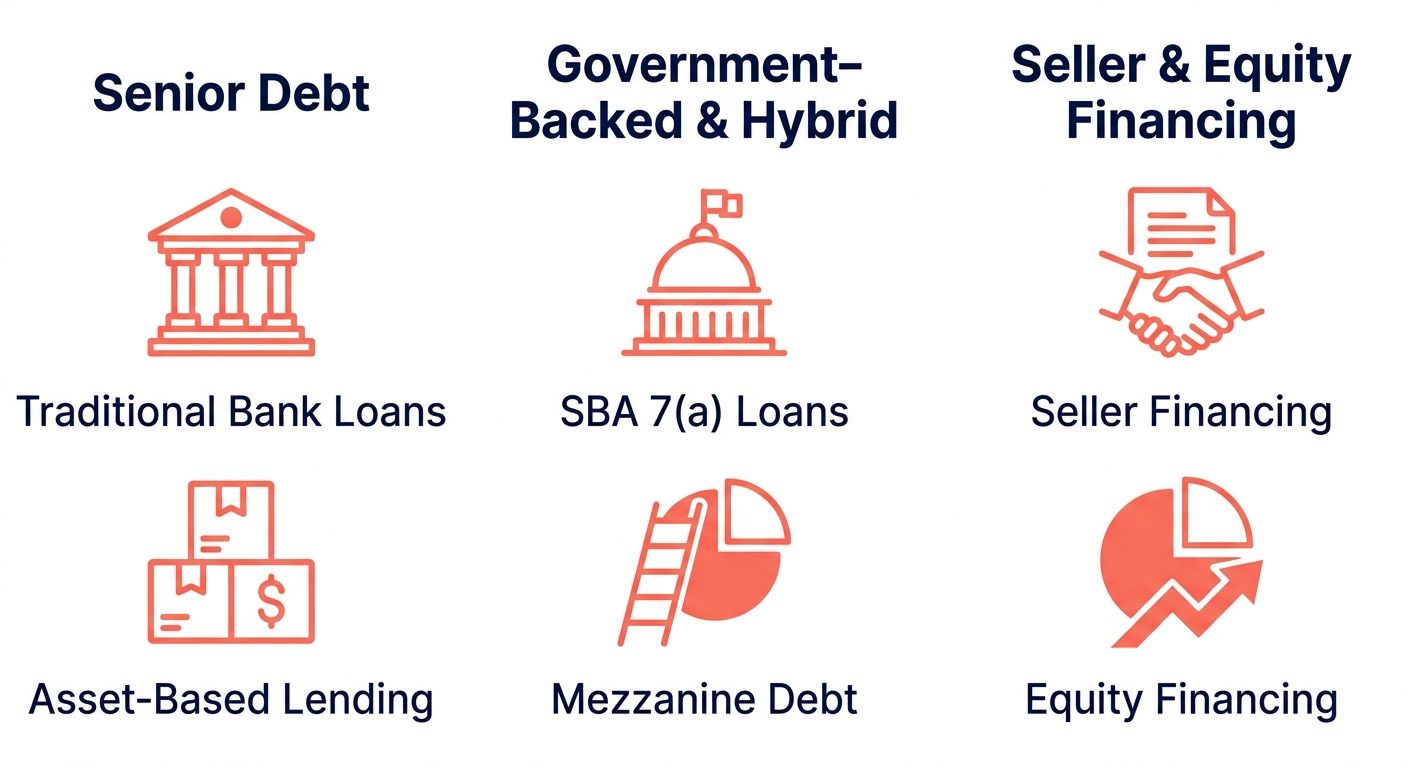
Core sources of capital for business acquisition financing.
Choosing the right capital source hinges on accurate valuation. Explore our business valuation advisory to ensure your acquisition is properly priced. Once the source is selected, the next step is preparing a strong application and assembling an investor-ready package. Our advisory team at Zaidwood Capital can help evaluate which capital source best fits your financial profile and acquisition strategy.
Debt vs. Equity Financing and the Capital Stack in Acquisitions
In business acquisition financing, one of the first major decisions is whether to use debt, equity, or a combination. At Zaidwood Capital, a Boutique M&A and Capital Advisory Firm providing Full-Cycle M&A services, we help clients navigate the capital stack–the layered structure that funds acquisitions–so they can choose the right mix.
Understanding the Difference Between Debt and Equity Financing
Debt financing involves borrowing capital with a fixed repayment schedule. It does not dilute ownership–lenders do not take equity stakes–but it imposes mandatory principal and interest payments. Equity financing, on the other hand, involves selling an ownership share in the business. While equity offers flexible repayment (dividends are paid at the board’s discretion), it dilutes the founder’s stake. These differences create a trade-off between control and cost. Debt is often cheaper, with interest that may be tax-deductible, whereas equity expects higher returns to compensate for greater risk.
The following table summarizes the key trade-offs between debt and equity financing.
| Feature | Debt Financing | Equity Financing |
|---|---|---|
| Ownership dilution | None | Significant (investor gets ownership stake) |
| Cost of capital | Lower (6%-18%) | Higher (25%-40%+ target return) |
| Repayment obligation | Mandatory principal + interest payments | No fixed repayment (dividends at discretion) |
| Risk to investor | Lower (secured or subordinated) | Higher (last in liquidation) |
| Personal guarantee | Often required (especially for smaller deals) | Seldom required |
| Best use case | Proven, cash-flow-generating acquisitions | High-growth, unproven, or turnaround acquisitions |
The table highlights a fundamental tension: debt preserves ownership and carries lower capital costs but requires steady cash flow to service payments, while equity avoids fixed obligations but comes with significant dilution and a higher expected return. For most middle-market acquisitions, a blend of both debt and equity–structured through a capital stack–balances these trade-offs.
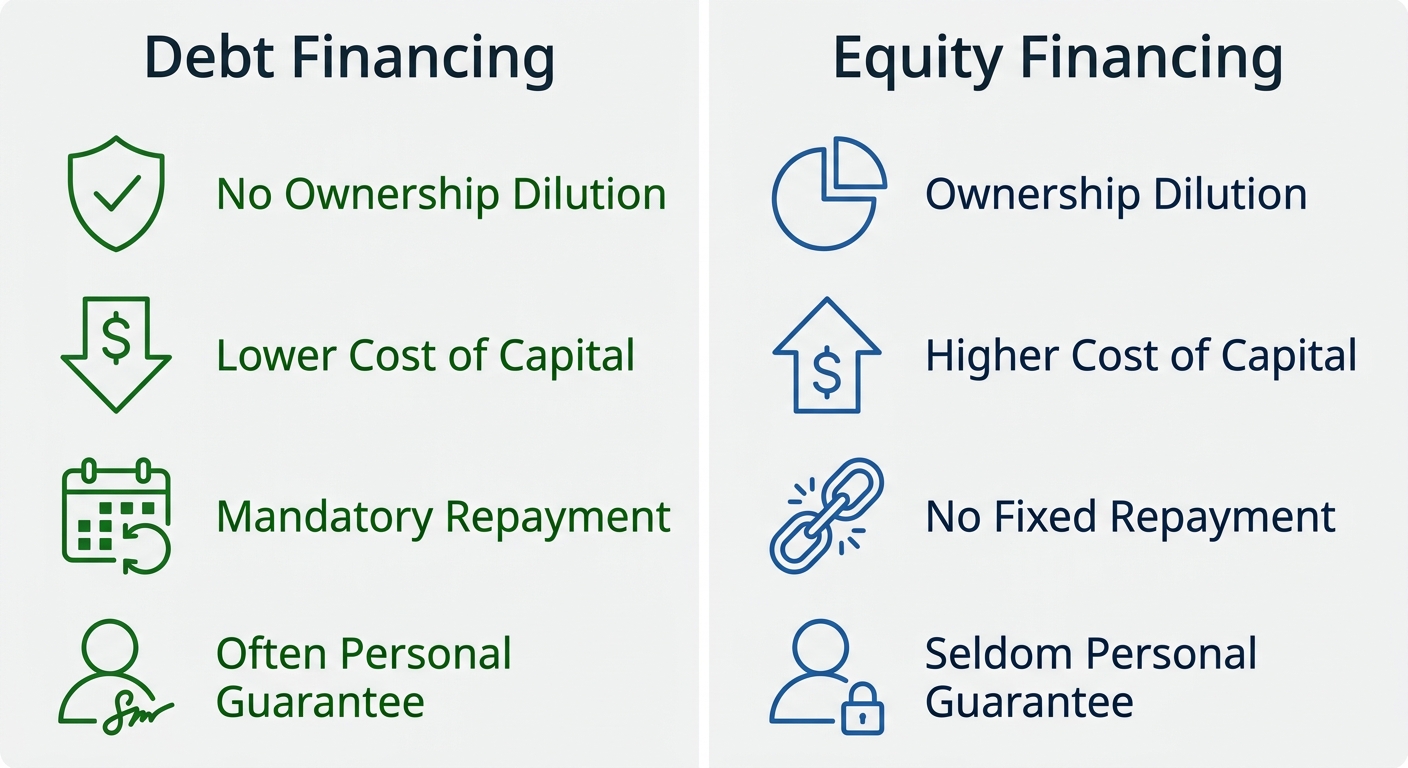
Debt vs. Equity Financing Comparison Infographic
Understanding these trade-offs is essential, but equally important is how debt and equity are layered in the capital stack.
How the Capital Stack Layers Debt and Equity
The capital stack organizes financing into layers, ranked by seniority and risk. According to industry data from SIFMA, structures typically include:
- Senior secured debt: lowest risk, lowest return; backed by collateral and first in line for repayment
- Mezzanine financing: subordinated debt with higher interest, often including warrants to enhance returns
- Preferred equity: fixed dividend, senior to common equity but junior to all debt
- Common equity: residual claim, bears the highest risk and expects the highest return
Each layer’s risk-return profile influences the overall cost of capital and the cushion of cash flow available to service debt. For a $10 million acquisition, a typical stack might be 60% senior debt ($6M), 20% mezzanine ($2M), 10% preferred equity ($1M), and 10% common equity ($1M). Senior debt providers usually require amortization schedules, while mezzanine lenders may offer interest-only periods in exchange for higher yields.
Evaluating Cash Flow for Debt Service
Lenders focus on cash flow coverage. A common benchmark is a debt service coverage ratio (DSCR) of 1.25x or higher–meaning the business must generate at least 25% more cash than needed to cover debt payments. EBITDA is the primary metric; for owner-operated businesses, Seller’s Discretionary Earnings (SDE) is often used. SBA 7(a) loans, a popular choice for smaller acquisitions, require demonstrated cash flow to support the loan. For tech acquisitions, additional costs like tech M&A advisory fees can affect net cash flow available for debt service.
Now that you understand the financing options, the next step is evaluating your cash flow and building a tailored capital stack. This information is for educational purposes only and does not constitute an offer or solicitation; securities are offered through Finalis Securities LLC. Zaidwood Capital is not a registered broker-dealer.
Navigating SBA 7(a) Loans and Preparing Your Company for Financing
There are several financing paths to acquire a business, but one of the most popular is the SBA 7(a) loan program. For business acquisition financing, the SBA 7(a) program offers a government-backed structure that reduces lender risk and makes capital more accessible.
Understanding SBA 7(a) Loan Requirements for Acquisitions
According to the U.S. Small Business Administration (SBA), 7(a) loans can be used to purchase business assets, working capital, inventory, and transaction costs. The business must operate for profit, meet SBA size standards (generally 500 employees or fewer), and not engage in prohibited activities such as speculative real estate. Borrowers must demonstrate industry experience, good credit, and no federal debt delinquency. Lenders also require a personal guarantee from all owners holding at least 20% of the business.
The table below highlights the key differences between SBA 7(a) and conventional bank financing for acquisitions.
| Feature | SBA 7(a) Loan | Conventional Bank Loan |
|---|---|---|
| Down payment requirement | 10% equity injection (can include seller note) | 20%-30% typical |
| Interest rate | Prime + 2.25%-4.75% (capped) | Prime + 1%-3% (uncapped) |
| Collateral | Business assets + personal guarantee required | Hard collateral + personal guarantee |
| Personal guarantee | Required from all owners with 20%+ stake | Usually required from all owners |
| Closing timeline | 60-90 days via Preferred Lender Program | 30-60 days |
While conventional loans may close faster and carry slightly lower interest rates, the SBA 7(a) program’s lower down payment and capped rates often benefit first-time buyers. Balancing these factors is key to selecting the right capital structure. In some cases, mezzanine financing can be layered with the SBA 7(a) loan to meet total capital needs.
How to Calculate the 10% Equity Injection and Down Payment
The SBA requires a 10% equity injection from the buyer’s unencumbered personal funds, calculated as 10% of the Total Project Cost (TPC). TPC is defined as Purchase Price + Closing Costs + Working Capital. For example, if the purchase price is $500,000, closing costs are $25,000, and working capital is $50,000, TPC equals $575,000, so the buyer must contribute $57,500. For business acquisition financing, this equity injection is a key factor in structuring the deal. These personal funds must be unencumbered, meaning they cannot be borrowed or come from a gift without a formal gift letter. Seller financing can fill part of the acquisition price, but it does not replace the buyer’s equity injection. The seller note may be structured with deferred payments to improve post-acquisition cash flow, yet the buyer’s personal funds still constitute the required 10%. A fully deferred seller note improves post-acquisition cash flow, which lenders favor when evaluating DSCR. The remaining portion can be covered by an SBA-guaranteed bank loan, and the seller note reduces the amount borrowed from the bank but not the buyer’s equity obligation. For larger acquisitions, mezzanine financing may supplement the SBA 7(a) loan to bridge any remaining capital gaps.
Preparing Financial Documentation for Lender Evaluation
Lenders scrutinize several documents to evaluate the borrower’s ability to repay. The DSCR is calculated as net operating income (or EBITDA) divided by total debt service; a ratio below 1.15 signals insufficient cash flow to lenders. The SBA requires a minimum DSCR of 1.15 to 1.25 to ensure the business can cover loan payments. Key items to prepare include:
- Personal and business tax returns for the previous three years
- Profit and loss statements (current and year-to-date)
- Cash flow projections for at least 12 months post-acquisition
- A comprehensive business plan detailing operations and growth strategy
- A fully executed purchase agreement
- A personal financial statement (SBA Form 413)
- DSCR calculation demonstrating the required coverage
Lenders also review the buyer’s resume to assess industry experience and management capability. We guide acquirers through document preparation, ensuring that every requirement is met and that the financial picture presented is compelling to lenders. Once the documentation is complete, the application moves to underwriting and, if approved, to closing. If you’re ready to move forward, you can Get A Loan To Buy A Business through our streamlined application process.
Advanced Mezzanine Financing and Deal Structuring Considerations
After senior debt has been secured, mezzanine financing steps in as a hybrid capital layer, bridging the remaining funding gap without requiring full equity dilution. For companies pursuing business acquisition financing or growth capital, this subordinated instrument provides leverage and flexibility. As a Boutique M&A and Capital Advisory Firm, Zaidwood Capital delivers boutique investment banking services that structure mezzanine deals to align with both borrower objectives and investor return targets.
The following table summarizes typical mezzanine financing terms to help borrowers understand what to expect.
| Term | Typical Range | Key Considerations |
|---|---|---|
| All-in cost (cash pay + PIK + warrants) | 12%-18% IRR equivalent | Higher than senior debt but lower than pure equity; PIK interest accrues. |
| Warrants (equity kicker) | 0.5%-2% of fully diluted equity | Often structured as a small equity interest to sweeten the lender’s return. |
| Personal guarantee | Not typical in middle-market mezzanine | May be required for smaller sub-$5M deals; avoid if possible. |
| Prepayment flexibility | Often call protection 2-3 years | Hard prepay penalties are common; negotiate early. |
| Covenants | Moderate (e.g., minimum EBITDA, maximum leverage) | Fewer than senior debt but stricter than equity; monitor regularly. |
As the table illustrates, the all-in cost of mezzanine capital reflects a blended IRR that bundles cash interest, PIK interest, and an equity kicker. Warrants–typically a small slice of fully diluted equity–are designed to enhance lender returns without increasing near-term cash obligations. Personal guarantees are uncommon in middle-market mezzanine, but they can appear in deals below $5 million; we recommend borrowers push for their removal. Prepayment flexibility is constrained by call protection spanning 2-3 years, so negotiating prepay terms early is key to preserving optionality. Covenants, such as minimum EBITDA and maximum leverage, are moderate and require ongoing monitoring to stay in compliance. Lenders typically test these covenants quarterly, making accurate and timely financial reporting essential.
For business acquisition financing, growth capital, and recapitalizations, mezzanine financing offers a strategic bridge between senior debt and equity, preserving cash flow while avoiding excessive dilution. When structuring a mezzanine deal, we focus on matching repayment schedules to projected free cash flow, balancing the equity kicker, and limiting covenant restrictions where possible. Because mezzanine lenders sit in a subordinated position, they naturally seek higher returns and may use warrants, but the structure preserves founder control. We urge borrowers to model the overall cost of capital carefully, negotiate for prepayment flexibility early, and maintain adequate covenant headroom. With disciplined structuring, mezzanine capital can unlock acquisition opportunities while keeping equity upside intact, making it a powerful tool in middle-market transactions.
Looking ahead, equity financing and SBA 7(a) loans offer alternative or complementary capital paths, depending on deal size and risk profile. Understanding these options in a unified capital structure framework improves decision-making.
Frequently Asked Questions About Business Acquisition Financing
Still have questions about the process? See answers to the most common inquiries below.
What types of business acquisition financing are available? We advise on a range of solutions, including SBA 7(a) loans and mezzanine financing, tailored to your acquisition goals and business profile across various industries.
How can I qualify for SBA 7(a) loans to acquire a business? SBA 7(a) loans are government-backed, requiring acceptable credit history and an eligible industry. Our firm guides you through eligibility and structuring, helping you prepare a strong application.
What is mezzanine financing and how does it work in acquisitions? Mezzanine financing is a hybrid debt-equity solution often used for larger acquisitions, typically requiring collateral and subordinated to senior debt, providing flexible capital for growth-oriented buyers.
How does the acquisition financing process work at Zaidwood Capital? As a Full-Cycle M&A advisory firm, we start with an initial consultation, then data analysis, investor matchmaking, and due diligence to structure optimal financing aligned with your strategic goals.
Can I use acquisition financing for working capital after the deal? Yes. Many owners also secure working capital for merchants to stabilize cash flow post-acquisition.
Selecting the Right Acquisition Financing Strategy
Securing business acquisition financing–the capital used to purchase a company, including debt, equity, and hybrid instruments–is the essential next step after targeting an acquisition. Key strategies include SBA 7(a) loans, which the U.S. Small Business Administration backs with lower rates and longer terms; mezzanine financing, a subordinated debt with equity features; and asset-based lending secured against company assets. Selection pivots on borrower credit profile, deal size, funding speed, interest cost, and required collateral. We at Zaidwood Capital help structure and negotiate these options. We recommend comparing strategies with an experienced advisor to make an informed choice.
Resources


