


Series D
Table of Contents
Navigating Series D Funding for Growth-Stage Companies
Once a company has navigated earlier funding rounds, Series D becomes a pivotal stage for mature growth-stage companies. Securing Series D Funding signals that a business has achieved strong product-market fit and recurring revenue. This late-stage growth equity round is typically raised to accelerate expansion, fund acquisitions, or build dominant market share before an anticipated IPO. For many, series d represents the final private capital infusion before a public listing.
Investors in Series D rounds are sophisticated and include institutional funds, private equity firms, sovereign wealth funds, and family offices seeking pre-IPO valuation upside. These rounds often involve a valuation step-up and demand complex financial structuring to balance dilution, control, and growth milestones. A successful raise requires matching with capital providers who truly understand the company’s stage and sector.
As a Boutique M&A and Capital Advisory Firm, Zaidwood Capital guides growth-stage companies through this critical fundraise. Our Growth Equity Advisory practice combines the Precision Catalyst AI-driven investor matching engine with the Velocity Matrix rapid-execution framework, ensuring each Series D round is positioned for the best possible terms. We manage the full cycle–from refined narrative and materials to introductions and negotiation–so founders can focus on execution. A successful Series D often sets the stage for a company’s eventual IPO or strategic acquisition.
Understanding Series D Funding in the Capital Stack
Having established the capital stack framework, we now examine the series d stage–where late-stage companies secure capital for pre-IPO growth. Understanding What is Series D Funding requires a look at where it sits in the funding lifecycle. According to the Securities Industry and Financial Markets Association (SIFMA), a series d round is a late-stage equity raise for mature startups, typically securing $100 million or more at valuations between $500 million and $2 billion, resulting in 5-15% dilution. This round represents the lowest dilution in the venture cycle, reflecting both the startup’s maturity and the reduced risk perceived by investors.
As the capital stack matures, the series d round occupies the final equity layer before a potential IPO or acquisition. It differs sharply from earlier rounds in raise size, investor profile, and strategic intent. The following table compares the series d stage with Series A, B, and C across these dimensions.
Series D vs. Earlier Funding Rounds
| Round | Average Raise | Valuation Range | Lead Investor Type | Dilution | Strategic Objective |
|---|---|---|---|---|---|
| Series A | $10M-$15M | $40M-$80M | Institutional VC | 20-30% | Product-market fit & scalability |
| Series B | $30M-$60M | $100M-$300M | Growth-stage VC | 15-25% | Market expansion & team build |
| Series C | $50M-$120M | $200M-$600M | Late-stage VC, growth equity | 10-20% | New markets, product lines |
| Series D | $100M+ | $500M-$2B+ | Growth equity, crossover, sovereign wealth | 5-15% | Pre-IPO scaling, acquisition, bridge to exit |
The table illustrates that the series d raise is the largest round by capital raised, often exceeding $100 million, while carrying the lowest dilution range of 5-15%. Lead investors evolve from traditional VC firms in Series A to late-stage growth equity, crossover, and sovereign wealth funds at this stage, reflecting the company’s reduced risk and clear exit path. For a mature startup, this pre-IPO financing is not a discovery phase–it’s a scaling vehicle aimed at expanding market share, funding large acquisitions, or bridging to a liquidity event. However, a growth-stage round without a clear pathway to an IPO or acquisition can sometimes signal to the market that the company is struggling to achieve its earlier growth projections, which may make raising additional capital more challenging.
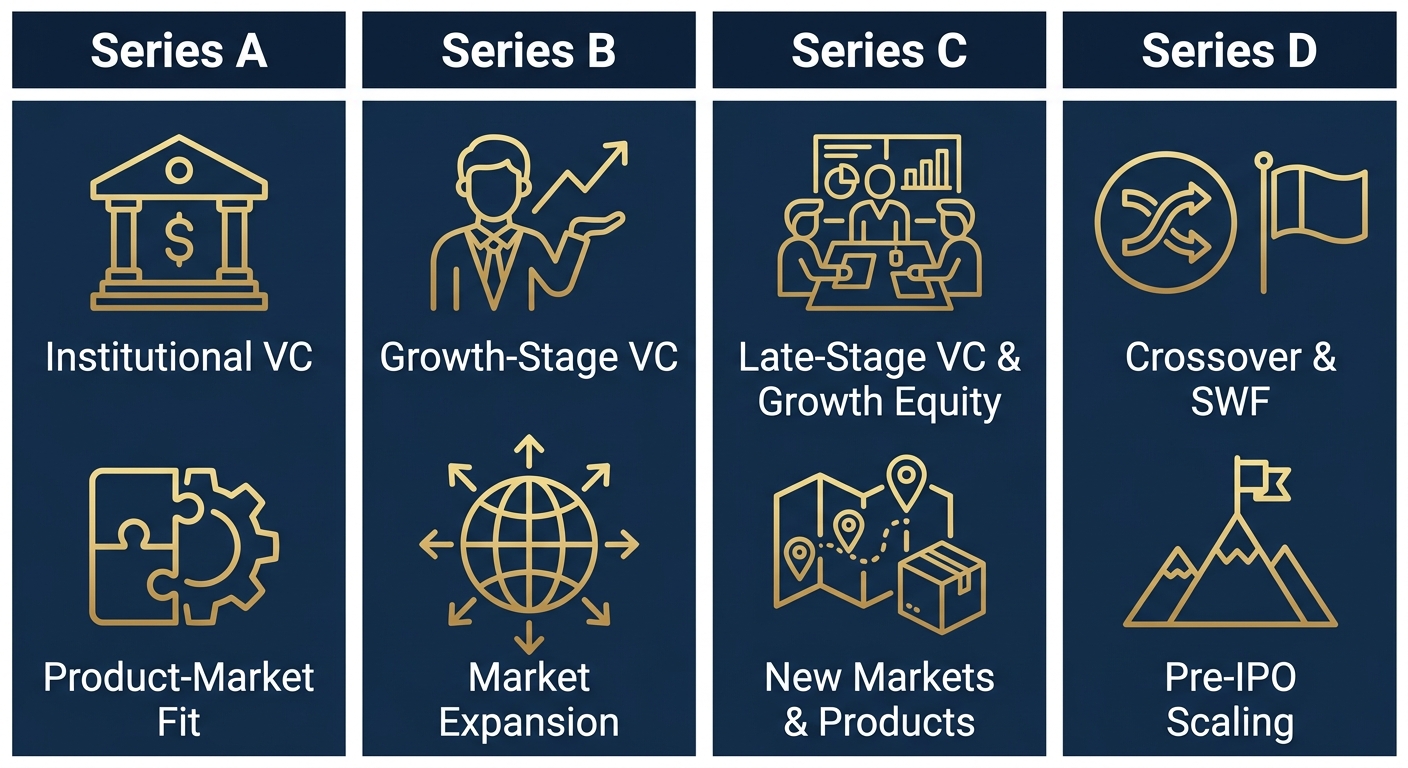
Understanding Series D as the pre-IPO scaling round in the capital stack.
The involvement of crossover funds and sovereign wealth funds signals a company’s transition to pre-IPO valuation and late-stage growth equity, where institutional investors prioritize capital preservation and strategic alignment over high-risk speculation. At this stage, dilution is carefully managed, typically staying below 15%, preserving founder and early-investor stakes. For founders, the series d milestone is a signal of strong revenue traction and a clear exit plan, and they must vet potential investors for strategic fit. Firms like our Boutique M&A and Capital Advisory Firm in West Palm Beach leverage the Precision Catalyst platform and Sovereign Data Nexus to match companies with the right institutional investors for these late-stage transactions, serving clients across the United States. We must emphasize that this type of financing involves significant risk; no outcome is guaranteed, and companies should consult a qualified capital advisor. Next, we discuss the key criteria investors use to assess Series D readiness.
Investor Dynamics and Evaluation Criteria in a Series D Round
To successfully raise a Series D, founders and CFOs must first understand who they are pitching to and what those investors demand. This section breaks down the key institutional investor types and the evaluation metrics they apply. We at Zaidwood Capital see firsthand how a founder’s grasp of these dynamics can accelerate the path to a completed round.
The Role of Institutional Investors in Series D Rounds
Institutional investors active in a Series D round span four distinct categories, each with its own capital mandate and diligence lens. According to SIFMA industry data, growth equity firms typically deploy $50M-$150M checks with a 3-7 year horizon, providing board seats, strategic guidance, and hiring support–they target an IPO or M&A exit within five years. Crossover funds, in contrast, invest $75M-$250M with a shorter 2-5 year horizon and an explicit expectation of an IPO within 18-36 months; they bring public-market insights, IPO preparation, and analyst relations to the table. Sovereign wealth funds write the largest checks–$100M-$500M–and operate on a 5-10+ year timeline, offering global networks, regulatory support, and a flexible exit strategy that can accommodate either an IPO or a strategic sale. Corporate venture capital units, investing $20M-$100M over 3-6 years, are primarily driven by strategic alignment and often pursue a strategic acquisition as the preferred exit.
The following table compares these investor types side by side.
| Investor Type | Typical Check Size | Investment Horizon | Value-Add Services | Exit Expectation |
|---|---|---|---|---|
| Growth Equity Firms | $50M-$150M | 3-7 years | Board seat, strategic guidance, hiring support | IPO or M&A within 5 years |
| Crossover Funds | $75M-$250M | 2-5 years | Public market insights, IPO preparation, analyst relations | IPO within 18-36 months |
| Sovereign Wealth Funds | $100M-$500M | 5-10+ years | Global network, regulatory support, long-term partnership | Flexible; exit via IPO or strategic sale |
| Corporate Venture Capital | $20M-$100M | 3-6 years | Commercial partnerships, distribution channels, R&D collaboration | Strategic acquisition likely |
This diversity in investor profiles means that a company’s narrative must speak to very different incentive structures. Late-stage growth equity firms emphasize operational metrics and a clear path to profitability, while crossover funds scrutinize public-market comparables and IPO readiness.
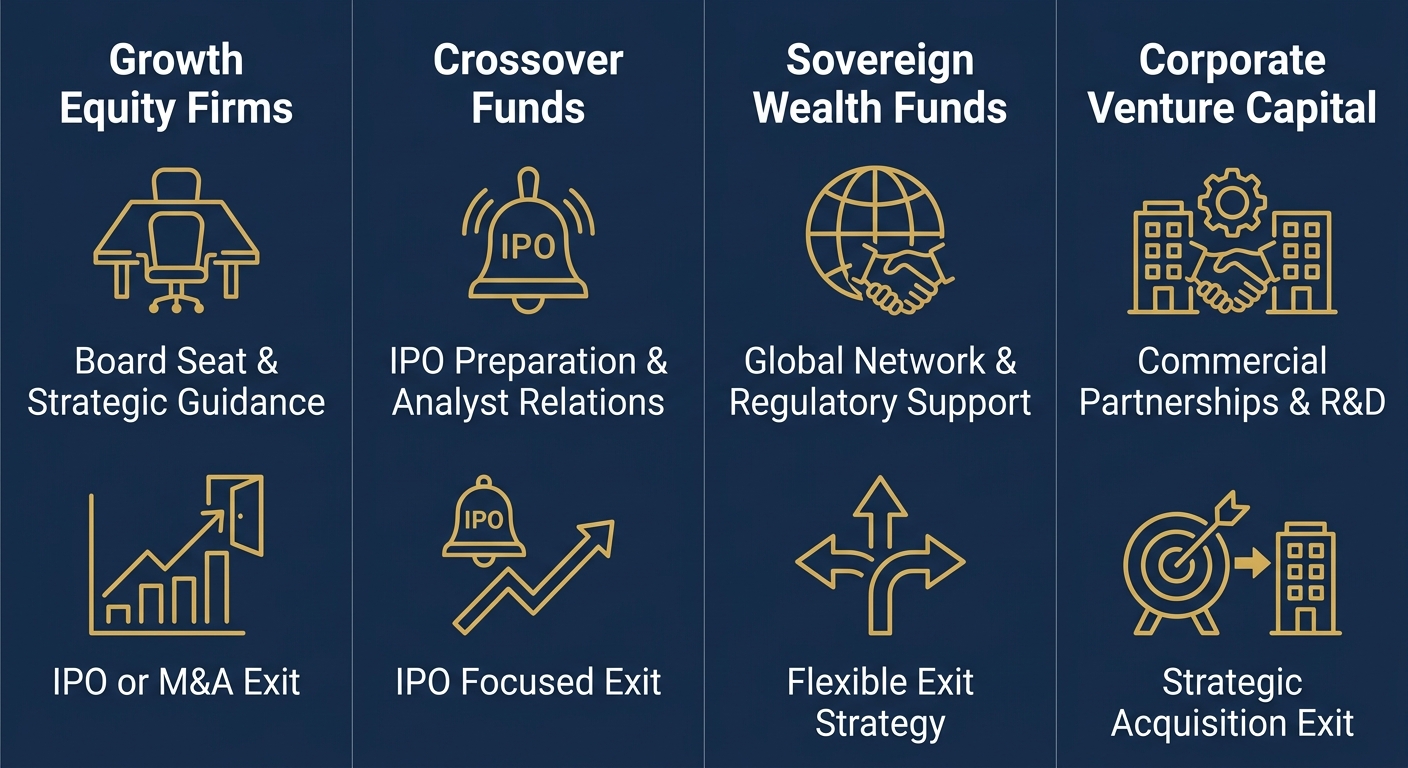
Institutional investor types and their evaluation criteria in a Series D round
Key Evaluation Metrics for Late-Stage Investors
When assessing a Series D opportunity, investors dissect six fundamental metrics. Revenue growth rate remains the headline figure–consistent, above-market expansion signals strong product-market fit. Annual Recurring Revenue (ARR) is particularly critical for subscription-based businesses, as it demonstrates revenue predictability. Unit economics, measured through the LTV/CAC ratio, reveal whether customer acquisition is sustainable; a ratio of 3x or higher is generally sought. Total Addressable Market (TAM) penetration quantifies how much runway remains–investors want to see that a company can still double or triple within its existing market. The burn multiple (net burn divided by net new ARR) shows capital efficiency; investors in the current environment favor companies that can grow without excessive cash consumption. Finally, governance readiness encompasses board composition, financial controls, and audit readiness–late-stage investors need confidence that the company can withstand public-market scrutiny and a pre-IPO valuation process. We at Zaidwood Capital regularly stress-test these metrics with our clients through the Velocity Matrix framework so that they enter conversations with a data-room that answers these questions before they are asked.
How Growth Equity Firms Screen Series D Opportunities
The growth equity screening process follows a structured timeline: initial outreach, due diligence, and term sheet negotiation. During initial outreach, firms identify potential portfolio companies through proprietary data platforms–Zaidwood Capital’s Sovereign Data Nexus, for instance, enables investors to surface growth-stage companies whose revenue velocity and unit economics match their mandate. Once a target passes the initial screen, the due diligence phase deep-dives into financial records, customer reference calls, and stress-tested financial models; investors often spend four to eight weeks validating the growth narrative. If the diligence clears the bar, the process moves to a term sheet that defines liquidation preference, board seat allocation, and anti-dilution provisions. Because growth equity firms typically expect an IPO or acquisition within five years, management teams simultaneously begin preparing for exit. Companies preparing for an exit often seek clarity on tech M&A advisory fee models to budget for transaction costs. Our Boutique M&A and Capital Advisory Firm guides founders through each phase–from calibrating the growth story to negotiating terms–so that the outcome aligns with the capital strategy and exit vision.
Preparing Your Company for a Successful Series D Raise
With an understanding of the Series D landscape, the next step is internal preparation. At Zaidwood Capital, a Boutique M&A and Capital Advisory Firm, we help late-stage growth companies build the foundation for a successful raise.
Building a Compelling Pitch Deck and Financial Narrative
A Series D round demands a pitch deck that tells a story of proven scalability and IPO readiness. Your narrative must connect historical performance with a clear vision for public market success. At Zaidwood Capital, we guide founders through crafting each slide with precision.
First, include a ‘Use of Funds’ slide that breaks out allocations for R&D, sales team expansion, and potential acquisitions. This transparency builds confidence in capital stewardship. Equally important is demonstrating customer health: net revenue retention (NRR) should exceed 120%, accompanied by a cohort retention chart that shows consistent expansion. When targeting late-stage growth equity investors, these metrics are non-negotiable.
Emphasize your competitive moat, large addressable market, and the strength of your management team. We often recommend including a slide that maps the competitive landscape, underscoring your defensible advantages. Use specific data points–such as median revenue multiples from PitchBook and SaaS Capital–to frame your growth expectations. Additionally, highlight product differentiation and improving unit economics. The deck should culminate in a summary of financial projections that illustrate how Series D capital will accelerate revenue to the next valuation inflection point. Every element must reinforce that your company is a disciplined, growth-oriented organization ready for pre-IPO preparation.
Pre-IPO Valuation Modeling and Preparation
A meticulous pre-IPO valuation model anchors your Series D negotiations. We recommend building a three-statement financial model with monthly projections for 18 months and annual projections for three to five years, incorporating revenue forecasts, cash flow paths, and balance sheet interactions. Key drivers such as customer acquisition cost, lifetime value, and headcount ramp should be integrated to show scalability.
To ground your assumptions, reference industry revenue multiples. The table below summarizes median pre-IPO valuation multiples for late-stage software companies across SaaS, Fintech, and HealthTech, drawn from PitchBook, SaaS Capital, and the SIFMA Capital Markets Fact Book.
| Vertical | Median Revenue Multiple (ARR) | Median EBITDA Multiple | Revenue Growth YoY Expectation | Net Revenue Retention Threshold |
|---|---|---|---|---|
| SaaS | 8x-15x | 25x-40x | ≥50% | ≥120% |
| Fintech | 6x-12x | 20x-35x | ≥40% | ≥110% |
| HealthTech | 7x-13x | 22x-38x | ≥45% | ≥115% |
These multiples reflect the premium public market investors place on high growth and strong retention. Using these benchmarks, develop three scenarios: a base case reflecting expected growth, an upside case for accelerated adoption, and a downside case to stress-test capital needs. Each scenario yields an implied valuation range, enabling you to test dilution sensitivity and investor returns. Incorporate detailed cash burn and runway analysis to ensure the Series D capital extends the path to profitability. We help clients stress-test each scenario, ensuring the model withstands scrutiny and supports a compelling, data-driven equity story for the round.
Navigating Due Diligence and Closing the Round
The due diligence phase of a Series D raise is rigorous, requiring meticulous organization and transparency. We advise assembling a comprehensive data room containing at least three years of audited financials, a clean cap table, full IP portfolio documentation, signed top-10 customer contracts, and board meeting minutes. Beyond financials, legal and regulatory compliance reviews are exhaustive, covering employment agreements, material contracts, and compliance certifications. We guide founders through organizing these documents and ensuring consistency across disclosures. A due diligence readiness checklist helps ensure nothing is overlooked, and we strongly recommend a mock Q&A session with management to prepare for investor interrogations.
Auditors will closely examine your pre-IPO valuation assumptions, so your financial model must be defensible. As part of diligence, founders should understand typical tech M&A advisory fee structures and budget for professional services, as advisory costs contribute to the total raise expense. Our team helps clients anticipate common diligence questions, coordinate responses across departments, and manage the closing process efficiently. Once you have prepared your pitch, model, and data room, you are ready to engage investors and negotiate term sheets.
Late-Stage Growth Equity and Pre-IPO Valuation Strategies
When a company reaches Series D, the financing landscape changes. Series D marks the transition from venture capital’s high-growth, high-risk approach to a more mature, metrics-driven financing model. Late-stage growth equity becomes the primary source of capital for firms with $30M-$100M+ in annual recurring revenue (ARR) that are near break-even or profitable. At this stage, growth equity investors typically acquire a 5-20% minority stake and hold one board seat, preserving founder control. In contrast, venture capital investors in earlier rounds pursue 20-40% ownership with multiple seats and often exert significant influence. The table below highlights the key distinctions at Series D.
| Dimension | Growth Equity | Venture Capital |
|---|---|---|
| Stage Focus | Late-stage (Series D+); companies with proven models | Early-stage (Seed-Series C); youthful companies |
| Ownership Target | 5-20% minority stake | 20-40% often majority or near-majority |
| Board Seat Expectation | Generally one board seat; not controlling | Often multiple seats; may lead or control board |
| Revenue Threshold | $30M-$100M+ ARR; profitable or near break-even | Pre-revenue to $10M ARR; often still unprofitable |
| Control Provisions | Minority protections, anti-dilution, pro-rata rights; founders retain control | Majority voting rights, protective provisions; founders may lose control |
Growth equity’s preference for minority stakes with limited board control allows founders to maintain operational autonomy while accessing substantial capital. At Series D, the revenue thresholds are significantly higher, ensuring that companies have demonstrated product-market fit and scalable operations. Pre-IPO company valuation at this stage relies on revenue multiples commonly between four and eight times ARR, and EBITDA multiples, along with comparable public company analysis. Institutional investor demand and the company’s growth trajectory drive the final pricing. According to the Securities Industry and Financial Markets Association (SIFMA), late-stage equity volumes have expanded as companies remain private longer, underscoring the rising significance of this financing stage. This trend underscores the importance of robust pre-IPO valuation strategies. Many companies also weigh M&A as an alternative exit or subsequent growth path. For a detailed breakdown of our tech M&A advisory fee models, visit our advisory services page. To navigate these strategies effectively, many businesses engage specialized advisors; Zaidwood Capital’s Growth Equity Advisory team provides guidance to structure Series D rounds aligned with long-term objectives.
Frequently Asked Questions About Series D Funding
What is Series D funding? Series D is a late-stage growth equity round typically raised by companies looking to scale operations and prepare for an initial public offering (IPO).
Why do companies raise a Series D round? Companies raise Series D to fuel final expansion, make strategic acquisitions, strengthen balance sheets, or prepare for an initial public offering.
How are Series D valuations determined? Series D valuations, or pre-IPO valuation, are driven by revenue multiples, growth metrics, market traction, and prevailing macroeconomic conditions–not absolute guarantees.
How can Zaidwood Capital assist with Series D financing? As a boutique M&A and capital advisory firm, we provide strategic guidance and investor matching; we can discuss tech M&A advisory costs and engagement structures during a confidential consultation.
This content is for informational purposes only and does not constitute an offer or solicitation.
Positioning for Long-Term Success with Series D Capital
Beyond the capital itself, a Series D financing round serves as a bridge to a future IPO. We help companies strengthen financial reporting, governance, and operational scalability to meet public market standards. In partnership with late-stage growth equity investors, we secure not only capital but also strategic guidance, industry connections, and operational expertise. Establishing a credible pre-IPO valuation during this final private capital round attracts institutional investors and underwriters, positioning the company for a confident market debut.
Resources


