


Series A Funding
Table of Contents
Series A Funding Essentials for Growth-Stage Companies
Series A funding is the first significant round of institutional equity financing, typically led by venture capital firms. It is designed for companies with proven product-market fit seeking to scale operations and expand market reach.
Central to any round are the valuation and term sheet. The series a valuation determines a company’s pre- and post-money worth, directly influencing founder dilution and investor returns. The series a term sheet outlines critical governance and economic terms such as liquidation preferences, board seats, and anti-dilution provisions. These documents set the foundation for the entire fundraising effort.
A typical Series A involves a lead investor who conducts rigorous due diligence and often assembles a syndicate of co-investors. We at Zaidwood Capital help growth-stage companies navigate this complexity by preparing pitch decks, refining financial projections, and facilitating introductions to our network of over 4,000 global investors. Our Sovereign Data Nexus platform gives founders secure, organized data rooms during investor review, streamlining the due diligence phase. According to the Securities Industry and Financial Markets Association (SIFMA), institutional investors–representing over 90% of the U.S. broker-dealer market–play a crucial role in capital formation. While we cannot guarantee outcomes, our advisory services streamline the process. Important: Zaidwood Capital is not a registered broker-dealer; securities are offered through Finalis Securities LLC, and all investments involve risk.
Understanding these fundamentals sets the stage for exploring valuation multiples and term sheet negotiations in the following sections.
What Is Series A Funding and How Does It Work?
After a startup validates its product-market fit with seed capital, the next step is often to secure series a funding to scale. This is the first major institutional venture capital round, typically led by VC firms, that provides the resources to expand operations, hire key talent, and accelerate product development.
Because investors receive equity in exchange for capital, founders face dilution–a reduction in ownership percentage. The scale of dilution varies across funding rounds. The following table, drawing on industry data from the Securities Industry and Financial Markets Association (SIFMA), shows typical equity give-ups and raise amounts.
| Round | Typical Equity Given Up | Average Raise Amount |
|---|---|---|
| Seed | 10-20% | $500K – $2M |
| Series A | 15-25% | $2M – $15M |
| Series B | 10-20% | $10M – $30M |
As the figures illustrate, a Series A round commonly involves giving up 15-25% of the company for $2M to $15M in capital–a trade-off that funds the transition from early traction to a scalable business.
The series a funding process typically begins with thorough due diligence, where VC firms and sometimes angel syndicates scrutinize the startup’s traction, total addressable market, and team. A promising review prompts an investor to issue a term sheet–a non-binding proposal that details the investment structure. Key elements of the series a term sheet include pre-money valuation, investment amount, liquidation preferences, board representation, and protective provisions. Once both parties agree, legal counsel drafts definitive documents such as a Stock Purchase Agreement, and the deal is closed with the transfer of funds.
Understanding the series a valuation mechanics is critical: the pre-money valuation (company value before investment) and post-money valuation (pre-money plus investment) determine the equity stake surrendered. Founders who grasp these relationships can negotiate more effectively.
Resources from a Series A round fuel operational scaling, strategic hires, market expansion, and product refinement–milestones that set the stage for a Series B.
At Zaidwood Capital, a Boutique M&A and Capital Advisory Firm, we provide capital formation and equity advisory services to help growth-stage companies navigate their Series A fundraising. While we assist with positioning, investor introductions, and materials, it is important to note that Zaidwood Capital is not a registered broker-dealer; securities are offered through Finalis Securities LLC. This article is for informational purposes only and is not an offer or solicitation. Understanding the Series A process is essential before addressing valuation and term sheet details, which we explore next.
Series A Valuation: What Founders Need to Know
A core question for any founder raising a Series A is how investors will value your company. Understanding series a funding mechanics is essential, and working with a Series A Investment Bank can help model valuation scenarios and negotiate with investors. As a boutique M&A and capital advisory firm, we at Zaidwood Capital help founders position their startup for success.
How Investors Determine Series A Valuation
Investors typically rely on three methodologies to arrive at a series a valuation. The most common is comparable analysis, which applies a multiple of revenue or EBITDA from similar recent transactions in the same industry. At this stage where revenue history can be thin, the approach gives a market-anchored benchmark. The venture capital method projects a future exit value and divides it by the investor’s target return multiple to back into the required pre-money valuation. For thoroughness, discounted cash flow (DCF) analysis discounts projected free cash flows to their present value, though it is less frequently used at Series A due to the uncertainty in early-stage forecasts. Together, these methods frame the series a valuation conversation, with comparable analysis leading the discussion.
While methods provide the math, real-world valuations are shaped by several key factors.
Key Factors Influencing Valuation
Several quantitative and qualitative inputs drive the final valuation at Series A:
- Traction: Strong user growth, engagement metrics, or month-over-month revenue expansion signal product-market fit and reduce investor risk.
- Market size: A large total addressable market (TAM) with a clear serviceable obtainable market (SOM) demonstrates the potential for outsized returns.
- Team quality: Founder experience, domain expertise, and a cohesive leadership team build confidence in execution ability.
- Revenue and growth rate: Recurring revenue (MRR) and year-over-year growth rates are direct indicators of business momentum. Investors often benchmark these against industry peers.
- Competitive landscape: Clear differentiation, defensible moats, and barriers to entry influence the premium a startup can command.
- Growth rate consistency: Steady month-over-month or year-over-year growth signals sustainable scalability and reduces perceived risk.
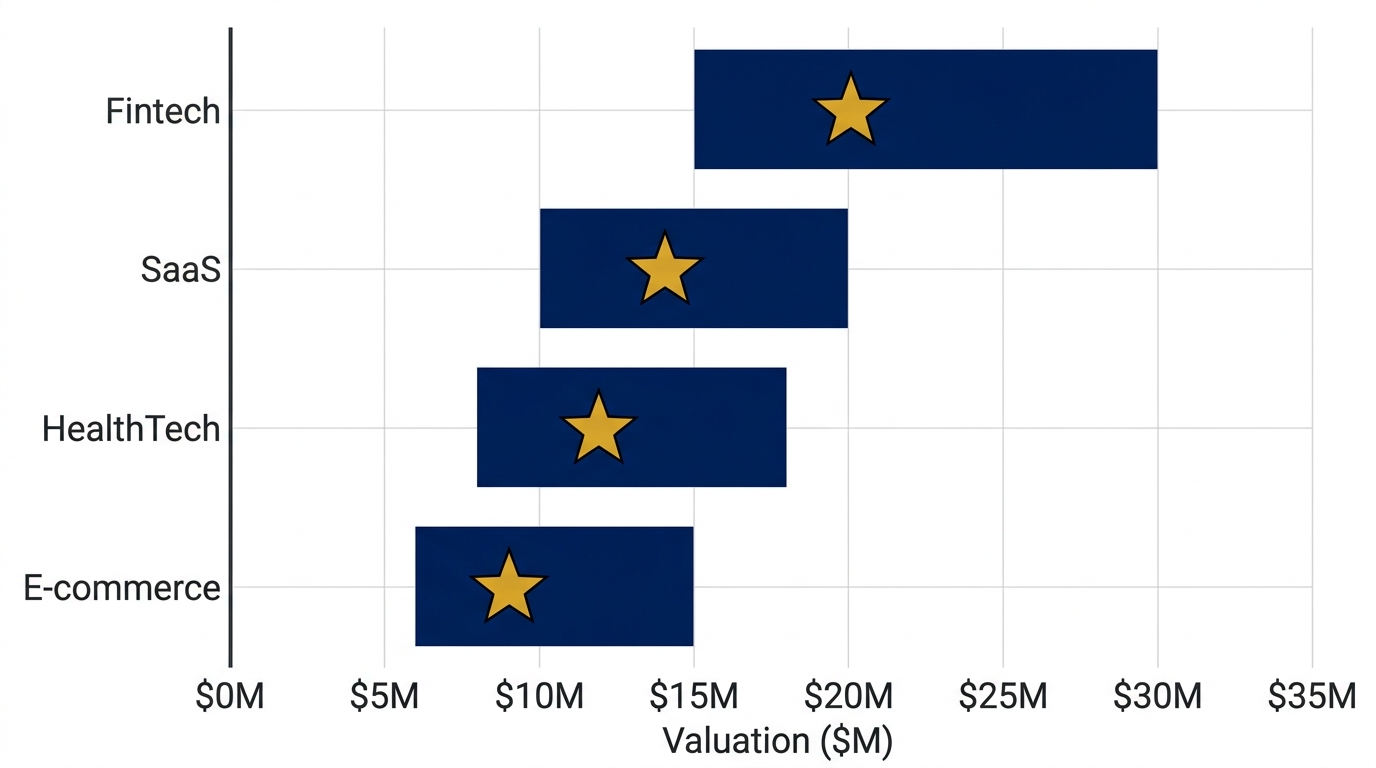
To see how these factors translate into numbers, here is a comparison of average Series A valuation ranges by industry.
| Industry | Average Series A Valuation Range | Median Valuation |
|---|---|---|
| SaaS | $10M-$20M | $14M |
| Fintech | $15M-$30M | $20M |
| HealthTech | $8M-$18M | $12M |
| E-commerce | $6M-$15M | $9M |
Source: SIFMA market data and public Series A filings
These industry-specific ranges serve as approximate benchmarks drawn from historical market data. They illustrate how sectors with high gross margins and recurring revenue models, such as SaaS and Fintech, often command higher median valuations. Founders should view these figures as context, not as a precise target for their own startup. Past performance does not guarantee future results–these ranges are industry benchmarks, not guarantees. The broader market environment and investor sentiment at the time of fundraising ultimately influence where a given deal lands.
Infographic outlining the five key aspects of DIY Fundraising for Series A.
Series A valuation ranges by industry for founders.
Understanding these dynamics prepares founders for the negotiation that unfolds once a term sheet is on the table.
Pre-Money vs Post-Money: A Practical Example
Pre-money valuation reflects the company’s worth before new investment, while post-money is the pre-money plus the cash injected. The difference drives ownership and dilution. For instance, if the pre-money valuation is $8 million and an investor contributes $2 million, the post-money valuation becomes $10 million. The investor’s ownership is calculated as $2 million / $10 million = 20%, meaning the original shareholders are diluted to 80% of the equity.
This simple math highlights why the pre-money figure is a critical component of the series a term sheet–it directly dictates how much of the company the founders give up in the round. We help founders model these scenarios early so they can approach term sheet discussions with clear expectations and negotiation leverage.
Once you understand valuation, the next step is navigating the term sheet–covered in the following section.
Navigating the Series A Term Sheet
Raising series a funding is a critical step; the term sheet that follows will define the investor-founder relationship. Engaging a specialized Investment Bank For Series A such as our Boutique M&A and Capital Advisory Firm provides founders with the negotiation leverage needed to secure founder-friendly terms.
Essential Terms in a Series A Term Sheet
A Series A term sheet sets the economic and governance framework. As shown in the table, SIFMA standards illustrate the spectrum from founder-friendly to investor-friendly:
| Term | Founder-Friendly | Standard | Investor-Friendly |
|---|---|---|---|
| Liquidation Preference | Non-participating, 1× | Participating, 1× | Participating, 2×+ |
| Anti-Dilution | Weighted average, broad-based | Weighted average, narrow-based | Full ratchet |
| Board Composition | 2 founders, 1 investor | 2 founders, 2 investors | 1 founder, 3 investors |
| Protective Provisions | Limited to major events | Standard list of veto rights | Extensive veto rights |
Liquidation preferences govern the payout order in an exit. A non-participating 1× preference allows investors to recover their capital before common shareholders, leaving substantial upside for founders. Participating structures, especially with a 2× multiple, let investors double their money and then share in remaining proceeds, severely diluting founder economics. Anti-dilution provisions protect against valuation drops: broad-based weighted average is the fairest, while full ratchet can decimate founder ownership in a down round. Board composition sets the balance of power; a founder-friendly board of two founders and one investor ensures founder majority, whereas an investor-heavy board can lead to founder removal. Protective provisions grant veto rights–limiting them to fundamental transactions preserves operational flexibility. Founders should also negotiate pro-rata rights to maintain their ownership share in future rounds and vesting schedules that incentivize long-term commitment.
Negotiation Strategies for Founders
When reviewing a series a term sheet, our team advises founders to separate the provisions into economic and control buckets. In our experience, it is usually wiser to concede on certain control terms–such as board observer seats or informational rights–than to give up meaningful economic protections like liquidation preferences. Too often, founders obsess over the series a valuation without reading the full series a term sheet; this oversight can lead to significant downside.
Prioritize economic terms first. A high series a valuation may feel like a win, but aggressive valuations can cause problems in future rounds if performance stalls. Negotiating a broad-based weighted average anti-dilution clause and a non-participating 1× liquidation preference preserves founder upside. Second, understand trade-offs. Accepting a slightly lower valuation in exchange for more favorable protective provisions or a cleaner cap table can enhance long-term control. Third, create competitive tension–leverage competing term sheets to shift provisions toward founder-friendly outcomes. Secure pro-rata rights and negotiate reasonable vesting acceleration upon a change of control. By balancing these dynamics, founders can craft a term sheet that aligns incentives and sustains growth.
Common Pitfalls and How to Avoid Them
One frequent mistake during series a funding negotiations is an overemphasis on the headline series a valuation while ignoring the liquidation preference structure. A sky-high valuation with a 2× participating preference can leave founders with minimal returns in a moderate exit. Model the cap table under several exit scenarios to understand true economics.
Another pitfall is accepting full ratchet anti-dilution, which can devastate founder ownership in a down round. Always push for broad-based weighted average anti-dilution. Many founders undervalue protective provisions–granting investors veto power over routine decisions can strip operational agility. Limit vetoes to fundamental transactions. Neglecting board composition can erode founder control. Maintain at least two founder board seats and tie investor board rights to meaningful ownership thresholds. Giving up pro-rata rights without negotiating a seed-round extension can result in painful dilution. Retain pro-rata rights to keep major investors aligned. Excessive drag-along rights can also undermine founder leverage; ensure consent thresholds are reasonable. By avoiding these missteps, founders preserve economic upside and strategic direction.
How an Advisory Firm Accelerates Series A Fundraising
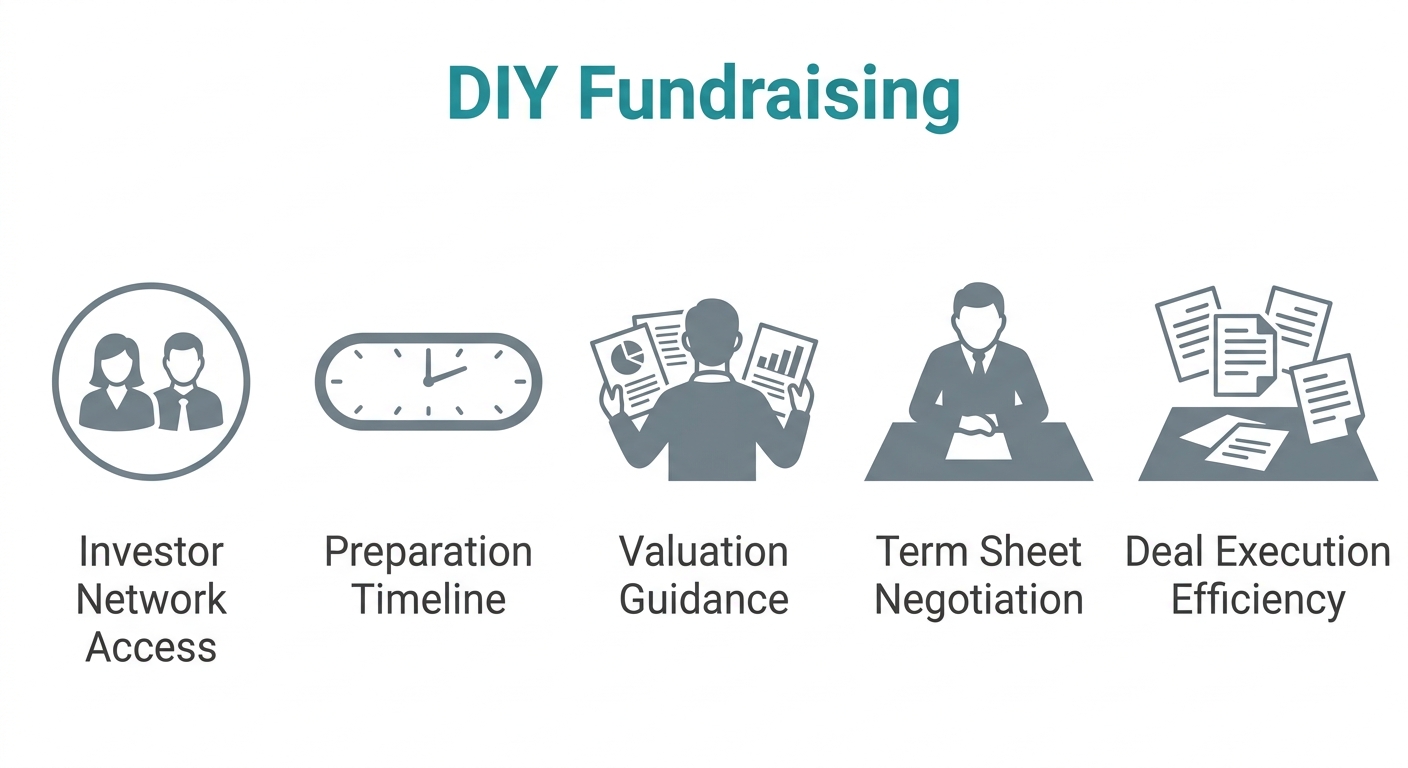
Given these challenges, many founders turn to advisory firms to streamline the fundraising process. According to industry data from the Securities Industry and Financial Markets Association (SIFMA), a typical DIY Series A round often lasts three to six months, constrained by limited investor networks, self-researched valuation data, and term sheet negotiations managed by the founder with only legal counsel. Advisory firms bring expertise in areas like tech M&A advisory fees, offering clarity on cost structures, and provide a curated database of over 4,000 investors, market intelligence for series a valuation, and advisors who negotiate series a term sheets with deal insights. The following infographic and table show how advisory assistance accelerates each stage.
Series A valuation ranges by industry for founders.
Infographic outlining the five key aspects of DIY Fundraising for Series A.
DIY fundraising relies on a founder’s personal network and self-researched market data, resulting in a preparation timeline of three to six months. In contrast, advisory-assisted fundraising leverages a curated database of over 4,000 investors and structured support, compressing the timeline to one to three months. From investor access to deal execution, the advisory approach introduces market intelligence and seasoned negotiation skills rarely available to founders working alone. The table below contrasts these five key dimensions, highlighting how advisory firms enhance each element of the capital raise.
| Aspect | DIY Fundraising | Advisory-Assisted Fundraising |
|---|---|---|
| Investor Network Access | Limited personal network | Curated database of 4,000+ investors |
| Preparation Timeline | 3-6 months | 1-3 months with structured support |
| Valuation Guidance | Self-researched / limited market data | Market intelligence and benchmarking |
| Term Sheet Negotiation | Founder-led (often with legal counsel only) | Experienced advisors with deal insights |
| Deal Execution Efficiency | Variable, founder-managed | Structured process with project management |
As the table demonstrates, advisory-assisted fundraising addresses the core pain points of a DIY process. At Zaidwood Capital, we apply this model through our full-cycle capital advisory approach. Our team combines the investor network with structured project management, ensuring milestones from valuation benchmarking to series a term sheet review are executed efficiently. As a Boutique M&A and Capital Advisory Firm, we accelerate the Series A timeline without performance guarantees, helping founders navigate early-stage capital raises with confidence. Founders gain market intelligence that benchmarks series a valuation, and our advisors bring deal insights to series a term sheet negotiations, reducing common pitfalls in DIY deal-making. This structured, data-driven process converts fundraising challenges into actionable outcomes, providing a competitive edge.
Ultimately, partnering with an experienced advisory firm can be the catalyst that turns fundraising complexity into a competitive advantage. This is where Zaidwood Capital’s full-cycle advisory and proprietary platform make a measurable difference.
Frequently Asked Questions About Series A Funding
To address common concerns, we have compiled a few frequently asked questions.
What is Series A funding?
Series A funding is the first institutional equity round for startups, typically led by venture capital firms. It differs from seed rounds by focusing on scaling a proven business model rather than validation. Series A valuation is based on market opportunity, traction metrics such as revenue or user growth, and comparable transactions within the sector.
What does a Series A term sheet include?
A Series A term sheet outlines key deal terms including company valuation, liquidation preferences, anti-dilution protections, and board seat allocations. These elements establish investor protections and governance expectations without being legally binding.
How are advisory fees structured?
Advisory fee structures for fundraising engagements vary with scope and complexity. For a detailed breakdown of M&A advisory fee structures, see our dedicated FAQ. We encourage founders to discuss specific needs with our team directly.
Securing Your Series A Round with Confidence
Now that you know what it takes in a series a funding round, confidence stems from thorough preparation. We help founders craft a compelling narrative and understand their series a valuation. Sovereign Data Nexus and Precision Catalyst bring data-driven insights and AI matchmaking, connecting you to over 4,000 investors and $15B+ in capital. This confidence isn’t a guarantee, but it strengthens your position for a stronger series a term sheet. With this strategic foundation, the due diligence and negotiation process becomes a natural next step.
Resources


