



Sell Side Advisory
Table of Contents
Sell-Side Advisory for Growth-Stage Companies
For growth-stage companies at a pivotal phase, achieving a successful liquidity event or strategic acquisition demands experienced sell side advisory. This comprehensive service encompasses every aspect of the sale process, from preparing the business for market to identifying the ideal buyer and negotiating favorable terms. Our sell-side m&a approach combines rigorous preparation with confidential buyer identification to help founders achieve optimal outcomes.
Our process begins with comprehensive valuation preparation and strategic positioning. We leverage our proprietary Sovereign Data Nexus platform to access a curated database of over 4,000 global institutional investors, while Precision Catalyst’s AI-driven investor matchmaking identifies the most compatible strategic and financial acquirers. We also prepare investor-ready pitch decks, detailed business plans, and pro forma financial projections to present the company in the best light. All materials are hosted in a secure virtual data room, streamlining the due diligence process for prospective acquirers. This technology-enabled methodology supports exit strategy planning for growth-stage companies and facilitates strategic buyer outreach with discretion and precision.
Throughout the sell-side process, we prioritize confidentiality, protecting sensitive business information while maintaining market momentum. We manage all communications through a secured data room and employ disciplined processes to control information flow. Our full-cycle advisory includes negotiation support and close coordination with legal, tax, and compliance advisors to manage the transaction to closing. As a boutique M&A and capital advisory firm, we follow established securities industry practices as guided by organizations like FINRA.
With over 80 years of collective experience and a track record of 350+ closed deals representing $24.4 billion in transaction volume, our team brings seasoned expertise to every sell-side engagement. Zaidwood Capital is not a registered broker-dealer. Securities transactions are conducted through Finalis Securities LLC, a registered broker-dealer and member of FINRA/SIPC, ensuring full regulatory compliance and investor protection.
Understanding Sell-Side Advisory: Roles, Strategies, and Value Maximization
Sell-side advisory is a critical process for business owners planning their exit strategy. Our Sell Side Advisory Services are designed to help business owners navigate the complexities of a transaction, working to achieve the highest value and optimal terms. For founders engaged in exit strategy planning, selecting the right sale process is crucial, and understanding the two primary paths–traditional auction and exclusive negotiation–forms the foundation of a successful outcome.
As a Boutique M&A and Capital Advisory Firm, we serve as the selling company’s representative throughout the full transaction lifecycle. Our role encompasses financial valuation and transaction structuring, buyer identification and marketing, negotiation, and management of due diligence. Strategic buyer outreach leverages industry data and AI-driven insights from our proprietary platforms, Sovereign Data Nexus and Precision Catalyst, to target the most suitable acquirers. By deeply understanding the seller’s business, we position it to attract qualified interest while preserving confidentiality and control over timing.
The following table highlights key differences between the two primary sell-side processes:
| Aspect | Traditional Auction | Exclusive Negotiation |
|---|---|---|
| Buyer Pool | Broad, multiple buyers | Single pre-qualified buyer |
| Timeline | 3-6 months | 1-3 months |
| Price Discovery | Competitive bidding uncovers value | Negotiated based on valuation |
| Confidentiality | Moderate, more parties involved | High, limited exposure |
| Best For | Companies with broad buyer appeal | Founders seeking speed and discretion |
Both approaches reflect standards influenced by FINRA’s regulatory framework, which shape disclosure requirements and transaction timelines. A traditional auction casts a wide net, creating competitive tension that can drive price discovery upward, but it involves a broader buyer pool that may reduce confidentiality. In contrast, exclusive negotiation targets a single pre-qualified buyer, shortening the timeline and heightening confidentiality while allowing for tailored deal terms. The choice hinges on the seller’s priorities: maximizing competitive pressure versus optimizing speed and discretion.
Value maximization is achieved differently in each path. In an auction, competitive tension among multiple parties can push bids higher; in exclusive negotiation, we structure bespoke terms that align with the founder’s personal and financial objectives. Regardless of the chosen route, rigorous preparation is essential–audited financial statements, a fully stocked data room, compelling management presentations, and strategic positioning sharpen the narrative and increase buyer confidence. While we provide strategic sell-side advisory services, any securities transaction execution is conducted through our partnership with Finalis Securities LLC, a registered broker-dealer.
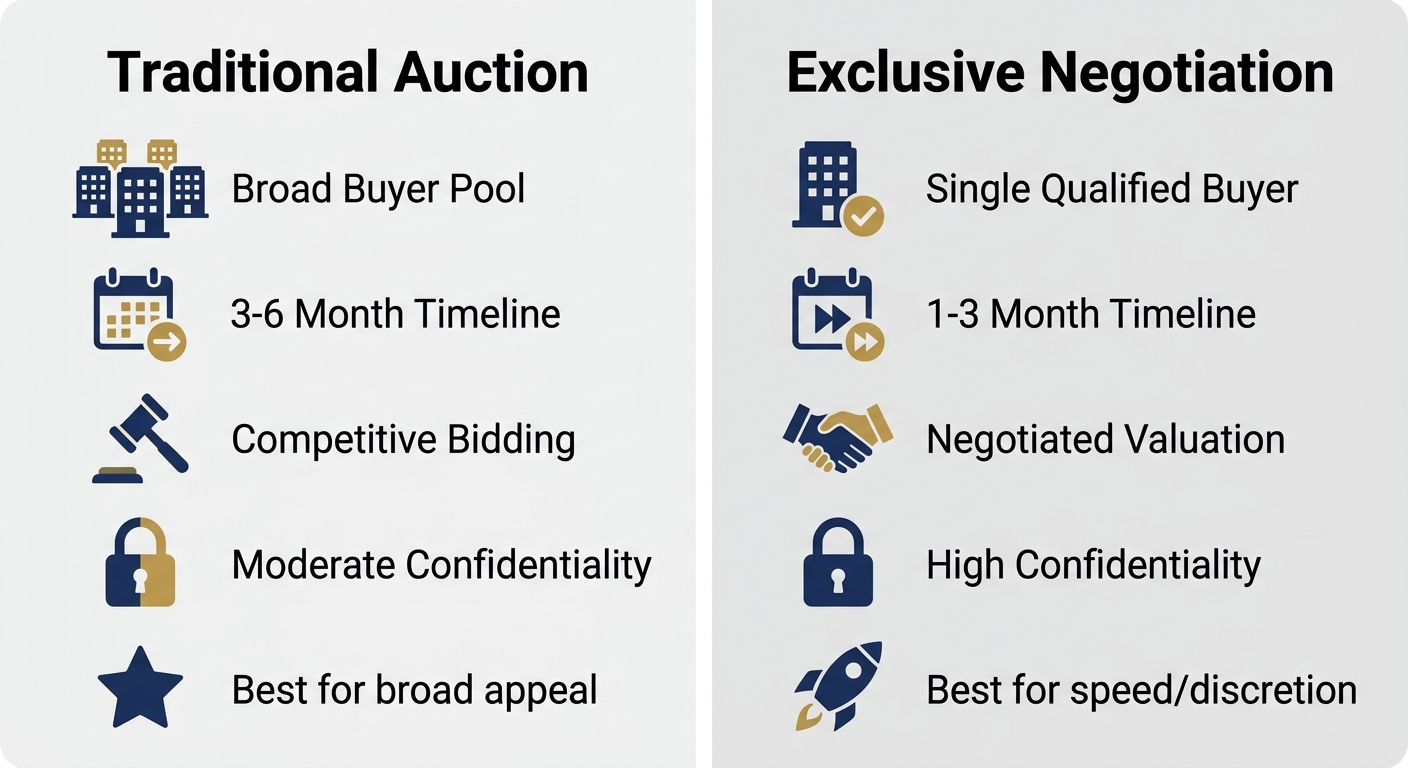
Comparing Traditional Auction and Exclusive Negotiation in sell-side M&A advisory.
Once you understand the two primary sale approaches, the next step is exploring the tactical execution of each, from initial preparation through closing.
Preparing Your Business for a Sell-Side Transaction
Once you understand the landscape, the next critical phase is preparing your business for the transaction. Preparing for a sell side advisory engagement requires discipline and foresight–from organizing financial records to streamlining operational details. Taking deliberate steps early not only smooths due diligence but also signals professional readiness to potential acquirers.
Pre-Engagement Preparation
Effective exit strategy planning starts with three foundational areas that directly influence buyer confidence and the quality of offers you receive.
Financial statement cleanup is essential. Buyers expect at least three years of reviewed or audited financials: a clear profit-and-loss statement, a reconciled balance sheet, and a detailed cash flow statement. Inconsistencies or gaps will invite scrutiny and can delay or even derail negotiations.
Cap table simplification removes noise that can complicate a transaction. We advise eliminating minor investors with negligible stakes, clarifying the terms of any outstanding convertible notes, and ensuring that all equity grants are properly documented. A clean, transparent ownership structure makes it easier to model deal economics and reduces legal friction.
Operational housekeeping addresses bookkeeping practices that may distort performance. Common steps include standardizing revenue recognition, resolving pending litigation or disputes, and removing personal expenses run through the business. These adjustments present a truer picture of normalized earnings and protect the integrity of your valuation.
Once you’ve laid the groundwork, you can start evaluating which path best aligns with your goals. The table below compares common exit strategies to help you choose your direction.
Common Exit Strategies Comparison
| Exit Strategy | Description | Best For | Timeline |
|---|---|---|---|
| Acquisition by strategic buyer | Sale to a buyer seeking synergies, market expansion, or technology | Founders seeking synergies and premium valuation | 6-12 months |
| Financial sale (PE/VC) | Sale to a financial sponsor | Companies needing growth capital and eventual exit | 4-8 months |
| Merger | Combination with another entity | Companies aiming to consolidate market position | 6-12 months |
| Internal buyout (ESOP) | Sale to employees or management | Founders prioritizing legacy and team continuity | 9-18 months |
These timelines reflect typical M&A execution cycles observed by the Securities Industry and Financial Markets Association (SIFMA). The actual duration depends on deal complexity, buyer readiness, and market conditions. With your documents ready, you can now focus on the factors that directly impact valuation.
Valuation Impact and Exit Readiness
Engaging in sell side advisory early–ideally 12 to 18 months before your target exit date–creates room to shape the story that drives value. Buyers and investors weigh several levers when assessing your company’s worth, and proactive adjustments can move your business into a higher bracket.
Growth trajectory and recurring revenue are two of the strongest signals. Consistent, predictable income streams reduce perceived risk and often translate into stronger offers. Equally important is customer concentration: if more than 20-30% of revenue comes from a single client, we recommend diversifying before approaching the market. Gross margins also play a pivotal role–operational efficiencies that widen margins demonstrate scalability and command attention.
The exit strategy table above maps common timelines to structural fit, helping you decide when to press forward and when to double down on operational improvements. While no two transactions are identical, companies that begin readiness work well in advance typically close deals within their expected window and on more favorable terms.
Building Your Deal Infrastructure
Turning readiness into execution requires a dedicated team with the right mix of relationships and technical expertise. We recommend assembling a core group that includes a sell-side investment bank, an M&A attorney with deep experience in your industry, a tax advisor who understands deal structuring, and, where appropriate, a financial due diligence firm to validate your numbers before a buyer does.
One of the first steps in building your deal infrastructure is to engage a trusted Sell Side Investment Bank advisor who can manage the entire process. This advisor leads the creation of the Confidential Information Memorandum (CIM)–a document typically spanning 40 to 60 pages that integrates a thorough business description, a market overview, detailed financials, and forward-looking growth plans. The CIM becomes the centerpiece of your narrative and shapes every subsequent conversation.
The investment bank also coordinates strategic buyer outreach to qualified acquirers, running a disciplined marketing process while shielding management’s day-to-day focus. From initial teasers through management presentations and final negotiations, the advisor ensures that every step follows a proven cadence–keeping the transaction on track without overpromising outcomes.
Strategic Buyer Outreach and Teaser Preparation
In sell side advisory, strategic buyer outreach is the foundation for a successful transaction. Advisors identify potential acquirers, prepare confidential materials, and manage sensitive communications while protecting the seller’s interests. Confidentiality and targeting precision are paramount throughout this disciplined approach.
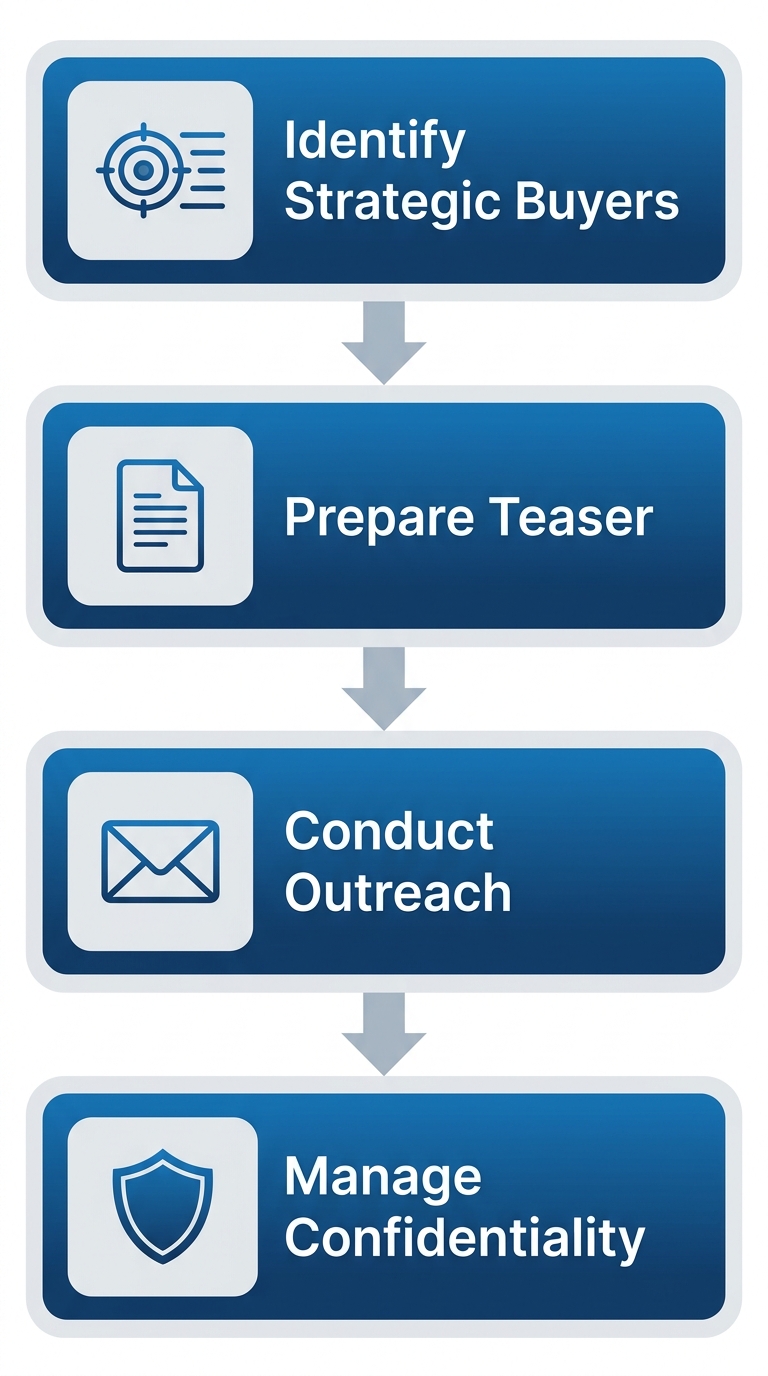
Strategic buyer outreach process with teaser preparation and confidentiality management.
Identifying and Researching Strategic Buyers
Strategic buyers–companies in related industries that can capture synergies from an acquisition–often pay higher valuations than financial buyers. According to SIFMA data, these premiums reflect expected cost savings or revenue growth.
While owners may engage in exit strategy planning years earlier, strategic buyer outreach begins with building a targeted list. As a Boutique M&A and Capital Advisory Firm, Zaidwood Capital uses M&A databases (Capital IQ, PitchBook) and our proprietary network of 4,000+ investors and $15B+ capital to identify acquirers. A boutique investment bank leverages deep industry relationships to uncover non-obvious candidates. We evaluate each prospect on strategic fit, financial capacity, and cultural alignment before initiating contact. This methodical, data-driven approach ensures only the most relevant buyers are approached, maximizing value and confidentiality.
Teaser Preparation and Confidential Outreach
Once the buyer list is finalized, we prepare a one-page blind teaser that summarizes the company’s investment highlights without revealing its identity. This document includes the industry sector, high-level metrics such as revenue range and EBITDA margin, growth trajectory, and key competitive advantages. Crucially, it omits the company name, location, and any identifying details to maintain strict confidentiality.
Outreach is initiated via targeted email or a secure data-room link from our team in West Palm Beach. Recipients must execute a non-disclosure agreement (NDA) before receiving the full confidential information memorandum (CIM). This sequential approach ensures that only genuinely interested parties see detailed information, while we serve as an intermediary to prevent competitive intelligence from leaking prematurely.
Confidentiality Management and Competitor Risks
In the sell side advisory process, handling competitor outreach demands extra precautions. When a potential buyer is also a competitor, we use an even more generic blind description–for instance, ‘a leading industrial manufacturer with $50 million revenue’–and include a specific NDA clause that prohibits the buyer from using the information for competitive purposes.
Strategic buyer outreach to competitors is managed through a competitive firewall: our advisors serve as the sole point of contact, and information is released only after serious interest and a signed NDA are confirmed. We limit the depth of disclosure until we are confident the buyer’s intentions are genuine. This discipline prevents operational details from reaching a rival prematurely. At Zaidwood Capital, we advise centralizing all competitor communications through our team in West Palm Beach to avoid direct leaks. This approach is essential when pursuing the higher valuations strategic acquirers may offer.
With strategic buyers identified and initial outreach managed confidentially, the next step is to engage financial buyers.
Strategic Buyer vs. Financial Buyer
According to industry data from the Securities Industry and Financial Markets Association (SIFMA), the distinctions between strategic and financial buyers are outlined in the table below.
| Aspect | Strategic Buyer | Financial Buyer |
|---|---|---|
| Valuation Premium | Often higher (synergies) | Based on financial returns |
| Motivation | Market expansion, technology, talent | IRR and ROI targets |
| Integration Approach | Full integration likely | Hands-off or partial |
| Confidentiality Risk | Higher if competitor | Lower |
These differences explain why strategic buyers may offer premium valuations, yet require rigorous confidentiality controls when competitors are involved. By contrast, financial buyers typically seek returns based on financial performance and are less likely to fully integrate the acquired entity. Recognizing these dynamics informs the advisor’s approach to both outreach and negotiation.
Selecting the Right Advisor and Understanding Fee Structures
When pursuing a sell side advisory engagement, selecting the right partner is a critical first step. The advisor you choose will shape your transaction outcome, and understanding how they are compensated helps align incentives with your goals. A mismatch in fee expectations can derail even the most promising deal.
Beyond compensation, the advisor’s track record, industry expertise, and network are equally vital. Exit strategy planning requires an advisor who understands strategic buyer outreach and can structure a deal that maximizes value. Consider engaging a lower middle market investment bank that has deep experience with companies of your size and understands the nuances of sell-side advisory. As a boutique M&A and capital advisory firm, we tailor fee arrangements to the complexity of lower middle market transactions, ensuring alignment between cost and effort.
Advisor compensation typically blends multiple fee types, each with distinct mechanics. According to the Securities Industry and Financial Markets Association (SIFMA), industry-standard structures in sell-side advisory include success fees, retainers, flat fees, and equity-based arrangements. The choice among them should reflect the transaction’s size, complexity, and your objectives.
The following table outlines standard fee structures and their purpose.
| Fee Type | Description |
|---|---|
| Success Fee (Lehman Formula) | Percentage of transaction value, declining rates for larger deals. Focuses advisor on maximizing price. |
| Retainer Fee | Fixed recurring payment; secured commitment; typically credited against success fee at close. |
| Flat Fee | Single negotiated fee; cost predictability regardless of outcome. |
| Equity / Warrants | Advisor receives company shares; links compensation to long-term performance, dilutes ownership. |
Actual fee amounts are negotiated directly with the advisor. This information is educational and not an offer or solicitation.
Success fees strongly align advisor incentives with achieving a higher valuation, while flat fees offer budget certainty–important for planning. Retainers, typically credited toward the success fee, ensure the advisor’s commitment during early stages. Equity compensation aligns long-term interests but requires careful evaluation of ownership impact. While cost matters, the advisor’s industry expertise, deal volume, and strategic buyer network often drive substantially better outcomes.
With a clearer picture of how advisors are compensated, you can now turn to the engagement process itself. Evaluating fee structures in the context of your overall strategy will position you to negotiate terms that align interests and mitigate surprises.
Frequently Asked Questions About Sell-Side Advisory
We’ve compiled answers to common questions about sell side advisory below.
What is sell side advisory?
Sell side advisory is a boutique service that prepares a business for sale to strategic and financial buyers, managing the transaction to maximize value and achieve a successful exit.
How does the typical sell-side process work, and how do you integrate exit strategy planning?
The process spans 4-6 months, integrating exit strategy planning with strategic buyer outreach, while NDAs protect confidentiality.
What makes Zaidwood Capital’s sell-side advisory different, and are you a registered broker-dealer?
We leverage Sovereign Data Nexus and Precision Catalyst to identify buyers. Zaidwood Capital is not a registered broker-dealer; securities transactions are offered through Finalis Securities LLC. Investments involve risk and are not guaranteed.
For more detailed answers to specific questions, visit our Capital Advisory FAQ page.
Next Steps in Your Sell-Side Transaction
If you’re ready to move forward in a sell-side advisory engagement, we begin with your initial contact. We then schedule a confidential, no-obligation discovery call to understand your business, timeline, and valuation expectations. Next, our team leverages Sovereign Data Nexus and Precision Catalyst to tailor a comprehensive sell-side strategy. This culminates in a strategic buyer outreach program with exit strategy planning and precise buyer targeting. As a Boutique M&A and Capital Advisory Firm, we provide hands-on, Full-Cycle M&A support from strategy to closing.
Resources


