



Business Valuation For Sale
Table of Contents
The Essentials of Business Valuation for Sale
Selling a business marks a pivotal moment for owners seeking optimal returns amid complex mergers and acquisitions landscapes. Accurate Business Valuation For Sale establishes the foundation for successful exits, helping sellers set realistic expectations and negotiate favorable terms. At Zaidwood Capital, we guide clients through this process, leveraging our full-cycle expertise to maximize value in every transaction.
Business valuation for sale involves determining a company’s economic worth in a transaction context through comprehensive company worth assessments. Key factors influencing this enterprise value calculation for transactions include financial performance, such as revenue growth and profitability; market conditions, like industry trends and competitive positioning; and growth potential, including operational scalability and intellectual property. For instance, a mid-market manufacturing firm might see its value fluctuate based on supply chain efficiencies versus economic downturns. We emphasize professional involvement to navigate these elements, drawing on our aggregate transaction volume of 24.4 billion USD to inform precise evaluations. Common business valuation methods, from income approaches to asset-based techniques, ensure tailored assessments, particularly for small business valuation scenarios where nuances like owner dependency play a significant role.
Understanding these essentials equips sellers to attract qualified buyers and streamline deals. Our Business Valuation Services provide access to institutional networks, facilitating informed decisions. As we explore specific methods next, professional guidance remains key to unlocking your business’s true potential in the M&A arena.
Key Methods in Business Valuation
At Zaidwood Capital, we specialize in guiding clients through the complexities of mergers and acquisitions, where accurate business valuation methods form the foundation of successful transactions. These approaches help determine a fair market value, ensuring informed decisions during sales. From our experience with over 300 completed deals totaling $24.4 billion in aggregate volume, we frequently apply income, market, and asset-based techniques to tailor valuations to each company’s unique profile. Understanding these business valuation methods empowers owners preparing for a sale, aligning expectations with market realities.
Income-Based Approaches like DCF
Income-based approaches focus on a company’s ability to generate future cash flows, making them ideal for growth-oriented businesses in M&A sales. The discounted cash flow (DCF) method is our go-to for such scenarios, as it projects financial performance and discounts those estimates to present value. We start by forecasting free cash flows (FCF) for 5-10 years based on revenue growth, margins, and capital expenditures. Then, we apply a discount rate–often the weighted average cost of capital (WACC)–using the formula: Value = Σ [FCF / (1 + r)^n] + Terminal Value / (1 + r)^n, where r is the discount rate and n is the period.
This forward-looking nature suits tech startups with high growth potential, like one we valued at $50 million using an 8% discount rate, projecting 25% annual growth. Pros include capturing intrinsic value and scalability; cons involve sensitivity to assumptions, which can introduce subjectivity. For small business valuation, we adapt by simplifying projections to conservative estimates, ensuring realism in sale negotiations.
Market-Based Methods Using Comparables
Market-based methods rely on real-world benchmarks to gauge value, providing a reality check against peer performances. We use comparable company analysis by selecting publicly traded peers with similar size, industry, and growth rates–say, SaaS firms with $10-50 million in revenue. EBITDA multiples are calculated from these, such as applying a 10x multiple derived from recent comparables to a target’s $5 million EBITDA for a $50 million valuation.
For transaction analysis, we review recent M&A deals, adjusting for synergies or market conditions; for instance, a comparable acquisition at 7x revenue helps refine sale price determination techniques. This approach shines in mature industries, offering quick, market-driven insights. Pros: objectivity through external data and ease of communication to buyers. Cons: challenges in finding perfect matches and potential outdated multiples during economic shifts. Enterprise appraisal strategies here emphasize clean, adjusted financials for accurate peer alignment.
Asset-Based Valuation Techniques
Asset-based techniques emphasize a company’s balance sheet, valuing it by assets minus liabilities, which suits asset-heavy firms like manufacturing or real estate entities in sale scenarios. The adjusted net asset method appraises tangible assets (e.g., machinery at fair market value) and intangibles (e.g., patents), subtracting debts for equity value. Liquidation value, conversely, assumes a forced sale, discounting assets by 20-50% for quick exit.
We apply this for industrial clients, like valuing a factory at $30 million based on equipment appraisals versus $20 million in liquidation. It’s straightforward for tangible-heavy businesses but undervalues intangibles in service firms. Pros: provides a floor value and simplicity in audits. Cons: ignores earning potential and can undervalue growth assets. For small business valuation, it’s practical when operations wind down post-sale.
Selecting the right method depends on the business type and transaction stage; we at Zaidwood Capital often blend them for robust appraisals in M&A, drawing from our full-cycle due diligence to validate inputs.
| Method | Description | Best For | Pros | Cons |
|---|---|---|---|---|
| DCF | Discounts projected cash flows | Growth-oriented companies | Captures future potential; intrinsic focus | Subjective assumptions; complex calculations |
| EBITDA Multiples | Applies peer-derived multiples to earnings | Mature, profitable firms | Market-aligned; quick to apply | Relies on comparable availability; ignores specifics |
| Comparables | Benchmarks against similar deals/companies | Mid-market sales | Real-world validation; buyer perspective | Matching challenges; market volatility |
| Asset-Based | Assets minus liabilities, adjusted | Asset-intensive businesses | Tangible floor value; audit-friendly | Undervalues intangibles; static view |
In practice, hybrid approaches combining these methods enhance accuracy, as we’ve seen in our 300+ transactions where integrating DCF with multiples mitigated risks and optimized outcomes for clients seeking efficient M&A execution.
Building on this comparison, our team’s expertise allows us to navigate variables like economic cycles, ensuring valuations support strategic goals. For instance, in a recent deal, blending market multiples with asset checks revealed hidden value, streamlining negotiations. This integrated view not only addresses potential biases in single methods but also aligns with buyer due diligence, fostering smoother closings. As valuation evolves, we emphasize adaptability to deliver precise, defensible figures.
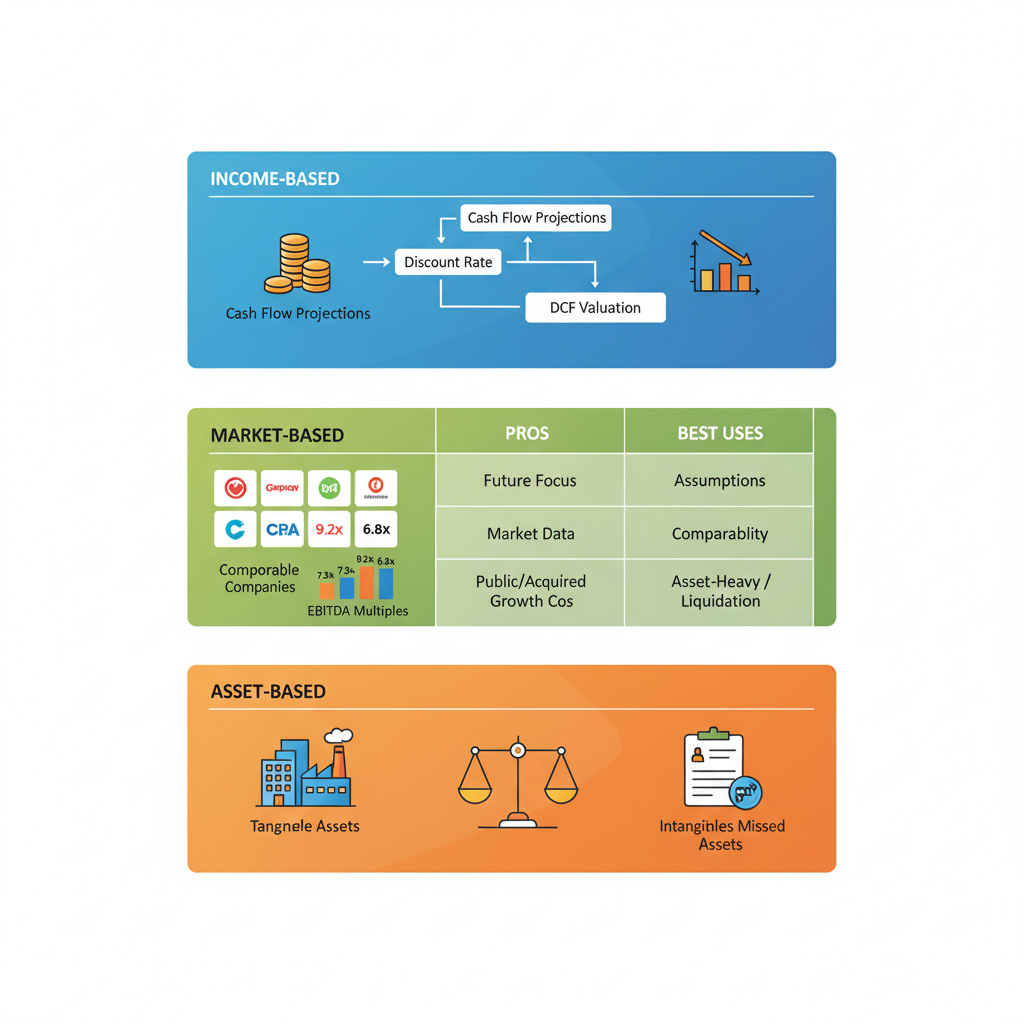
Key business valuation methods for M&A advisory services
Transitioning to application, these techniques underpin our advisory services, helping clients like family offices and private equity firms achieve fair Business Valuation For Sale outcomes.
Advantages of Professional Business Valuation
When preparing for a sale, obtaining a professional Business Valuation For Sale can significantly elevate the process. Our team at Zaidwood Capital leverages decades of expertise to deliver valuations that not only reflect true market worth but also position sellers for optimal outcomes in mergers and acquisitions. By engaging advisors, businesses avoid common pitfalls like undervaluation or inflated expectations, ensuring a smoother transaction. This approach integrates advanced business valuation methods to provide defensible figures that withstand scrutiny during negotiations.
Enhanced Accuracy and Objectivity
Professional advisors ensure valuations are grounded in certified methodologies, such as discounted cash flow analysis and market multiples, free from the emotional biases that often plague self-assessments. Sellers frequently overestimate their business’s value due to personal attachment, leading to stalled deals or suboptimal pricing. Our team applies standardized data sources and industry benchmarks to deliver objective appraisals, minimizing these risks.
For small businesses, this objectivity is particularly vital. A tailored small business valuation accounts for unique factors like localized market dynamics and operational nuances, which DIY efforts often overlook. Consider a manufacturing firm we advised: by using precise business valuation methods, we identified overlooked assets, resulting in a 20% higher sale price than initial estimates. This precision builds trust with buyers and facilitates quicker closings.
Access to Market Insights and Networks
One of the standout advantages of professional involvement is gaining access to exclusive market insights and expansive networks. Our firm connects clients to over 4,000 institutional investors, providing real-time comparable data that informs competitive valuations. This institutional rolodex enables us to benchmark against recent transactions, ensuring your valuation reflects current trends rather than outdated assumptions.
In practice, this network advantage streamlines the sale process. For instance, during a recent advisory engagement, our insights into peer multiples helped a mid-sized tech company secure a premium offer. By drawing on our aggregate experience from more than 300 deals totaling 24.4 billion USD in volume, we equip sellers with strategic intelligence that DIY approaches simply cannot match.
Common pitfalls of DIY valuations include relying on generic online tools, which fail to capture nuanced market shifts and often lead to inaccurate pricing. Sellers may undervalue growth potential or ignore competitive benchmarks, resulting in lost revenue opportunities.
| Aspect | DIY Valuation | Professional Valuation | Key Difference |
|---|---|---|---|
| Accuracy | Subjective, prone to bias | Data-driven, objective methodologies | Reduces errors by up to 30% in estimates |
| Time Investment | Extensive self-research required | Efficient, expert-led process | Saves months of effort |
| Outcome Potential | Limited to basic multiples | Optimized for premium pricing | Unlocks 15-25% higher sale values |
| Risk Level | High exposure to disputes | Comprehensive due diligence integration | Minimizes legal and financial risks |
Professionals become essential when transactions involve complex assets, regulatory hurdles, or high stakes, as our full-cycle M&A advisory ensures compliance and value maximization. In our experience, clients facing intricate deals benefit most from this structured support.
Risk Mitigation in M&A Deals
Engaging professionals integrates thorough due diligence into the valuation, safeguarding against post-sale disputes and hidden liabilities. Our advisory services include fairness opinions that validate pricing, protecting both parties and enhancing deal credibility. This proactive approach identifies risks early, allowing for adjustments that preserve value.
In M&A contexts, risk mitigation extends to negotiation preparation. A defensible valuation, backed by our institutional data, empowers sellers to counter lowball offers effectively. For a family-owned enterprise we supported, comprehensive due diligence uncovered synergies that not only averted potential litigation but also boosted the final negotiated price by emphasizing untapped opportunities. Ultimately, our expertise turns potential vulnerabilities into strategic advantages, ensuring transactions close confidently.
The Business Valuation Process Step by Step
At Zaidwood Capital, we guide clients through the business valuation for sale, ensuring a thorough assessment that maximizes value in M&A transactions. Our process, honed from over 300 deals, leverages the Velocity Matrix to streamline steps from data collection to final reporting. For those wondering How To Value My Business, this structured approach provides clarity and precision.
Gathering Financial Data and Projections
We begin the valuation workflow for exits by collecting essential financial data. This includes historical financial statements, tax returns from the past three to five years, and forward-looking projections. Our team normalizes earnings by adjusting for owner-specific perks, such as excessive salaries or personal expenses, to reflect true operational performance.
- Review balance sheets, income statements, and cash flow reports for accuracy.
- Gather industry benchmarks and economic forecasts to inform projections.
- Document all adjustments meticulously to support sale assessment procedures.
These steps ensure a solid foundation, often revealing opportunities to enhance value before market entry. For a manufacturing firm, we might adjust for one-time equipment costs, projecting steady revenue growth over five years.
Applying Valuation Methods and Adjustments
Next, we select and apply business valuation methods tailored to the company’s profile. Common approaches include discounted cash flow (DCF) analysis with 3-5 year forecasts and EBITDA multiples of 4-8x for mid-market firms. We emphasize synergies in M&A contexts, adjusting for potential cost savings or revenue uplifts from acquisitions.
- Calculate DCF by discounting future cash flows at a weighted average cost of capital.
- Apply comparable company multiples, drawing from our extensive transaction database.
- Incorporate market adjustments for risks like economic shifts or competitive pressures.
This phase demystifies how the EBITDA multiple method works and the discounted cash flow approach, using comparable transactions for validation.
The following table outlines the core steps in our process, highlighting key activities and tools to illustrate the structured nature of business valuation for sale:
| Step | Key Activities | Tools/Methods | Potential Challenges |
|---|---|---|---|
| 1. Gathering Data | Collect financials, normalize earnings | Financial statements, projections software | Incomplete records, owner bias in perks |
| 2. Applying Methods | Select DCF, multiples; adjust for synergies | Excel models, industry databases | Volatility in forecasts, subjective adjustments |
| 3. Review and Diligence | Verify data, sensitivity analysis | Due diligence checklists, scenario modeling | Unforeseen risks, data discrepancies |
| 4. Small Business Specifics | Simplify multiples, owner adjustments | Revenue multiples (0.5-2x), benchmarks | Limited data, reliance on local markets |
This overview underscores our efficient execution, adapting to client needs while addressing common hurdles proactively.
For small versus large businesses, customization is key; larger entities benefit from complex DCF models, while smaller ones rely on simpler revenue multiples to account for scale differences. This tailored approach ensures relevance across deal sizes.
Building on these foundational steps, our process incorporates visual aids to enhance understanding. The diagram below captures the sequential flow, from initial data review to final synthesis, aiding clients in visualizing the journey.
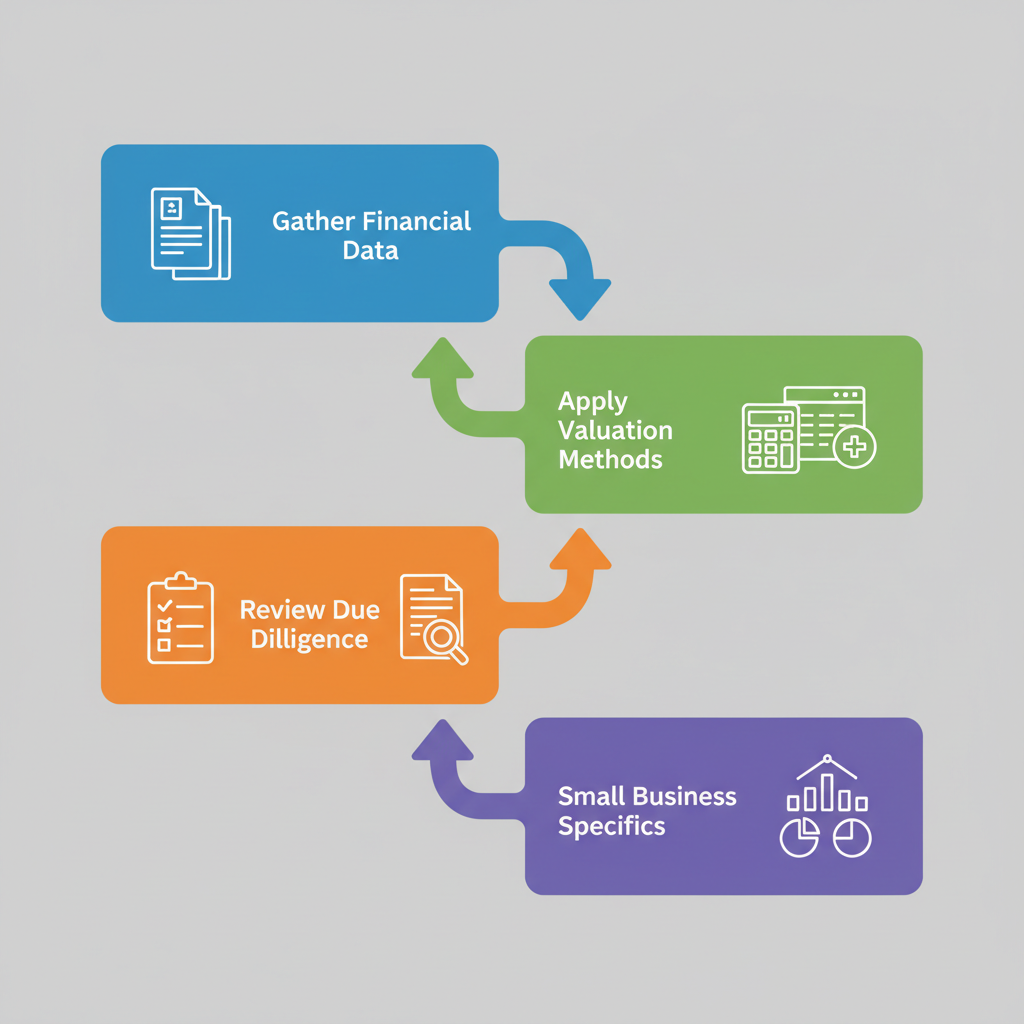
Step-by-step guide to the business valuation process at Zaidwood Capital
Such tools, integrated via the Velocity Matrix, accelerate insights without compromising depth.
Review, Due Diligence, and Final Report
In this phase, we conduct thorough due diligence to validate collected data and mitigate risks. Our full-cycle team scrutinizes financials, operations, and legal aspects, performing sensitivity analysis to test valuation ranges under varying scenarios.
- Engage experts for operational and commercial reviews.
- Identify and quantify risks, adjusting the valuation accordingly.
- Compile findings into a comprehensive report outlining the value range and rationale.
The final report serves as a negotiation tool, backed by our 24.4B USD in transaction experience. For the manufacturing example, diligence might confirm projected synergies, solidifying a 6x EBITDA multiple.
Small Business Specifics in the Process
Adapting the process for small business valuation requires simplification to fit limited resources. We focus on revenue multiples of 0.5-2x, adjusted for industry effects like local market dynamics in manufacturing or retail.
- Emphasize owner adjustments for non-recurring expenses.
- Use simplified comparables from similar small entities.
- Highlight preparation tips, such as clean books to boost multiples.
This approach answers how industry affects small business valuation multiples, ensuring owners understand steps like using 1-3x revenue for service firms. By streamlining, we help small businesses achieve fair value in sales, often uncovering hidden strengths through targeted benchmarks.
Strategies to Maximize Your Business Value
Preparing your business for sale requires deliberate value enhancement tactics to achieve an optimal Business Valuation For Sale. At Zaidwood Capital, we recommend pre-exit optimization strategies that align financial health, operational efficiency, and market positioning with buyer expectations. These steps not only boost EBITDA but also demonstrate scalability, making your company more attractive in mergers and acquisitions.
To guide your preparation, consider this pre-sale readiness checklist:
- Review and normalize financial statements for add-backs and recurring revenue.
- Document processes to minimize key-person dependencies.
- Conduct internal audits across legal, operational, and compliance areas.
- Develop growth narratives supported by pro forma financials.
- Engage advisors to time the sale with favorable market cycles.
By addressing these areas systematically, owners can influence business valuation methods and secure higher multiples.
Optimizing Financials and Operations
We advise starting with financial cleanup to present accurate, normalized earnings that reflect true profitability. Normalize add-backs for non-recurring expenses, such as one-time legal fees or personal benefits, to build a credible EBITDA baseline. Focus on recurring revenue streams, like subscription models, which command premium valuations by showcasing stability. For small businesses, implementing scalable systems can significantly elevate small business valuation, emphasizing transferable operations over owner-centric models.
Reducing owner dependencies is crucial; document key processes in manuals and cross-train staff to mitigate risks that deter buyers. Streamline operations by automating workflows and optimizing supply chains, potentially increasing efficiency by 20-30% within 6-12 months. These efforts appeal to acquirers seeking seamless integration. At Zaidwood Capital, our strategic financial consulting and pro forma financials services help craft these narratives, leveraging our access to over $15 billion in deployable capital networks for validation.
The following table outlines key strategies and their valuation impacts:
| Strategy | Impact on Valuation | Implementation Time | Cost Estimate |
|---|---|---|---|
| Financial Cleanup | +15-25% EBITDA uplift | 3-6 months | $5,000-$20,000 |
| Operational Streamlining | Reduces risks, +10-20% multiple | 4-8 months | $10,000-$30,000 |
| Due Diligence Audit | Enhances credibility, +5-15% | 2-4 months | $7,500-$25,000 |
| Market Positioning | Highlights synergies, +20-40% | 6-12 months | $15,000-$50,000 |
Selecting these strategies depends on your business stage and industry; prioritize based on quick wins like financial normalization for immediate gains.
Integrating these approaches holistically amplifies results, as combined efforts create a compounded valuation lift while minimizing isolated weaknesses.
Conducting Pre-Sale Due Diligence
Self-audits form the backbone of credible valuations; we urge thorough reviews of financial, legal, and operational facets to preempt buyer scrutiny. Begin with financial audits to verify revenue recognition and expense categorization, ensuring alignment with GAAP standards. Legally, scrutinize contracts, intellectual property ownership, and compliance with regulations like data privacy laws to avoid surprises that could slash multiples.
Operationally, assess supply chain vulnerabilities and IT systems for scalability, fixing issues such as outdated software within 3-6 months. For small entities, these audits tie directly to asset-based valuation considerations, confirming tangible and intangible assets’ worth. Our full-cycle due diligence services at Zaidwood Capital provide a blueprint, drawing from our 300+ completed deals to identify common pitfalls early.
Document findings in a virtual data room, complete with remediation timelines, to build buyer confidence. This proactive stance can enhance valuation by 10-20%, as it signals a low-risk acquisition. Engage external experts for objectivity, budgeting 2-4 months for comprehensive coverage.
Leveraging Market Timing and Positioning
Timing your sale around industry trends maximizes multiples; monitor cycles like economic upswings or sector consolidations to position advantageously. Craft growth stories using pro forma financials that project synergies with potential acquirers, such as cost savings or market expansion, supported by our pitch decks at Zaidwood Capital.
Highlight scalable systems and comparables in your narrative, especially for small businesses where growth potential drives premiums. Leverage advisor networks–our connections to 4,000+ institutional investors offer introductions that uncover strategic buyers willing to pay 20-40% above baseline for fit.
We recommend 6-12 months of positioning, aligning with favorable windows like post-earnings rallies. Factors influencing small business valuation during a sale include these narratives, which can justify higher ask prices based on projected cash flows. Emphasize variables like market conditions, as outcomes depend on execution and external dynamics.
Key Takeaways on Business Valuation for Successful Sales
As we wrap up this guide on Business Valuation For Sale, the core insights revolve around leveraging proven business valuation methods like discounted cash flow (DCF), comparable multiples, and asset-based approaches to determine fair market value tailored to your exit strategy. These techniques ensure accuracy, especially for small business valuation where nuances such as owner dependency and localized assets play a key role. Professional involvement brings benefits like access to extensive networks and rigorous due diligence, streamlining the sale process from initial assessment through negotiations. By preparing financials, optimizing operations, and timing the market, sellers maximize outcomes while mitigating risks in today’s dynamic M&A landscape.
Looking ahead, exit valuation essentials underscore the importance of strategic sale preparation recaps, including regular valuations and expert consultations to navigate complexities. At Zaidwood Capital, our full-cycle M&A and capital advisory services, backed by over $24.4 billion in aggregate transaction volume, position us to guide clients toward successful transactions. We encourage exploring how our expertise can align with your goals–reach out to discuss tailored strategies without any commitments. Remember, informed decisions empower sustainable growth and optimal value realization in every deal.


