



Due Diligence Checklist
Table of Contents
Understanding the Due Diligence Checklist in M&A Transactions
In the intricate landscape of mergers and acquisitions, a Due Diligence Checklist serves as a vital tool for buyers and sellers alike. This systematic review process involves meticulously examining a target company’s financial, legal, and operational aspects to identify potential risks, validate growth opportunities, and support informed strategic decisions. By uncovering hidden liabilities or strengths early, it helps mitigate uncertainties that could derail transactions. Essential categories include financial statements, organizational charts, material contracts, and intellectual property details, drawing from standard practices outlined in resources like the SCORE checklist for business acquisitions.
At Zaidwood Capital, we deliver full-cycle due diligence expertise as part of our ma capital advisory services, guiding private equity firms and corporate clients through buy-side and sell-side mandates. Our team-led approach, headed by experienced professionals, has facilitated over $24.4 billion in aggregate transaction volume across more than 300 deals. We leverage an extensive network of over 4,000 institutional and private investors, providing access to more than $15 billion in deployable capital. This enables us to streamline evaluations, ensuring comprehensive insights into financial health and compliance without assuming undisclosed liabilities, as emphasized in preparation guides from the Small Business Administration.
This guide offers valuable information for those preparing for deals, starting with M&A due diligence checklist fundamentals and progressing to advanced practices like financial due diligence checklists and acquisition review frameworks. We explore core components, such as transaction verification lists for legal and operational reviews, to equip you with a structured approach for successful outcomes.
Core Fundamentals of Due Diligence Checklists
In the realm of mergers and acquisitions, a well-structured Due Diligence Checklist serves as the cornerstone for evaluating potential transactions. This essential tool enables buyers to systematically assess risks and opportunities, ensuring informed decision-making during buy-side processes. At Zaidwood Capital, we emphasize the integration of such checklists into our advisory services to streamline client evaluations and mitigate unforeseen liabilities.
The core fundamentals of a due diligence checklist revolve around key categories that provide a comprehensive view of the target entity. These include financial reviews, legal documents, and operational assessments, each critical for uncovering value drivers and potential pitfalls in M&A scenarios. We recommend beginning with a clear outline of required documents to facilitate efficient preparation.
- Financial Review: Examine balance sheets, income statements, and historical financial performance to gauge fiscal health.
- Legal Documents: Review contracts, licenses, and corporate governance structures for compliance and obligations.
- Operational Review: Assess assets, employee records, and supply chain dependencies to understand day-to-day viability.
Preparation for buy-side transactions starts with compiling these elements into an M&A due diligence checklist. Buyers should request audited financials, organizational charts, and material agreements from the seller early on. This transaction assessment protocol helps identify discrepancies in reported data versus actual operations. For instance, verifying tax filings and lease terms prevents post-closing surprises. In private equity contexts, financial due diligence checklists play a pivotal role by quantifying synergies and validating projections against industry benchmarks.
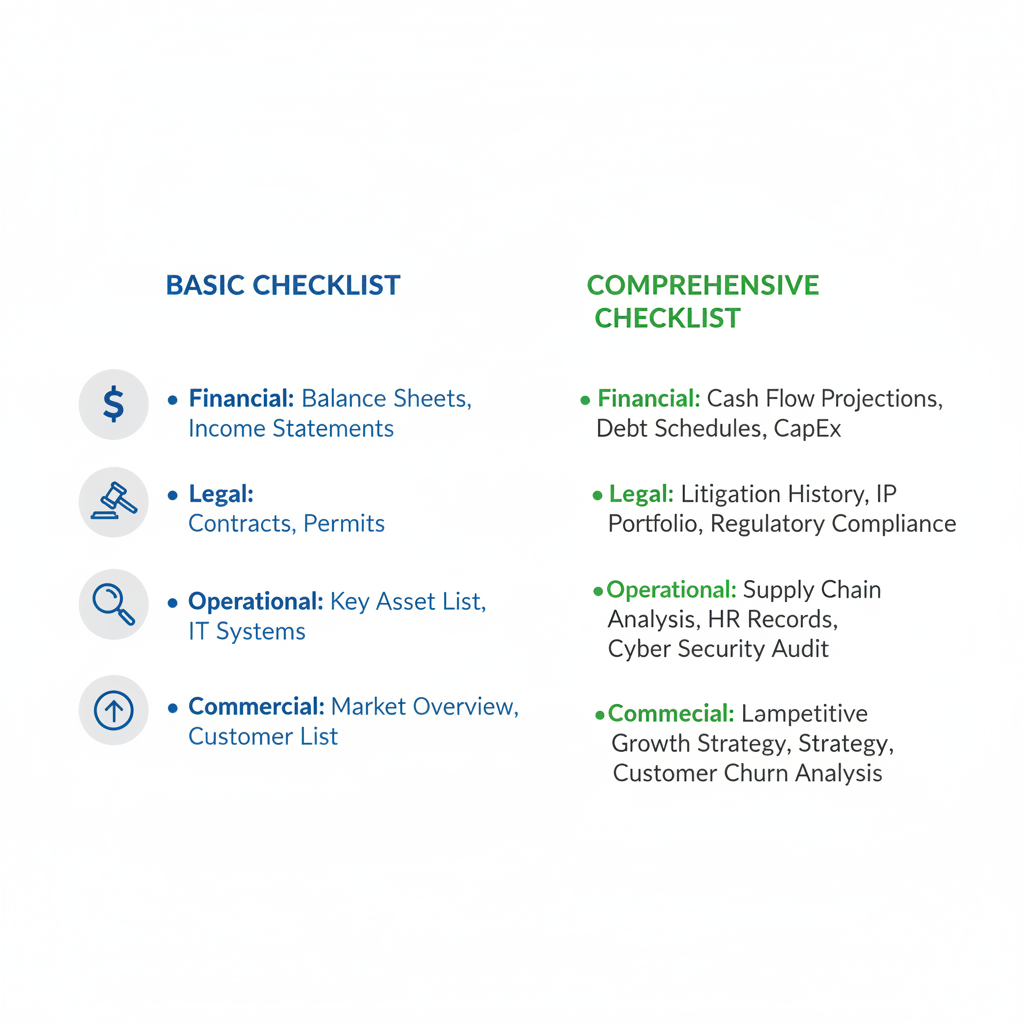
As checklists evolve from basic to comprehensive formats, they adapt to the complexity of deals. The following table outlines differences between standard and detailed approaches, drawing from established practices outlined by SCORE resources.
| Category | Basic Checklist Items | Comprehensive Checklist Additions |
|---|---|---|
| Financial Review | Balance sheets, income statements | Cash flow projections, tax compliance audits |
| Legal Documents | Contracts, licenses | Litigation history, IP assignments |
This comparison highlights how basic checklists suffice for straightforward acquisitions, focusing on core financial and legal essentials as recommended by SCORE guidelines. In contrast, comprehensive versions incorporate forward-looking analyses like cash projections and litigation reviews, ideal for high-stakes private equity deals. Data from SCORE underscores the value of these additions in reducing liability exposure, with standard items like employee records forming the baseline for any thorough evaluation. Facilities opting for basic formats can quickly assess surface-level viability, while comprehensive ones enable deeper risk identification, particularly in operational assets not detailed here but essential for holistic reviews.
Building on these foundational differences, integrating advanced elements such as environmental audits or customer data analytics enhances the deal evaluation outline. For example, SCORE advises comparing financials to industry norms to spot undervalued opportunities or red flags in sustainability. This layered approach not only aligns with informational search intent for M&A preparation but also addresses common queries on key components and steps.
Basic vs. comprehensive due diligence checklists for M&A
At Zaidwood Capital, our M&A Due Diligence Services incorporate these fundamentals into full-cycle support, customizing checklists for efficiency in buy-side mandates. We guide clients through preparation by prioritizing audited statements and compliance checks, leveraging our expertise to structure protocols that accelerate informed decisions. This tailored integration ensures seamless transitions from assessment to closing, aligning with our commitment to precision in capital advisory.
In-Depth Exploration of Due Diligence Components
At Zaidwood Capital, our team conducts a comprehensive due diligence checklist to uncover critical insights that drive informed M&A decisions. This process integrates financial, legal, operational, and compliance evaluations, leveraging our proprietary tools to streamline transactions for clients seeking precision in mergers and acquisitions. By examining these components, we align strategies with 2025 trends, such as enhanced digital compliance frameworks, ensuring robust risk mitigation throughout the acquisition lifecycle.
Financial and Legal Checklist Elements
Our financial due diligence checklist begins with a thorough review of audited financial statements, tax returns, and cash flow projections to validate revenue streams and profitability. Key metrics like EBITDA margins, working capital ratios, and debt schedules provide a clear picture of the target company’s fiscal health; for instance, we scrutinize inconsistencies in revenue recognition that could signal underlying issues. Legal reviews complement this by examining material contracts, intellectual property rights, and ongoing litigation. We assess vendor agreements for termination clauses and IP portfolios for patent validity, drawing from SBA guidelines on business evaluations to ensure all encumbrances are identified early. This integrated approach at Zaidwood allows our team to flag potential liabilities, such as undisclosed lawsuits, enabling clients to negotiate better terms in acquisitions. In practice, we use merger scrutiny templates to cross-reference financial data against legal obligations, confirming compliance with regulatory standards before advancing to operational phases.
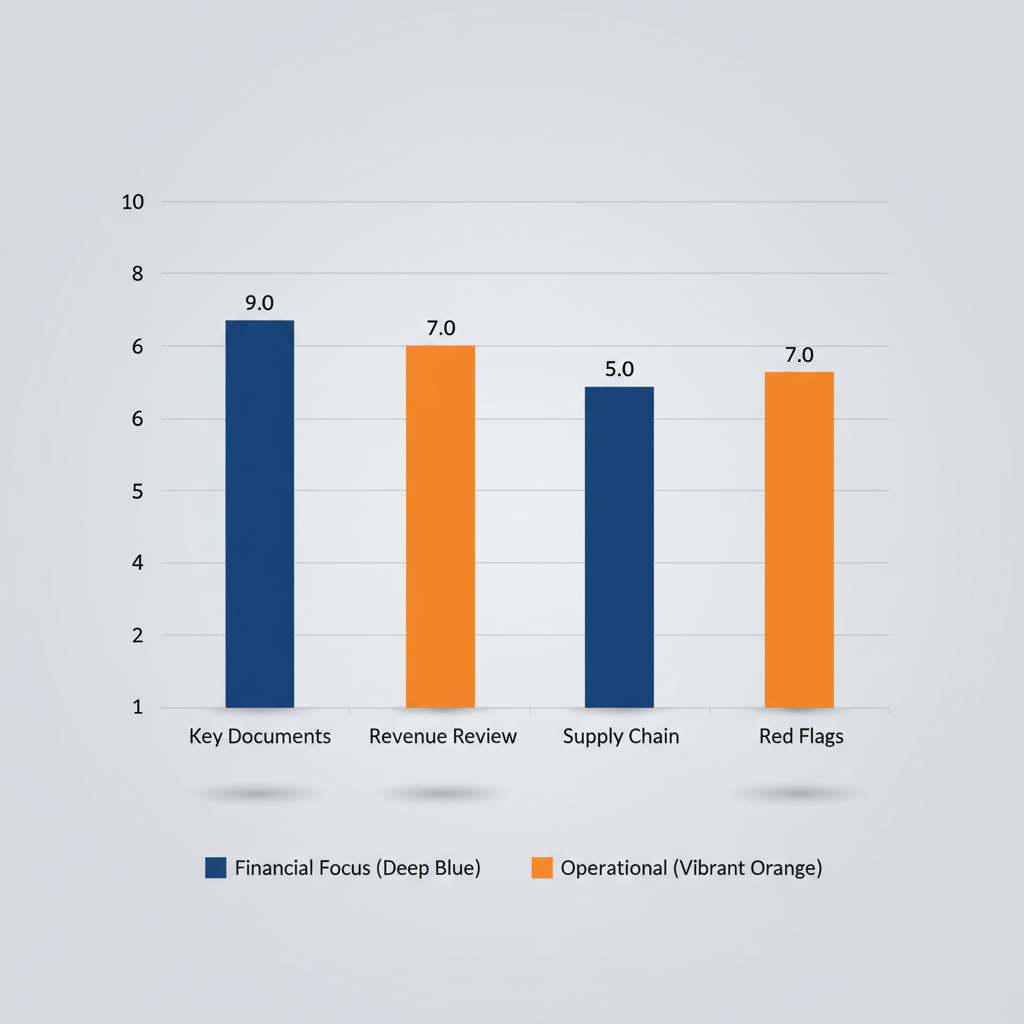
The following table outlines key differences in focus areas between financial and operational due diligence, highlighting their interconnections as per SBA-recommended practices for business acquisitions.
| Aspect | Financial Due Diligence | Operational Due Diligence |
|---|---|---|
| Key Documents | Audited statements, tax returns | Supply chain contracts, IT audits |
| Red Flags | Revenue inconsistencies | Operational inefficiencies |
This comparison underscores how financial discrepancies often stem from operational bottlenecks, such as inefficient supply chains impacting cash flows. At Zaidwood, we emphasize these linkages to provide a holistic view, preventing siloed analyses that could overlook cascading risks in M&A transactions.
Building on this foundation, our evaluations extend beyond numbers to operational realities, ensuring that financial health translates into sustainable performance post-acquisition.
Comparison of financial vs operational due diligence key aspects
Operational and Compliance Reviews
Operational due diligence at Zaidwood encompasses supply chain assessments, human capital evaluations, and IT infrastructure audits to gauge efficiency and scalability. We review employee retention metrics, organizational charts, and key personnel contracts to identify talent gaps that could disrupt post-merger operations; for example, high turnover rates might indicate cultural mismatches. Compliance checks focus on regulatory filings, environmental reports, and data privacy adherence, incorporating 2025 trends like AI-driven audit tools for enhanced scrutiny. Drawing from the SBA guide on buying existing businesses, we quote their emphasis on franchise due diligence to validate operational risks, such as unpermitted expansions that could lead to fines. In legal overlaps, Investment Bank Due Diligence plays a pivotal role, where investment banks coordinate with our team to review cross-border compliance and antitrust implications. This M&A due diligence checklist ensures all facets align, mitigating disruptions in human capital transitions and IT system integrations.
Our proprietary acquisition audit guides facilitate these reviews, allowing for real-time collaboration across teams. By addressing these elements proactively, Zaidwood helps clients avoid common pitfalls in operational handovers, fostering long-term value creation.
Risk Assessment in Depth
In buy-side evaluations, our risk assessment identifies red flags like overstated assets or pending regulatory probes, using the financial due diligence checklist to quantify exposures. Integration strategies involve phased rollouts, starting with cultural alignment workshops to ease transitions. Common issues include cybersecurity vulnerabilities in IT ops and supply chain dependencies exposed during compliance checks.
The table below contrasts buy-side and sell-side focuses, informed by SBA data on transaction evaluations.
| Focus Area | Buy-Side Due Diligence | Sell-Side Due Diligence |
|---|---|---|
| Primary Goal | Value maximization, risk mitigation | Attractive presentation, clean exit |
| Key Scrutiny | Synergies, integration feasibility | Historical performance, liabilities |
These distinctions guide our tailored approaches at Zaidwood, ensuring buy-side clients capitalize on opportunities while navigating complexities toward successful deal closure.
Practical Applications and Preparation Strategies
Applying a comprehensive Due Diligence Checklist transforms theoretical knowledge into actionable strategies for mergers and acquisitions. At Zaidwood Capital, we guide clients through practical preparation to ensure thorough evaluation of potential deals, minimizing risks and maximizing value in buy-side and sell-side scenarios. This section explores preparation techniques, red flag identification, timelines, and execution tools, drawing on established practices to support informed decision-making in capital advisory transactions.
Buy-Side Preparation Techniques
In buy-side scenarios, effective preparation begins with assembling a multidisciplinary team, including financial advisors, legal experts, and operational specialists. We recommend starting with a detailed M&A due diligence checklist to systematically gather and review documents. Key steps include:
- Document Gathering: Collect financial statements, tax returns, and contracts from the target company. Require sellers to provide audited financials and written confirmations of accuracy, as emphasized in standard checklists like those from SCORE, which cover areas such as organizational standing, intellectual property, and customer information.
- Team Coordination: Assign roles for reviewing specific checklist sections, such as legal compliance or employee benefits. Coordinate with stakeholders like bankers to analyze creditworthiness and competition.
- Initial Risk Mapping: Use a deal preparation inventory to outline potential liabilities early, ensuring alignment with strategic goals.
This structured approach, typically spanning 4-8 weeks, allows buyers to verify disclosures and assess sustainability. By integrating these techniques, clients can execute checklists efficiently, identifying opportunities while mitigating surprises in the transaction process.
The following table contrasts preparation strategies from buyer and seller perspectives, highlighting key differences in focus during M&A due diligence:
| Preparation Step | Buy-Side Focus | Sell-Side Focus |
|---|---|---|
| Document Review | Verify seller disclosures | Organize internal records |
| Risk Assessment | Target liabilities | Highlight strengths |
Buy-side efforts prioritize scrutiny of external data to uncover hidden issues, whereas sell-side preparation emphasizes presenting a polished narrative. This distinction helps teams anticipate counterpart needs, fostering smoother negotiations and reducing deal friction at Zaidwood Capital.
Identifying Red Flags and Timelines
Common red flags in due diligence often surface in financial discrepancies, such as inconsistent revenue reporting or undisclosed liabilities, which can signal deeper operational issues. Legal pitfalls, including pending litigation or non-compliance with regulations, also demand attention. For instance, reviewing environmental issues or material contracts via a financial due diligence checklist reveals risks like unrecorded debts. Debt-related concerns, such as unsustainable leverage, require expert intervention; our debt advisory services assist in structuring solutions to address these proactively.
Typical review durations range from 4 to 8 weeks, depending on deal complexity, allowing time for thorough validation without delaying closings. Mitigation strategies include phased checklists, starting with high-risk areas like taxes and insurance, and engaging professionals for valuations. Use a risk identification sheet to document findings, prioritizing issues by impact. At Zaidwood, we educate clients on these pitfalls, emphasizing written seller representations and escrow provisions to protect against post-closing surprises, ensuring resilient transaction outcomes.
Tools and Best Practices for Execution
Practical tools streamline due diligence, from virtual data rooms for secure document sharing to AI-driven analytics for pattern detection. At Zaidwood Capital, our integrated approaches incorporate proprietary platforms for full-cycle due diligence, enhancing efficiency in 2025 with digital verification protocols.
Best practices include adopting hybrid workflows: combining checklists with collaborative software for real-time updates. We leverage SCORE-inspired basics, like inventory lists for assets, while advancing to automated compliance checks.
The table below compares manual and digital tools, underscoring the shift toward technology for faster, more accurate execution:
| Tool Type | Manual Approach | Digital Approach |
|---|---|---|
| Document Review | Physical files and spreadsheets | Virtual data rooms with search |
| Risk Analysis | Manual audits and interviews | AI analytics and automated flags |
Digital tools reduce timelines by up to 30%, minimizing errors and supporting our Velocity Matrix for streamlined transactions. By blending these with Zaidwood’s capital introductions, clients achieve precise, efficient due diligence tailored to complex deals.
Advanced Techniques in Due Diligence Analysis
At Zaidwood Capital, we elevate due diligence beyond the basics by integrating a comprehensive Due Diligence Checklist with sophisticated transaction audit methods tailored for complex mergers and acquisitions. Our approach ensures thorough risk assessment in high-volume private equity deals, drawing on our full-cycle due diligence services to uncover hidden opportunities and mitigate threats. For experienced professionals navigating intricate transactions, these advanced techniques provide the elite risk evaluation framework needed to drive informed decision-making and streamlined execution.
In financial modeling, we employ sensitivity analysis to test how variations in key assumptions impact deal outcomes. This goes further than a standard financial due diligence checklist by incorporating scenario-based projections that account for market volatility and regulatory changes. We also integrate our proprietary Velocity Matrix, which accelerates the review process while maintaining precision in capital structuring. This allows us to align financial insights with broader capital formation strategies, supporting clients in securing mezzanine and venture debt efficiently.
IT due diligence represents another critical layer, where we conduct cybersecurity audits to evaluate data integrity and compliance in technology-driven acquisitions. Particularly in deep tech investment opportunities, these assessments reveal vulnerabilities that could derail post-merger integration. Our team examines network security protocols and software scalability, ensuring seamless alignment with operational goals. Human capital reviews complement this by identifying key person risks and talent retention strategies, essential for sustaining value in knowledge-intensive firms.
To illustrate the evolution of our methods, the following table compares standard and advanced due diligence tools, informed by evolving practices from resources like the SBA’s guidance on business acquisitions.
| Tool/Method | Standard Approach | Advanced Approach |
|---|---|---|
| Data Analysis | Manual spreadsheet review | AI-driven anomaly detection |
| Risk Modeling | Basic scenario planning | Quantitative stress testing |
Standard approaches suffice for routine transactions but often miss nuanced risks in private equity environments. In contrast, advanced tools like AI-driven detection enable proactive identification of irregularities, while stress testing simulates extreme conditions to fortify M&A due diligence checklists against unforeseen disruptions. By adopting these enhancements, we at Zaidwood Capital help clients achieve faster, more robust outcomes in their advisory engagements.
Frequently Asked Questions on Due Diligence Checklists
At Zaidwood Capital, we often encounter questions about the Due Diligence Checklist, a vital tool in M&A transactions. These checklist FAQ insights provide due diligence query resolutions based on our advisory experience and best practices, drawing from comprehensive guides like those from SCORE.
What should an M&A due diligence checklist include? An M&A due diligence checklist typically covers legal standing, financial records, assets, intellectual property, contracts, and customer data to uncover risks and ensure informed decisions.
How do you prepare for buy-side due diligence? Start by organizing internal documents, engaging experts for reviews, and aligning with advisors on key focus areas like operations and compliance for efficient processes.
Why is a financial due diligence checklist essential? It verifies revenue accuracy, debt obligations, and cash flow projections, preventing surprises in valuations and helping secure sustainable investments.
What are common red flags in a due diligence checklist? Watch for inconsistent financials, undisclosed liabilities, pending litigation, or weak customer retention. In such cases, boutique ma advisory services can provide specialized scrutiny to mitigate these issues.
How long does reviewing a full due diligence checklist take? Timelines vary, but a thorough review often spans 4-8 weeks, depending on business complexity and data availability, as per standard advisory protocols.
Key Takeaways for Effective Due Diligence in M&A
Effective due diligence begins with a comprehensive Due Diligence Checklist, covering core components like financial reviews, legal assessments, and operational evaluations. Preparation tips include early team assembly and clear timelines, while watching for red flags such as inconsistent financials or regulatory issues. Advanced techniques, including our full-cycle approaches at Zaidwood Capital, enhance the M&A due diligence checklist and financial due diligence checklist for thorough insights.
We at Zaidwood Capital leverage our extensive network and $24.4B transaction experience to guide clients through these checklist summary highlights, ensuring seamless due diligence wrap-up essentials aligned with SBA standards for business acquisitions.
Armed with these essentials, approach M&A decisions confidently by partnering with expert advisors for informed outcomes.
Resources


