


Growth Equity Investment
Table of Contents
Unlocking Growth Through Equity Investments
For scaling businesses facing funding hurdles, Growth Equity offers a compelling path forward. Growth Equity Investment provides minority stakes in mature startups to accelerate expansion while preserving founder control, unlike venture capital’s early-stage focus. This late-stage equity funding supports market expansion, product development, and operational scaling. Recent HEC Paris-Dow Jones rankings highlight US-based private equity firms’ dominance in mid-market performance, underscoring the competitive landscape.
At Zaidwood Capital, we leverage our expertise in structuring these deals, connecting clients to over 4,000 investors across growth equity firms. With $24.4B in aggregate transaction volume, our equity advisory services in the US navigate this dynamic space effectively.
Explore key insights on growth equity vs venture capital, qualifications, terms, assessments, and benefits ahead to unlock your business’s potential.
1. Defining Growth Equity Fundamentals
Understanding Growth Equity Investment fundamentals is crucial for businesses evaluating funding options, as it enables targeted acceleration without surrendering full control. At Zaidwood Capital, we guide clients through these strategies to align with their scaling goals effectively.
Growth equity represents a form of What Is Growth Equity that provides capital to revenue-generating companies beyond the venture stage, typically through minority stakes of 20-40%. This expansion-stage capital supports initiatives like geographic expansion or strategic acquisitions, preserving founder ownership while fueling sustainable growth. In the US market, growth equity firms thrive, with US-based private equity players dominating the latest HEC Paris-Dow Jones Mid-Market Performance Ranking, which highlights their superior returns and operational expertise. We at Zaidwood specialize in equity advisory, structuring deals to connect clients with high-performing networks for optimal outcomes.
Consider a tech firm in Wyoming leveraging growth equity for international market entry: This maturing company financing allows hiring key talent and acquiring complementary software, boosting revenue 50% within two years without diluting majority control. As we explore growth equity vs venture capital next, note how control levels and maturity stages define these distinct approaches.
2. Qualifying for Growth Funding
Assessing eligibility for Growth Equity Investment empowers companies to evaluate their funding readiness assessment effectively. Our team at Zaidwood Capital guides clients through this process, highlighting key metrics that signal scalability potential in private markets, where opportunities have expanded significantly with unicorns growing from around 100 in 2014 to 1,463 in 2024.
Qualifying typically requires at least $10M in annual revenue, a proven business model, a strong management team, and a clear growth trajectory. Growth equity firms conduct thorough due diligence, focusing on financial health, market position, and expansion plans–contrasting with growth equity vs venture capital, which targets earlier stages. We provide full-cycle due diligence support, covering financial, legal, and operational aspects to streamline eligibility for scaling capital and navigate these complex assessments.
To prepare, compile detailed financial statements and projections for a Zaidwood consultation. This step enhances your positioning among institutional investors, leveraging our access to over 4,000 global networks and $15B in deployable capital for informed private market entry.
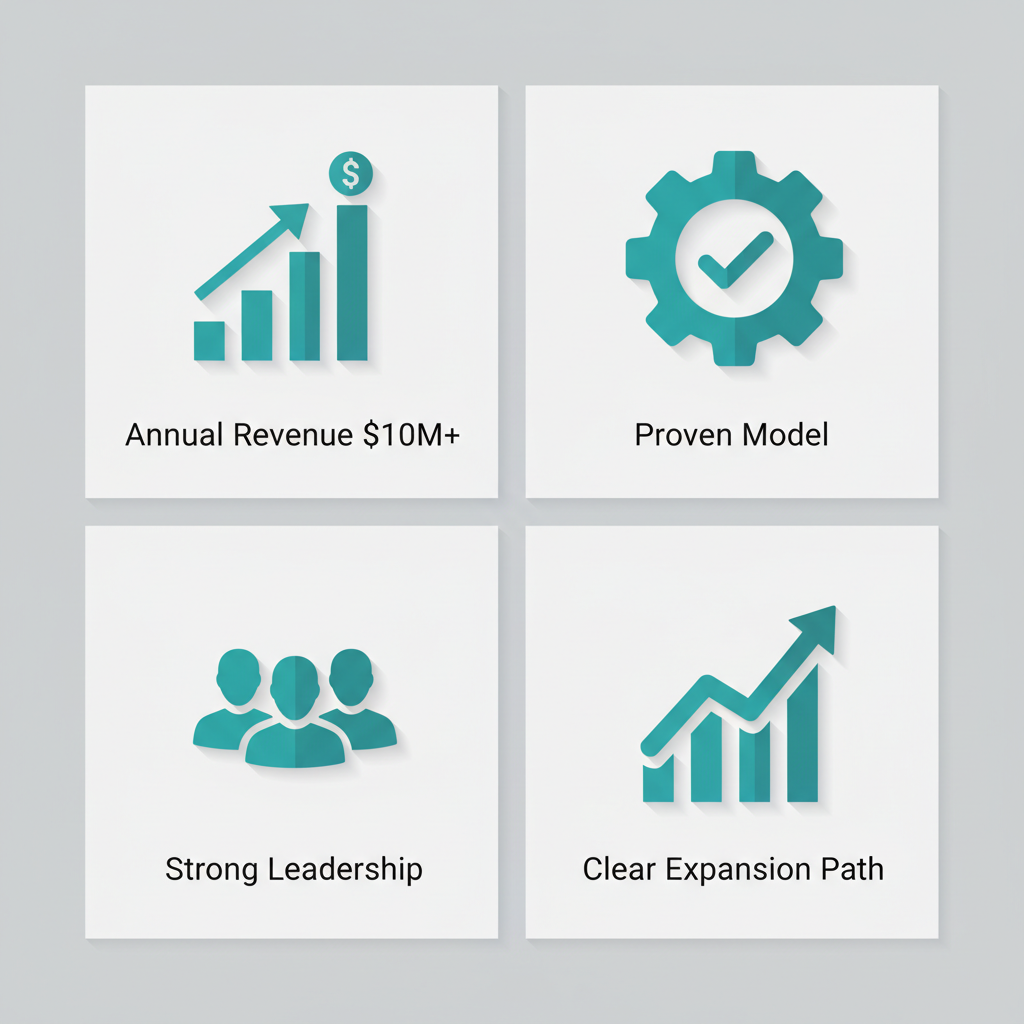
Visual icons of essential qualifications for growth equity funding
3. Navigating Typical Deal Terms
Understanding the typical terms in a growth equity investment is crucial for entrepreneurs seeking to partner with growth equity firms without compromising control. These deal structure essentials form the foundation of investment agreement basics, influencing long-term value creation and exit potential. As advisors with over $24.4 billion in aggregate transaction volume, we guide clients through these negotiations to align interests effectively.
Key provisions often include preferred equity structures, where investors receive priority returns, typically targeting 5-10x multiples on invested capital. In growth equity vs venture capital, investment sizes are larger–often $10-50 million versus venture’s $1-10 million–for more mature companies. Governance rights may grant board seats or veto powers on major decisions, alongside anti-dilution protections to safeguard ownership during future rounds. Exit timelines generally span 3-7 years, reflecting trends where companies stay private longer, as seen with the rise from 100 unicorns in 2014 to 1,463 in 2024. This shift, per private market insights, creates opportunities in late-stage growth equity by allowing sustained focus on innovation.
We recommend prioritizing board composition early; negotiate for balanced representation to retain strategic input. Our transaction advisory expertise optimizes term sheets, drawing from 300+ completed deals to mitigate risks and enhance alignment before due diligence confirms terms’ viability.
4. Assessing Company Potential
Preparation for Growth Equity Investment opportunities begins with understanding how investors evaluate potential. Our team at Zaidwood Capital emphasizes thorough assessments to identify scalable businesses aligned with market demands, ensuring clients position effectively for funding.
Growth equity firms scrutinize company potential through rigorous due diligence, starting from initial pitch reviews to detailed financial modeling. Key criteria include total addressable market (TAM) analysis, sustained revenue growth exceeding 20% year-over-year, robust intellectual property strength, and defensible competitive moats. Unlike growth equity vs venture capital approaches, which prioritize early-stage innovation, these evaluations focus on proven scalability and management expertise. Our full-cycle due diligence services validate these elements, complemented by equity advisory services for strategic support. Recent HEC Paris-Dow Jones rankings highlight US-based private equity dominance, underscoring the assessment rigor we mirror with proprietary data insights.
For instance, in a SaaS scalability review, our due diligence team analyzes user acquisition metrics and churn rates to project long-term viability, helping clients refine pitches that resonate with investors seeking sustainable growth trajectories.
5. Benefits of Growth Partnerships
Growth equity investments can transform established businesses by fueling scalable expansion without the full dilution of early-stage funding. At Zaidwood Capital, we deliver these partnership advantages through our boutique advisory approach, connecting clients to over $15 billion in deployable capital from more than 4,000 institutional and private investors. This access empowers companies to pursue ambitious growth strategies in private markets, where opportunities abound as firms stay private longer to focus on long-term objectives.
Partnering with growth equity firms accelerates revenue trajectories, provides strategic network introductions to key stakeholders, and offers operational expertise to optimize processes. Unlike traditional venture capital, growth equity vs venture capital differs by preserving founder control while enabling faster exits through structured liquidity events. In today’s landscape, with unicorns surging from 100 in 2014 to 1,463 in 2024, these expansion collaboration perks help businesses scale efficiently amid concentrated public markets.
To maximize value post-investment, we recommend actively leveraging introduced networks for ongoing synergies, such as joint ventures or follow-on funding. Selecting partners with proven qualities ensures sustained benefits, guiding firms toward optimal selection in the competitive private equity arena.
6. Understanding Firm Investments
Our insights reveal that Growth Equity Investment involves a structured approach where growth equity firms identify and support scaling companies, particularly in high-potential sectors like technology. This process emphasizes sustainable expansion over early-stage risks, distinguishing it from more speculative ventures.
Growth equity firms typically begin with thesis-driven sourcing, targeting mature businesses with proven revenue streams in areas such as SaaS and tech infrastructure. Unlike venture capital’s focus on startups, growth equity vs venture capital prioritizes later-stage funding for accelerated growth through operational enhancements and market expansion. Key strategies include co-investment models to share risks and rewards, alongside LP placements that secure institutional backing. The latest HEC Paris-Dow Jones Mid-Market Performance Ranking highlights US-based firms’ dominance in efficient processes, underscoring their prowess in timely deployments. At Zaidwood, our M&A capital advisory facilitates these introductions to over 4,000 investors, ensuring seamless capital deployment.
For instance, investing in a SaaS company might involve sector-specific funding to bolster product development and customer acquisition, yielding scalable returns while mitigating volatility through diversified firm investment strategies.
7. Comparing Growth and Venture
When navigating scaling decisions, selecting between growth equity and venture capital profoundly impacts a company’s trajectory and control. At Zaidwood Capital, we advise clients on these options, drawing from our experience in equity advisory to align funding with business maturity and risk appetite.
Growth equity vs venture capital highlights stark capital stage contrasts. Venture capital fuels early-stage, high-risk ventures with $1-10M investments, often in unproven concepts like Uber’s nascent ridesharing model, accepting higher failure rates for potential outsized returns. A Growth Equity Investment, however, targets mature firms with established revenue, deploying $10-50M to accelerate expansion while preserving founder control, as exemplified by Airbnb’s post-validation scaling. Growth equity firms emphasize lower-risk profiles in private markets, where companies increasingly remain private longer–evidenced by unicorns surging from 100 in 2014 to 1,463 in 2024–offering strategic support amid technological advancements and market concentration.
This risk-profile difference makes growth equity ideal for businesses generating over $10M annually, seeking to scale without diluting ownership excessively. We help clients evaluate these paths, leveraging our network to connect with suitable investors for sustainable growth.
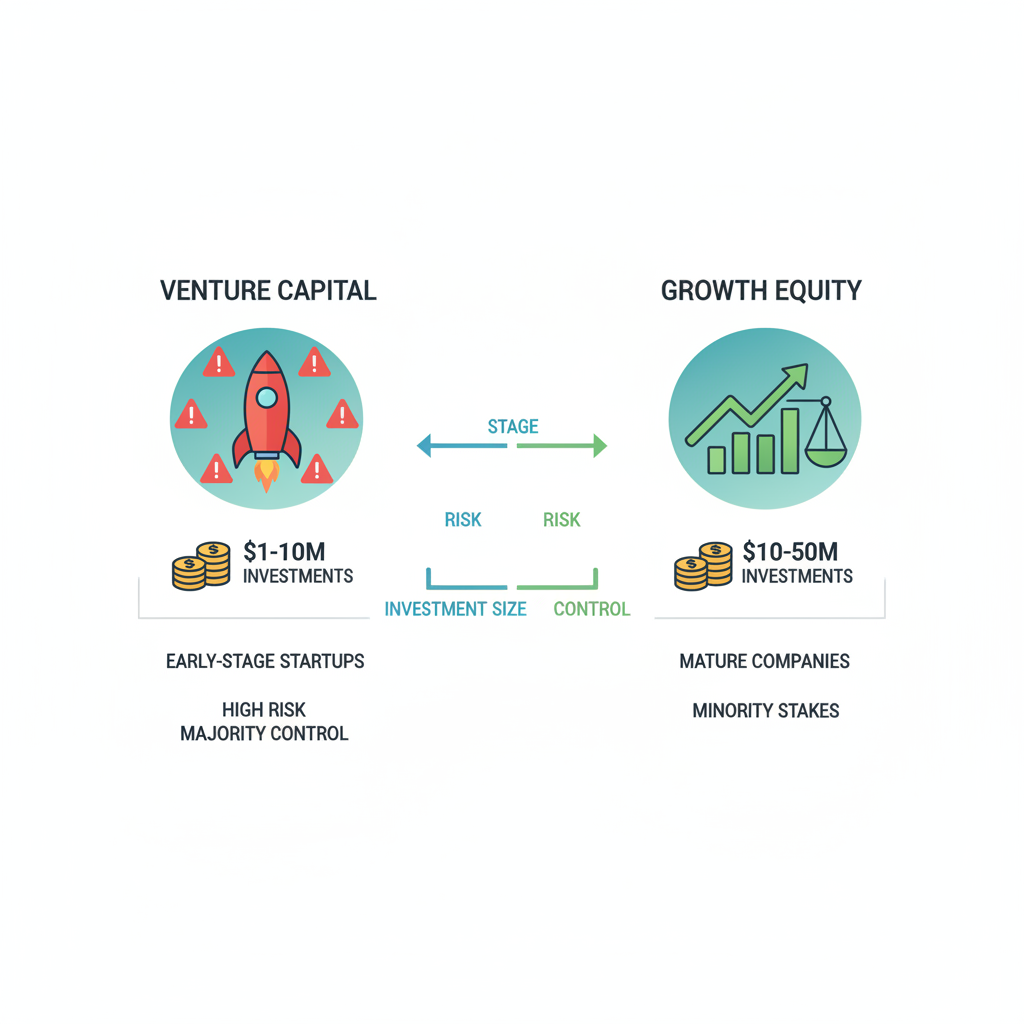
Comparison of growth equity vs. venture capital: stages, risks, and investment sizes.
8. Growth vs Private Equity
Growth Equity Investment represents a strategic midpoint on the private capital spectrum, bridging venture capital and traditional private equity. It targets mature startups scaling operations without full ownership changes. Our experience shows how growth equity firms provide flexible minority stakes to fuel expansion, contrasting with private equity’s emphasis on majority control and operational overhauls.
Private equity firms often pursue leveraged buyouts for control-level funding, imposing longer investment horizons of five to seven years to restructure and exit via sales or IPOs. In contrast, growth equity focuses on non-control investments in established companies with proven revenue, typically $10-100 million annually, emphasizing sectors like technology and healthcare for sustained growth. Recent HEC Paris-Dow Jones rankings highlight US-based private equity firms dominating mid-market performance, underscoring their buyout strategies versus growth equity’s collaborative approach. These PE contrasts reveal distinct risk profiles: private equity demands deeper involvement, while growth equity aligns with management for agile scaling, differing from growth equity vs venture capital in maturity focus.
Selecting between growth equity and private equity depends on business stage; early-stage firms benefit from growth’s lighter touch, while mature entities suit PE’s transformative control. At Zaidwood Capital, our boutique M&A advisory services bridge these worlds, guiding clients through tailored capital solutions to match their growth trajectory.
Strategic Partnering for Expansion
Growth equity investment offers a strategic pathway for companies seeking controlled expansion without the intensity of early-stage funding. Unlike venture capital, which targets high-risk startups, growth equity focuses on mature businesses with proven models, often through recapitalizations or acquisitions. This approach, distinct from growth equity vs venture capital dynamics, qualifies firms with stable revenues–typically over $20 million–for investments between $10-100 million, emphasizing assessments of scalability, market position, and exit potential. Benefits include accelerated growth, liquidity for owners, and diversified risk profiles compared to traditional private equity.
At Zaidwood Capital, we leverage our expertise in guiding clients through these opportunities, drawing on a network of over 4,000 investors and more than 300 completed deals totaling $24.4 billion in transaction volume. Our full-cycle M&A services provide comprehensive advisory, from capital decision frameworks to strategic funding recaps, ensuring optimal solutions in expanding private markets where unicorns have surged to 1,463 by 2024.
Contact us at Zaidwood to explore growth equity firms and unlock your expansion potential.
Resources


