


Healthcare Investment Banking Services
Table of Contents
Healthcare Investment Banking Services Overview
The healthcare sector stands as one of the fastest-growing industries globally, driven by innovation in biotechnology, digital health solutions, and an aging population’s demands. At Zaidwood Capital LLC, a Healthcare Investment Bank, we specialize in Healthcare Investment Banking Services, providing tailored financial advisory to navigate this dynamic landscape. These services are essential for healthcare entities seeking to fund groundbreaking research, expand operations, or consolidate through strategic partnerships.
Healthcare investment banking focuses on specialized financial advisory within sub-sectors like pharma/biotech, medical devices, health tech, and providers, as outlined by academic insights from Duke University’s Fuqua School of Business. We at Zaidwood offer core services including healthcare M&A advisory, debt and equity financing, and comprehensive healthcare due diligence. Unlike general investment banking, our approach accounts for stringent regulations such as HIPAA compliance and FDA approvals, ensuring transactions align with sector-specific complexities. Our full-cycle capabilities connect clients to over 4,000 investors and more than $15 billion in deployable capital, facilitating seamless capital raising and strategic growth.
Key trends shaping the industry include the integration of digital health technologies and accelerated post-pandemic consolidation, exemplified by recent mergers between telehealth platforms and traditional providers. These developments underscore the need for expert guidance to mitigate risks and capitalize on opportunities. By leveraging our deep expertise, we empower healthcare firms to achieve sustainable financial strategies, setting the foundation for exploring detailed fundamentals in subsequent discussions.
Fundamentals of Healthcare Investment Banking
Healthcare investment banking services form the backbone of financing in a sector defined by rapid innovation and stringent oversight. At Zaidwood Capital, we observe that these services navigate unique challenges, such as funding groundbreaking research while ensuring compliance with evolving regulations. This foundational role supports everything from startup capital raises to large-scale consolidations, enabling healthcare entities to thrive amid complexity.
Core services in healthcare investment banking begin with mergers and acquisitions advisory, where professionals structure deals that align clinical and financial objectives. Capital formation involves raising funds tailored to high-risk ventures, often through equity or debt instruments suited for extended development cycles. Due diligence rounds out the essentials, scrutinizing intellectual property, clinical trials, and regulatory filings to mitigate risks. For instance, healthcare M&A advisory requires integrating FDA approvals into valuation models, a step that extends timelines but safeguards long-term viability. These elements address the sector’s demands for precision in medical finance advisory.
Healthcare’s unique risks, including regulatory scrutiny and ethical considerations, necessitate specialized services beyond standard practices. Unlike other industries, healthcare deals often involve intangible assets like patents and patient data, demanding expertise in HIPAA compliance and biotech synergies. We see these adaptations as critical for managing spillovers from international investments, such as knowledge transfer and cost efficiencies highlighted in sector analyses.
| Service Category | Healthcare Investment Banking | General Investment Banking |
|---|---|---|
| M&A Advisory | Focuses on regulatory compliance (e.g., FDA, HIPAA) and sector synergies like biotech-pharma integrations | Broad cross-industry deals with standard antitrust reviews |
| Capital Formation | Tailored for R&D-heavy firms, including venture debt for clinical trials | Standard equity/debt raises across mature industries |
| Due Diligence | Emphasizes IP valuation and clinical data review | Financial and operational audits without sector-specific risks |
This comparison underscores how healthcare investment banking adapts to sector-specific hurdles, drawing from peer-reviewed insights on globalization patterns. Boutique firms like Zaidwood excel here due to our full-cycle due diligence and access to over 4,000 institutional investors, facilitating connections for R&D funding. Reference data on FDI growth validates this edge, noting increased cross-border activities that enhance accessibility and innovation without resource drainage.
Building on these distinctions, healthcare due diligence processes differ markedly from general sectors through their emphasis on clinical validations and IP assessments. In healthcare mergers and acquisitions, investment bankers play a pivotal role by structuring transactions that account for longer approval cycles, often using analogies like assembling a complex puzzle where each regulatory piece must fit precisely. Our expertise at Zaidwood ensures valuations reflect not just financials but also therapeutic potentials, streamlining transactions for clients in this dynamic field.
Key trends are reshaping these fundamentals, with telemedicine accelerating post-pandemic and driving demand for digital health investments. We note a surge in ESG integration, where sustainable practices influence capital formation for eco-friendly medical devices. Additionally, health sector due diligence processes now prioritize data security amid rising cyber threats. These evolutions, informed by analyses of international trade growth, position healthcare investment banking as a catalyst for equitable global outcomes, balancing innovation with accessibility.
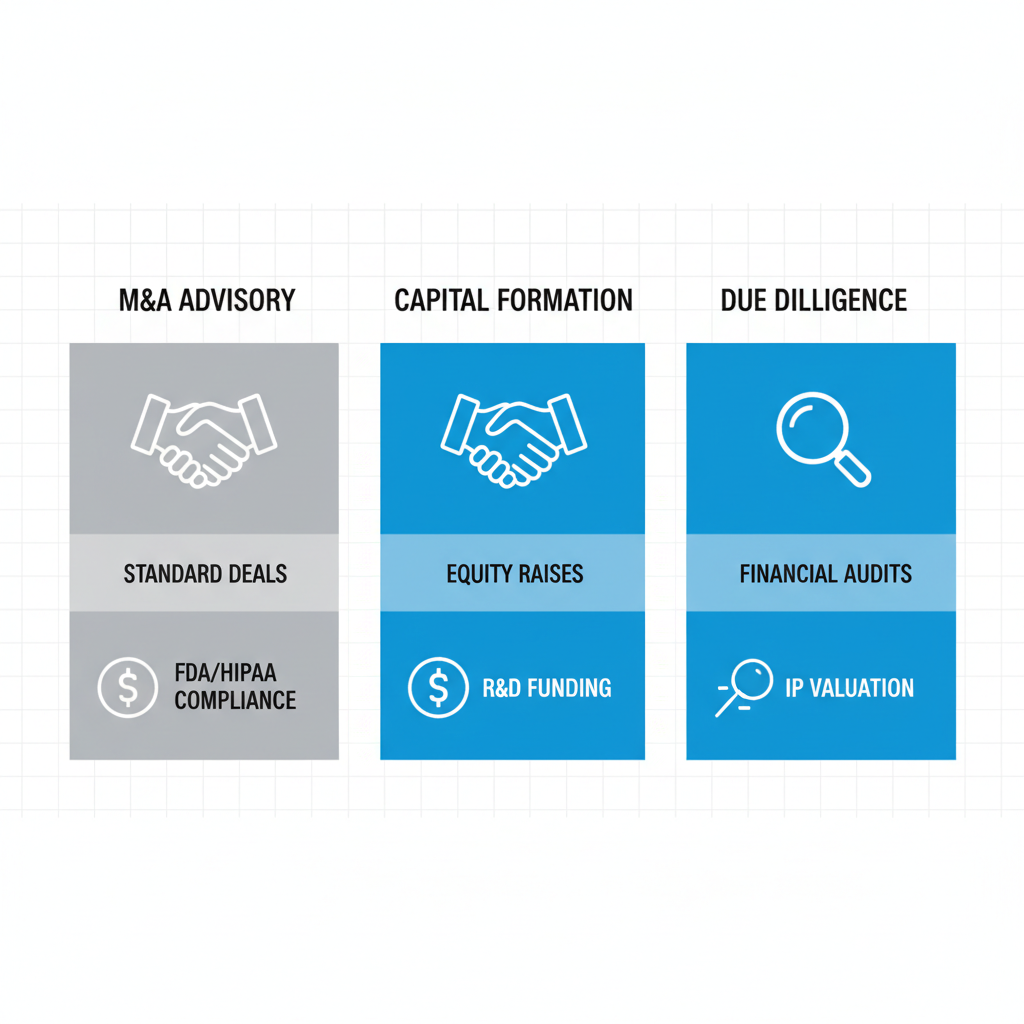
Core services comparison: healthcare vs general investment banking
Core services comparison: healthcare vs general investment banking
As telemedicine and ESG trends gain momentum, they highlight the need for adaptive strategies in Healthcare Mergers And Acquisitions. This forward-looking approach ensures sustained growth in a sector poised for continued internationalization.
Deep Dive into Healthcare M&A Advisory
In the evolving landscape of healthcare, zaidwood capital advisory plays a pivotal role in navigating complex transactions. Our expertise in Healthcare Investment Banking Services enables clients to achieve strategic growth through mergers and acquisitions. We provide comprehensive healthcare M&A advisory, drawing on our $24.4 billion in aggregate transaction volume and connections to over 4,000 institutional investors. This deep dive explores the intricacies of the process, benefits for startups, and emerging trends shaping the sector.
Key Steps in the Healthcare M&A Process
The healthcare M&A process demands meticulous attention due to stringent regulations and the high stakes involved in patient care and innovation. Unlike general mergers, healthcare deals incorporate unique elements such as compliance with federal agencies and protection of sensitive data, which can extend timelines and introduce complexities. At Zaidwood, we facilitate seamless execution by leveraging our full-cycle capabilities to address these challenges from inception to completion.
To illustrate the structured approach, the following table outlines the primary stages of healthcare M&A advisory:
| Stage | Key Activities | Healthcare-Specific Considerations | Typical Timeline |
|---|---|---|---|
| Target Identification | Market analysis and deal sourcing | Regulatory compatibility checks (e.g., FDA) | 1-3 months |
| Valuation and Negotiation | Financial modeling and term sheets | IP and clinical trial valuations | 2-4 months |
| Due Diligence and Closing | Comprehensive reviews and documentation | HIPAA compliance and antitrust filings | 3-6 months |
This framework highlights how each phase builds on the previous one, ensuring thorough preparation. Healthcare-specific considerations often prolong due diligence, where we conduct rigorous healthcare due diligence to mitigate risks like non-compliance. Boutique firms like ours accelerate timelines through proprietary networks and streamlined workflows, reducing the overall process from up to 12 months to as little as 6-9 months in optimized scenarios. Our experience with over 300 completed deals underscores the value of expert guidance in compressing these periods while maintaining compliance.
The integration of targeted sourcing early on sets a strong foundation, allowing for informed negotiations that align with clinical and financial objectives. Following valuation, we emphasize transparent term sheets to foster trust among parties. As we move toward closing, our team coordinates multi-disciplinary reviews, ensuring all regulatory hurdles are cleared efficiently.
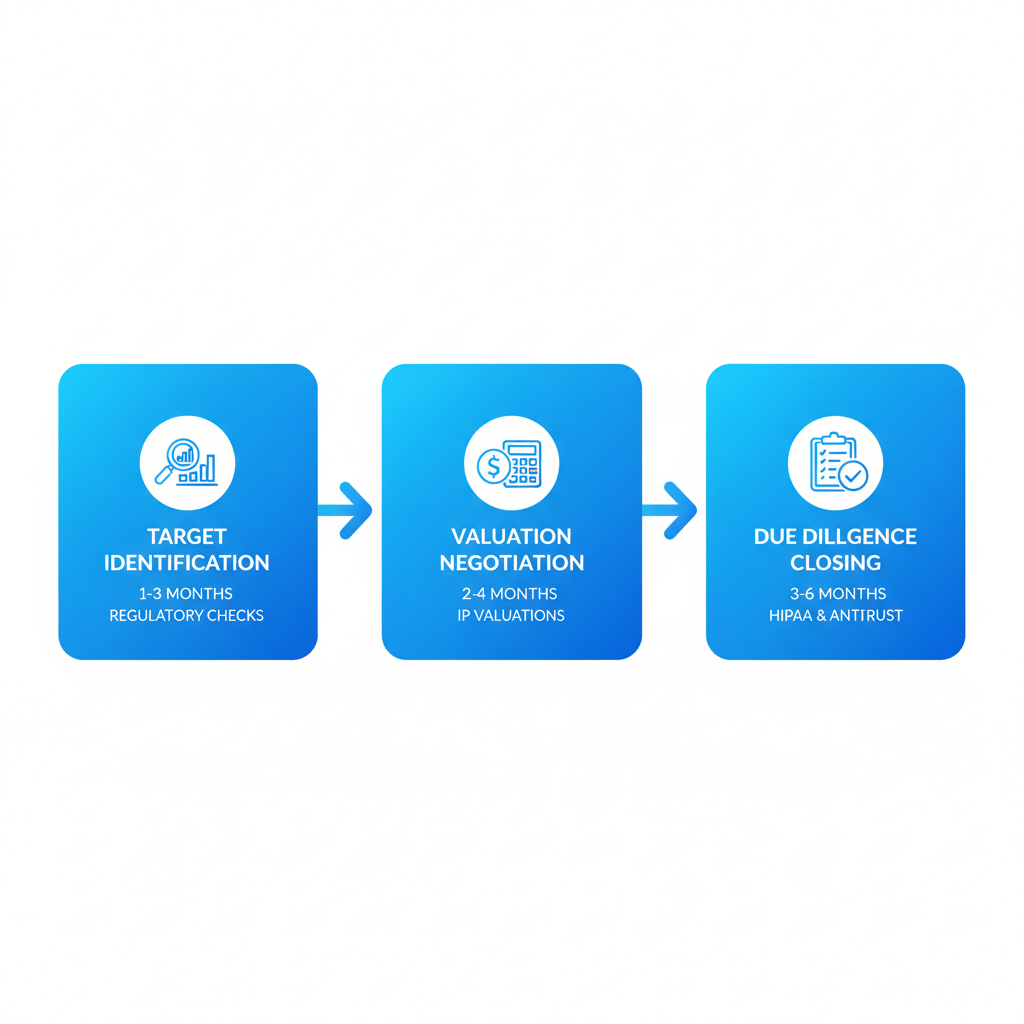
Three-stage healthcare M&A advisory process from identification to closing.
Three-stage healthcare M&A advisory process from identification to closing.
Visual representations like this flowchart aid in understanding the interconnected nature of these steps, reinforcing the need for specialized support in healthcare merger guidance.
- Target Identification: We begin with in-depth market scans to pinpoint viable opportunities, prioritizing entities with strong regulatory alignment.
- Valuation and Negotiation: Financial models incorporate healthcare metrics, such as revenue from reimbursements, to craft competitive offers.
- Due Diligence and Closing: Exhaustive audits cover operational, legal, and clinical aspects, culminating in secure transaction finalization.
Benefits and Support for Healthcare Startups
Healthcare startups often face barriers to scaling, but M&A advisory provides critical pathways for growth and sustainability. Through strategic acquisitions or well-timed exits, emerging companies can access capital, technology, and markets that accelerate development. At Zaidwood, we offer tailored M&A support in medical fields, connecting innovators to our vast investor network for optimal outcomes.
Key benefits include:
- Exit Strategies: We guide startups toward lucrative sales, maximizing valuation by highlighting intellectual property and growth potential. Our track record includes facilitating exits that unlock value for founders and stakeholders.
- Acquisition Opportunities: For inbound growth, we identify targets that complement core competencies, such as digital health tools, enabling rapid expansion without internal development delays.
- Network Leverage: With access to $15 billion in deployable capital, we bridge startups to private equity and venture firms, streamlining funding rounds and partnerships.
- Risk Mitigation: Our full-cycle due diligence uncovers potential pitfalls early, protecting nascent ventures from costly oversights in regulated environments.
For instance, a biotech startup might partner with us to acquire complementary R&D assets, bolstering their pipeline while we handle negotiations. This support not only enhances scalability but also positions startups for long-term success in a competitive landscape. We emphasize collaborative approaches, ensuring alignment with each client’s vision.
Current Trends in Healthcare M&A
The healthcare M&A landscape is undergoing rapid transformation, driven by technological advancements and market pressures. Consolidation remains a dominant trend, with hospitals and providers merging to achieve economies of scale and navigate rising costs. According to the Healthcare Value Hub’s report on financialization, private equity investments in healthcare have surged, leading to increased acquisitions that sometimes raise patient costs but also fund innovations.
AI integration is another key shift, as firms acquire startups specializing in predictive analytics and telemedicine to enhance efficiency. For example, deals involving digital health technologies have grown, reflecting a push toward value-based care. The report notes that antitrust deregulation since the 1980s has facilitated this consolidation, resulting in higher commercial prices but also expanded service access in some regions.
These trends underscore the dual impacts: while financial strategies like private equity buyouts can improve quality through investments, they risk service reductions in unprofitable areas. Zaidwood monitors these dynamics closely, advising clients on opportunities in AI-driven M&A to capitalize on consolidation waves. Data from the report illustrates a 20-30% rise in private equity deals over the past decade, influencing patient affordability and care equity.
We help clients adapt by focusing on sustainable transactions that balance profitability with ethical considerations, ensuring resilience amid evolving regulations.
Practical Aspects of Healthcare Due Diligence
In the realm of zaidwood capital services, healthcare investment banking services play a pivotal role in navigating complex mergers and acquisitions. Our expertise in healthcare M&A advisory ensures that due diligence in health deals is thorough and tailored to the sector’s unique demands. This section delves into the practical elements of healthcare due diligence, highlighting essential processes that safeguard investments amid regulatory and operational intricacies.
Financial and Regulatory Due Diligence Essentials
Financial due diligence in healthcare transactions begins with robust modeling to assess the viability of revenue streams. We evaluate payer contracts, Medicare reimbursements, and the impact of policy shifts on cash flows, drawing from insights in healthcare finance literature that underscore the sector’s vulnerability to reimbursement changes. For instance, modeling must account for intangibility and high regulation, as noted in studies on healthcare internationalization, where quality and trust factors amplify financial scrutiny.
Regulatory checks for medical M&A form the backbone of compliance verification. This involves auditing adherence to FDA approvals, HIPAA privacy standards, and Stark Law provisions prohibiting self-referrals. Our process includes reviewing CMS audits and potential litigation risks, ensuring that all documentation aligns with institutional factors unique to healthcare. Step-by-step, we conduct site visits, interview key personnel, and analyze historical compliance records to mitigate exposure. These essentials not only protect buyer interests but also facilitate smoother transaction closings, with financial projections incorporating spillover effects from global trade dynamics in the sector.
Operational due diligence extends to sub-sectors like pharma/biotech and medical devices, verifying supply chain integrity and R&D pipeline valuations. By integrating these elements, we provide a comprehensive framework that addresses the heightened complexity of healthcare deals compared to general industries.
Common Risks and Preparation Strategies
Healthcare due diligence reveals several common risks that can derail transactions. Regulatory changes, such as evolving FDA guidelines or reimbursement cuts under Medicare, pose significant threats, potentially eroding projected revenues by 10-20% as highlighted in PMC analyses of sector finance. Litigation from compliance lapses, including HIPAA breaches, adds legal vulnerabilities, while operational disruptions in supply chains for medical devices amplify exposure in globalized markets.
Other risks include IP disputes in biotech sub-sectors and cultural mismatches in cross-border deals, where trust and quality standards vary. Negative spillovers from FDI, like resource drainage in host countries, further complicate assessments.
For preparation, sellers should assemble clean data rooms with audited financials and compliance certifications well in advance. We recommend conducting preemptive internal audits to identify gaps. Buyers benefit from phased due diligence, starting with high-level reviews and escalating to detailed forensic analysis. Strategies include engaging specialized advisors early and simulating regulatory scenarios to build resilience. Through proactive measures, our healthcare M&A advisory minimizes surprises, ensuring informed negotiations and value preservation in these high-stakes environments.
Checklist for Comprehensive Healthcare Reviews
A customized healthcare due diligence checklist integrates financial, legal, and operational facets to address the sector’s distinct demands. Unlike general sectors, healthcare requires heightened scrutiny due to its regulatory intensity and sub-sector variances, such as those in providers versus payers as outlined in industry overviews.
The following table compares key checklist items to underscore healthcare’s unique demands:
| Aspect | Healthcare Due Diligence | General Due Diligence |
|---|---|---|
| Financial | Revenue cycle analysis including payer contracts and Medicare reimbursements | Standard P&L and balance sheet reviews |
| Regulatory | FDA approvals, HIPAA audits, and Stark Law compliance | Basic corporate governance and contracts |
| Operational | Clinical trial data and supply chain for medical devices | General supply chain and HR assessments |
This comparison illustrates how healthcare due diligence demands deeper dives into specialized areas like reimbursement modeling and clinical validations. At Zaidwood Capital, our full-cycle due diligence approach encompasses these elements, leveraging our network to connect clients with institutional investors for seamless execution. By incorporating sourced risk examples, such as policy-driven financial volatilities, we enhance preparedness across sub-sectors, delivering actionable insights that streamline transactions and mitigate pitfalls in healthcare M&A.
Advanced Strategies in Healthcare Capital Formation
In the dynamic landscape of Healthcare Investment Banking Services, advanced capital formation plays a pivotal role in enabling healthcare entities to scale innovations and navigate complex financial environments. At Zaidwood Capital, we specialize in providing tailored strategies that facilitate capital raising in healthcare, drawing on our expertise in investor introductions and deal structuring to support clients from startups to established medtech firms. Our approach integrates sustainable investing trends, ensuring alignments with evolving regulatory and ethical standards in the sector.
Boutique investment banks like ours offer distinct advantages in healthcare capital formation, particularly through full-cycle support that encompasses zaidwood capital m&a firm services. We assist clients by connecting them to a network of over 4,000 institutional and private investors, providing access to more than $15 billion in deployable capital. This includes comprehensive healthcare due diligence processes, where we conduct thorough financial, legal, and operational reviews to mitigate risks and enhance deal viability. Our team structures transactions with precision, emphasizing advanced financing for medtech that aligns with client growth objectives while adhering to best practices in capital advisory.
When exploring financing options, healthcare organizations must weigh debt and equity instruments to match their strategic needs. Debt solutions, such as mezzanine financing and equipment lending, allow for non-dilutive funding that preserves ownership, ideal for asset-heavy expansions like clinical facilities. Equity options, including growth capital, bring in strategic partners for innovation scaling but involve sharing control. These choices are influenced by broader trends in financialization, as noted by the Healthcare Value Hub, where private equity investments have surged, impacting hospital consolidations and patient access through increased mergers and for-profit strategies.
The following table outlines key differences in these financing approaches tailored to healthcare contexts:
| Financing Type | Key Features | Healthcare Applications | Pros and Cons |
|---|---|---|---|
| Debt (e.g., Venture Debt) | Non-dilutive, asset-backed | Funding clinical trials without equity loss | Pro: Preserves ownership; Con: Repayment pressure |
| Equity (e.g., Growth Equity) | Investor stakes for expansion | Scaling medtech innovations | Pro: No repayment; Con: Dilution |
This comparison highlights how debt maintains control during early-stage development, while equity fuels aggressive growth, often integrated with our healthcare M&A advisory for seamless transitions. Following such evaluations, we leverage our proprietary Velocity Matrix to expedite executions, referencing ongoing trends like equitable financialization to optimize outcomes. Our $24.4 billion in aggregate transaction volume underscores our ability to deliver integrated solutions that bridge due diligence with capital deployment, preparing clients for sustained success in US markets.
Frequently Asked Questions on Healthcare Investment Banking
Our Healthcare Investment Banking Services address common queries in medical banking, providing clarity on key aspects of the sector. Below are answers to frequently asked questions, drawing from our expertise in health finance.
What are the latest trends in healthcare M&A advisory? Consolidation in sub-sectors like pharma/biotech and health tech drives M&A activity, with a focus on digital innovation and cross-border deals. We guide clients through these evolving dynamics to maximize value.
What are common risks in healthcare due diligence? Regulatory changes, intellectual property disputes, and reimbursement uncertainties pose key challenges across providers and payers. Thorough healthcare due diligence mitigates these by scrutinizing sub-sector specifics.
How do boutique firms differ in healthcare investment banking? Boutiques like ours offer specialized healthcare M&A advisory with agile, tailored strategies, contrasting larger banks’ broader scope while leveraging deep industry networks.
Why focus on sub-sectors in healthcare deals? Sub-sectors such as medical devices and health consulting vary in growth potential and risks; targeted approaches ensure precise valuations and strategic alignments.
How does Zaidwood support healthcare clients? We provide full-cycle advisory, connecting to institutional investors for seamless capital formation in dynamic healthcare landscapes.
Key Takeaways in Healthcare Investment Banking
In exploring Healthcare Investment Banking Services, this guide has highlighted the essential roles in navigating complex transactions within the medical sector. From healthcare M&A advisory to thorough healthcare due diligence, key services ensure regulatory compliance and value maximization. A summary of health banking essentials reveals growing trends like increased FDI in healthcare facilities, with studies showing positive spillovers such as cost reductions and knowledge transfer (PMC, 2021).
At Zaidwood Capital, we deliver specialized mergers and acquisitions advisory, capital formation, and due diligence, leveraging our network of over 4,000 investors for boutique advantages in efficiency and access. Our full-cycle approach streamlines deals while minimizing risks.
These final insights on medical finance underscore strategic partnerships’ importance. Explore Zaidwood’s offerings today–no commitment required.
Resources


