


Investment Banking
Table of Contents
The Role of Investment Banking in Middle-Market Growth and Exit Strategy
Mid-market companies–loosely defined by annual revenues ranging from $10 million to $500 million–often reach a stage where investment banking in the middle market becomes instrumental for the next phase of expansion or ownership transition. At Zaidwood Capital, a Boutique M&A and Capital Advisory Firm, we provide the strategic guidance to navigate these complex inflection points. Our firm’s approach is built on strategic insight and rigorous analysis, enabling mid-market leaders to make informed decisions at every stage.
Through our full-cycle M&A advisory, we help middle-market firms pursue growth via targeted acquisitions that add capabilities or market share, and access capital for organic expansion–whether through equity, debt, or hybrid structures. Our team leverages a network of over 4,000 investors and deep market intelligence to structure financing that aligns with long-term objectives without unnecessarily diluting ownership. This integrated approach to capital formation and M&A strategy ensures that each growth initiative is both executable and value-accretive.
When owners turn their attention to exit, we offer comprehensive sell-side M&A advisory beginning with a rigorous middle market business valuation. This valuation establishes realistic price expectations and identifies key value drivers to enhance before going to market. We prepare detailed financial documentation, profile strategic and financial buyers, and orchestrate a disciplined sale process designed to maximize outcomes. For a complete suite of Investment Banking Services tailored to mid-market exits, we invite you to explore our dedicated page.
Core Investment Banking Services for Growth-Stage and Middle-Market Companies
To fully appreciate our core investment banking services, it helps to understand What Is An Investment Bank, as this foundation clarifies the comprehensive offering for growth-stage and middle-market companies. According to the Securities Industry and Financial Markets Association (SIFMA), core investment banking services encompass M&A advisory, capital raising, underwriting, and strategic advisory–a scope far exceeding traditional corporate finance placement, which is often limited to lending, basic advisory, or transaction processing. For growth-stage and middle-market companies, accessing the full transaction lifecycle through a boutique firm can mean the difference between a standard outcome and a maximized valuation.
The table below highlights the distinct advantages of partnering with a boutique M&A and capital advisory firm for middle-market transactions.
| Aspect | Investment Banking Services | Traditional Corporate Finance Placement |
|---|---|---|
| Core services | M&A advisory, capital raising, strategic guidance, due diligence, negotiation support | Limited to lending, basic advisory, or transaction processing |
| Target client | Middle-market and growth-stage companies seeking growth or exit | Large corporations or small businesses with straightforward capital needs |
| Deal types | Full buy‑side and sell‑side advisory, equity/debt capital markets, structured transactions | Basic loan syndication, plain‑vanilla debt placement, limited advisory |
| Fee structure | Retainer plus success fee based on transaction value | Hourly, flat, or transaction‑based fees with limited upside alignment |
| Value add | Market intelligence, buyer/seller matching, negotiation support, full lifecycle management | Standard execution with minimal strategic advisory |
As shown, investment banking services encompass a broader range of strategic activities that directly impact transaction outcomes. For middle-market companies navigating growth or a potential exit, the comparison underscores that a full-cycle investment banking partner offers not just transaction facilitation but comprehensive strategic support–from due diligence and negotiation to capital structuring. While traditional finance placement provides basic execution, our boutique advisory model leverages proprietary tools and deep sector expertise to optimize outcomes, transforming the deal-making process into a strategically driven value-creation event.
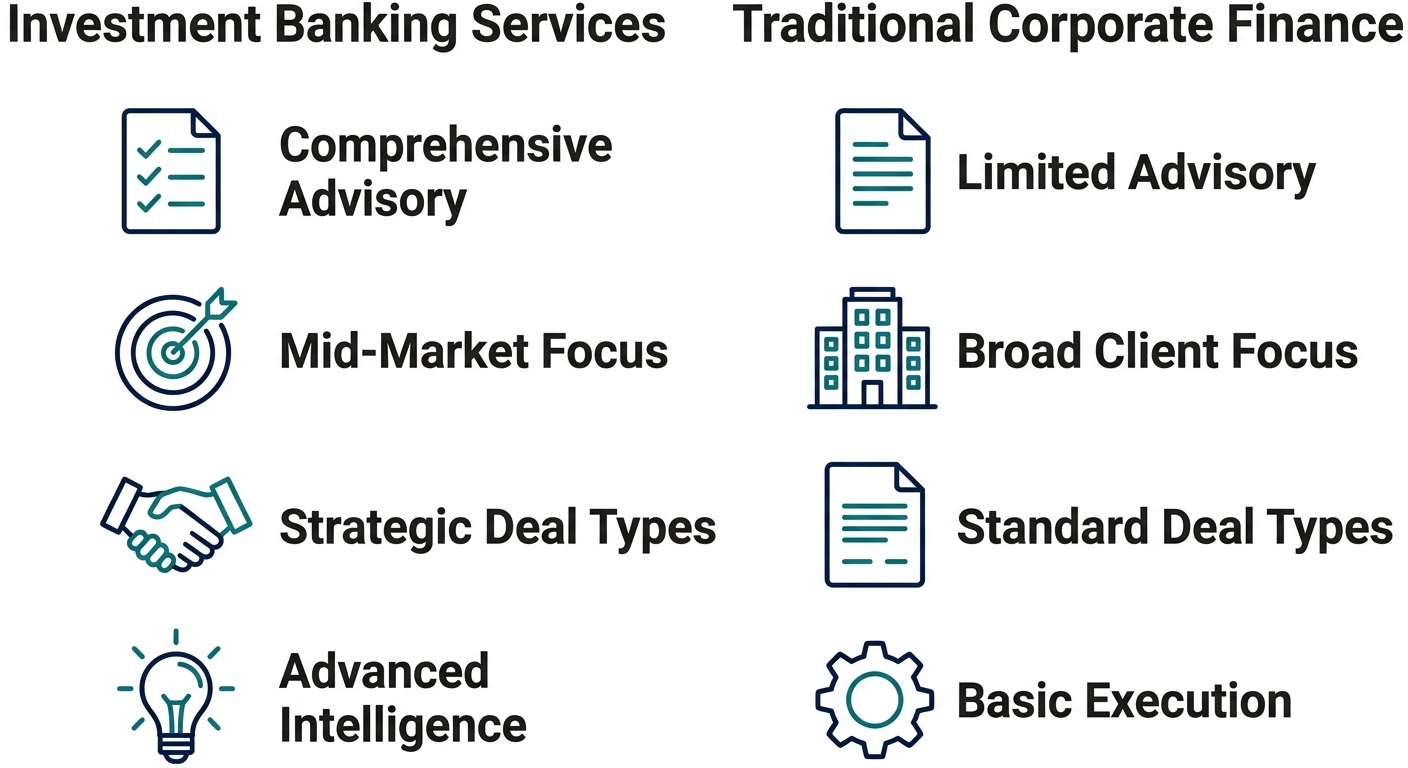
Full-cycle investment banking vs. traditional corporate finance comparison
Our firm’s core services include full-cycle M&A advisory, capital formation (both equity and debt), strategic guidance, due diligence, and negotiation support–each underpinned by our proprietary technology platforms. For instance, during middle market business valuation analysis, our Sovereign Data Nexus platform integrates real-time market data to provide accurate and defensible valuations. When engaging in sell-side M&A advisory, Precision Catalyst uses AI-driven matchmaking to connect business owners with qualified acquirers, while the Velocity Matrix framework accelerates execution without sacrificing thoroughness. These capabilities, combined with the expertise of a boutique M&A and capital advisory firm, provide growth-stage companies with the strategic infrastructure needed to navigate complex transactions. Whether the goal is to raise capital, acquire a competitor, or prepare for an eventual exit, our full-cycle investment banking approach equips clients with the insights and execution capacity to achieve superior outcomes. These core services form the foundation of our approach, which we detail in the following sections on M&A advisory and capital formation.
How Full-Cycle M&A Advisory Drives Maximum Transaction Value
For founders and business owners considering a sale, a precise middle market business valuation is the essential starting point. Our full-cycle M&A advisory process, grounded in investment banking discipline, ensures every phase is optimized to maximize transaction value.
Understanding the difference between sell-side and buy-side advisory is crucial for founders planning an exit or acquisition.
| Aspect | Sell‑Side Advisory | Buy‑Side Advisory |
|---|---|---|
| Primary client | Company selling its business | Company acquiring another |
| Goal | Maximize sale price and terms | Identify and acquire target at optimal value |
| Key activities | Business valuation, marketing to buyers, managing data room, negotiating LOI | Target identification, valuation analysis, structuring offer, due diligence oversight |
| Typical timeline | 6-12 months | 3-9 months |
| Fee structure | Success fee (e.g., Lehman formula) | Retainer + success fee or flat fee |
Both require deep market knowledge and a robust investor network to achieve optimal outcomes.
Whether pursuing a sale or an acquisition, success hinges on a structured, data-driven process. At Zaidwood Capital, our full-cycle approach is powered by Precision Catalyst’s AI-driven matchmaking and the Velocity Matrix execution framework, which together streamline buyer outreach and accelerate deal timelines. These proprietary tools, combined with our Sovereign Data Nexus data room, create a seamless, secure transaction environment that protects value and builds buyer confidence.
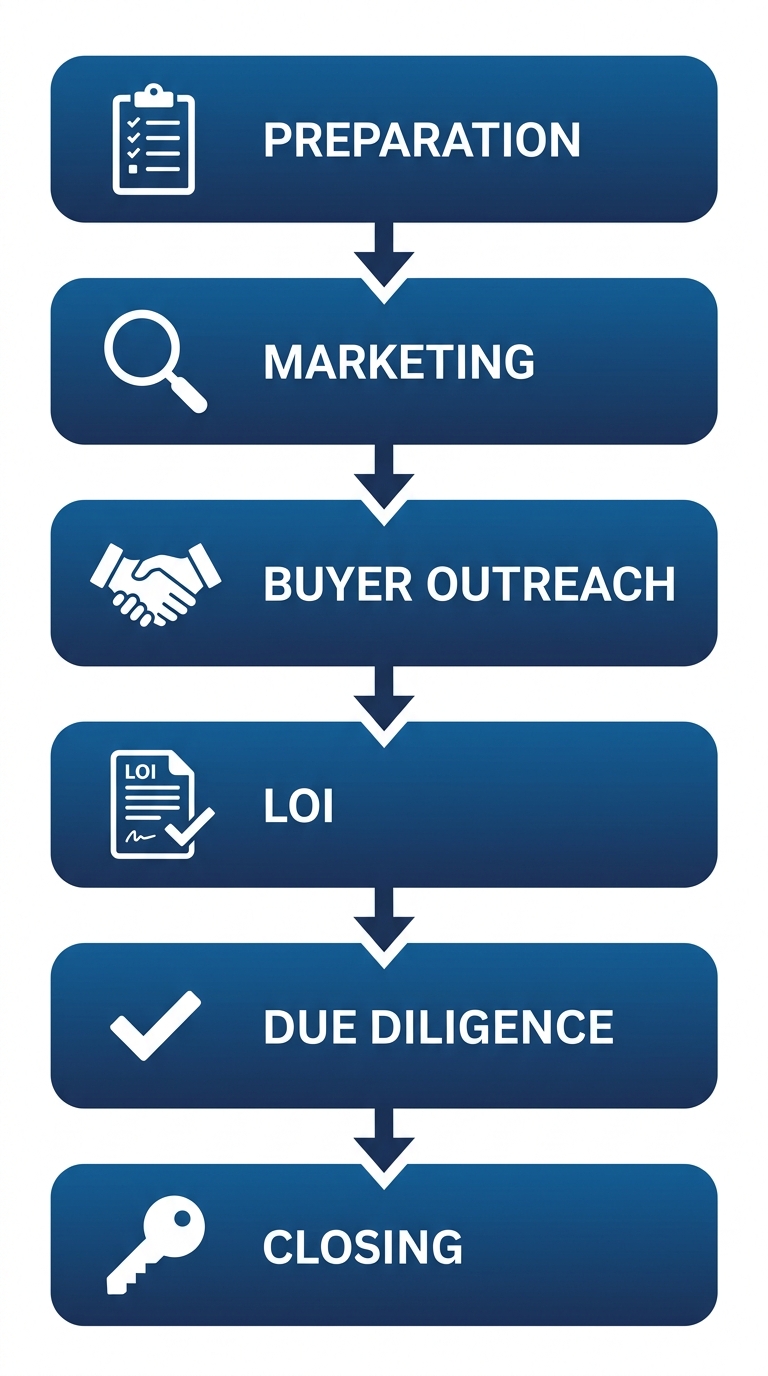
Full-cycle M&A advisory process visualization with six stages
Key Stages of the Sell-Side M&A Process
Our sell-side M&A advisory follows a six-stage framework: Preparation, where we restate financials, develop the equity narrative, and organize the data room; Marketing, where we create a confidential memorandum highlighting growth levers and competitive positioning; Buyer Outreach, where our Precision Catalyst platform systematically engages strategic and financial buyers from a network of over 4,000 investors; LOI, where we structure non-binding terms to balance price, structure, and closing certainty; Due Diligence, where we manage a secure virtual data room–powered by Sovereign Data Nexus–and coordinate with legal and accounting teams to address buyer inquiries; and Closing, where we finalize the transaction and preserve all negotiated protections. At every stage, our team applies investment banking rigor to maximize valuation and minimize friction.
Identifying and Engaging Strategic and Financial Buyers
We differentiate between two main buyer types to tailor marketing and maximize competitive tension. Strategic buyers–competitors, suppliers, or firms in adjacent verticals–acquire to capture synergies, enter new markets, or gain technology. Financial buyers, including private equity firms and family offices, focus on cash flow stability and return on invested capital. Our team customizes the confidential information memorandum to emphasize the value drivers each group prioritizes: operational efficiencies and market expansion for strategics, and scalable growth and management depth for financial sponsors. Using the Sovereign Data Nexus platform, we map over 4,000 qualified investors and target those whose investment thesis aligns with the seller’s profile. This distinction between buyer categories shortens the marketing cycle and drives higher valuation multiples through focused competitive bidding.
Navigating Due Diligence and Negotiation with Investment Banker Support
As a transaction enters the diligence phase, our investment banking advisory services provide comprehensive management of the virtual data room, handling all third-party requests and coordinating with legal and tax advisors. We maintain the data room’s integrity using Sovereign Data Nexus, ensuring buyers have timely access to verified information. To drive bid escalation, we create a competitive auction environment, leveraging our Velocity Matrix to accelerate timelines while maintaining control. When valuation gaps arise, our bankers employ scenario analysis and reference comparable transactions to align buyer and seller expectations. Throughout negotiations, we act as a buffer, preserving the founder’s relationship with the buyer while pushing for optimal price and deal terms. This proactive support reduces risk and shortens the path to closing.
Preparing Your Company for a Capital Raise or Business Sale
Once the strategic choice is made, careful preparation sets the stage for success. As you prepare your company, understanding what is an investment bank can streamline your approach. In investment banking, capital raising and business sale transactions each require a distinct set of financial and strategic readiness steps. At Zaidwood Capital, we tailor preparation to each path, ensuring our clients present the most compelling case to investors or buyers. The preparation steps for raising capital differ significantly from those for selling a business, as shown below.
| Preparation Area | Capital Raise | Business Sale |
|---|---|---|
| Financial documentation | 3-5 years historicals + projections | 3-5 years historicals + quality of earnings report |
| Pitch deck | Investor deck focused on growth story and use of funds | Teaser / Confidential Information Memorandum (CIM) focused on strategic value |
| Target investor/buyer types | Venture capital, growth equity, family offices | Strategic acquirers, private equity, management buyout groups |
| Due diligence emphasis | Business model scalability, market opportunity, unit economics | Operational synergies, risk factors, customer concentration, retention |
An experienced M&A advisor tailors the preparation process to meet the expectations of the target audience and transaction type.
Step-by-Step Guide to Preparing Financial Documents and Projections
We begin every engagement with a forensic review of your financials. For a Capital Raise, we assemble three to five years of audited historicals and build forward-looking projections with clearly documented assumptions about revenue growth, margin expansion, and cash needs. For a Business Sale, these are augmented by a quality of earnings report from an independent CPA–a foundational sell-side M&A advisory deliverable–to validate earnings quality and adjust for owner-specific expenses. Supporting schedules round out the package:
- Accounts receivable aging and customer concentration analyses.
- Detailed capex history and fixed-asset registers.
- Recurring revenue streams and cohort-based churn metrics for software companies.
- Margin breakdowns and supply-chain resilience assessments for manufacturers.
We coordinate with your accounting team to compile everything into a virtual data room and update financials monthly. A clear, well-organized financial package builds trust with investors and acquirers.
Building a Compelling Investor Story and Pitch Deck
We craft narratives that resonate. For a Capital Raise, the investor deck centers on growth story, use of funds, market opportunity, and unit economics. We highlight recurring revenue, customer logos, and scalable go-to-market strategies. For a Business Sale, the Confidential Information Memorandum (CIM) emphasizes strategic value–synergies for acquirers, customer relationships, and operational integration paths. A middle market business valuation anchors the discussion, providing buyers a defensible price range. We tailor messaging for the audience: venture capital firms seek rapid-growth potential; strategics assess accretion and market expansion. Key components include:
- Executive summary that captures vision and traction.
- Detailed market analysis with TAM/SAM/SOM.
- Competitive positioning and intellectual property differentiators.
- Financial projections with sensitivity scenarios.
- Management team profiles highlighting relevant experience.
Software founders should lead with metrics like annual recurring revenue and net revenue retention; manufacturing founders should focus on order backlog and contract manufacturing relationships. Our process iterates through draft decks, testing narratives with sample investors before broad distribution. The goal is to inspire confidence and prompt engagement.
Managing the Due Diligence Data Room and Timeline
Due diligence can derail a transaction if not managed proactively. We set up a secure virtual data room with a standard folder structure–financials, legal, commercial, operational, HR–and grant tiered access based on investor or buyer type. A realistic timeline spans 8-12 weeks for document assembly and organization, followed by a 4-6 week diligence period. Weekly coordination calls with legal, accounting, and advisory teams keep all parties aligned. Our approach includes:
- Folder organization: Financial statements, tax returns, contracts, IP, employee records, compliance.
- Access control: Tiered permissions; time-limited access for sensitive information.
- Q&A management: Centralize questions and track responses to avoid redundancy.
- Red flag mitigation: Proactively address potential issues like customer concentration or pending litigation.
Software companies should highlight source code escrow and data security protocols; manufacturers should document supply chain redundancies and environmental compliance. Investment banking preparation differences between capital raise and sale require tailored diligence depth. Throughout the process, our team monitors information flow and ensures only verified, consistent data reaches counterparties. This transparency speeds negotiations and solidifies trust.
Advanced Valuation and Deal Structuring for Founders and Boards
For founders and boards exploring a sale, understanding what is an investment bank reveals the structured advisory support that drives valuation and deal execution. Valuation is the foundation of every M&A discussion, shaping price expectations and negotiation strategy. As a company moves toward a transaction, establishing a credible valuation range becomes the first critical task.
Selecting the right valuation method is critical for both sellers and buyers in middle-market M&A. When performing a middle market business valuation, we rely on three core methodologies–EBITDA multiples, discounted cash flow (DCF), and comparable transactions–each serving distinct purposes. EBITDA multiples derive value from normalized earnings and industry benchmarks rather than projected growth, offering a market-based snapshot. DCF analysis is often preferred for high-growth firms, but it requires defensible cash flow projections and a carefully determined discount rate (WACC). Comparable transactions provide a market reality check, though we adjust them for deal size, timing, and structure to ensure relevance. Together, these methods create a more complete view of value.
| Methodology | Description | Best For | Key Inputs |
|---|---|---|---|
| EBITDA Multiple | Market‑based approach using industry‑specific multiples | Companies with stable, normalized earnings | EBITDA, industry multiples, growth rate, market conditions |
| Discounted Cash Flow (DCF) | Intrinsic value based on projected future cash flows discounted to present | High‑growth firms with predictable free cash flow | Cash flow projections, discount rate (WACC), terminal value |
| Comparable Transactions | Multiples derived from recent M&A deals in the same sector | Benchmarking value against actual market outcomes | Deal size, deal type, industry, premium paid, timing |
When valuation gaps emerge between buyer and seller, deal structuring can bridge the distance. Earn-outs, seller notes, and equity rollovers are tools that align interests and share risk. An earn-out ties a portion of the purchase price to post-close performance metrics, while a seller note defers cash and keeps the founder invested. Equity rollovers let founders retain a stake in the combined entity, aligning incentives with the buyer. In our sell-side M&A advisory work, we help founders structure terms that address valuation uncertainty and protect downside, turning a gap into a workable agreement. These structuring levers not only bridge valuation differences but also signal commitment and confidence to counterparties.
Founders should work with advisors to triangulate across multiple methods for a robust valuation range that supports price expectations. At Zaidwood Capital, we apply judgment to each methodology’s inputs–selecting appropriate multiples, stress-testing cash flows, and benchmarking relevant transactions–to present a defensible range during negotiations. No single technique captures the full picture; triangulation mitigates biases and supports a value that withstands buyer scrutiny. Valuation is not a single number but a negotiated outcome grounded in methodology triangulation and current market conditions. With a valuation range established, the focus shifts to due diligence to validate assumptions and structure the final agreement.
Common Questions About Investment Banking and M&A Advisory
To address common questions, here are answers to frequently asked queries about investment banking and M&A.
What is the role of a boutique investment bank in M&A?
Our team delivers Full-Cycle M&A services, guiding clients from strategic positioning through closing while leveraging Sovereign Data Nexus to identify ideal acquirers.
How does sell-side M&A advisory work for middle-market companies?
Our sell-side M&A advisory leverages the Velocity Matrix for rapid execution and Sovereign Data Nexus for precise buyer targeting. As bank mergers reshape the market, we help companies secure optimal outcomes.
Why is business valuation important in an M&A transaction?
A thorough middle market business valuation provides a realistic negotiation foundation, tailored to each company’s financials and market conditions without speculative guarantees.
The Role of Investment Banking in Middle-Market Growth and Exit Strategy
Middle-market companies often lack the internal resources needed to navigate complex transactions, making investment banking expertise critical for both sustainable growth and successful exits. Our Investment Banking Services are tailored to middle-market clients seeking growth and exit solutions.
For growing firms, investment banking in the middle market encompasses M&A advisory, capital raising, valuation, due diligence, and strategic planning. We draw on decades of combined experience to structure equity and debt facilities that fuel expansion, always seeking to align capital solutions with each company’s unique growth trajectory.
Beyond capital formation, investment banking plays a crucial role in exit strategies. Our sell-side M&A advisory services guide owners through each stage, from comprehensive middle market business valuation and market positioning to buyer targeting and negotiation support. We work to position your company to attract qualified buyers and achieve optimal transaction terms.
As a boutique M&A and capital advisory firm, we leverage proprietary tools like Sovereign Data Nexus, Precision Catalyst, and the Velocity Matrix to accelerate deal execution and enhance outcomes. These platforms enable data-driven decision-making and efficient matching with strategic acquirers, helping to de-risk transactions and surface the most promising opportunities.
Our full-cycle M&A approach seamlessly shepherds clients from initial readiness assessment through to a successful exit, ensuring continuity and the pursuit of maximized value at every stage.
Resources


