


Investment Banking Services
Table of Contents
For growth-stage and middle-market companies, a boutique approach offers distinct advantages. Our boutique Investment Banking services are tailored to businesses with $10M to $500M in revenue that need personalized advisory, not template-driven processes.
We leverage our proprietary Sovereign Data Nexus platform to deliver sector intelligence and valuation insights that drive informed decisions during growth stage capital raising and M&A mandates. Precision Catalyst, our AI-driven investor matchmaking tool, identifies the most suitable capital sources from a network of over 4,000 investors with access to $15B+ in committed capital. The Velocity Matrix rapid-execution framework then accelerates deal timelines without sacrificing diligence, delivering what we call Financial Services 3.0.
Our full-cycle M&A approach spans strategic preparation, buyer or investor outreach, negotiation, and closing, ensuring middle market M&A advisory clients receive seamless end-to-end support. Headquartered in West Palm Beach, our team brings over 80 years of collective experience and $24.4B in aggregated transaction volume across more than 350 closed deals worldwide.
Unlike bulge-bracket banks that prioritize large-cap transactions, we focus exclusively on the middle market, delivering attentive, conflict-free guidance within a boutique M&A and capital advisory model. Securities are offered through Finalis Securities LLC; Zaidwood Capital is not a registered broker-dealer and is unaffiliated with Finalis.
This specialized approach ensures growth-stage and middle-market companies receive the strategic support they need to achieve successful outcomes.
Core Investment Banking Services and Boutique Firm Advantages
Building on the fundamentals, we now explore the specific investment banking services that boutique firms deliver — and the practical advantages they offer growth-stage and middle-market companies over larger institutions. Before examining the boutique model in detail, a foundational understanding of What Is An Investment Bank can clarify how these advisory roles fit into the capital-raising and deal-making landscape. At Zaidwood Capital, our core investment banking services encompass full-cycle M&A advisory, capital formation (debt and equity), business valuation, and strategic positioning — all geared to companies navigating growth-stage and middle-market transactions in the $5 million to $500 million deal range.
Unlike large institutions that structure services around institutional clients, a boutique investment bank focuses on building senior-led relationships with founders, CEOs, and management teams. Our approach keeps partners directly involved from mandate to close, ensuring that every engagement benefits from decades of transaction experience, deep industry knowledge, and a commitment to conflict-free advice. Because we do not operate proprietary trading desks or in-house funds, our advisory can remain objective and aligned with our clients’ strategic goals.
To illustrate these differences clearly, the table below compares boutique and bulge-bracket investment banks across the decision factors that matter most to growth-stage companies.
Boutique vs Bulge Bracket: Key Differences for Growth-Stage Companies
| Aspect | Boutique Investment Bank | Bulge Bracket Investment Bank |
|---|---|---|
| Client Focus | Growth-stage and middle-market companies; high-touch, senior-led relationships | Large corporations and institutional clients; often team-driven with junior staff handling execution |
| Deal Size Range | Typically $5M-$500M; flexible engagement models | Typically $500M+; minimum deal thresholds often exclude smaller transactions |
| Industry Specialization | Deep domain expertise in specific sectors (e.g., enterprise AI, energy, healthcare) | Broad coverage with generalist teams; less sector depth per banker |
| Personal Attention Level | Senior partners work directly on every engagement from mandate to close | Senior bankers oversee strategy but rely heavily on junior analysts for day-to-day execution |
| Decision-Making Speed | Fast — lean teams enable quick strategic pivots and rapid response to market changes | Slower — multiple layers of internal approvals and bureaucracy can delay execution |
| Service Offering Breadth | Focused on core advisory: M&A, capital raising, valuation, and strategic positioning | Full-service including sales & trading, research, lending, and proprietary investing (may create conflicts) |
| Conflict of Interest Risk | Low — no proprietary trading desks or in-house funds that could compete with clients | Higher — multiple business lines may create competing interests with advisory clients |
What the table makes clear is that boutique firms are purpose-built for the middle market. According to the Securities Industry and Financial Markets Association (SIFMA), middle-market M&A advisory consistently accounts for a substantial share of overall transaction activity, reinforcing the need for specialized guidance that understands the unique capital structures and growth trajectories of these companies. Our Boutique M&A and Capital Advisory practice provides that precision, delivering growth-stage capital raising solutions that are tailored to each company’s stage, sector, and strategic objectives.
From our headquarters in West Palm Beach, Florida, we serve founders and management teams across the country, bringing a full-cycle perspective to every mandate. The senior partner involvement highlighted in the table translates directly into faster decisions and a more cohesive deal process — a meaningful advantage when timing and market sentiment can make or break a transaction. Equally important, the low-conflict structure of the boutique model means clients never have to wonder whether a proprietary trading desk or an in-house lending team is acting on information that could undermine their position.
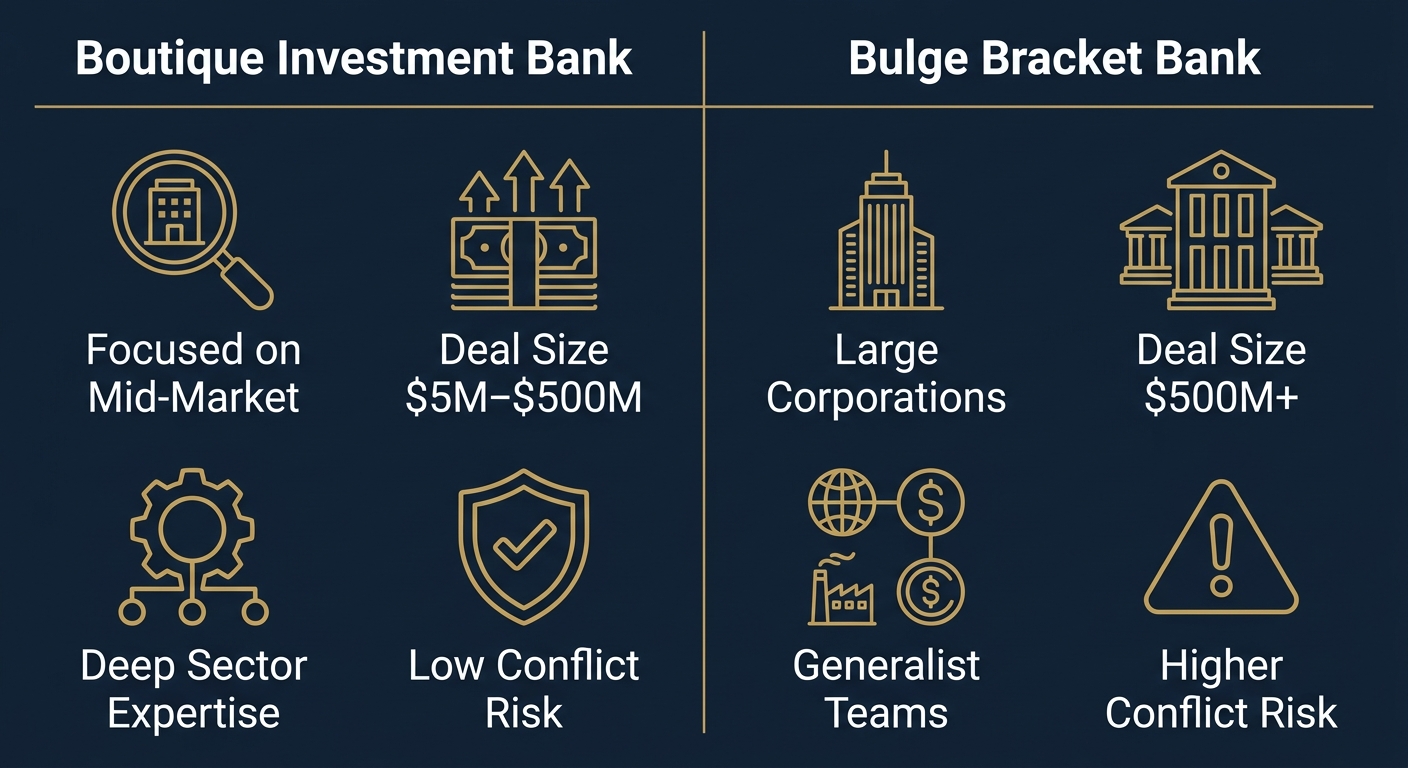
Boutique vs Bulge Bracket: mid-market specialization and lower conflict risk.
Growth-stage companies that prioritize deep domain expertise, senior attention, and conflict-free advice increasingly choose boutique investment banks. The combination of specialist industry knowledge, agile decision-making, and a focus on transactions within the $5 million to $500 million range makes the boutique model a natural fit for businesses seeking a true advisory partner — not just a transaction processor. With this comparison as a backdrop, the following sections detail our proprietary frameworks for M&A and capital raising.
The Sell-Side M&A Advisory Process: From Strategy to Close
At Zaidwood Capital, our sell-side M&A advisory process follows a structured, full-cycle framework designed to maximize value and ensure a seamless transaction. The table below summarizes the four key stages, typical timelines, and our advisory responsibilities at each phase of a sell-side engagement.
| Stage | Key Activities | Typical Timeline | Advisory Role |
|---|---|---|---|
| Preparation & Positioning | Financial statement review, historical & pro forma projections, industry benchmarking, positioning narrative, data room construction, management presentation preparation | 3-6 weeks | Lead strategy sessions, prepare marketing materials, build data room, align management on positioning |
| Marketing & Buyer Outreach | Identify and vet potential buyers (strategic, financial, international), distribute teaser and CIM, manage inbound inquiries, coordinate management meetings and site visits | 4-8 weeks | Curate buyer list (4,000+ network), manage confidentiality, orchestrate management presentations, collect and evaluate initial indications of interest |
| Due Diligence Management | Provide secure virtual data room, respond to buyer queries, coordinate legal/financial/operational diligence, manage advisor meetings, negotiate diligence scope | 4-8 weeks | Facilitate diligence process, manage data flow, address buyer concerns, maintain competitive tension among bidders |
| Negotiation & Closing | Negotiate definitive agreement, resolve final diligence issues, coordinate legal documentation, manage regulatory approvals, oversee signing and closing mechanics | 3-6 weeks | Lead price and terms negotiation, manage counter-parties, ensure smooth closing, support post-close transition if needed |
In the following sections, we explore each stage in greater depth, demonstrating how our proprietary tools, extensive network, and full-cycle approach drive superior outcomes for our clients.
Preparation and Positioning: Building the Foundation for a Successful Sale
As a Boutique M&A and Capital Advisory Firm, we begin every engagement with rigorous preparation. Our team conducts a thorough financial statement review, builds historical and pro forma projections, and benchmarks the company against industry peers using our proprietary Sovereign Data Nexus platform. This data-driven foundation allows us to identify value drivers and growth opportunities that will resonate with buyers. We then craft a compelling positioning narrative and an investor-grade management presentation that articulates the company’s strengths and future potential. Simultaneously, we construct a secure virtual data room that organizes all essential documents — financials, legal agreements, operational metrics — ensuring buyers can access information efficiently during later stages. Understanding the foundations of what is an investment bank advisory services is critical to appreciating how we align the company’s strategic objectives with market realities. Throughout this preparation phase, we work closely with management to refine messaging and anticipate buyer questions, setting the stage for a successful marketing effort.
Buyer Identification and Confidentiality Management in Middle Market M&A
With the company fully prepared, we transition to targeted buyer outreach, leveraging our extensive network of over 4,000 institutional investors, family offices, and strategic acquirers. Our proprietary Precision Catalyst platform uses AI-driven matchmaking to identify the most suitable financial and strategic buyers based on investment criteria, sector focus, and past transaction behavior. This data-centric approach, a hallmark of our middle market M&A advisory practice, ensures that only qualified, interested parties are approached, maximizing competition while preserving confidentiality. We manage all aspects of marketing: distributing teaser documents and confidential information memoranda only after executed non-disclosure agreements, fielding inbound inquiries, and coordinating management presentations and site visits. Throughout this phase, we maintain a strict confidentiality protocol, shielding the company’s identity from public disclosure until the appropriate time. By orchestrating a controlled auction-like process, we collect and evaluate initial indications of interest, building a pipeline of credible suitors for the due diligence stage.
Due Diligence, Negotiation, and Closing Coordination
Once buyer interest is narrowed, we move into the intensive due diligence phase. We facilitate a structured process using our Sovereign Data Nexus virtual data room, which provides tiered access to sensitive documents and tracks buyer activity. We coordinate legal, financial, and operational diligence across multiple workstreams, responding promptly to buyer queries and resolving issues before they become deal obstacles. Maintaining competitive tension among remaining bidders is a critical advisory function; we schedule overlapping management meetings and timely updates to encourage final offers. As negotiations commence, our Velocity Matrix rapid-execution framework comes into play, streamlining the definitive agreement review, aligning legal teams, and managing regulatory approvals where required. We lead the negotiation of price, earnouts, representations and warranties, and other key terms, always advocating for our client’s best interests. The closing process is carefully coordinated with legal counsel, accountants, and escrow agents to ensure a seamless transition, culminating in a successful transaction that meets the seller’s strategic and financial objectives.
Preparing Your Company for Capital Raising and M&A Advisory Engagement
Now that you understand the value of engaging a boutique M&A and capital advisory firm, let’s walk through the essential preparation steps. A successful capital raise or M&A transaction depends on meticulous preparation well before the first investor meeting. From building credible financial projections to organizing a secure data room, every element of your readiness package signals operational maturity to prospective investors. At our boutique M&A and capital advisory firm, we have refined these preparation standards through decades of executing middle-market transactions, and we recommend founders invest the time upfront to align their documentation with institutional expectations. Proper preparation not only accelerates the capital formation process but also increases the likelihood of a successful raise.
Financial Projections, Pitch Decks, and Data Room Essentials
The foundation of any capital raise rests on robust financial projections. We recommend developing 3-5 year pro forma financial statements–including a profit and loss statement, balance sheet, and cash flow statement–supported by scenario analysis that models base, upside, and downside cases. The term pro forma refers to forward-looking financials that project future performance based on current assumptions, and institutional investors in the US middle market expect these to be built from a bottoms-up revenue model. Every assumption must be clearly documented, and projections should align with your historical performance and relevant market benchmarks.
Equally critical is the investor pitch deck, which should span 10-15 slides covering the problem, solution, market opportunity, traction, business model, management team, and use of funds. The narrative must be tailored to your target investor type, whether venture capital, growth equity, or family office. We emphasize highlighting key performance indicators and defensible competitive moats while maintaining a clean, data-rich design.
Your data room must be a secure virtual data room (VDR) with tiered access permissions. The folder structure should index legal documents, material contracts, capitalization table records, IP filings, financial records, and customer data with clear naming conventions. We advise preparing a due diligence checklist for prospective investors and granting access in stages, separating confidential from non-confidential materials.
The following checklist consolidates the key deliverables and best practices for each preparation area.
Capital Raising Preparation Checklist: Key Deliverables and Best Practices
| Preparation Area | Key Deliverables | Best Practices |
|---|---|---|
| Financial Projections | 3-5 year pro forma P&L, balance sheet, cash flow statement; scenario analysis (base, upside, downside) | Build bottoms-up revenue model; align projections with historical performance and market benchmarks; include clear assumptions documentation |
| Investor Pitch Deck | 10-15 slide deck covering problem, solution, market opportunity, traction, business model, team, use of funds | Tailor narrative to target investor type (VC, growth equity, family office); highlight KPIs and defensible moats; keep design clean and data-rich |
| Data Room Setup | Secure virtual data room with organized folder structure; legal documents, contracts, cap table, IP filings, financial records, customer data | Index all documents with clear naming conventions; grant tiered access (confidential vs. non-confidential); prepare a due diligence checklist for prospective investors |
| Legal & Compliance | Up-to-date capitalization table, corporate charter, board resolutions, material contracts, IP assignments, regulatory filings, employee agreements | Engage legal counsel early; resolve any outstanding litigation or IP issues; ensure compliance with securities laws (Reg D, Rule 506, etc.) |
| Management Team | Management bios, organizational chart, board member list, advisor agreements, track record summaries | Prepare for investor meetings and Q&A; highlight relevant experience and past exits; consider adding board members or advisors to address gaps |
Each preparation area in the table above represents a critical dependency in the broader capital formation process. Founders who address legal and compliance items early, for example, avoid delays during due diligence that can erode investor confidence. Similarly, a well-organized data room demonstrates operational discipline and respect for the investor’s time, both of which influence the final investment decision.
Selecting an Investment Banking Partner and Structuring the Engagement
Choosing the right investment banking partner is among the most consequential decisions a growth-stage company will make. When evaluating a boutique investment banking services partner, prioritize firms with deep domain expertise, a proprietary institutional network, and a demonstrated track record in middle market M&A advisory. At Zaidwood Capital, our team brings 80+ years of collective experience, access to 4,000+ global investors, and $24.4B+ in aggregated transaction volume across 350+ closed deals worldwide.
Cultural alignment matters as much as credentials. The engagement should feel collaborative, with the advisor acting as an extension of your leadership team. We structure engagements to align incentives through milestone-driven work plans while maintaining transparency on deal strategy and timeline. Before signing, confirm that the firm’s network includes investors actively deploying capital in your sector and stage. Our proprietary tools, including Sovereign Data Nexus for data-driven insights, Precision Catalyst for AI-driven investor matchmaking, and our Velocity Matrix rapid-execution framework, are integrated into every engagement to increase the likelihood of a successful raise, though we never guarantee outcomes.
Navigating the Capital Raising Timeline and Investor Outreach
A typical growth stage capital raising timeline spans 12-16 weeks from initial outreach to close. During weeks 1-2, we refine positioning and build the target investor list. Weeks 3-4 focus on data room preparation and finalizing marketing materials. Investor meetings occupy weeks 5-8, followed by due diligence in weeks 8-12, with closing targeted for weeks 12-16. This timeline assumes the company has completed the preparation checklist discussed earlier; gaps in financial projections or legal documentation can extend the process considerably.
Investor outreach is a disciplined process, not a mass email campaign. We develop a tiered pipeline of institutional investors, family offices, and strategic partners matched to the company’s profile through our Precision Catalyst platform. Initial contact typically begins with a warm introduction or a concise teaser document, followed by the full pitch deck for interested parties. Throughout this phase, we manage communication flow, coordinate meetings, and provide weekly pipeline updates.
With these preparations in place, you will be well-positioned to initiate a capital raise. Proceed to the next section to learn how our engagement process works and what you can expect during each phase of the transaction lifecycle.
Valuation Methods and Investor Evaluation in Growth-Stage Transactions
Building on the landscape of growth-stage transactions, we now turn to how valuations are determined and evaluated by investors. As part of our full-cycle investment banking services, we recognize that a single valuation method rarely tells the whole story for companies still scaling revenue predictability. Because growth-stage firms often lack consistent cash flows and a broad set of public peers, we apply a combination of methods to triangulate a defensible valuation range. The table below summarizes each method’s best use, key inputs, and typical applications.
Discounted Cash Flow analysis works best for cash-flow-positive businesses with long-term contract visibility. It projects future free cash flows and discounts them back to a present value, making it especially useful for hardware, infrastructure, or enterprise SaaS companies with recurring revenue streams. However, even modest changes in the terminal growth rate or weighted average cost of capital can swing outcomes dramatically.
Comparable Company Analysis derives valuation multiples from publicly traded peers in the same sector. When a robust set of relevant comparables exists, this approach provides market-grounded benchmarks. In growth-stage contexts, revenue multiples often serve as the primary metric, though careful normalization of growth rates and margins is essential to avoid misleading comparisons.
Precedent Transactions Analysis looks at recent M&A deals in comparable industries to extract valuation premiums and control premia. In middle market M&A advisory, we often see that transaction-specific synergies and competitive bidding dynamics influence the price paid significantly beyond what public market multiples suggest. This method captures the reality of negotiated deal value–not just the theoretical worth.
The Venture Capital Method is a practical starting point when companies lack positive cash flow or reliable public comparables. For growth stage capital raising, this forward-looking approach starts with an anticipated exit valuation and works backward, applying a target return and dilution assumptions. It is particularly relevant for technology ventures, including enterprise ai capital raising, where projected exit valuations drive the analysis and traditional metrics simply do not apply.
| Valuation Method | Best Used For | Key Inputs | Typical Application |
|---|---|---|---|
| Discounted Cash Flow (DCF) | Mature, cash-flow-positive companies with predictable future earnings | Free cash flow projections, terminal value, discount rate (WACC) | Hardware, infrastructure, or enterprise SaaS with long-term contracts and visible revenue streams |
| Comparable Company Analysis (Comps) | Growth-stage companies with publicly traded peers in the same sector | Revenue, EBITDA, or net income multiples from comparable public companies | Cross-industry standard; most useful when a strong set of relevant public comparables exists |
| Precedent Transactions Analysis | Companies in active M&A markets where recent comparable deals provide valuation benchmarks | Deal size, transaction multiples, revenue/EBITDA premiums from recent closed transactions | M&A-driven valuations where deal premiums and buyer synergies significantly impact pricing |
| Venture Capital Method | Early to growth-stage companies without positive cash flow or reliable public comparables | Projected exit valuation, required rate of return (ROI target), time to exit, dilution assumptions | Pre-revenue or early-growth startups where traditional valuation methods are not directly applicable |
Because no single method is definitive, investors typically weigh each output to triangulate a range rather than a fixed number. In our boutique M&A and capital advisory work, we combine these lenses alongside proprietary deal intelligence and qualitative factors such as management depth and market traction. A disciplined multi-method approach reduces blind spots and provides a balanced view that both sides can negotiate from. With a clear view of the valuation toolkit, the next section explores how these methods are applied in real negotiations and deal structures.
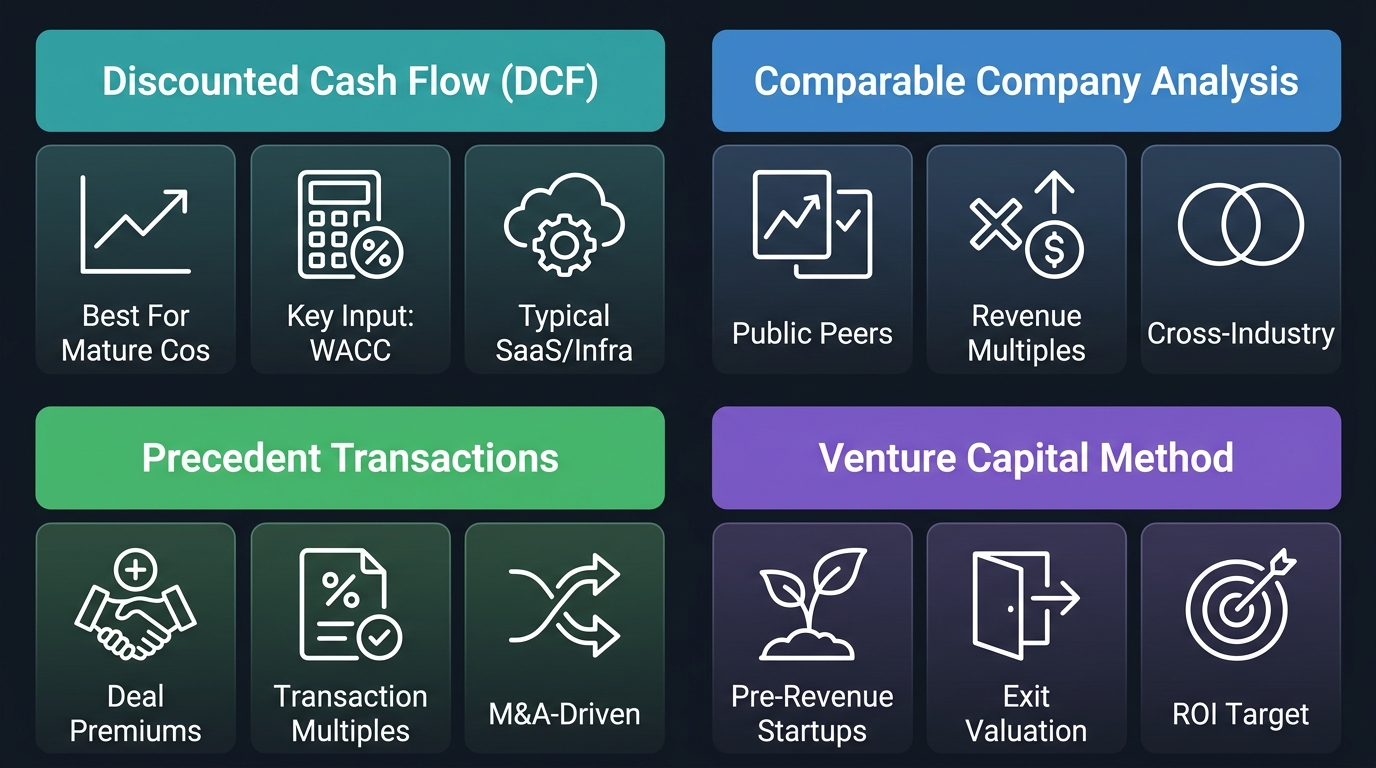
Four valuation methods for growth-stage transactions compared in an infographic grid.
Frequently Asked Questions About Investment Banking for Growth Companies
Below are answers to common questions.
What investment banking services does Zaidwood Capital offer growth companies?
As a Boutique M&A and Capital Advisory Firm (not a registered broker-dealer; securities offered through Finalis Securities LLC), we provide full-cycle M&A advisory, capital formation, and business valuation for growth-stage and middle-market companies nationwide. We offer specialized energy mergers and acquisitions advisory services for sector-specific transactions.
How does Zaidwood Capital help growth companies raise capital?
We manage the full capital-raising lifecycle–from valuation to investor targeting–using data-driven insights to accelerate growth stage capital raising. Our Sovereign Data Nexus platform matches you with over 4,000 institutional investors.
What makes Zaidwood Capital different from large investment banks?
Unlike large banks, we focus on middle market M&A advisory with a boutique approach. Our Precision Catalyst AI matchmaking and Velocity Matrix rapid execution give you access to a deep institutional network without bureaucracy.
Accelerate Growth with Strategic Boutique Investment Banking Guidance
To put that promise into action, our strategic boutique investment banking services accelerate growth for middle-market and growth-stage companies. At the core is a differentiated approach that combines our proprietary data platform (Sovereign Data Nexus), AI-driven matchmaking (Precision Catalyst), and a rapid-execution framework (Velocity Matrix) to deliver sharper insights and faster execution. With introductions to a curated network of more than 4,000 institutional investors and access to over $15 billion in capital, we provide the middle market M&A advisory and strategic guidance leaders need to navigate complex transactions with confidence. Our entire model rests on three proprietary accelerators that transform growth stage capital raising–each detailed in the following sections.
Resources


