



What Is An Investment Bank
Table of Contents
The Role of Investment Banks in Modern Finance
What Is An Investment Bank? At its core, an Investment Banking firm provides specialized financial advisory services to corporations, governments, and institutions, focusing on complex transactions in capital markets rather than everyday lending like commercial banks. These firms guide clients through mergers and acquisitions, restructuring, and securities issuance, helping navigate regulatory landscapes and market dynamics. Investment bankers often hold Series 79 qualifications as per FINRA guidelines, ensuring expertise in M&A and capital markets transactions, which underscores the professional standards in this field.
We at Zaidwood Capital embody these financial advisory roles as a boutique firm dedicated to driving business growth through tailored solutions. Our key activities include underwriting securities, providing deal advisory, and managing risks for mid-sized companies seeking expansion. For instance, our M&A advisory supports firms with over $1 million in revenue to strategically acquire competitors or divest assets, facilitating seamless transitions in competitive markets.
Specializing in Investment Banking Services, we offer buy-side and sell-side expertise in mergers and acquisitions alongside capital raising initiatives. With access to more than 4,000 investors and a proven track record of $24.4 billion in transaction volume, we connect clients to substantial funding opportunities for innovation and scaling. This investment banking fundamentals approach empowers organizations to achieve sustainable growth in today’s dynamic economy.
In this guide, we delve into the essentials, explore deep dives into M&A and capital raising, share practical applications, offer advanced insights, and address common FAQs. To understand these roles better, let’s explore the core functions next.
Core Functions of Investment Banking
What Is An Investment Bank? At its core, an investment bank serves as a strategic partner for corporations, institutions, and governments seeking to navigate complex financial landscapes. These firms specialize in facilitating mergers and acquisitions, raising capital, and underwriting securities, distinct from everyday banking. As a boutique M&A advisory firm, we at Zaidwood Capital deliver tailored services like M&A advisory and capital raising, supporting clients in achieving growth objectives through full-cycle due diligence and strategic documentation.
Underwriting represents a pivotal function where investment banks act as intermediaries for securities issuance. In this process, firms like ours assess the risks associated with issuing stocks or bonds, then purchase these securities from the issuer and resell them to investors. This ensures companies can access public markets efficiently. For instance, during an initial public offering, our team structures the deal, prices the shares, and manages distribution to institutional buyers. Such activities not only provide essential funding but also stabilize market entry for mid-cap firms expanding operations.
Advisory services form the backbone of investment banking, offering expert guidance on mergers and acquisitions, restructurings, and financing strategies. We advise clients on deal structuring, valuation, and negotiation tactics to maximize outcomes. In mergers and acquisitions, our approach includes comprehensive due diligence–covering financial, legal, operational, and commercial aspects–to identify synergies and mitigate risks. For a mid-cap technology firm pursuing expansion, we might facilitate investor introductions while preparing fairness opinions to validate transaction terms. Professionals in this field must pass rigorous exams like the FINRA Series 79 to ensure competency in these high-stakes advisory roles.
Capital raising involves securing equity or debt financing to fuel corporate initiatives. Through equity advisory, we connect clients to growth capital from venture firms or private equity, while debt options like mezzanine or asset-based lending provide flexible funding strategies. Our network of over 4,000 institutional investors enables efficient capital formation, often streamlining transactions via proprietary tools. This service answers key questions about how companies fund ambitious projects without diluting control excessively.
Risk management in investment banking encompasses hedging strategies and compliance oversight to safeguard transactions. We integrate risk assessments into every advisory engagement, ensuring regulatory adherence and protecting stakeholder interests. Though boutique firms offer personalized attention, all operations align with stringent frameworks to prevent conflicts.
To understand investment banking’s unique role, consider its historical separation from commercial banking under the Glass-Steagall Act of 1933. This legislation prohibited banks from engaging in both deposit-taking and securities activities to avert conflicts and systemic risks following the Great Depression. The act created clear boundaries, allowing investment banks to focus on high-level advisory without retail distractions. Over 80 years, this framework shaped modern finance by promoting specialized expertise in deal advisory services.
| Aspect | Investment Bank | Commercial Bank |
|---|---|---|
| Primary Focus | Advisory on M&A, capital raising, and securities underwriting | Deposit-taking, loans, and everyday banking services |
| Client Type | Corporations, institutions, governments | Individuals, small businesses, retail clients |
| Services | Deal structuring, due diligence, investor introductions | Checking accounts, mortgages, personal loans |
Today, regulatory overlaps from repeals like Gramm-Leach-Bliley in 1999 allow some convergence, yet distinctions persist for client protection. Understanding these differences helps corporate clients select the right partners–investment banks for strategic growth via capital raising, commercial for operational needs–ensuring aligned expertise without overlap confusion.
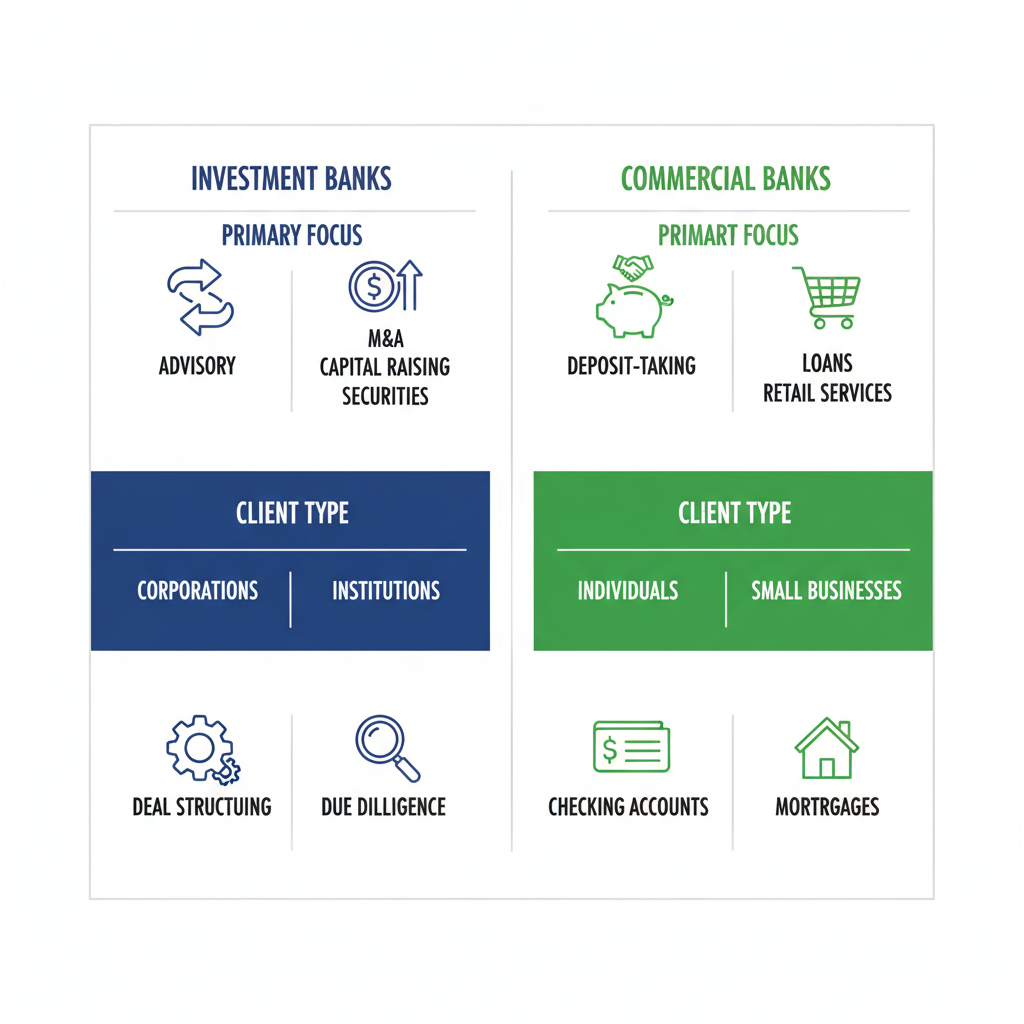
Comparison of investment and commercial banking functions
This visual underscores how investment banks prioritize sophisticated funding strategies over routine services, aiding readers in grasping operational variances. For example, while commercial banks handle personal loans, we focus on equity placements for institutional scalability.
Having covered core functions, let’s examine M&A in greater detail.
Exploring Mergers and Acquisitions in Depth
At Zaidwood Capital, we specialize in guiding clients through complex mergers and acquisitions, leveraging our expertise to facilitate seamless corporate combinations that drive strategic growth. These transactions represent pivotal moments for businesses seeking expansion, market consolidation, or enhanced operational efficiencies.
Defining Mergers and Acquisitions
Mergers and acquisitions form the cornerstone of strategic corporate evolution, enabling companies to merge resources or acquire assets for competitive advantage. In essence, a merger involves two firms uniting to form a single entity, while an acquisition sees one company purchasing another, often retaining separate identities initially. We at Zaidwood Capital have navigated these deals extensively, handling buy-side and sell-side mandates with precision.
Understanding the various types of mergers and acquisitions is crucial, as each serves distinct strategic purposes influenced by industry dynamics and regulatory environments. Selecting the right type depends on factors like market positioning, supply chain integration, and diversification goals. Investment banks play a vital role in assessing these elements to ensure alignment with client objectives.
The following table outlines common types of mergers and acquisitions supported by investment banks:
| Type | Description | Investment Bank Role |
|---|---|---|
| Horizontal Merger | Combination of competitors in same industry | Valuation, negotiation, regulatory approval |
| Vertical Merger | Integration along supply chain | Due diligence, synergy analysis |
| Conglomerate Merger | Unrelated businesses | Strategic advisory, financing |
This breakdown highlights how investment banks tailor their involvement to the merger’s nature. For instance, in horizontal mergers, banks focus on antitrust scrutiny to mitigate competitive concerns. At Zaidwood Capital, we provide comprehensive support across these types, drawing from our $24.4 billion in aggregate transaction volume to deliver full-cycle due diligence and strategic advisory that optimizes outcomes for our clients.
Consider a recent anonymized example where a mid-sized tech firm pursued a horizontal merger to consolidate market share. Our team conducted thorough valuations and facilitated negotiations, resulting in a successful integration that boosted synergies without regulatory hurdles.
The M&A Process in Investment Banking
Investment banks streamline the mergers and acquisitions process, acting as trusted advisors to navigate complexities from inception to completion. This structured approach ensures transparency and efficiency, particularly in regulatory compliance as emphasized in SEC testimony on disclosure requirements.
The process unfolds in key stages, with banks providing expert facilitation at each step:
- Valuation: Banks assess target worth using discounted cash flow models and comparable analysis to establish fair pricing.
- Due Diligence: Comprehensive reviews of financial, legal, and operational aspects uncover risks, with our full-cycle expertise at Zaidwood ensuring thorough vetting.
- Negotiation and Structuring: Banks mediate terms, including payment methods and contingencies, to align interests.
- Regulatory Approval and Closing: Final filings and approvals secure the deal, addressing disclosures as required by regulators.
We integrate capital advisory services to enhance financing options throughout, connecting clients to our network of over 4,000 investors.
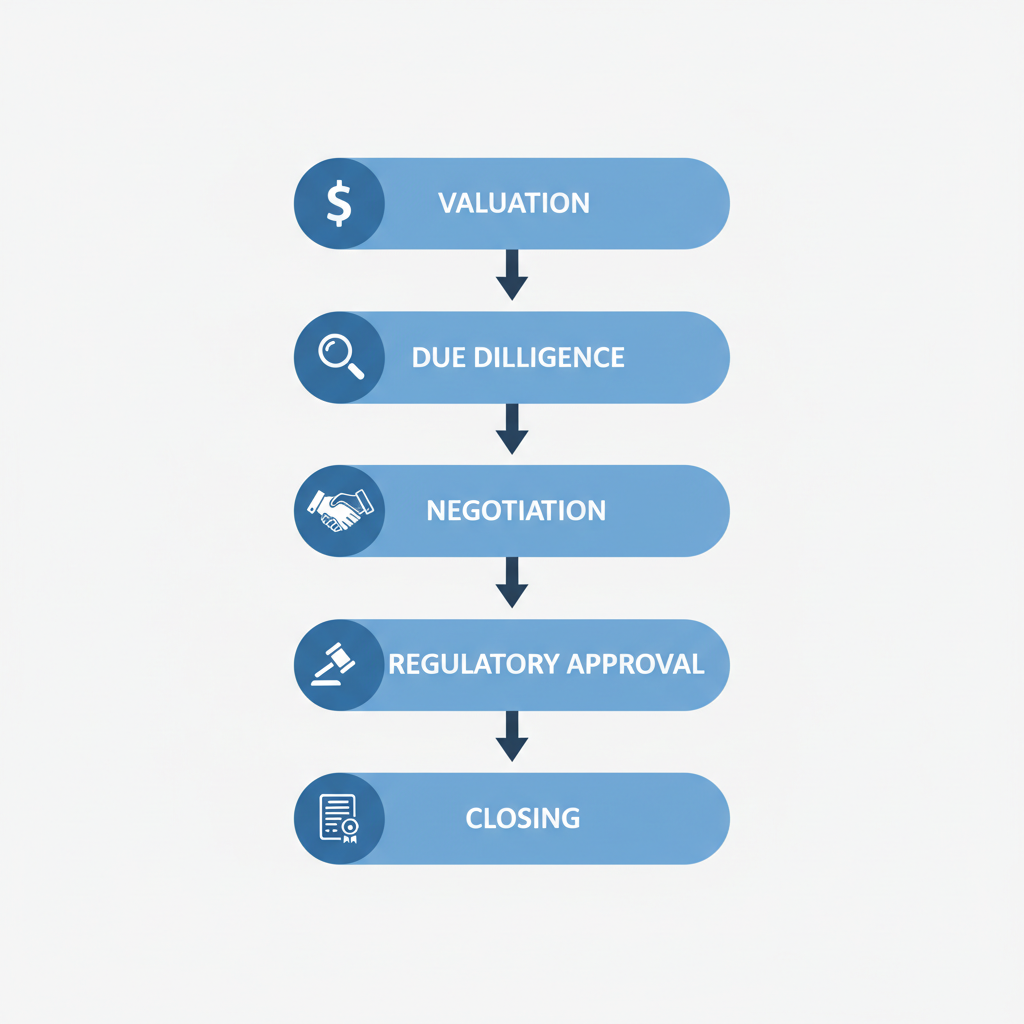
Five-stage vertical flowchart of the M&A process from valuation to closing
In practice, this process enabled a manufacturing client to acquire a supplier through meticulous due diligence, avoiding integration pitfalls and achieving swift closure.
Benefits and Challenges of M&A
Mergers and acquisitions offer substantial benefits, including accelerated growth and cost synergies that enhance shareholder value, as noted by FINRA in their insights on investor impacts from such deals. Companies gain access to new markets, technologies, and talent pools, fostering innovation and economies of scale.
Yet, challenges like cultural clashes and integration risks can undermine success if not managed proactively. Investment banks mitigate these through rigorous planning and post-merger advisory, ensuring smooth transitions. At Zaidwood Capital, we emphasize risk assessment in our strategic documentation to safeguard deal value.
Benefits manifest in enhanced competitive positioning; for example, vertical integrations streamline supply chains, reducing costs by up to 20% in optimized scenarios. Challenges, however, include overvaluation pitfalls, where rushed assessments lead to financial strain. Our team addresses this via detailed fairness opinions and scenario modeling, drawing on 300+ completed deals.
An anonymized case involved a conglomerate merger between unrelated businesses, where we facilitated synergies analysis to overcome diversification doubts, ultimately yielding diversified revenue streams while navigating regulatory disclosures per SEC guidelines. Understanding these dynamics equips businesses to leverage M&A effectively, leading naturally to how banks enable capital for such transformative deals.
(Note: This content is for informational purposes only and is not an offer, solicitation, recommendation, or commitment to transact. Not investment advice–consult your legal, tax, and financial advisors before making decisions. Investments involve risk; investments may be illiquid and investors may lose all or part of their investment. Past performance does not guarantee future results.)
How Investment Banks Support Capital Raising
In the realm of mergers and acquisitions, securing adequate funding is essential for executing strategic initiatives. Investment banks play a pivotal role in capital raising, enabling businesses to access the resources needed for growth, acquisitions, or operational expansion. At Zaidwood Capital, we facilitate this process by connecting clients to over $15 billion in deployable capital through our extensive network of more than 4,000 institutional and private investors and providing M&A transaction services. This support extends beyond traditional financing, incorporating tailored advisory services that align with each client’s objectives.
Methods of Equity and Debt Financing
When businesses seek to expand, they often turn to investment banks for guidance on capital raising strategies. Equity financing involves selling ownership stakes, such as through initial public offerings (IPOs) or private placements, which allow companies to raise funds without incurring debt. This method appeals to startups and growth-stage firms needing substantial capital infusions to scale operations. In contrast, debt financing provides loans or issues bonds, requiring repayment with interest but preserving ownership control. These options suit established companies preferring predictable repayment structures over dilution.
Choosing between equity and debt depends on factors like company stage, market conditions, and financial health. For instance, high-growth tech firms might favor equity to fuel innovation without immediate repayment pressures, while mature manufacturers opt for debt to leverage existing assets. Investment banks assess these elements to recommend the most suitable approach, ensuring alignment with long-term goals.
| Method | Equity | Debt |
|---|---|---|
| Ownership Impact | Dilutes existing shares | No ownership change |
| Cost Structure | Dividends discretionary | Interest payments required |
| Bank Role | Underwriting IPOs, placements | Structuring loans, bonds |
This comparison highlights the trade-offs in capital raising methods. Equity offers flexibility in payouts but impacts control, whereas debt enforces discipline through fixed obligations yet maintains equity intact. At Zaidwood Capital, our expertise in structuring these arrangements allows us to guide clients through selections that optimize cost and risk. For example, we recently advised a mid-market enterprise on a hybrid approach, blending equity placements with mezzanine debt to secure $50 million efficiently.
Steps in the Capital Raising Process
The capital raising journey begins with thorough preparation, where investment banks evaluate a company’s financials, craft compelling pitch materials, and identify potential investors. We at Zaidwood Capital assist in developing pro forma financials and strategic documentation to present a clear growth narrative.
Next, roadshows and investor outreach follow, involving presentations to gauge interest and build relationships. This phase secures commitments through targeted engagements with our investor network.
- Preparation: Assemble due diligence packages and valuation models.
- Marketing: Conduct roadshows for fund procurement, highlighting opportunities.
- Negotiation: Finalize terms for financing arrangements.
- Closing: Execute legal documents and disburse funds.
These steps ensure a structured path to successful capital access, minimizing delays.
Addressing Challenges in Capital Raising
Capital raising is vital for company growth, enabling investments in new markets or technologies that drive competitive advantage. However, businesses face hurdles like volatile market timing, regulatory scrutiny, and investor skepticism, particularly in uncertain economic climates.
Investment banks mitigate these by providing market intelligence and timing strategies. For regulatory aspects, SEC guidelines ensure transparent roadshows, as discussed in the 2008 testimony on investment bank oversight, which emphasized liquidity monitoring to prevent crises like Bear Stearns’. This validation underscores the need for robust compliance in financing.
At Zaidwood Capital, we address such challenges through our full-cycle due diligence and capital introductions. Consider a startup we supported in raising venture debt amid tight credit conditions; our network facilitated $10 million in funding by matching the firm with aligned lenders. By leveraging specialized advisory in mezzanine and equity solutions, we navigate obstacles to deliver efficient outcomes. With these methods in mind, consider boutique firms’ specialized advantages.
The Advantages of Boutique Investment Firms
At Zaidwood Capital, we specialize in the dynamic world of boutique investment firms, which are agile, focused entities dedicated to delivering tailored financial solutions for mid-market clients. Unlike larger institutions, boutique firms like ours prioritize specialized mergers and acquisitions advisory and capital raising strategies, enabling efficient navigation through complex transactions. Our approach emphasizes deep industry knowledge and rapid execution, ensuring clients receive personalized guidance without the bureaucracy often found in bulge bracket operations. This structure allows us to address unique needs in areas such as debt and equity advisory, full-cycle due diligence, and strategic documentation, fostering seamless growth for private equity firms, family offices, and companies generating at least $1 million in revenue.
Boutique firms offer distinct advantages that enhance client outcomes in today’s fast-paced financial landscape. Key benefits include:
- Personalized Service: We provide dedicated attention to each deal, crafting bespoke strategies for mid-market mergers and acquisitions that align precisely with client goals.
- Agility and Speed: Our lean teams accelerate processes, reducing timelines for capital raising and advisory services compared to more cumbersome large-scale operations.
- Specialized Expertise: With targeted industry focus, we deliver nuanced insights, such as structuring mezzanine debt or facilitating investor introductions to over 4,000 institutional partners.
- Integrated Solutions: Combining M&A advisory with equity and debt options ensures comprehensive support, from pitch decks to fairness opinions, all under one roof.
These strengths position boutique firms to excel in efficient, client-centric transactions. For instance, our velocity matrix optimizes deal flow, enabling quicker placements like connecting a family office to deployable capital sources.
The following table illustrates key differences between boutique and bulge bracket firms:
| Aspect | Boutique Firms | Bulge Bracket Firms |
|---|---|---|
| Client Focus | Personalized service for mid-market deals | High-volume, large-scale transactions |
| Network Access | Targeted investor introductions | Broad global syndication |
| Expertise | Specialized industry knowledge | Comprehensive product offerings |
Boutique firms like Zaidwood Capital leverage these attributes through innovative tools, such as our deal vault investments, which grant access to over $15 billion in deployable capital. Our team, holding advanced certifications like the FINRA Series 79, ensures precise advisory in M&A and capital formation. With $24.4 billion in aggregate transaction volume and over 300 completed deals, we streamline transactions via the velocity matrix for optimal results. For more specifics, see common questions below.
Frequently Asked Questions About Investment Banking
What role do investment banks play in mergers and acquisitions deals? Investment banks facilitate mergers and acquisitions by providing advisory services, including valuation, negotiation, and due diligence. We at Zaidwood Capital specialize in full-cycle M&A advisory, connecting clients to our network of over 4,000 investors for seamless buy-side and sell-side mandates. This expertise ensures strategic alignment and value creation, as highlighted in FINRA insights on how such deals impact investors through enhanced growth opportunities.
What are the key steps involved in capital raising? Capital raising begins with assessing funding needs and preparing pitch decks and financial models. We then identify suitable investors and conduct targeted outreach, followed by negotiations and closing. Our process leverages proprietary documentation to streamline transactions efficiently.
What challenges arise in capital raising? Common hurdles include market volatility, regulatory compliance, and securing favorable terms. Boutique firms like ours mitigate these through deep due diligence and access to $15 billion in deployable capital. Addressing these ensures resilient funding strategies.
How does Zaidwood Capital support boutique investment banking needs? We offer tailored equity and debt advisory, investor introductions, and strategic consulting. Our $24.4 billion aggregate transaction volume underscores our precision in deal execution. These services pave the way for informed decisions in the evolving financial landscape.
Key Takeaways on Investment Banking Services
Investment banking services encompass essential functions like mergers and acquisitions, which facilitate strategic consolidations, and capital raising, enabling companies to secure funding for growth. Boutique firms offer personalized advisory, streamlining complex processes with efficiency and expertise to drive business expansion.
At Zaidwood Capital, we leverage our extensive network of over 4,000 investors and deep market knowledge to guide clients through these processes, ensuring tailored solutions for optimal outcomes.
As highlighted in SEC testimony on regulatory oversight, a robust framework supports market stability. We invite you to explore our advisory services further. This information is for educational purposes only and not investment advice.
Resources


