


Series F
Table of Contents
Navigating Series F Funding: A Guide for Late-Stage Companies
We at Zaidwood Capital, a boutique M&A and capital advisory firm, explain Series F Funding for late-stage companies seeking a final private infusion before a public debut. Typically occurring 12-24 months prior to an IPO, these rounds attract growth equity firms, mutual-fund families, and sovereign wealth funds–not traditional venture capital. Pre-IPO valuation becomes the central negotiation point as investors assess market position, revenue momentum, and growth trajectory against public comparables. Investors aim to secure favorable entry prices, making rigorous due diligence and a compelling equity narrative essential.
Compliance with FINRA’s private-placement rules, including accredited-investor verification and Form D filings, is mandatory. As a full-cycle M&A and capital advisory firm, we guide late-stage companies through these regulatory nuances while building the valuation story that resonates with institutional investors. Understanding Series F is the first step; the next involves positioning your company for the valuation it deserves.
1. The Series F Distinction
Series F funding — What is Series F Funding — is the final venture round before a potential public listing, a stage we at Zaidwood Capital view as the pre-IPO milestone where late-stage growth equity meets institutional demand.
In contrast to earlier stages, a Series F is not about proving viability or fueling expansion. Series A-C rounds focus on product-market fit and initial scaling; Series D-E target late-stage growth and geographic expansion. By the time a company reaches Series F, it has demonstrated staying power and is aggressively positioning for a public offering. Ticket sizes routinely exceed $100 million, and the investor mix shifts to sovereign wealth funds, large asset managers, hedge funds, and strategic corporates — not traditional VCs.
Valuation is guided by pre-IPO valuation metrics and comparable public companies. Our Sovereign Data Nexus helps founders benchmark these dynamics. Complex structures such as secondary sales and convertible instruments underscore the round’s pre-IPO character. Understanding these distinctions leads to examining the investors driving Series F.
2. Investor Profiles in Series F
Investor profiles in Series F funding rounds span institutional investors (pension funds, mutual funds, insurance companies), sovereign wealth funds, growth equity private equity firms, hedge funds, family offices, and strategic corporates. Institutions prefer large, liquid positions and an IPO or acquisition exit within 12-24 months. Sovereign wealth funds invest long-term in scalable companies with strong governance. Growth equity firms target minority or majority stakes in profitable ventures, seeking 2-5x returns over 3-5 years. Hedge funds may use PIPEs or convertible notes with shorter hold periods. Family offices write $5M-$20M checks, aligning with founder vision. Strategic corporate investors pursue technology access and potential acquisitions.
Pre-IPO valuation is critical; institutional investors benchmark against public comparables and demand an illiquidity discount. These diverse investor profiles require targeted engagement, as illustrated below.
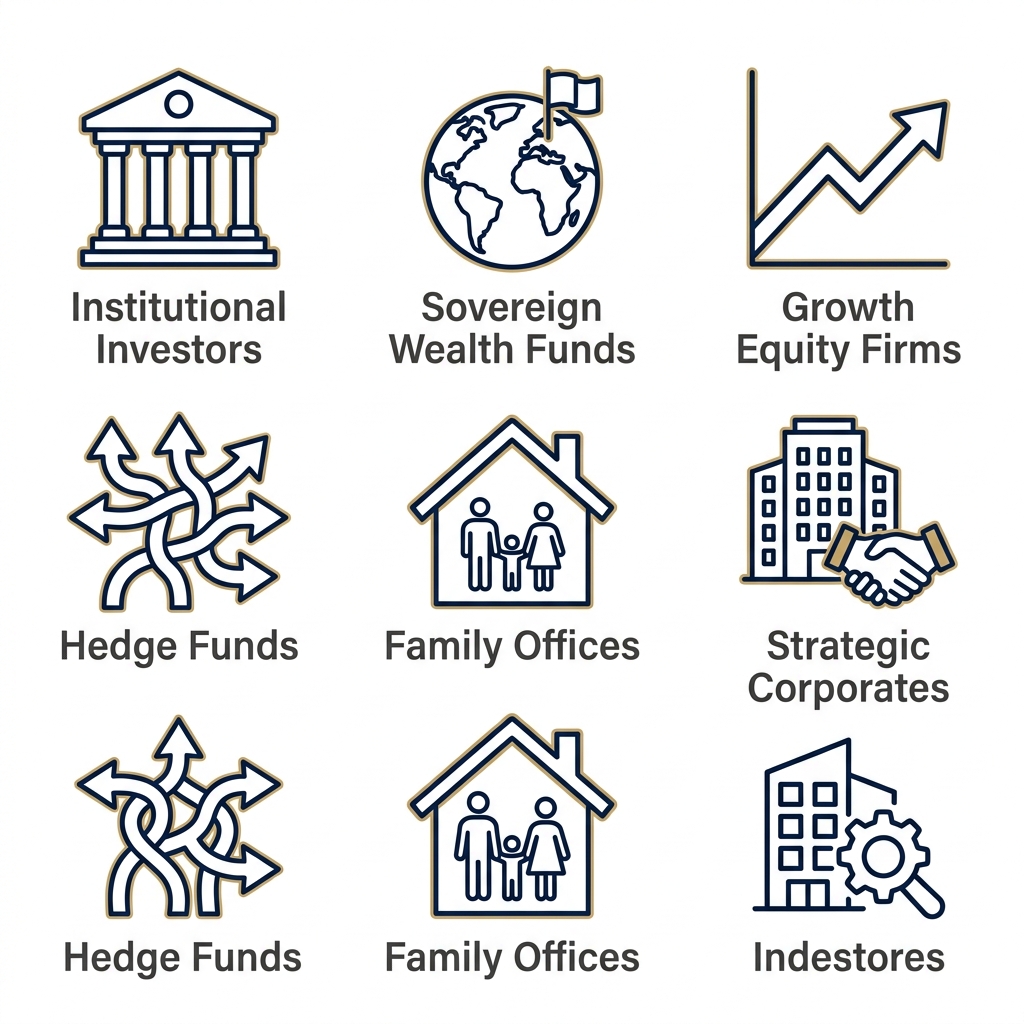
Six investor profile icons for Series F funding stages
As a lower middle market investment bank, we at Zaidwood Capital leverage our Sovereign Data Nexus and Precision Catalyst platforms to analyze investor behavior and identify the optimal mix of investors for a Series F round. Our network of over 4,000 institutional investors provides broad access. This information is for educational purposes only and does not constitute a solicitation.
3. Milestones That Unlock Series F
To unlock a Series F round, companies must demonstrate milestones in revenue scale, market leadership, and governance readiness.
- Revenue exceeding $100 million annual run rate with over 30% year-over-year growth, or a 12-month path to profitability.
- Market leadership in a TAM exceeding $10 billion, shown through a top-3 share or proprietary technology moat.
- A management team with prior IPO experience and independent board members who bring public-company governance expertise.
- Institutional investors including cross-over funds, sovereign wealth, and growth equity partners, plus S-1 readiness within 6-12 months.
- Pre-IPO valuation above $1 billion, backed by audited financials, defensible intellectual property, and a scalable go-to-market model.
Collectively, these milestones signal readiness for growth equity.
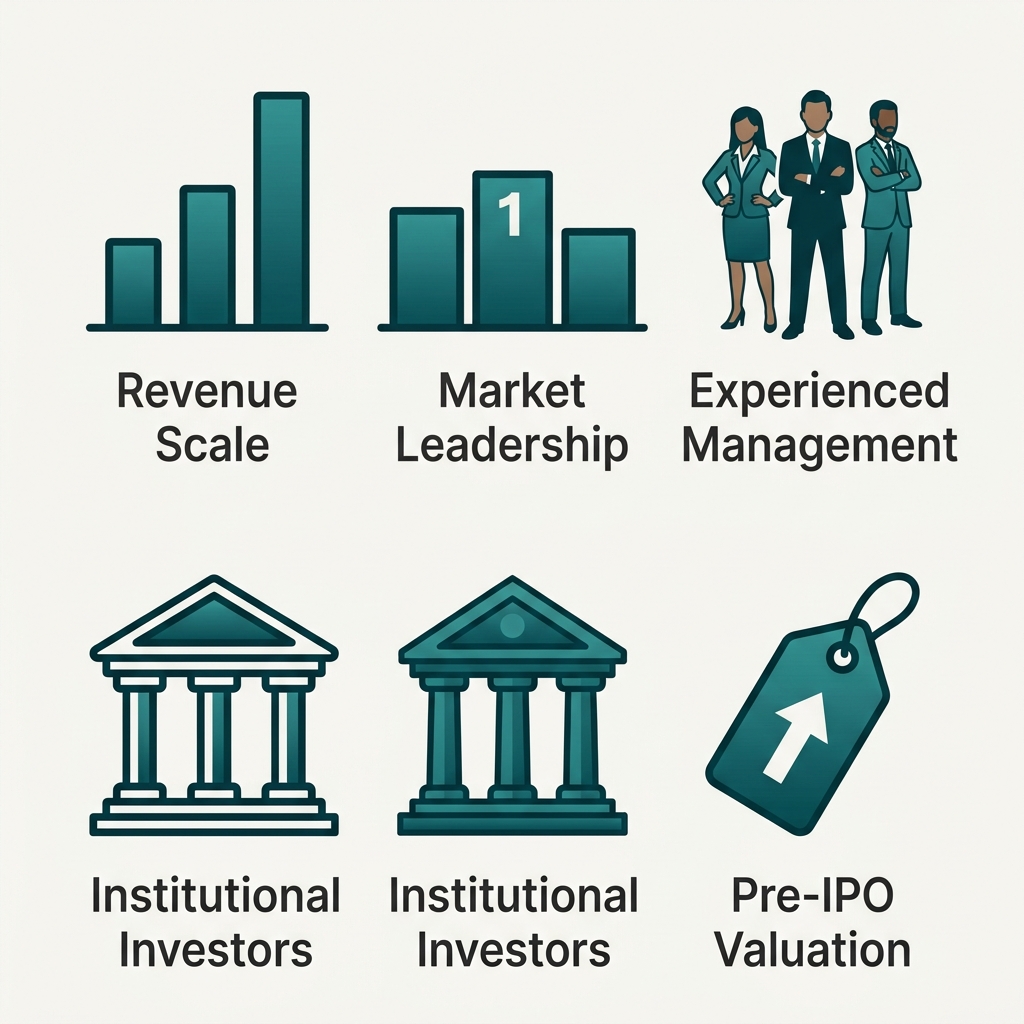
Five key milestones for Series F fundraising.
Meeting them requires a coordinated approach across revenue operations, market positioning, and governance structures.
We help clients achieve these milestones; for AI-native enterprises, enterprise AI capital raising is often the most effective path.
4. Using Series F to Prepare for IPO
Beyond earlier growth rounds, the Series F stage becomes the final private gateway toward a public offering. Series F funding plays a pivotal pre-IPO role, representing the final institutional round before a company begins the public-offering process. Typically led by crossover investors such as mutual funds and sovereign wealth funds that will also participate in the IPO, this stage is critical for building the operational and financial rigor that public markets demand.
Companies deploy Series F proceeds to invest in compliance systems–including SOX readiness and internal audits–and to recruit CFOs with public-company experience, both non-negotiable for underwriters. Growth equity investors often push for these upgrades to strengthen pre-IPO valuation. In the tree care sector, for instance, firms are using similar capital to adopt AI-driven job costing and fleet management, aligning with tree care industry trends 2026 to impress institutional investors. These actions signal to underwriters and public-market investors that the company is ready for the scrutiny of a public listing.
We view the valuation established during the Series F round as directly anchoring the IPO price range, though it does not guarantee the eventual public-market valuation. With Series F capital deployed for IPO readiness, the next step is navigating the regulatory filing process and refining the equity story for institutional bookrunners.
5. Valuation Methods in Series F
A critical component of any Series F round is determining valuation–this section outlines the primary methods used. Valuation in Series F rounds adapts conventional frameworks to reflect a company’s maturity and proximity to the public markets. Comparable company analysis evaluates publicly traded peers with similar revenue profiles and margin structures, providing a market-relative valuation benchmark.
Growth equity frameworks emphasize forward-looking revenue multiples, often applying an EV/Revenue metric based on next-twelve-months projections to capture near-term scaling potential. We also employ a discounted cash flow analysis with an exit multiple approach, incorporating a pre-IPO discount rate and specific terminal value assumptions suitable for late-stage ventures. This pre-IPO valuation often relies on event-driven scenarios that model the step-up a company achieves as it readies for a public listing. Engaging a technology investment bank can provide the requisite expertise in structuring these late-stage valuation models. Precedent transaction analysis examines recent VC-backed rounds at a comparable stage to validate the inferred valuation range. These valuation methods inform term sheet negotiations and investor expectations, which we examine next.
6. Growth Equity Evaluation Criteria
When evaluating growth equity opportunities, particularly for companies raising late-stage series f capital or approaching an IPO, we apply a rigorous set of criteria designed to assess readiness for scale. Only after a company meets our minimum revenue threshold of $20M+ in annual recurring revenue and demonstrates a clear path to profitability do we activate our full evaluation framework.
Our core financial filters include trailing twelve-month revenue growth of at least 30%, gross margins above 60%, and a burn multiple below 1.5x. These metrics signal sustainable unit economics and capital efficiency in a growth equity context.
We then assess market position through our Sovereign Data Nexus platform, which analyzes competitive density, customer concentration, and total addressable market size. We look for markets exceeding $1 billion and a defendable competitive moat.
Management team quality is evaluated through board composition, C-suite tenure, and a demonstrated track record of scaling a business to exit or IPO. We place a premium on teams that have successfully navigated late-stage capital raises.
Our valuation benchmarks are derived from peer-comparable analysis and pre-IPO public filings, but we do not guarantee any pre-IPO valuation outcome. Instead, we use these references as inputs to our underwriting, always overlaying our qualitative judgment.
These criteria serve as a framework, not a rigid checklist, and final decisions incorporate our advisory team’s qualitative judgment. As a Boutique M&A and Capital Advisory Firm, we combine these dimensions with proprietary tools like the Sovereign Data Nexus to build a data-driven evaluation process. Once evaluation criteria are applied, the next step is determining the optimal capital strategy–which we cover in the next section on venture fundraising.
7. Pre-IPO Valuation Determinants
With an understanding of the Series F funding process, the next critical consideration is valuation. The pre-IPO valuation–often set during a late-stage funding round–reflects a blend of financial metrics and strategic factors that go beyond simple comparables.
Key determinants include revenue growth trajectory, gross margin trends, total addressable market (TAM), and the strength of the competitive moat. Institutional investor demand, secondary market liquidity, and the quality of the management team also significantly influence the final range. In a Series F round, institutional demand often drives valuation more heavily than in earlier rounds, making real-time investor sentiment analysis–via Precision Catalyst–critical for growth equity pricing. We combine these fundamentals with our proprietary data platform, Sovereign Data Nexus, which aggregates real-time market activity, and Precision Catalyst, which maps institutional demand signals, to build a more nuanced view of value. This iterative process relies on continuous market feedback rather than a static formula.
These valuation determinants shape the final deal structure, and by blending quantitative modeling with qualitative insights from our global investor network, we help growth-stage companies achieve valuations that reflect both current fundamentals and future potential.
8. Navigating Market Volatility in Series F
A Series F round, typically the last private raise before an IPO, is especially vulnerable to public market sentiment shifts that can compress valuations and delay exit windows, abruptly altering pre-IPO valuation.
Valuation expectations must be calibrated using current market comparables, sector volatility indices, and an honest assessment of growth equity investor appetite. Companies should stress-test their financial models under multiple market scenarios to demonstrate resilience–without guaranteeing any specific outcome.
In a Series F context, flexible deal structures such as ratchet provisions, downside protections, and earnouts may bridge valuation gaps, but they do not eliminate risk and demand meticulous negotiation to align incentives.
Transparent investor communication throughout due diligence is essential: timely updates on market dynamics and scenario-based projections reinforce trust and reduce the risk of deal breakdowns. We recommend maintaining an open dialogue about current market headwinds and their potential impact on the exit timeline–without overpromising outcomes.
Given these volatility risks, the following considerations are critical to position your Series F for a successful close.
Maximizing Your Series F Success
Maximizing your series f success demands more than compelling metrics; it calls for a precise valuation narrative and data-driven investor targeting. We believe a well-structured late-stage funding strategy is the foundation of pre-IPO momentum.
For a series f round, a transparent due diligence package highlighting growth equity metrics and pre-IPO valuation milestones is critical. Our approach leverages proprietary tools like Sovereign Data Nexus to identify aligned institutional investors and stress-test deal terms through the Velocity Matrix framework. Building a diversified syndicate reduces reliance on a single relationship.
With these strategies in place, the path to closing becomes clearer–leading us to the execution phase. As a full-cycle M&A advisory firm, we provide the execution support to convert planning into commitments.
Resources


