


What is Series F Funding
Table of Contents
Series F Funding Explained: A Late-Stage Venture Capital Primer
While earlier series focus on product-market fit and growth, understanding what is series f funding is essential as companies approach the final stage of late-stage venture capital. Series F funding is a late-stage round typically pursued by companies with strong revenue, validated business models, and clear paths to an IPO or acquisition.
Companies leverage Series F rounds to scale operations, expand into new markets, pursue strategic acquisitions, or execute pre-IPO financing strategies that fuel continued growth. Investors in these rounds are primarily institutional–hedge funds, private equity firms, sovereign wealth funds, and large corporate venture arms–who bring substantial capital and a lower risk appetite than early-stage backers. Series F often involves raises in the tens to hundreds of millions, reflecting the company’s market validation.
Unlike early-stage rounds (A-E), Series F investments carry higher dollar amounts, stronger valuation justification, and a clearer exit timeline. These rounds are less common and generally signal that a company may be ready for public markets, though outcomes are never guaranteed.
Thus, Series F sets the stage for the eventual IPO or acquisition–covered in the next section. As a full-cycle M&A and capital advisory firm, we help companies navigate these critical late-stage milestones with precision and professionalism.
How Series F Funding Fits into Venture Capital Rounds
To understand what is series f funding, it helps to see how it fits into the venture capital round structure. At Zaidwood Capital, we help companies navigate Series F Funding, the final private equity round before an IPO. This late-stage funding bridges the critical gap between scaling operations and entering public markets, providing the capital needed for market expansion and pre-IPO positioning.
Each venture capital round serves a distinct purpose, and the differences between Series A-C, later-stage rounds like D-F, and the eventual IPO become clear when comparing typical deal sizes, valuations, investor types, and strategic goals. The following table summarizes this progression.
Comparison Table: Venture Capital Round Stages
| Round Stage | Typical Deal Size | Valuation Range | Primary Investors | Strategic Goals | Dilution Impact |
|---|---|---|---|---|---|
| Series A-C | $5M-$50M | <$100M | VC firms, seed funds | Product-market fit, scaling | Significant dilution (15‑30%) |
| Series D-F | $50M-$500M+ | $500M-$5B+ | Late‑stage VC, PE, SWF, institutional | Market expansion, pre‑IPO preparation | Moderate dilution (10-20%) |
| Pre‑IPO / IPO | Varies widely | Public market comps | Cross‑over funds, institutional | Liquidity event, transition to public | Minimal dilution (5‑10%) |
Where Series F Stands in the Round Progression
Companies typically pursue Series F after completing Series D or E rounds, when they have proven business models and substantial revenue. While Series A-C focuses on product-market fit and early scaling, Series F shifts toward market expansion and preparing for a liquidity event. This round is often the last round of Pre-IPO financing, enabling the company to strengthen its balance sheet, corporate governance, and operational infrastructure ahead of a public listing. Late-stage venture capital investors–including private equity firms, sovereign wealth funds, and cross-over funds–expect a near-term exit, making the investment thesis less about growth capital and more about bridging to public markets. According to SIFMA industry data, late-stage deal sizes typically range from $50 million to over $500 million, with valuations exceeding $500 million and often reaching into the billions. Dilution at this stage is moderate, generally 10-20%, significantly lower than the 15-30% typical in Series A-C rounds because the company is already well-established.
This visual comparison highlights how deal size and valuation escalate across stages, reinforcing that Series F sits at a critical juncture before the public market leap.
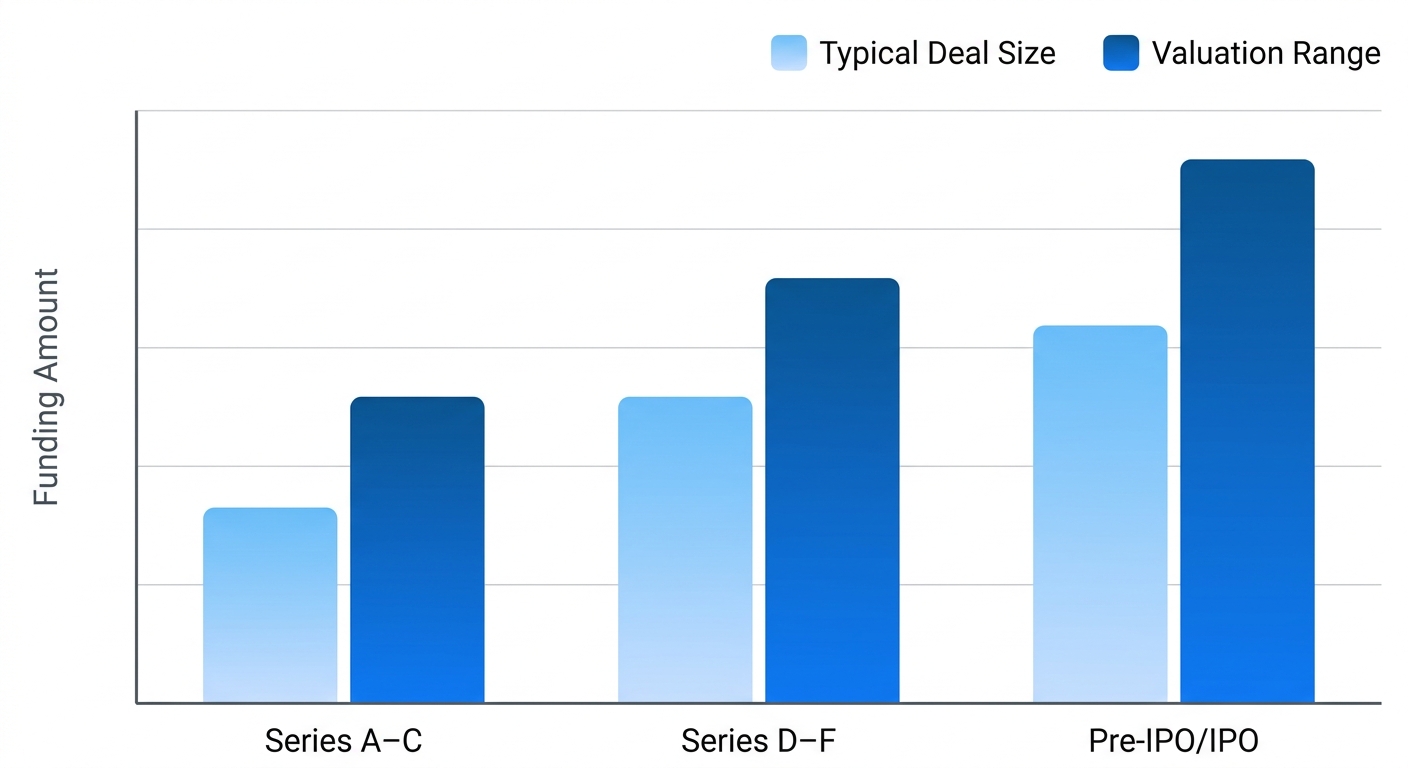
Venture capital stages comparison: deal size and valuation ranges from Series A to IPO.
As a Boutique M&A and Capital Advisory Firm, Zaidwood Capital specializes in guiding companies through the complexities of Series F fundraising, leveraging our Velocity Matrix and institutional network. Understanding where Series F stands in the VC lifecycle is key to appreciating its strategic value for late-stage companies–it is the pivotal bridge between private funding and public markets, aligning investors’ liquidity expectations with the company’s readiness for an IPO. By successfully executing a Series F round, companies position themselves for smoother transitions to public exchanges and sustained long-term growth.
Securities are offered through Finalis Securities LLC; Zaidwood Capital is not a registered broker-dealer.
Investors, Valuation, and Strategic Goals in Series F Rounds
After raising Series E, companies ready for pre-IPO scaling may pursue a Series F round. To understand what is series f funding, it helps to examine the investors, valuation mechanics, and strategic objectives that define this late-stage capital raise. As a boutique M&A and capital advisory firm, we’ve seen how these rounds bridge venture growth and public market readiness.
Who Participates in a Series F Round?
Four primary investor categories dominate Series F: late-stage venture capital, private equity, sovereign wealth funds, and cross-over/hedge funds. Late-stage VCs like Accel, Sequoia, and Andreessen Horowitz write checks of $50M-$200M with moderate-high risk for growth equity returns. Private equity funds such as KKR, TPG, and General Atlantic deploy $100M-$500M+, targeting moderate risk and operational control. Sovereign wealth funds–Mubadala, Temasek, GIC–commit $200M-$1B+ with a low-moderate risk appetite for long-term strategic holds. Cross-over/hedge funds, including Tiger Global, Coatue, and D1 Capital, provide $50M-$300M, aiming for pre-IPO access and near-term liquidity.
The following table summarizes these investor types, typical check sizes, risk profiles, and representative entities, based on industry surveys and SIFMA data.
| Investor Type | Typical Check Size | Risk Appetite | Strategic Motivation | Example Entities |
|---|---|---|---|---|
| Late‑Stage Venture Capital | $50M-$200M | Moderate‑high | Growth equity returns, exit timeline | Accel, Sequoia, Andreessen Horowitz |
| Private Equity / Growth Equity | $100M-$500M+ | Moderate | Control, operational improvements | KKR, TPG, General Atlantic |
| Sovereign Wealth Funds | $200M-$1B+ | Low‑moderate | Strategic alignment, long‑term hold | Mubadala, Temasek, GIC |
| Cross‑over Funds / Hedge Funds | $50M-$300M | Moderate | Pre‑IPO access, liquidity event | Tiger Global, Coatue, D1 Capital |
Sovereign wealth funds and private equity dominate in absolute check sizes, while late-stage VCs and cross-over funds contribute sector expertise and IPO-readiness support. This mix reflects companies’ need for both strategic capital and public-market credibility.
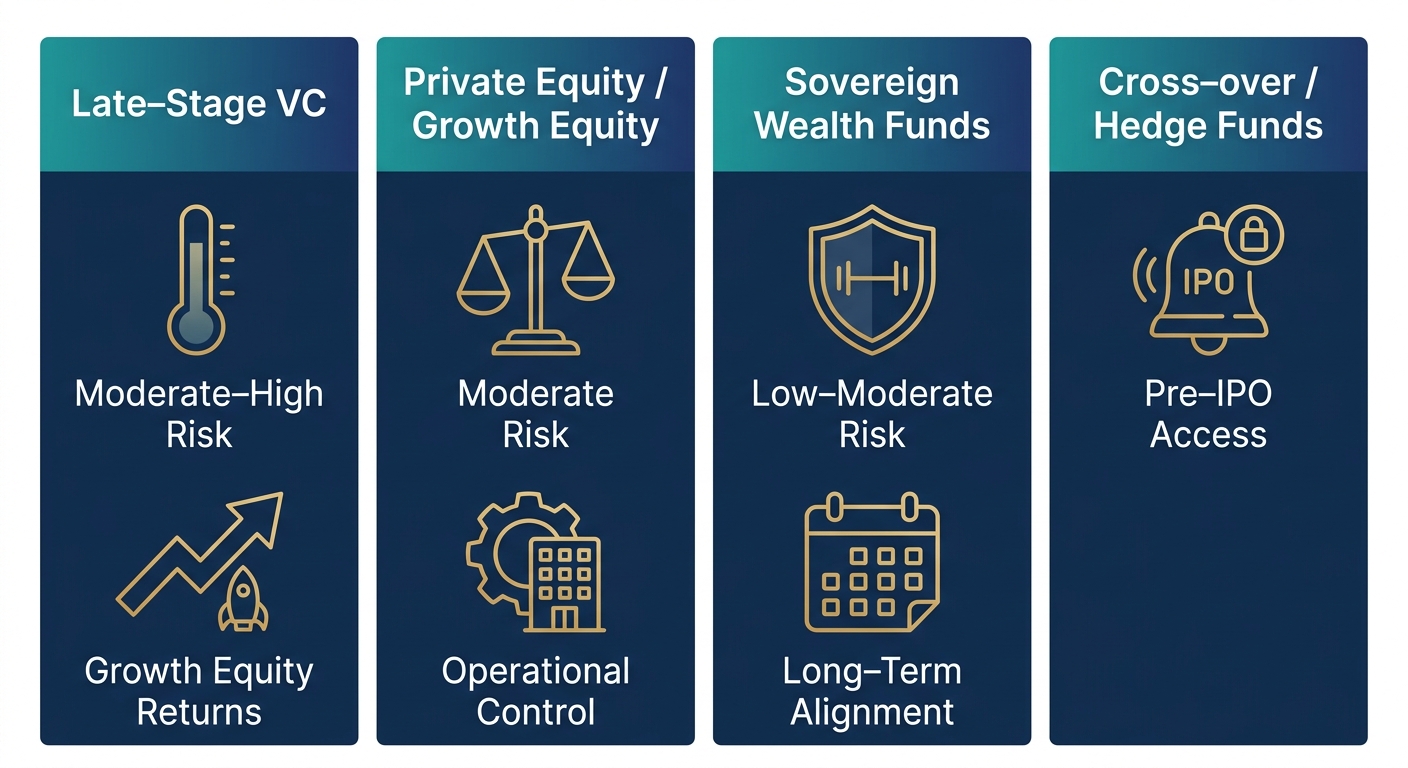
Investor types in Series F rounds: risk and strategic goals comparison.
Given these diverse participants, how is the company valued?
Valuation and Dilution Dynamics
Common valuation methodologies at the Series F stage include revenue multiples–particularly multiples of annual recurring revenue (ARR) or forward revenue–and market comparables against public companies in the same sector. Pre-IPO financing rounds can inflate valuations when strategic investors compete for allocation, sometimes pushing multiples above typical public-market levels. When investors ask what is series f funding, they often seek to understand these valuation dynamics, which blend financial metrics and market sentiment.
As more capital is raised, dilution affects founders and early investors. By Series F, founders may hold a reduced ownership percentage, but if the company has grown significantly, the absolute value of their stake may still be high. Liquidation preferences and participation rights from earlier rounds can further influence how proceeds are distributed at exit.
Strategic Objectives for Series F
Series F objectives are distinct from earlier funding rounds. Unlike series a funding, which focuses on product-market fit and initial traction, Series F rounds are primarily about scaling for a public offering. Companies deploy capital to expand into new geographies, recruit a CFO with public-company experience, and clean up the cap table by buying out early investors who could complicate an IPO. They also strengthen governance, invest in marketing and sales infrastructure, and target an IPO within 12-24 months. These strategic moves aim to position the company as an attractive public-market candidate, with strong revenue growth, a seasoned leadership team, and transparent financials.
Understanding the investors and goals in Series F sets the stage for the IPO process, which we cover next.
Preparing for Series F Due Diligence and Pre-IPO Planning
With the structure of Series F understood, preparation for the intensive due diligence and pre-IPO planning begins. Understanding what is Series F funding sets the stage for the rigorous scrutiny that late-stage investors apply to financials, governance, market positioning, and operational metrics. The following sections outline a comprehensive checklist, the revenue metrics that matter most, and how Zaidwood Capital supports founders through this critical phase.
Due Diligence Checklist for Series F
A comprehensive Series F due diligence checklist covers financial statements, corporate governance, market positioning, legal and intellectual property, data room preparedness, and management team assessments. Addressing each area thoroughly is essential to withstand the heightened scrutiny of late-stage investors.
Due diligence rigor intensifies with each funding round. While early-stage investors in Series A funding often focus on burn rate and unit economics, Series F investors demand audited GAAP statements and deferred revenue analysis. The table below contrasts the escalating standards across stages.
| Diligence Area | Series A Focus | Series D/E Focus | Series F/Pre‑IPO Focus |
|---|---|---|---|
| Financial Statements | P&L, burn rate, unit economics | Audited financials, revenue growth | GAAP/IFRS audit, revenue quality, deferred revenue |
| Governance & Legal | Basic IP assignment, incorporation docs | ESOP, board composition, material contracts | SEC readiness, insider trading policy, SOX compliance |
| Market Positioning | TAM, competitor analysis, product roadmap | Market share, competitive moat, customer concentration | Market leadership, regulatory landscape, global expansion risk |
| Operational Metrics | Monthly burn, customer acquisition cost (CAC) | ARR, gross margin, net revenue retention | Rule of 40, EBITDA margins, cash flow predictability |
Boutique M&A and Capital Advisory firms like Zaidwood Capital help founders meet these rising expectations by organizing a secure data room, coordinating institutional investor introductions, and aligning governance frameworks with pre-IPO readiness. Our team works alongside management to manage the detailed diligence requests that accompany Series F rounds.
Revenue Metrics That Matter
In the late-stage venture capital landscape, investors shift focus from top-line growth to sustainable revenue metrics that signal IPO readiness. The following six metrics define financial health at the Series F stage and inform pre-IPO financing decisions.
- Annual Recurring Revenue (ARR) Growth Rate: ≥30% annual growth, confirming sustained demand and scale potential.
- Net Revenue Retention (NRR): >100% NRR shows existing customers expanding spend, offsetting churn and demonstrating upsell success.
- Gross Margin: ≥70% preferred, reflecting cost structure defensibility and pricing power.
- Rule of 40: Combined ARR growth rate and EBITDA margin ≥40%, balancing growth and profitability.
- EBITDA Margin: Positive or rapidly improving margin, indicating a clear path to profitability and cash generation.
- Cash Flow Efficiency: DSO and free cash flow conversion highlight liquidity and working capital management.
These metrics diverge sharply from earlier KPIs, and demonstrating command of them is non-negotiable for pre-IPO preparation. We help founders benchmark these figures against industry standards and refine their financial narrative for institutional investors.
Engaging Capital Advisory Partners
Our team at Zaidwood Capital guides founders through Series F preparation with a structured engagement encompassing five core activities:
- Data Room Curation: Organizing financials, contracts, and IP into a secure, investor-ready repository.
- Investor Introductions: Facilitating targeted connections to our network of 4,000+ institutional investors.
- Positioning Strategy: Crafting a market-leadership narrative using our Sovereign Data Nexus intelligence.
- Diligence Management: Coordinating Q&A and follow-ups to maintain momentum throughout the process.
- Negotiation Support: Providing term sheet analysis and valuation benchmarks to help founders secure favorable terms.
These activities are augmented by proprietary tools–Sovereign Data Nexus provides market data and investor matching, Precision Catalyst powers AI-driven engagement, and the Velocity Matrix accelerates execution timelines–but they are enablers, not guarantors of success. At Zaidwood Capital, our boutique team leverages these enablers and our deep investor network to guide founders through Series F due diligence and pre-IPO planning. With a thorough preparation framework in place, the next step is to execute the fundraise efficiently.
Navigating Risks and Transitioning from Growth Equity to Series F
Building on the growth equity journey, Series F represents the critical bridge toward public markets — typically the last private round before an IPO. Founders seeking to understand what is series f funding must recognize that this stage is less about hyper-growth and more about cap table clean-up, institutional investor alignment, and pre-IPO scaling. The following comparison table distills how Series F differs from Growth Equity and IPO Preparation across primary goals, deal size, investor profile, risk, and dilution.
| Criteria | Series F | Growth Equity | IPO Preparation |
|---|---|---|---|
| Primary Goal | Pre‑IPO scaling, cap table clean‑up | Accelerate growth, operational scaling | Public market readiness, liquidity event |
| Typical Deal Size | $100M-$500M+ | $20M-$150M | Varies (depend on underwriters) |
| Investor Profile | Late‑stage VC, SWF, cross‑over | Growth equity firms, PE | Institutional investors, retail |
| Risk Level | Moderate (pre‑IPO execution risk) | Moderate‑high (scaling risk) | Low‑moderate (market volatility) |
| Dilution | 10-20% | 15-25% | 5-15% |
These benchmarks, drawn from industry reports and transaction databases, underscore a distinct risk continuum. As a company enters Series F, the investor profile shifts markedly toward late-stage venture capital funds, sovereign wealth funds, and cross-over investors — a contrast to the growth equity and private equity backers of earlier rounds. This Pre-IPO financing phase introduces moderate execution risk: misaligned investor expectations, inadequate cap table optimization, or a rushed transition can lead to unfavorable terms in the public offering. While market volatility carries only low-moderate risk at this stage, the dilution band of 10-20% requires careful structuring to avoid excessive founder dilution. Working with an experienced advisory partner who understands M&A advisory fee models can help mitigate cost surprises and ensure the round is positioned for long-term value.
We approach Series F preparation as a disciplined exercise in readiness — optimizing the cap table, stress-testing investor alignment, and executing due-diligence management with velocity. Founders who treat this final private milestone as the rehearsal for public life substantially de-risk their IPO trajectory.
Frequently Asked Questions About Series F Funding
To further clarify, here are answers to common questions about Series F funding.
What is Series F funding?
Series F funding is the sixth major institutional equity round, typically reserved for startups with proven revenue, strong market position, and a clear IPO timeline.
How does Series F differ from earlier rounds?
Unlike earlier rounds, Series F involves institutional investors like pension funds and sovereign wealth funds, with deal sizes often exceeding $100 million.
How does Series F funding prepare a company for an IPO?
Series F is a form of Pre-IPO financing, bridging the gap between late-stage growth and a public listing through capital that strengthens the balance sheet.
What role does a boutique advisory firm play in Series F fundraising?
We, a Boutique M&A and Capital Advisory Firm, assist with investor targeting, term sheet negotiation, and due diligence leveraging Sovereign Data Nexus. Companies should evaluate M&A advisory fee structures to ensure alignment with the round’s complexity.
Why is Series F considered a late-stage capital event?
It is a hallmark of Late-stage venture capital, where institutional investors provide the final capital injection before an expected IPO or direct listing.
Key Takeaways on Series F Funding for Late-Stage Companies
In summary, key takeaways for late-stage founders and CFOs about what is Series F funding:
- The last major equity tranche before an IPO, typically exceeding $100 million, marking late-stage venture capital.
- Funded by institutional investors: sovereign wealth funds, pension funds, large mutual funds, and strategic corporate VCs.
- Fuels aggressive expansion, large-scale M&A, and pre-IPO preparation; serves as pre-IPO financing at scale.
- Valuations surpass $1 billion, requiring decacorn-level performance.
- Typical instruments: convertible notes, SAFEs, structured preferred equity–not common stock.
- As a boutique M&A and capital advisory firm, we help late-stage companies navigate this critical inflection point with disciplined execution.
Resources


