


Series F Funding
Table of Contents
Series F Funding as a Strategic Capital Event for Mature Growth Companies
For founders asking What is Series F Funding, a Series F funding round represents a late-stage capital infusion for mature growth companies that have moved beyond earlier venture rounds and are generating substantial revenue or approaching profitability.
Industry data shows that Series F funding rounds frequently surpass $100 million, drawing participation from institutional investors such as private equity firms, hedge funds, and sovereign wealth funds. Stripe’s $600 million Series F raise at a $36 billion valuation, for example, illustrates the scale these rounds can achieve. This late stage venture capital event often serves as a pre-IPO bridge, strengthening balance sheets and demonstrating public-market readiness.
Financial analysis indicates that Series F funding is commonly allocated toward large-scale expansion, funding major acquisitions, or providing liquidity through secondary share sales. These growth equity financing rounds also build institutional confidence ahead of a direct listing or eventual acquisition, reflecting the mature company’s strategic pivot toward a full exit.
At Zaidwood Capital, we approach Series F as a Full-Cycle M&A opportunity, leveraging our Precision Catalyst and Velocity Matrix frameworks to guide clients through every stage of the raise–from investor targeting to due diligence–ensuring a seamless transition to public markets or a strategic sale.
The Core Mechanics and Purpose of a Series F Round
A Series F funding round, often referred to as series f funding, represents the final major private capital injection before a company pursues an IPO, direct listing, or strategic acquisition. At this advanced stage, businesses demonstrate robust revenue streams, established customer bases, and sustainable competitive advantages that justify nine-figure or larger checks.
While earlier rounds (Series A through E) focus on product-market fit, user acquisition, and scaling operations, Series F signals a shift toward market dominance and exit readiness. The following table contrasts Series F against Series A/B rounds across key attributes.
| Attribute | Series A / B | Series F |
|---|---|---|
| Primary Purpose | Product-market fit & growth | Market dominance, IPO readiness, or strategic M&A |
| Typical Investors | Seed / VC firms, angels | Large institutional VCs, sovereign wealth funds, growth equity firms, corporate VCs, hedge funds |
| Deal Size | $2M – $30M | $100M – $1B+ |
| Valuation Approach | Revenue multiples, growth rate | EBITDA multiples, comparable public companies, discounted cash flow |
| Dilution Impact | High (20-40% per round) | Moderate (10-20% per round, but larger absolute stakes) |
This comparison underscores the dramatic escalation in both capital scale and investor sophistication. Where Series A/B rounds often back vision and growth potential, Series F investors demand rigorous financial discipline, clear paths to liquidity, and enhanced governance rights.
In the realm of late stage venture capital, Series F deals routinely attract institutional giants, sovereign wealth funds, and dedicated growth equity financing firms. Industry benchmark data indicates that these rounds routinely surpass $100 million, with some exceeding $1 billion. Valuation methodologies mature accordingly: investors pivot from simple revenue multiples to EBITDA multiples, comparable public-company analyses, and discounted cash flow (DCF) models that discount projected free cash flows to present value. While percentage dilution per round moderates to 10-20%, the absolute equity surrendered can be enormous given pre-money valuations that can exceed $10 billion. Capital markets research confirms that Series F investors typically negotiate board seats and veto rights over major corporate actions to protect their stakes. Many companies use this later-stage capital injection as a final private round before a direct listing or as a precursor to a traditional IPO.
Companies channel Series F proceeds into multiple strategic levers. Market dominance initiatives, such as global market expansion, aggressive marketing campaigns, or the launch of adjacent product verticals, consume a large share. IPO readiness efforts focus on retiring convertible notes, strengthening the balance sheet, and upgrading financial reporting systems to meet public-company standards. Strategic M&A accelerates inorganic growth by acquiring regional competitors or complementary technology platforms. When executed successfully, a growth-equity infusion of this magnitude serves as a powerful pre-IPO signal to public markets, validating both operational maturity and governance discipline.
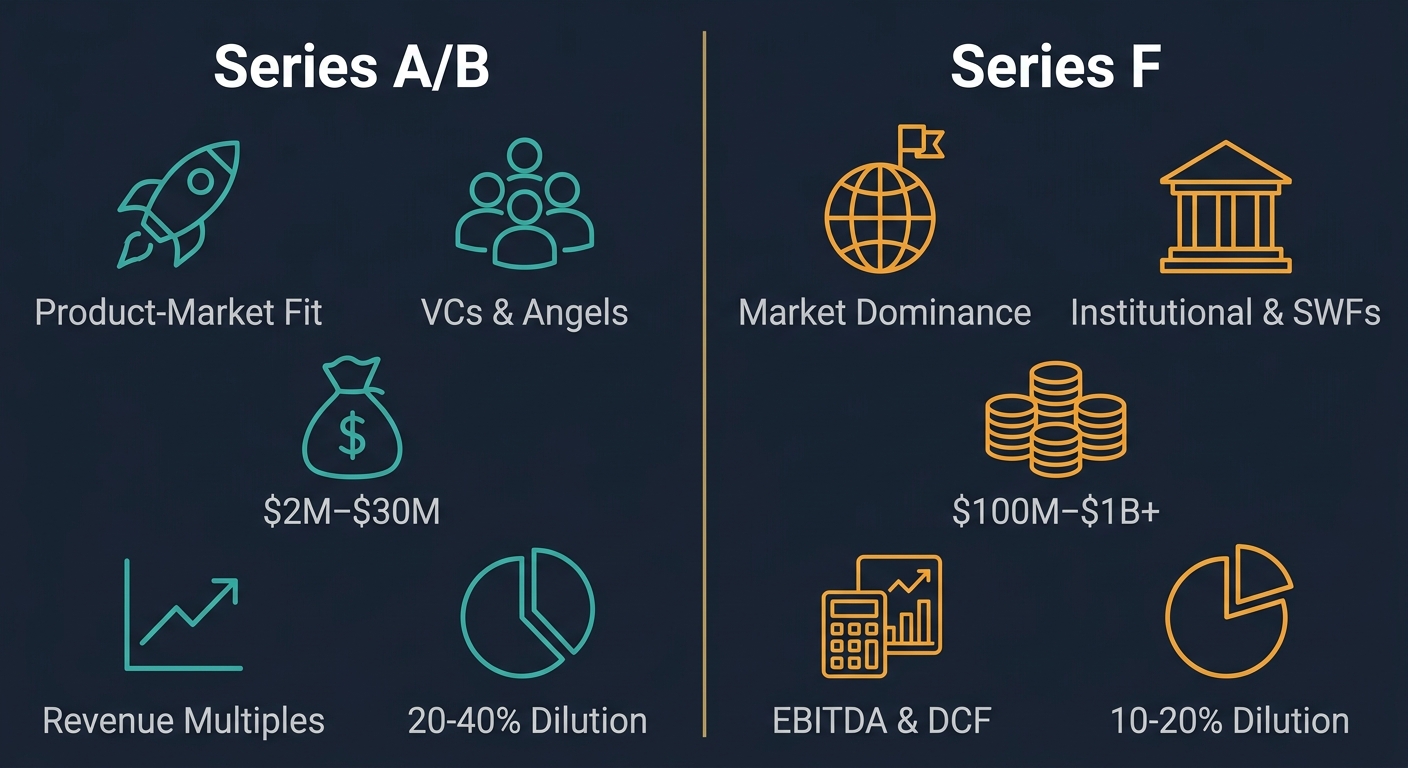
Series F shifts from product-market fit to market dominance with larger investors.
Understanding these mechanics sets the stage for how firms like Zaidwood Capital orchestrate these complex, late-stage transactions. Our role spans strategic positioning, investor matchmaking, and execution across the full lifecycle of a Series F raise, helping founders secure the capital that fuels their final private-market chapter.
Investor Dynamics and Deal Structures in Late-Stage Rounds
As companies approach Series F and beyond, the investor base and deal structures shift considerably. In series f funding rounds, the investor pool expands beyond traditional venture capitalists to include a range of institutional participants, each with distinct return expectations and governance preferences.
Late-Stage Venture Capital Landscape
The late stage venture capital landscape today brings together four primary categories: institutional VCs, sovereign wealth funds, crossover investors, and corporate venture arms. Institutional venture capital firms that have backed the company in earlier rounds frequently retain board seats, while sovereign wealth funds contribute patient capital and long-term stability. Crossover investors–mutual funds and hedge funds making private commitments–build pre-IPO exposure, and corporate VCs seek strategic synergies. According to industry research, these participants shape deal terms, board composition, and exit timelines. Engaging a specialized technology investment bank can help founders navigate complex deal terms and optimize investor syndicate composition. As a Boutique M&A and Capital Advisory Firm, we use the Velocity Matrix to accelerate syndication and the Sovereign Data Nexus to map the institutional landscape, aligning investor mandates with long-term goals. While we cannot guarantee outcomes, this approach helps founders align investor mandates with long-term goals.
Growth Equity Financing Structures
While late-stage VCs focus on pre-IPO momentum, growth equity investors take a slightly different approach. Growth equity financing targets companies that have already proven positive unit economics and are scaling revenue, but which may require additional capital to expand market share, launch new products, or enter adjacent geographies. Typically, growth equity providers take minority stakes of 10-30% with a 3-7 year horizon, aligning incentives without demanding board control. The table below compares growth equity with late-stage venture capital and traditional private equity across the dimensions most relevant to founders evaluating late-stage options.
| Dimension | Growth Equity | Late-Stage VC | Traditional PE |
|---|---|---|---|
| Investment Horizon | 3-7 years | 2-5 years (pre-IPO) | 5-10 years |
| Target Company Stage | Revenue growth with positive unit economics | Large scale, approaching profitability or profitable | Established cash flow, potential for operational improvements |
| Typical Ownership Stake | 10-30% minority | 5-20% minority | Control (50%+ or majority board) |
| Primary Return Driver | Revenue growth + multiple expansion | IPO valuation uplift | EBITDA improvement + leverage |
| Risk Profile | Moderate (growth-stage risk) | Moderate-low (market risk, execution risk) | Low-moderate (operational risk) |
Growth equity financing preserves founder control through minority ownership, whereas traditional PE often requires board control and operational restructuring. Growth equity providers, unlike private equity firms, typically do not seek control, making them ideal for founders who want to retain boardroom influence. Late-stage VC balances these extremes with a focus on IPO readiness. Our team uses Precision Catalyst to evaluate which structure best aligns with the founder’s risk appetite and growth objectives, and we apply the Sovereign Data Nexus to benchmark terms against recent comparable transactions, ensuring the financing structure supports long-term value.
Risk Assessment and Dilution Dynamics
Given these different financing structures, founders must carefully evaluate the dilution implications of each option. In late-stage rounds, two common anti-dilution provisions–weighted average and full ratchet–can significantly affect founder ownership if a down round occurs. A weighted-average provision adjusts the conversion price of preferred shares based on a formula that considers both the new lower price and the number of shares issued, thereby mitigating dilution for existing common holders. Full ratchet, by contrast, reprices all outstanding preferred stock to match the new, lower round price, which can cause severe ownership erosion for founders and employees. Industry data shows that the 2025 venture market rewarded companies with clean cap tables and governance documentation, underscoring the need for proactive dilution planning. We work with management teams to model dilution scenarios under both provisions and negotiate weighted-average mechanics that protect insiders without alienating new investors. Our Sovereign Data Nexus aggregates real-time market intelligence on term trends, allowing us to benchmark against peer transactions and tailor term-sheet provisions. Ultimately, managing dilution through clear-eyed negotiation and transparent communication with investors is central to preserving founder equity and maximizing long-term value creation.
Practical Preparation for a Series F Capital Raise
With the Series F landscape defined, practical preparation becomes the differentiator. Preparing for a series f funding round requires meticulous planning and institutional-grade readiness. In our experience as a Boutique M&A and Capital Advisory Firm, the companies that secure optimal terms are those that prepare early and thoroughly. We guide companies through three critical pillars: financial documentation and cap table preparation, articulating a compelling growth story, and engaging the right late-stage investor network.
Financial Documentation and Cap Table Preparation
Series F investors require a forensic view of your financial health. A three-statement financial model–covering profit and loss, balance sheet, and cash flow–must present at least three years of historical data and five-year forward projections. These projections should be stress-tested for key assumptions such as revenue growth, customer acquisition costs, and churn. Audited financials from a reputable firm (such as a Big Four auditor) are non-negotiable; they validate the accuracy of your reported numbers and demonstrate governance maturity–a non-negotiable element of series f funding due diligence. Equally critical is a clean cap table showing fully diluted shares outstanding, option pool allocations, warrant coverage, and any convertible instruments. Investors need a clear picture of ownership and dilution scenarios. We advise that any complex structures be simplified before the raise to avoid red flags. A well-organized cap table streamlines due diligence and builds confidence in your readiness for late-stage capital.
Articulating Your Growth Story and Key Metrics
A compelling growth narrative must be anchored in quantifiable proof points. Our approach emphasizes the metrics that institutional investors scrutinize most deeply. TAM/SAM/SOM analysis provides the market context, while year-over-year revenue growth of at least 30% signals the kind of momentum typical of Series F companies. Gross margin trends should show stable or improving unit economics, and the CAC:LTV ratio should exceed 3:1 to confirm efficient scaling. Investors also evaluate payback period–ideally under 12 months–and churn rates that validate product-market fit. A durable competitive moat, whether built on proprietary IP, network effects, or regulatory barriers, is essential to sustain growth. For growth equity financing, these metrics are paired with a strategic story that demonstrates a credible path to market leadership, a requirement that late-stage investors weigh heavily.
Engaging the Right Investor Network
Series F rounds demand a targeted approach to investor selection. Using our Sovereign Data Nexus platform, we filter potential investors by sector, check size, and governance preferences, creating a curated shortlist aligned with your growth stage. Our AI-driven Precision Catalyst tool then assigns match scores based on historical investment patterns and engagement signals, prioritizing outreach efficiently. With access to a network of over 4,000 institutional investors and more than $15 billion of committed capital, we connect you to the right late-stage partners. Engaging a lower middle market investment bank can provide the institutional credibility and deal sourcing needed for a Series F raise. The following comparison highlights the key investor types and their decision criteria.
| Investor Type | Typical Check Size | Strategic Focus | Governance Demands | Exit Preference |
|---|---|---|---|---|
| Institutional VC | $50M-$500M | Market leadership, scaling | Board seat, monthly reports | IPO or large M&A |
| Sovereign Wealth Fund | $100M-$1B+ | Long-term holdings, sector exposure | Observer seat, annual impact reporting | IPO or strategic partnership |
| Corporate VC | $20M-$200M | Strategic alignment, technology access | Lighter governance, product collaboration | Acquisition or commercial agreement |
| Hedge Fund | $50M-$300M | Pre-IPO discount, liquidity event | Minority seat, veto rights on key decisions | IPO or secondary sale |
| Growth Equity Firm | $30M-$250M | Organic growth, operational improvements | Board seat, management coaching | IPO or strategic M&A |
Sovereign wealth funds typically offer the largest checks but demand long-term holdings and impact reporting. Corporate VCs value strategic alignment and may prefer product collaboration over board control, while growth equity firms focus on operational improvements and management coaching. Understanding these nuances allows you to tailor your pitch to each investor’s expectations. After preparing your materials and investor target list, you are ready to engage in term sheet negotiations. Past performance does not guarantee future results.
Advanced Positioning for IPO Readiness and Long-Term Value Creation
After securing series f funding, leadership’s focus shifts to positioning the company for a successful exit and sustained long-term value. For late stage venture capital investors, the post-Series F window is critical: the business must now demonstrate the maturity, scalability, and governance that underpin a premium outcome. With growth equity financing having fueled the latest round, the team must align near-term financial planning with the ultimate exit route–and for enterprise-focused companies, continued enterprise ai capital raising after Series F must be strategically planned around the chosen exit path.
Comparing Post-Series F Exit Strategies
The table below outlines the three principal exit avenues available to a late-stage company, each carrying distinct trade-offs in time to close, investor liquidity, founder control, and valuation potential.
| Exit Path | Timeframe | Liquidity for Investors | Control Retained by Founders | Valuation Potential |
|---|---|---|---|---|
| IPO | 6-18 months post-Series F | Full liquidity after lock-up | Diluted but often retains control with dual-class shares | High (public market comparable) |
| Strategic M&A | 3-12 months after mandate | Full liquidity at close | Founders may exit or stay as executives | Premium (synergy-driven) |
| Secondary Sale | Immediate to 6 months | Partial liquidity for existing investors | Founders often retain control | Moderate (discount to primary round) |
Industry data confirms that an IPO, while offering the highest public-market valuation potential, typically requires a 6-to-18-month preparation window, with investor liquidity gated behind a lock-up period. Dual-class share structures allow founding teams to preserve voting control even as ownership dilutes–an arrangement often welcomed by late stage venture capital backers seeking long-term value creation. Strategic M&A can deliver a premium, synergy-driven valuation and full liquidity at close, with a compressed 3-to-12-month execution timeline after mandate; founders may exit immediately or negotiate executive roles within the acquirer. A secondary sale, by contrast, provides partial liquidity to existing investors–usually at a discount to the primary round–and allows founders to retain control while growth equity financing plans continue to support the company’s trajectory toward a later, more targeted exit.
Mapping these exit paths against your company’s specific growth trajectory and investor liquidity requirements is an essential exercise. Our advisory process helps founders evaluate trade-offs early–ensuring that the exit strategy aligns with both financial goals and operational continuity.
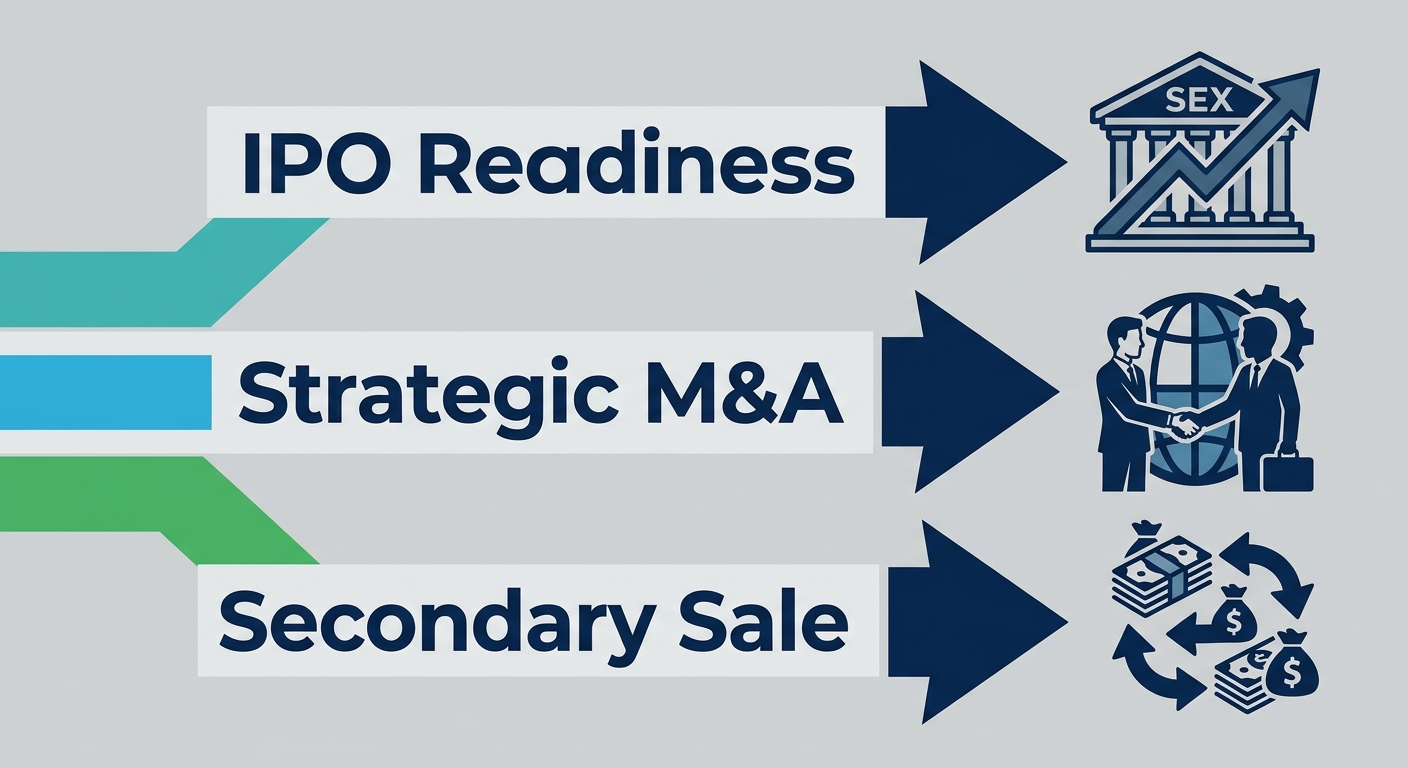
Three post-Series F exit pathways timeline for capital advisory.
Evaluating these exit paths early allows leadership to align future capital needs–whether through follow-on rounds or targeted M&A–with the chosen strategy. By integrating exit-ready governance, investor reporting, and a coherent series f funding narrative, late-stage companies can build lasting enterprise value while preserving optionality. As with all investment considerations, prospective investors should conduct their own due diligence and recognize that investments involve risk; they may lose part or all of their investment.
Frequently Asked Questions About Series F Funding
What is Series F funding?
Series F funding is a late-stage capital round for companies nearing an IPO or requiring substantial growth capital. These rounds often exceed $100 million and are used for scaling operations, making acquisitions, or strengthening balance sheets. Companies at this stage have typically achieved robust growth and are seeking strategic partners to fuel their next phase. It may precede an IPO, but outcomes vary.
Who invests in Series F rounds?
Investors typically include growth equity firms, late stage venture capital funds, and sovereign wealth funds. They seek established market leaders with clear competitive advantages.
How does a boutique investment bank support Series F fundraising?
A boutique investment bank provides strategic advisory and investor access for Series F rounds. We at Zaidwood Capital assist companies in securing growth equity financing from institutional investors and navigating the complexities of late-stage capital raises. Our approach helps founders articulate a long-term vision and connect with value-aligned partners.
Navigating Series F Funding with Strategic Capital Advisory
Series F funding is a late-stage round for mature companies seeking late stage venture capital to scale or prepare for exit. As a Boutique M&A and Capital Advisory Firm, we optimize investor selection, valuation, and term structures, avoiding common pitfalls in growth equity financing. Our proprietary Sovereign Data Nexus and Precision Catalyst tools match founders with institutional partners from a network of 4,000+ investors and access to $15B+ in capital. (Securities offered through Finalis Securities LLC; Zaidwood Capital is not a registered broker-dealer.) Our advisory approach connects founders with the right institutional partners.
Resources


