

Table of Contents
The Growing Importance of AI Due Diligence in M&A
Modern M&A deals generate data on an unprecedented scale, making manual due diligence increasingly insufficient. Integrating AI due diligence into our advisory work enables faster, more thorough analysis of financial, legal, and operational datasets. This technology uncovers risks and insights that traditional methods often miss.
AI-driven due diligence is becoming a competitive necessity across the industry. At Zaidwood Capital, we incorporate AI-powered analytics into our Full-Cycle M&A and capital advisory process to strengthen decision-making. This approach supplements the expertise of our seasoned team, allowing us to deliver deeper intelligence for our clients. By surfacing critical patterns early, AI in due diligence is emerging as a key differentiator for achieving successful transaction outcomes. We combine machine-assisted analytics with human review to prioritize material issues and support more informed transaction decisions across complex portfolios.
Before You Begin: Context for AI Due Diligence
AI due diligence in M&A has rapidly moved from a niche concern to a cornerstone of informed transaction decisions. As AI systems permeate business models—from predictive analytics to autonomous decision-making—you must understand the unique technical and regulatory exposures these assets carry. A comprehensive AI review examines data governance and lineage, model explainability and bias, intellectual property ownership, and compliance with evolving U.S. regulations. Industry frameworks, such as those published by Legistify, underscore the importance of a structured approach to these areas.
Unlike traditional financial or operational due diligence, AI-specific scrutiny uncovers hidden liabilities such as tainted training data, unlicensed third-party code, or algorithmic discrimination that can derail deal value or invite post-close literature. Because AI due diligence in M&A requires evaluating both technical and business risk, a cross-functional team is essential.
Zaidwood Capital provides full-cycle mergers and acquisitions advisory that embeds AI due diligence into every phase—from initial screening to post-close integration planning. Our approach integrates these technical findings with commercial and legal analysis, giving you a clear picture of the target’s AI capability and risk profile.
This guide is for informational purposes only and is not investment advice. In the sections ahead, we break down each pillar of AI due diligence—beginning with data and model risk assessment.
Assess the Target’s AI Infrastructure
Effective AI due diligence in M&A requires a meticulous technical review of the target’s AI infrastructure, moving beyond surface-level capabilities to evaluate the core assets underpinning its value. At Zaidwood Capital, our due diligence for AI infrastructure focuses on several critical dimensions. First, we map the compute architecture, determining the split between on-premise and cloud GPU resources and the capacity to scale. Second, we assess the maturity of data pipelines and quality frameworks, as model performance is entirely dependent on clean, well-governed data. Third, our AI due diligence process scrutinizes model governance, version control, and deployment protocols to identify hidden technical debt and key-person dependencies. This structured assessment, drawn from our full-cycle methodology, ensures the stack is resilient and scalable post-merger. By isolating these risks early, we pave the way for a seamless integration and set the stage for the subsequent phase of our review: data privacy and regulatory compliance. This technical foundation is a cornerstone of our broader capital advisory services.
Evaluate AI Data Assets and Intellectual Property
Building on AI’s expanding role in deal-making, this section narrows the focus to AI data assets and intellectual property evaluation—two of the most specialized areas of modern M&A. As a boutique M&A advisory firm, we recognize that AI due diligence in M&A must go beyond standard financial reviews to assess data provenance, licensing rights, and the competitive defensibility of proprietary algorithms.
The complexity of AI asset valuation requires more than conventional checklists. Through our Sovereign Data Nexus and private server infrastructure, we apply an intensive data asset evaluation methodology that surfaces hidden value and flags risks such as regulatory exposure or unclear ownership structures. This approach reflects the IP due diligence discipline we have refined across $24.4 billion in aggregate transaction volume.
When investors understand the quality and legal standing of a target’s data moat, they are better positioned to structure deals that protect long-term value. Our AI-driven M&A analysis transforms technical assets into clear negotiating inputs—setting a strong foundation for the deal structuring discussion that follows.
Analyze the AI Technology Stack
As AI due diligence in M&A transforms how transactions are evaluated, we at Zaidwood Capital focus on the underlying AI technology stack that powers this efficiency. Drawing from industry resources like Legistify, we see a multi-layered framework designed to augment our team’s expertise. This stack integrates machine learning models, natural language processing engines, and automation frameworks to provide a robust analytical backbone.
The primary layers include a data ingestion module that connects to virtual data rooms and financial databases, a processing core using NLP and anomaly detection for contract and financial review, and a reporting output that surfaces critical risks. A key component is the use of pre-trained language models to summarize lengthy agreements and flag non-standard clauses, dramatically reducing manual review time.
Crucially, this AI stack is a component of the broader category of legal technology software that supports, but does not supplant, human judgment. Legistify highlights how these technologies improve consistency without compromising the nuanced analysis our deal-makers provide. With the stack defined, we now turn to practical deployment considerations.
Review AI Risks and Compliance
As artificial intelligence becomes more embedded in transaction workflows, AI due diligence in M&A has evolved from a niche concern into a core component of deal preparedness. We recognize that AI-powered tools can accelerate target screening and financial analysis, yet they also introduce distinct risks that demand careful scrutiny. Integrating an AI compliance review early helps acquirers avoid post-close surprises that could erode deal value.
Key risks we evaluate during an AI risk assessment in M&A include:
- Data privacy vulnerabilities, particularly where models are trained on sensitive customer or employee information that may trigger GDPR or CCPA obligations.
- Algorithmic bias embedded in valuation or credit-scoring models, which can produce materially skewed financial projections.
- Regulatory uncertainty as lawmakers refine frameworks governing automated decision-making in financial services.
According to the American Finance Association, academic research increasingly documents how AI-related financial risks can compound when left unexamined—reinforcing why transaction readiness must account for these exposures. Our approach aligns with that insight, treating AI due diligence in M&A not as a standalone checklist but as an integrated layer within standard operational, legal, and financial reviews. This foundation supports the mitigation strategies the next section explores.
Assess AI Talent and Organizational Culture
In any AI due diligence in M&A, human capital analysis is critical. The scarcity of skilled AI professionals directly influences deal valuation and post-merger integration success. Beyond technical skills, organizational culture compatibility is a key predictor of whether the combined entity will thrive.
We incorporate AI talent and culture assessments into our full-cycle due diligence, recognizing that technology is only as strong as the teams that build and deploy it. Our process evaluates team depth, technical expertise, and cultural alignment alongside a company’s change readiness and leadership dynamics. This comprehensive view, supported by proprietary analytical tools like the Velocity Matrix, ensures our strategic advisory captures the full spectrum of integration risks and opportunities.
As we progress, the next section will examine the technological and data-related components that must be evaluated alongside human and cultural factors.
Model AI Value Creation in Valuation
In the context of AI due diligence in M&A, AI value creation in valuation represents a paradigm shift, enhancing accuracy and the depth of analysis. By integrating machine learning and predictive analytics, we can process vast datasets beyond the scope of traditional discounted cash flow or comparable company models. This fusion enables real-time assimilation of market intelligence, reducing human bias and strengthening our analytical foundation.
In the scope of AI due diligence in M&A, we employ AI-driven valuation leveraging techniques such as natural language processing to parse qualitative data from earnings calls and news. Academic research published by the American Finance Association in the Journal of Finance provides the theoretical underpinning for these advanced models. Our proprietary Sovereign Data Nexus feeds curated transactional data into our models, delivering nuanced insights that directly inform our next advisory stage, where AI applications extend into deal structuring and execution.
Integrate AI Due Diligence into Transaction Structure
Our Full-Cycle M&A and capital advisory process embeds AI due diligence in M&A directly into every phase of the transaction lifecycle. Rather than treating diligence as a disjointed checklist, we apply our proprietary Precision Catalyst and Velocity Matrix frameworks to integrate AI-powered analysis across financial, legal, operational, commercial, IT, and human capital domains from the very start.
This continuous, AI-driven due diligence accelerates cycle times and reduces manual effort, feeding real-time insights into valuation, risk mitigation, and structuring decisions. By contrast, traditional fragmented approaches often delay critical findings until late-stage review, introducing uncertainty. Our integrated model ensures that every data point — from contract reviews to cultural alignment assessments — informs transaction architecture as it evolves.
We use AI-driven due diligence to transform raw information into actionable intelligence, enabling more confident and timely deal execution. AI-powered transaction due diligence that lives within the deal flow from assessment to close is what differentiates high-velocity outcomes. This seamless integration of data and decision-making is central to Streamlining Transactions, paving the way for faster, more confident closure.
Common Pitfalls and Troubleshooting in AI Due Diligence
While AI accelerates deal evaluation, AI due diligence in M&A introduces hidden risks that demand careful navigation. We help clients recognize these challenges before they undermine transaction integrity.
- Over-reliance on AI models without human oversight can miss nuanced risks.
- Inadequate data validation leads to biased or inaccurate outputs, eroding trust.
- Lack of explainability in AI-driven risk assessments obscures decision logic.
- Data privacy and security gaps may expose sensitive IP or personal data.
These pitfalls can derail an M&A process if left unchecked.
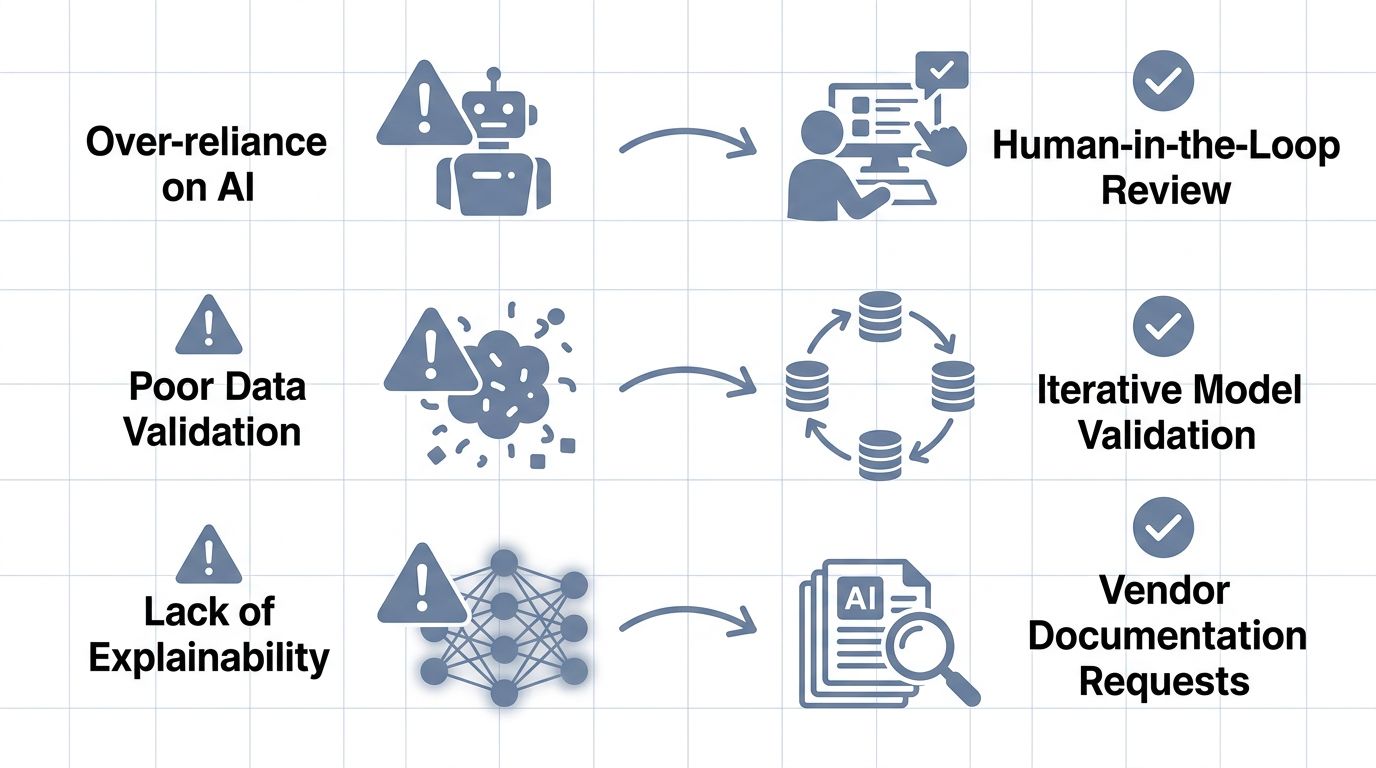
Common AI due diligence pitfalls and troubleshooting actions infographic.
According to Dealroom’s analysis of AI-driven due diligence, common pitfalls include data quality and model interpretability challenges. As Zaidwood Capital advises on complex M&A transactions, we note that AI-driven due diligence requires human-in-the-loop validation. We conduct iterative model validation using real M&A data and request vendor documentation to ensure transparency. Aligning AI findings with financial, legal and operational due diligence prevents isolated decision-making.
Zaidwood Capital’s FAQ on capital formation highlights that AI due diligence often surfaces questions around valuation of proprietary algorithms. By integrating AI insights with traditional due diligence, we deliver a holistic transaction view. The next section explores best practices for AI due diligence execution in today’s deal environment.
Making AI Due Diligence a Strategic Advantage
As the M&A landscape accelerates, AI due diligence in M&A has evolved from a competitive differentiator to a foundational capability. Dealroom research indicates that AI-driven due diligence can reduce manual review effort by up to 80%, allowing deal teams to shift focus from data gathering to strategic insight. This speed fundamentally changes the negotiation dynamic.
By processing vast datasets in minutes, AI-powered due diligence analysis uncovers subtle risk patterns and hidden opportunities in financial, legal, and operational records that human reviewers often miss. The result is deeper, faster deal intelligence, enabling more informed decision-making under tight timelines.
We integrate these capabilities directly into our Full-Cycle M&A process. Through proprietary infrastructure like our Sovereign Data Nexus and Precision Catalyst, we apply AI to streamline diligence without sacrificing rigor. This creates a strategic advantage — our clients gain the clarity to negotiate with confidence and structure deals more favorably, a theme we will explore further in the sections that follow.
Resources
- Get Boutique M&A and Capital Advisory Services
- Find Expert Capital Advisory and Funding Solutions
- Receive Boutique M&A Advisory and Capital Services
- Find Debt Advisory Services for Capital Optimization
- Explore M&A Strategies for Emerging Markets
- Explore Capital Formation Solutions in Emerging Markets
- Learn About Sovereign Wealth Funds in Emerging Markets
- Find Legal Technology Software for Enterprise Departments
- Learn How AI Improves M&A Due Diligence
- Explore the American Finance Association Resources