


Series E
Table of Contents
Series E Funding as a Strategic Milestone for Growth-Stage Companies
Series E Funding represents a pivotal milestone for growth-stage companies that have achieved meaningful scale and are preparing for an IPO, acquisition, or other liquidity event. This stage serves as the final private funding round before a public debut, making it a critical inflection point.
Unlike earlier rounds that fuel product development and market entry, a series e round provides growth equity capital to expand operations, enter new markets, or strengthen the balance sheet ahead of a public listing. Companies often use series e capital to scale their workforce, invest in technology infrastructure, and pursue strategic acquisitions that strengthen their market position. Institutional investors, private equity firms, and strategic corporate investors often lead these rounds, viewing them as pre-IPO financing opportunities that validate market confidence.
According to data from the Securities Industry and Financial Markets Association (SIFMA), private market capital formation activity remains a vital component of the U.S. economy. SIFMA’s Capital Markets Fact Book indicates that private placements, including late-stage rounds, represent a significant share of total capital raised annually, underscoring the importance of milestones like Series E in funding high-growth companies. While a successful series e round signals strong investor confidence, outcomes are not guaranteed, and shifting market conditions can alter exit timelines.
At Zaidwood Capital, a boutique M&A and capital advisory firm in West Palm Beach, we guide growth-stage companies through the complexities of late-stage fundraising, helping them navigate the pre-IPO landscape with confidence.
This article is for informational purposes only and does not constitute an offer, solicitation, or recommendation regarding any security. Investments involve risk and are not guaranteed.
Core Principles of Series E and Late-Stage Capital
We often field the question, What is Series E Funding? This late-stage capital round signals a shift from scaling operations to preparing a mature company for a public listing or acquisition. Series E financing typically closes 12 to 36 months before the planned exit, fueling pre-IPO acceleration–market expansion, regulatory compliance, and operational scaling. Unlike earlier rounds, its investors are institutional funds and growth equity firms that base valuations on forward revenue and public-market comparables, expecting a near-term path to liquidity.
The core principles of this stage revolve around liquidity readiness. The primary purpose of Series E is to accelerate the company’s positioning for a near-term exit, whether through an IPO or a strategic acquisition. Typical investors include growth equity firms, institutional asset managers, and PIPE funds that demand disciplined governance and audited financials. Valuations pivot to forward revenue projections and comparable public-company multiples rather than historical traction. Companies raising Series E often have substantial recurring revenue, so dilution per dollar raised is lower than in earlier rounds, where investors took larger equity stakes to offset higher risk.
The following table contrasts Series E with earlier venture capital rounds across key dimensions, highlighting the progressive shift in investor profile, valuation methodology, and time to exit:
| Funding Stage | Primary Purpose | Typical Investor Type | Valuation Basis | Time to Exit |
|---|---|---|---|---|
| Series A/B | Product-market fit & scaling | Venture capital firms, angel syndicates | Revenue multiples, traction metrics | 5-10 years |
| Series C/D | Market expansion & growth scaling | Late-stage VC, corporate venture, hedge funds | Revenue multiples, ARR, market share | 3-5 years |
| Series E | Pre-IPO acceleration & liquidity preparation | Growth equity, institutional investors, PIPE funds | Forward revenue, comparable public comps | 12-36 months |
These benchmarks, drawn from industry association data published by the Securities Industry and Financial Markets Association (SIFMA), reinforce how Series E stands apart. Unlike earlier rounds that emphasize growth at any cost, Series E capital is raised with institutional discipline, accompanied by audited financials and legal preparation for public-market listing. The compressed 12- to 36-month exit window aligns management and investors around a singular liquidity timeline, with returns expected in a fraction of the time typical for Series A or B.
At Zaidwood Capital, our boutique M&A and capital advisory firm guides founders through this transition, structuring late-stage rounds that optimize valuation while minimizing dilution. Our deep experience in growth equity and pre-IPO financing, combined with a network of institutional investors, allows us to tailor each late-stage capital raise.
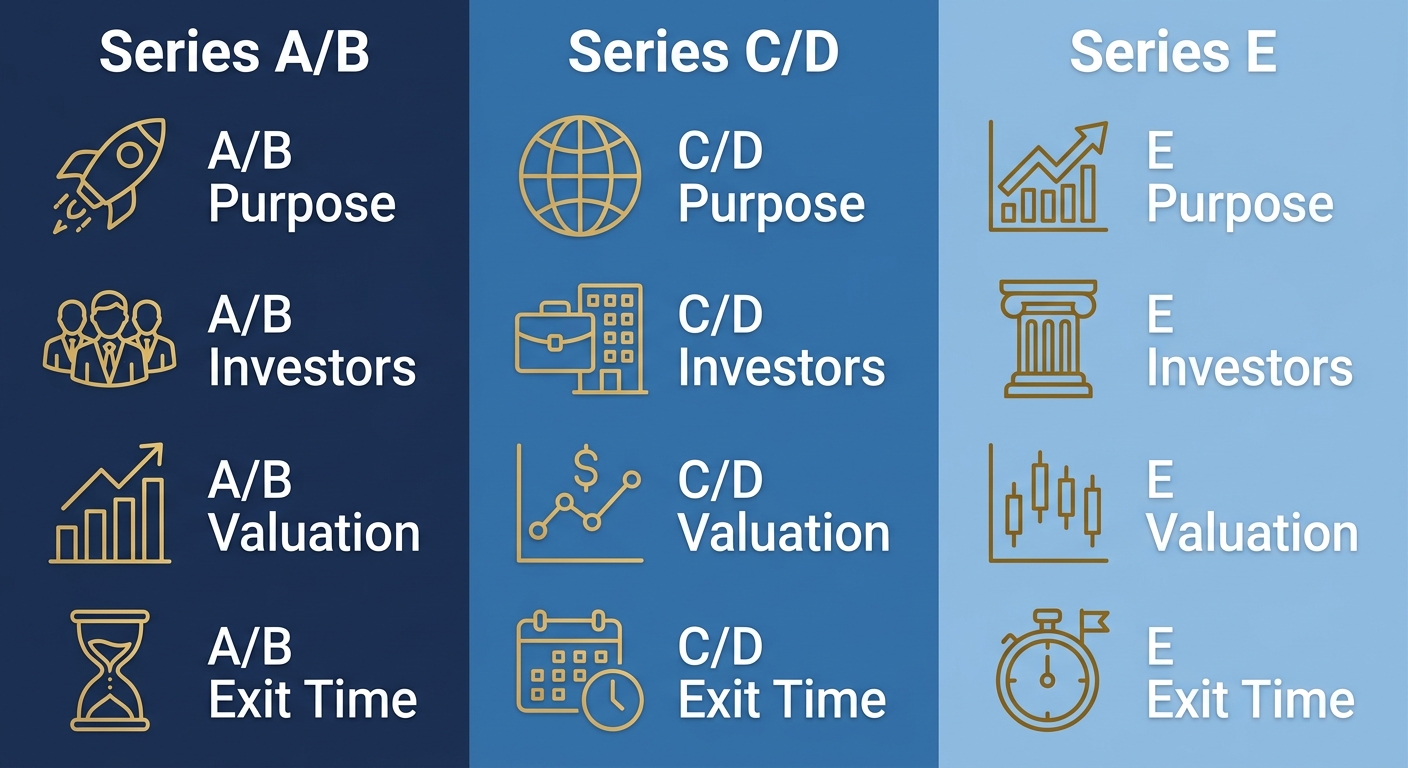
Three-stage funding comparison from early to late-stage capital
Understanding these core principles sets the stage for exploring how a Series E round is executed, from investor outreach to final close.
Strategic Dynamics of Late-Stage Investment Rounds
As companies near a public listing, late-stage investment rounds such as Series E financing present distinct strategic dynamics. Capital raised at this phase aims to optimize positioning for an imminent liquidity event. As a Boutique M&A and Capital Advisory Firm, we know that aligning investor expectations, pre-IPO financing structures, and governance is critical to preserving value.
Late-Stage Investor Syndicates and Expectations
Series E investor syndicates typically comprise a blend of growth equity funds, institutional investors, and crossover players. Growth equity firms such as Tiger Global and General Atlantic bring deep sector expertise and a 2-5x return expectation over an 18-36 month liquidity horizon. Institutional backers like pension funds and sovereign wealth funds supply patient capital but demand robust governance rights, often securing board seats or enhanced information rights. Crossover investors–mutual funds and hedge funds that operate across public and private markets–add a bridge to public market valuation expectations. Their involvement signals that the company’s fundamentals can withstand public scrutiny. We at Zaidwood Capital have observed that the cohesion of this syndicate–and the clarity of each investor’s exit assumptions–is critical to preventing governance disputes later in the process.
Pre-IPO Financing Mechanics and Valuation Impact
At the Series E stage, companies often deploy pre-IPO financing instruments to bridge the gap to a public listing while fine-tuning valuation. Bridge loans–short-term debt with a 12-24 month maturity, interest-only period, and a conversion discount–set a valuation floor without immediate dilution. Private placements, conducted under Regulation D or Rule 144A, offer equity or convertible notes at a premium, establishing a new valuation benchmark. PIPE deals involve discounted equity purchases with registration rights, common when institutional validation is needed, but the discount can temporarily weigh on valuation. SPAC mergers, a reverse merger with a SPAC and a PIPE backstop, frequently result in a negotiated valuation exceeding private comparables.
The table below compares these four structures based on typical terms and investor profiles.
| Financing Type | Typical Terms | Investor Profile | Impact on Valuation |
|---|---|---|---|
| Bridge Loan | 12-24 month maturity, interest-only, conversion discount | Existing investors, specialty debt funds | Minimal near-term valuation impact; sets floor |
| Private Placement | Equity or convertible note, 144A or Reg D | Institutional investors, family offices, sovereign funds | Establishes new valuation benchmark; often at premium |
| PIPE Deal | Discounted equity purchase with registration rights | Hedge funds, crossover investors | Discount may dilute near-term valuation |
| SPAC Merger | Reverse merger with SPAC, PIPE backstop | SPAC sponsors, institutional PIPE investors | Negotiated valuation; often above private comps |
The data in this comparison are informed by SIFMA pre-IPO market trends and FINRA’s offering documentation standards. These structures directly affect pre-money valuation and dilution. Because each vehicle carries distinct compliance obligations–such as Rule 144A restrictions or SEC registration–companies must weigh incremental value against complexity. In our Full-Cycle M&A advisory work, we help founders map these trade-offs to their liquidity timeline and growth metrics.
Risks and Strategic Considerations in Series E Rounds
Raising a Series E round introduces a distinct set of risks that can undermine both the near-term value and the eventual public debut. Valuation compression can arise if growth deceleration makes it difficult to justify the step-up from the prior round, forcing a flat or down round that erodes investor confidence. Dilution creep is another critical concern: each late-stage round adds new shares, and without careful management, founders and early employees may see their ownership stakes fall below 20%, impacting morale and control.
Investor pressure for an accelerated exit can force a company to go public before operational readiness, increasing the risk of a weak market debut. Similarly, board alignment becomes strained when investors with differing liquidity horizons push for conflicting strategies. Companies navigating these dynamics may benefit from consulting a dedicated M&A advisory FAQ for deeper guidance on managing internal governance. Ultimately, these pre-IPO financing choices directly influence a company’s readiness for the public market and require disciplined strategic oversight. Securities are offered through Finalis Securities LLC; Zaidwood Capital is not a registered broker-dealer.
Preparing Your Company for a Series E Fundraise
As your company surpasses $20M in recurring revenue, preparing for a Series E fundraise demands a distinct approach. Growth equity and institutional investors expect a comprehensive data room and a compelling equity story that demonstrates market leadership and a clear path to profitability.
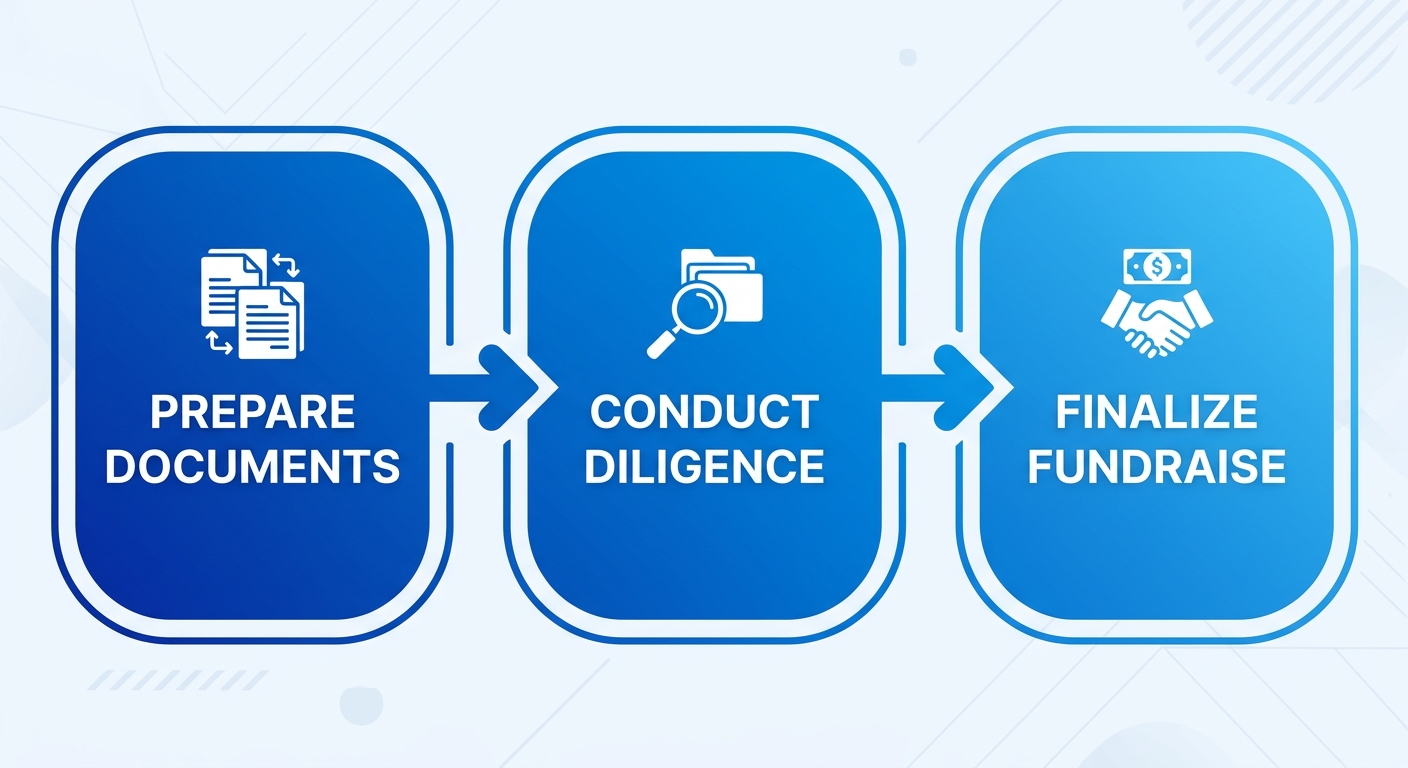
Three-step process flow for Series E fundraise preparation with blue gradient design.
This structured preparation begins with building a robust investor data room that aligns with late-stage expectations.
Building the Investor Data Room and Equity Story
Start assembling a comprehensive data room that includes detailed historical and projected financial models, a fully diluted cap table, top-10-plus customer contracts, a complete IP portfolio with patents and trademarks, and a strategic narrative that clearly positions the company for its next phase of growth. We often recommend using our Sovereign Data Nexus platform to securely organize and share these sensitive documents with vetted investors. The equity story for a Series E round should pivot from pure top-line momentum to unit-level profitability. Emphasize customer lifetime value (LTV) and acquisition cost (CAC) ratios, cohort retention curves, and the path to breakeven or profitability. Growth equity firms place high importance on operational maturity and a capital-efficient business model. A strong narrative will outline market leadership, defensible moats, and scalability. We have found that investors are persuaded by granular cohort analysis and retention data that validate product-market fit at scale. Preparing these materials early ensures a smooth diligence process and positions the company favorably in negotiations.
Navigating Diligence, Negotiation, and Term Sheet Dynamics
Due diligence for a Series E round is exhaustive, covering legal, financial, commercial, and technical areas in depth. Investors will scrutinize annual recurring revenue (ARR), net dollar retention, churn rates, customer acquisition cost (CAC), lifetime value (LTV), and cohort retention metrics with a level of granularity not seen in earlier rounds. We recommend preparing a comprehensive diligence checklist and appointing a dedicated project manager to coordinate responses across departments. Term sheet negotiations at this stage are complex and can materially affect founder economics. Founders must understand liquidation preferences (participation vs. non-participation), anti-dilution protections (weighted-average vs. full ratchet), board composition (majority control, observer seats), and registration rights (demand, piggyback, S-3). Managing a dual-track process–simultaneously pursuing Series E capital and preparing for an IPO–adds another layer of complexity. Companies need to align with legal counsel on S-1 filing timelines and roadshow planning. Engaging an experienced sell-side M&A advisory firm can streamline negotiations and dual-track management; we help clients navigate these dynamics while keeping strategic options open.
Transitioning from Venture Capital to Growth Equity
The decision to transition from venture capital to growth equity hinges on clear signals. Companies with revenue consistently above $20M-$50M, predictable unit economics, and a mature institutional investor base–such as pension funds, sovereign wealth funds, and mutual funds–are prime candidates for growth equity. Traditional venture capital firms often seek 10x returns over a long horizon, whereas growth equity targets more moderate returns (3-5x) over 2-4 years. This shift requires adjusting your investor narrative and expectations. A well-prepared Series E round should attract growth equity partners who provide not just capital but strategic value and a lighter governance touch. Recognizing these signals early allows management to prepare the right materials and target the right investors, avoiding wasted effort on VCs no longer aligned with the company’s scale. The following table illustrates the key differences between venture capital and growth equity for late-stage companies, as supported by FINRA-registered offering benchmarks.
| Metric | Venture Capital (Series A-D) | Growth Equity (Series E+) |
|---|---|---|
| Check Size | $2M – $40M per round | $25M – $200M+ per round |
| Board Involvement | Active board seat, high involvement | Board seat often required; lighter governance |
| Dilution per Round | 20-35% typical | 15-25% typical |
| Expected Return Horizon | 10x+ over 7-10 years | 3-5x over 2-4 years |
These benchmarks, drawn from aggregate data compiled by the Financial Industry Regulatory Authority (FINRA), help founders and CFOs determine the right capital partner for their Series E round.
With a Series E data room ready and term sheet dynamics understood, companies can strategically navigate toward an IPO or continue scaling with the right growth equity partner. This content is for informational purposes only and does not constitute an offer or solicitation. Securities are offered through Finalis Securities LLC; Zaidwood Capital is not a registered broker-dealer.
Growth Equity Strategies and Dilution Management in Late-Stage Rounds
While earlier rounds focus on rapid growth, late-stage rounds require careful dilution management. In a Series E round, companies often raise substantial growth equity to fund expansion, pursue strategic acquisitions, or prepare for a public offering–but each new capital injection can significantly dilute existing stakeholders. Pre-IPO financing, a common late-stage instrument, amplifies this tension between the need for scale-up capital and the imperative to preserve founder and early-investor ownership.
Effective dilution management hinges on several interrelated strategies. Pro-rata rights allow existing investors to maintain their percentage ownership by participating in new rounds, while careful allocation between primary capital (for company use) and secondary sales (for liquidity) calibrates the dilutive impact. Valuation caps and milestone-based fund tranches further protect existing shareholders by linking capital releases to the achievement of specific growth targets. Growth equity funds typically write larger checks at a lower risk profile than early-stage venture capitalists, making them more amenable to terms that balance dilution with long-term value creation. In addition, structuring rounds in compliance with SEC and FINRA private-placement exemptions, as the Financial Industry Regulatory Authority emphasizes in its Reg D guidance, adds a layer of oversight that supports orderly capital formation.
At Zaidwood Capital, our Growth Equity Advisory practice provides strategic counsel on investor negotiations and capital structure optimization. Engaging a boutique firm with comprehensive investment banking services can help structure terms that align the interests of new and existing stakeholders. We also guide companies through the regulatory obligations of private placements–securities offerings are conducted through a third-party broker-dealer, Finalis Securities LLC; Zaidwood Capital is not a registered broker-dealer–so that dilution strategies are executed on a sound legal foundation. Effective dilution management positions the company for a successful exit or public offering.
Common Questions About Series E and Late-Stage Financing
Potential investors and founders often ask how Series E financing works and what it means for a company’s trajectory. Below, we address the most frequent questions succinctly.
- What is Series E financing? Series E is a late-stage equity round, typically the final private raise before a company pursues an IPO or a major liquidity event.
- Who invests in Series E rounds? Institutional investors–hedge funds, sovereign wealth funds, and pension funds–commonly seek growth equity exposure at this stage.
- How does late-stage financing work? According to SIFMA, pre-IPO financing volumes reflect robust institutional demand. Companies often use convertible notes or preferred stock to bridge the gap to a public listing.
- What regulatory considerations apply? FINRA requires that private placements follow Rule 506 of Regulation D, limiting participation to accredited investors and mandating proper disclosures.
- Where can I learn more about advisory costs? For additional insight, refer to our FAQ on tech M&A advisory costs.
Understanding these common questions prepares you for the next step: evaluating the risks and rewards of late-stage investing.
A Series E round, the final private capital raise before an IPO or major liquidity event, must align with long-term capital objectives. Selecting growth equity investors who support strategic timelines and governance, rather than simply chasing the highest valuation, is critical. Optimizing the capital structure at this pre-IPO financing stage prevents over-dilution that could impair a public-market debut. SIFMA data indicates institutional investors, with over $75 trillion in global assets, increasingly favor late-stage companies with clear governance alignment. Maximizing short-term cash at the expense of strategic fit is a common misstep; achieving alignment requires careful attention to several factors we explore next.
Resources


