


Venture Capital Fundraising
Table of Contents
Navigating the Venture Capital Fundraising Journey
The venture capital fundraising journey begins well before a founder sends the first pitch deck–it starts with a deliberate state of readiness across financial documentation, market positioning, and leadership story. For a comprehensive step-by-step roadmap, see our guide on Raising Venture Capital For Startups.
The subsequent phases–investor identification, initial meetings, due diligence, term sheet negotiation, and closing–unfold across a structured path. Across the venture capital fundraising landscape, these stages interlock; thoughtful sequencing, clear milestones, and consistent focus help increase investor confidence and sustain momentum throughout an often-protracted fundraising process. According to Holloway, a standard fundraising process averages three months, though timelines shift with market conditions and company traction.
During venture capital due diligence, prospective investors scrutinize financials, team capabilities, market dynamics, and technology assets. A boutique advisory firm plays an instrumental role here, helping founders organize materials, anticipate investor questions, and manage the flow of information so that nothing stalls the process.
Term sheet negotiation marks a pivotal moment in the funding journey. Founders weigh valuation, governance rights, and liquidation preferences–terms that can permanently shape ownership and control. Experienced advisers help decode these provisions so founders negotiate from a position of strength rather than uncertainty.
Each of these phases warrants a closer look–starting with the critical due diligence stage.
Understanding the Venture Capital Fundraising Process
Raising institutional capital is a complex journey that can define a company’s trajectory. Understanding the venture capital fundraising process helps founders navigate preparation, outreach, due diligence, and term sheet negotiations with confidence. Self-directed fundraising often takes 6-12 months; our structured advisory-led approach, powered by the Velocity Matrix framework, compresses that to 3-6 months through warm introductions and refined materials.
Preparation starts with an investor-ready data room: cap table, financials, projections, and legal documents. UseHaven’s checklist advises organizing materials to reduce friction. Cold outreach rarely works; warm introductions through a trusted network are far more effective. As a Boutique M&A and Capital Advisory Firm, we connect founders with 4,000+ investors and $15B in capital for precision-matched engagement.
When investors express interest, due diligence begins. They examine market size, traction, unit economics, and competitive position. In venture capital due diligence, a professionally prepared data room and our Precision Catalyst platform streamline reviews, helping investors reach a term sheet quickly.
The term sheet negotiation stage defines valuation, liquidation preferences, board seats, and anti-dilution terms. In term sheet negotiation, inexperienced founders risk accepting unfavorable conditions. Our team provides strategic guidance to help founders understand trade-offs and secure growth-friendly terms.
Throughout venture capital fundraising, the differences between a self-managed effort and advisory-led process are stark. The table below contrasts key aspects.
| Aspect | Self-Fundraising | With Advisory Firm |
|---|---|---|
| Timeline to First Close | 6-12 months; often extended by cold outreach | 3-6 months; accelerated by warm introductions and structured process |
| Investor Access | Limited to personal network; cold outbound | Curated network of 4,000+ investors and $15B+ committed capital |
| Documentation Quality | Often incomplete; founders lack template experience | Investor-ready pitch decks, financial projections, and data room prepared by professionals |
| Successful Close Rate | Common average under 10% for first-time founders | Significantly higher; backed by proven deal lifecycle management |
Beyond speed, professional advisory support elevates documentation quality and investor confidence. Our investor-ready decks and populated data rooms, combined with a vast network, improve close rates–a sharp contrast to the sub-10% average Startups.com reports for first-time founders.
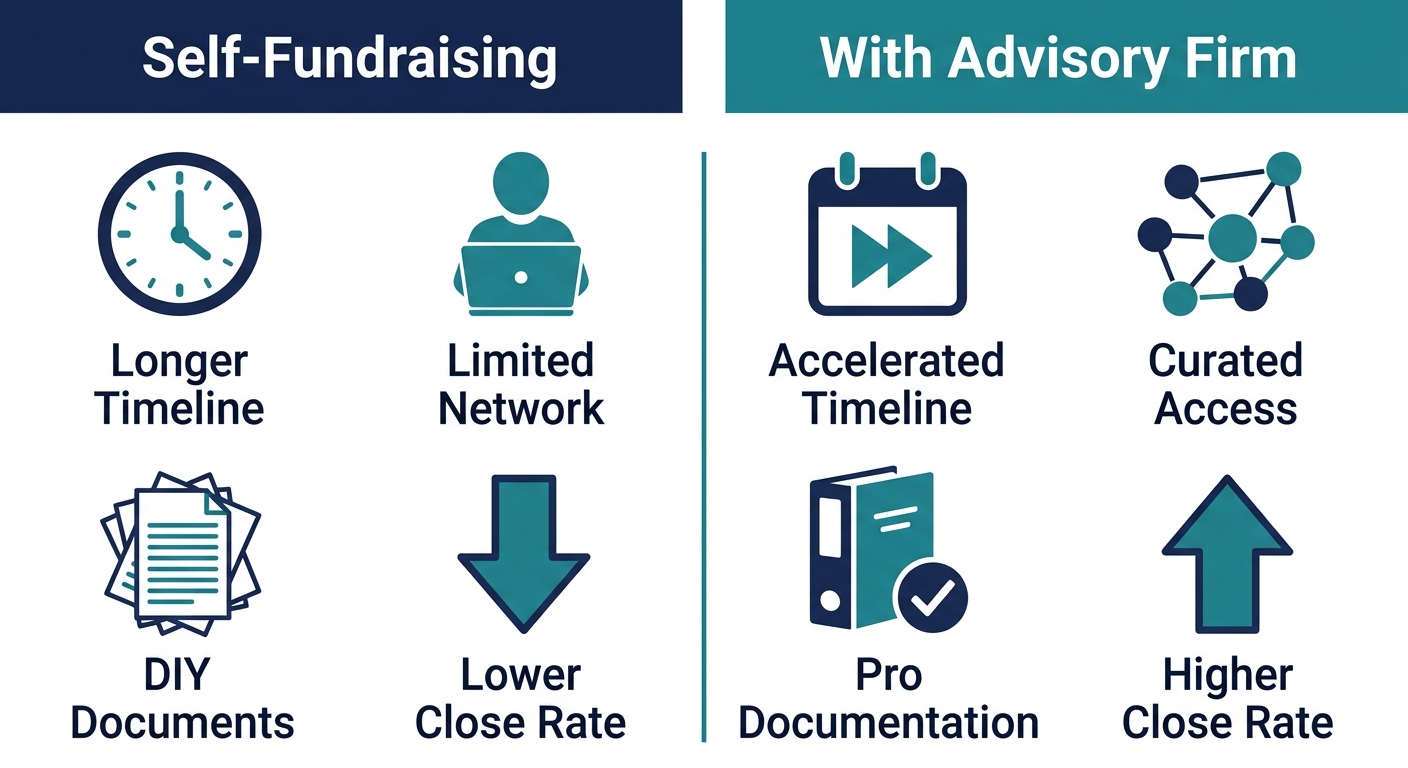
Advisory-led fundraising accelerates timelines and improves success rates.
Ultimately, venture capital fundraising is a high-stakes process where preparation, access, and negotiation skill are decisive. Founders who treat the fundraising journey as a disciplined, partner-supported campaign–rather than a series of disconnected outreach attempts–consistently achieve better terms and faster closes. For a comprehensive guide on each step, refer to our resource: How To Raise Venture Capital.
The venture capital fundraising process reaches its most rigorous stage when investors sign a Letter of Intent (LOI) and launch formal due diligence.
The Five Phases of VC Due Diligence
Once an LOI is executed, due diligence proceeds through five distinct phases–from data room setup to customer validation.
| Phase | Focus Area | Typical Duration | Key Activities & Documents |
|---|---|---|---|
| Pre-Diligence | Data Room & Initial Screening | 1-2 weeks | Prepare virtual data room with financials, cap table, legal docs, customer contracts |
| Financial Due Diligence | Financial Projections & Assumptions | 2-4 weeks | Verify revenue model, unit economics, historical statements, and growth drivers |
| Legal Due Diligence | Contracts, IP, Employment, and Corporate Structure | 3-6 weeks | Review IP assignments, employee agreements, board consents, litigation history |
| Technical Due Diligence | Product Architecture & Scalability | 1-3 weeks | Code audit, infrastructure review, security assessment, roadmap evaluation |
| Commercial / Customer Diligence | Market Fit & Customer Validation | 1-2 weeks | Customer reference calls, TAM analysis, competitive positioning review |
Pre-diligence focuses on building a comprehensive data room. For founders preparing for Series A funding, gathering financial statements, cap table records, legal agreements, and customer contracts is a critical head start. Nonprofit organizations like Launch NY, which provide capital access and mentorship, can help founders refine these materials before investor scrutiny begins.
Financial due diligence, the most scrutinized area, typically lasts two to four weeks and validates revenue projections, unit economics such as CAC and LTV, and growth assumptions. Legal due diligence (3-6 weeks) examines IP ownership, equity structures, and litigation history. Technical due diligence (1-3 weeks) involves code audits and scalability assessments. Finally, commercial due diligence (1-2 weeks) confirms market positioning through customer reference calls and competitive analysis. The Holloway Guide notes that the typical investor conducts due diligence on only four to five startups per year, underscoring the intensity of this phase.
The illustration below maps the end-to-end flow.
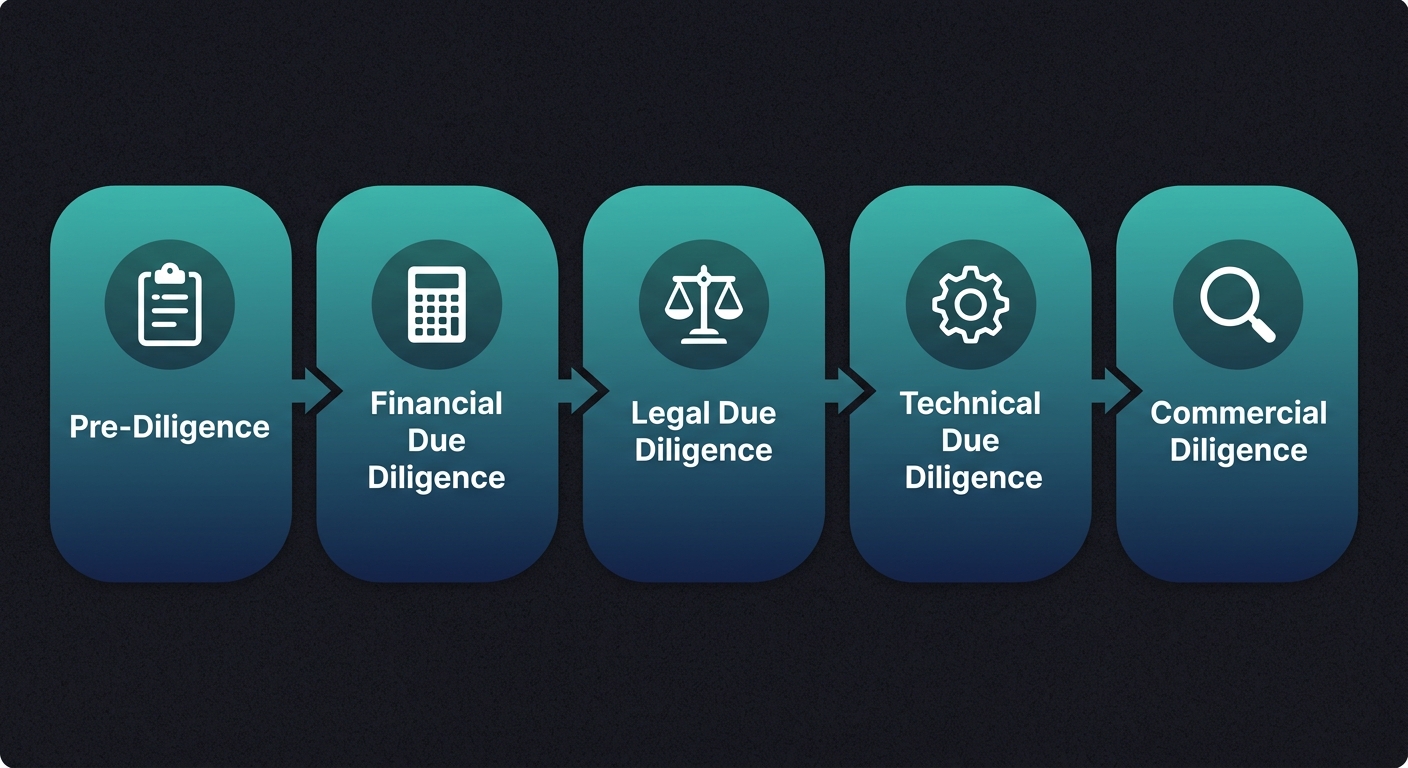
Five-stage venture capital due diligence process flow from pre-diligence to commercial diligence.
With the high-level framework established, we’ll now examine how investors verify financial projections.
How Investors Verify Financial Projections
Financial projections are often the first area to face intense scrutiny. Investors cross-check historical revenue and cost data against forward-looking assumptions, testing whether growth drivers are realistic. They analyze unit economics–customer acquisition cost (CAC), lifetime value (LTV), gross margins, and payback periods–to gauge sustainability. The Holloway Guide underscores that revenue quality and retention metrics trump topline growth. We find that the most resilient projections include sensitivity analyses that model best-case, base-case, and downside scenarios, allowing investors to assess risk. Common investor questions probe churn rates, cohort performance, and sales cycle length, so founders should prepare granular data to support every assumption.
Legal, Technical, and HR Due Diligence Deep Dive
Once the financial picture aligns with investor expectations, the focus shifts to legal, technical, and human capital hazards. Legal due diligence is the lengthiest phase–typically three to six weeks–and involves a thorough review of incorporation documents, board consents, IP assignments, and every material contract. Investors confirm that the company holds clear title to all intellectual property and that contractors and employees have signed invention assignment agreements. Any litigation history, regulatory exposure, or compliance gaps will be flagged. The term sheet negotiation process often surfaces at this stage, as investors may adjust representations and warranties based on legal findings. Technical due diligence runs in parallel: a code audit assesses architecture, security protocols (such as SOC 2 or encryption standards), and the product roadmap’s alignment with market needs. HR diligence simultaneously examines key-person risk, stock option plans, and employment classification to avoid misclassification liabilities. Together, these deep dives expose vulnerabilities that, if left unaddressed, could derail the transaction.
At Zaidwood Capital, we guide founder-led teams through every stage of due diligence, leveraging our proprietary data platform and investor network to help them anticipate investor questions and streamline the process. (Securities offered through Finalis Securities LLC; Zaidwood Capital is not a registered broker-dealer.)
Mastering Term Sheet Negotiations
Once you have identified the right investors, the next step is to master the term sheet. In venture capital fundraising, the term sheet distills the economic and control framework that will govern your company’s relationship with new investors. A clear understanding of its key clauses allows founders to negotiate from a position of strength without stalling the deal.
Valuation and Liquidation Preferences: The Two Key Levers
Valuation sets the economic baseline. Pre-money valuation is the company’s worth before the investment lands; post-money equals pre-money plus the new capital. Liquidation preference defines how proceeds are distributed in a sale or liquidation. Industry guidance from Holloway confirms that early-stage rounds (Seed, Series A) typically use a 1x non-participating preference, while later-stage or stressed rounds may introduce participating preferred, which lets investors recover their preference and then share pro-rata in the remaining proceeds–a double-dip structure that can reduce founder returns.
The following table illustrates the two most common structures and their impact on founder exit proceeds.
| Feature | Participating Preferred | Non-Participating Preferred (Standard) |
|---|---|---|
| How It Works | Investors take their liquidation preference THEN share in remaining proceeds pro rata | Investors choose between their preference amount OR converting to common and sharing pro rata |
| Founder Exit Proceeds (Successful Exit) | Less favorable to founders; investors collected double dip | More favorable to founders; investors only double dip if they choose conversion |
| Common Use Cases | Stressed or later-stage rounds where investors seek downside protection | Standard for most early-stage VC rounds (Seed, Series A, Series B) |
| Negotiation Leverage | Founders often concede in exchange for higher valuation or fewer board seats | Stronger position for founders; investors accept standard terms in competitive rounds |
Non-participating preferred is the market standard and aligns more closely with common stockholders because investors only double dip if they elect to convert. Participating preferred, while less founder-friendly, sometimes appears in tougher fundraising environments. We recommend founders push for the non-participating structure unless the valuation premium or strategic value of the investor justifies the concession.
Protective Provisions and Board Seat Allocation
Protective provisions grant investors veto power over specific corporate actions, even if they hold a minority stake. Common provisions require investor approval for changes to the authorized share structure, the incurrence of material debt, the sale of major assets, and alterations to executive compensation plans. We advise founders to negotiate carve-outs that preserve operational agility–for example, a debt threshold under $500,000 that does not trigger investor consent. These guardrails keep the company moving without unnecessary friction.
Board seat allocation is equally critical. Early-stage rounds frequently place one to two investor-appointed directors on the board, while common stockholders retain the majority. Founders should consider adding an independent director to balance perspectives and signal governance maturity. At Zaidwood Capital we have seen that a balanced board structure–one that respects investor oversight without ceding control–lays the groundwork for productive long-term partnerships. For full-cycle guidance on term sheets, founders can explore our investment banking advisory services.
Anti-Dilution Clauses and Other Key Negotiation Points
Anti-dilution provisions protect investors if the company later issues shares at a lower price. The weighted-average formula is the industry standard and adjusts the conversion price based on the size and price of the new round, dampening dilution for founders and employees alike. Full-ratchet anti-dilution–which reprices all prior shares to the lower price–is far more punitive and can severely dilute common holders; we caution founders to avoid it unless there is no viable alternative.
Drag-along rights allow a majority of shareholders to compel minority holders to accept a sale. To safeguard against premature exits, negotiate a minimum price or a minimum time horizon before the right can be exercised. Information rights set the cadence for investor reporting; the typical arrangement delivers quarterly and annual financial statements. Sticking to these standard information rights keeps the administrative burden manageable while satisfying investor oversight needs. As UseHaven’s investor data room checklist underscores, organizing due diligence materials early not only supports thorough venture capital due diligence by investors but also strengthens your hand during term sheet negotiation by demonstrating operational readiness.
With a clear understanding of the term sheet, you can now move toward investor due diligence and finalizing the deal.
Optimizing Your Fundraising Strategy with Data-Driven Tools
For founders of growth-stage companies, securing venture capital fundraising often depends on manually searching investor databases, leveraging personal networks, and enduring a serial, one-off process that can stretch beyond 12 months. Meaningful opportunities slip through the cracks when matching relies on instinct rather than analytics. Traditional ecosystem programs–like the capital access and mentorship initiatives offered by Launch NY–provide valuable connections, yet these remain network-bound and labor-intensive. To accelerate outcomes, companies need a more systematic, data-driven fundraising strategy.
The shift from manual to data-driven fundraising transforms four critical dimensions: investor matching, deal sourcing, negotiation support, and time to close. The following table illustrates the practical differences between traditional methods and the AI-augmented approach we deploy at Zaidwood Capital.
| Factor | Traditional Fundraising | Data-Driven Fundraising (with AI) |
|---|---|---|
| Investor Matching | Manual research; relies on founder network; high miss rate | AI-powered matchmaking based on fund criteria, sector, stage, and historical patterns (Precision Catalyst) |
| Deal Sourcing & Visibility | Static pitch decks and blind submissions | Dynamic dealflow portal with secured data room and proactive investor alerts (Sovereign Data Nexus) |
| Negotiation Support | Founder-led; often lacks market benchmarks and competitive term data | Advisory team uses live market analytics, term sheet comparables, and scenario modeling (Velocity Matrix) |
| Time to Close | 6-12 months; relies on sequential manual steps | 3-6 months; parallelized stages with automated data room and real-time investor feedback |
The comparison highlights how data-driven fundraising overcomes the inherent limitations of manual processes, fundamentally transforming venture capital fundraising.
Our Precision Catalyst tool leverages advanced algorithms to screen thousands of investor profiles, identifying high-probability matches based on fund size, sector affinity, and historical deal patterns. This AI-driven matchmaking–often referred to as what is gen ai–replaces the guesswork of manual research, significantly raising the likelihood of a successful introduction. Meanwhile, Sovereign Data Nexus serves as a comprehensive dealflow hub: it houses due diligence materials in a secure data room and proactively pushes deal alerts to relevant investors, thereby streamlining venture capital due diligence. On the negotiation side, Velocity Matrix equips our advisory team with real-time market comps and term sheet benchmarks, enabling more informed term sheet negotiation and reducing the risk of unfavorable clauses.
By integrating these capabilities, Zaidwood Capital helps founders compress the typical raise timeline from 6-12 months to a focused 3-6 month cycle, while also improving the quality of investor engagement and the competitiveness of term sheets. This is what we mean by Financial Services 3.0–a fusion of expertise and technology that powers better outcomes. By adopting this integrated approach, startups can move beyond the limitations of traditional fundraising and unlock more strategic capital relationships.
Common Questions About Venture Capital Fundraising
In our work with growth-stage companies, we are often asked: what are the key stages of venture capital fundraising? The VC fundraising lifecycle moves from preparation to closing, including due diligence and term sheet negotiation. Most venture capital fundraising cycles in the US run three to six months, but success is never guaranteed.
As they enter the due diligence phase, founders frequently ask: how does venture capital due diligence work? Investors review financials, legal documents, and market positioning. This venture capital due diligence validates the business before a term sheet is issued.
At the term sheet stage, a common question is: what should we know about term sheet negotiation? Valuation, board seats, liquidation preferences, and protective provisions are key. Because outcomes depend on many factors, term sheet negotiation requires careful alignment of founder and investor interests.
Key Takeaways for Your Fundraising Journey
- In venture capital fundraising, thorough venture capital due diligence is non-negotiable–our Sovereign Data Nexus database shortens vetting cycles with proprietary insight.
- Term sheet negotiation is where value is won or lost–our Precision Catalyst platform models term scenarios and streamlines fintech capital raising with 4,000+ investors.
- The right advisory partner compresses timelines–our network of 4,000+ investors and $15B+ in accessible capital open doors without unnecessary delay.
- We invite you to discuss your fundraising journey with our team and explore how we can help accelerate your next round.
Resources


