



Sell My Business
Table of Contents
Selling Your Business: A Comprehensive Guide
When you decide to sell my business, the journey begins with careful planning. If you are ready to learn the exact steps, visit our dedicated page on how to sell my business. The process involves three critical stages: preparation, marketing, and negotiation, each requiring specialized expertise.
Exit planning is the cornerstone of a successful ownership transition. Before listing your business, you need a formal business valuation to set a realistic asking price. Sellers should gather financial statements, conduct a professional valuation, and address any operational or legal issues. According to FINRA guidance, common legal pitfalls–such as incomplete documentation or undisclosed liabilities–can derail a sale. Early exit planning and a thorough valuation ensure you present a clean, attractive opportunity.
SIFMA reports that merger activity has remained strong, creating favorable conditions for sellers. Marketing your business leverages a curated network of pre-qualified investors. A boutique advisor can confidentially showcase your company without disrupting operations. When offers arrive, we evaluate not just price but also terms, timing, and buyer qualifications, structuring the deal to maximize value.
Whether you are ready to start or simply exploring, our sell-side advisory team can help. As a Boutique M&A and Capital Advisory Firm, we guide sellers through every step. Visit our how to sell my business page for a step-by-step guide.
Fundamentals of Exit Planning and Valuation
For many business owners, the moment they decide to sell my business is the start of a complex process that demands thorough preparation. Exit planning and business valuation are the cornerstones of a successful business sale process, enabling you to maximize value, reduce tax exposure, and avoid common pitfalls. We advise starting this planning three to five years in advance to build the financial and operational readiness buyers expect.
Exit planning is a strategic initiative that aligns your personal, financial, and business goals long before a transaction takes place. According to the Exit Planning Institute’s State of Owner Readiness research, over half of business owners still lack a written transition plan, and most have not assembled a professional advisor team. Starting early creates the necessary space to conduct a financial review, improve operational efficiency, and build a transferable enterprise that attracts qualified buyers.
A comprehensive exit plan covers a financial review (cleaning up statements and projecting cash flows), operational improvements (scalability and reduced owner dependence), a formal valuation assessment, legal and tax structuring to optimize proceeds, and succession planning to ensure continuity for customers and staff. This disciplined exit planning process transforms the exit from a single event into a manageable, value-building journey.
Determining what a business is worth is one of the most critical, yet misunderstood, aspects of selling your company. Business valuation is not a single number but a range informed by multiple methodologies. Penn State University outlines three primary approaches that serve as the academic backbone of modern valuation practice:
- Income Approach (Discounted Cash Flow) – projects future earnings and discounts them to present value, reflecting the business’s ability to generate cash.
- Market Approach (Comparables) – benchmarks the firm against recent sales of similar businesses, adjusted for size, industry, and geography.
- Asset-Based Approach (Net Asset Value) – calculates total assets minus liabilities, capturing the company’s tangible and intangible net worth.
The income approach, in particular, provides a forward-looking lens that helps owners understand the growth potential buyers might price into the deal.
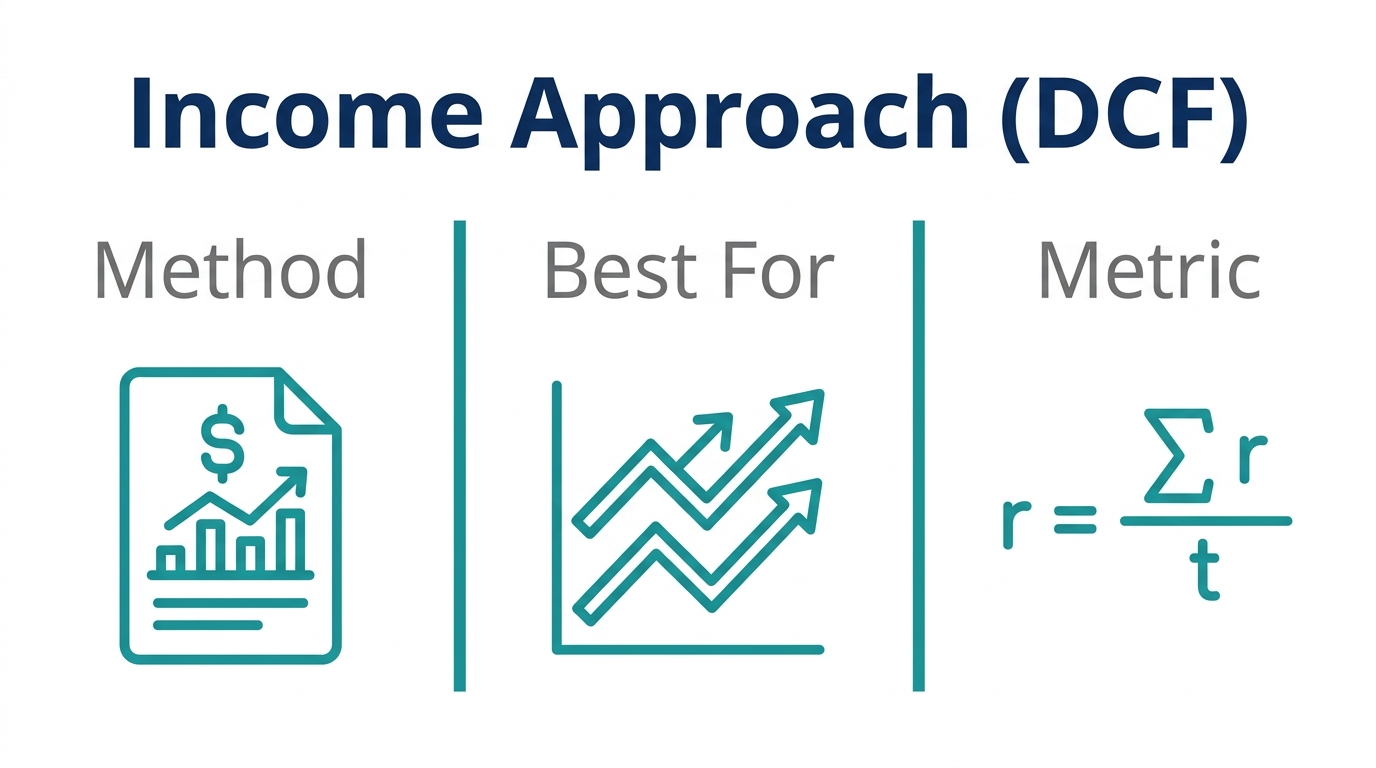
Income Approach (DCF) infographic for valuation methods.
These valuation methods produce a range that becomes one input in setting the asking price, not the final figure. Market conditions, buyer demand, and deal structure all influence the ultimate transaction value. Overpricing a business without supporting data, or listing it before operational weaknesses are resolved, are two of the most frequent reasons deals stall. A professional valuation analysis, integrated into a broader exit strategy, helps you set realistic expectations and enter negotiations with confidence.
As a Boutique M&A and Capital Advisory Firm, we place business valuation at the heart of our full-cycle M&A approach, delivering sell-side advisory that connects disciplined valuation with strategic positioning and buyer outreach. For a step-by-step guide tailored to your situation, visit our Help Selling My Business resource.
Deep Dive into Business Valuation and Timing
To make informed decisions when you decide to sell my business, it’s critical to understand what drives value and when to act. At Zaidwood Capital, a Boutique M&A and Capital Advisory Firm, we guide business owners through the complexities of valuation and timing to maximize outcomes.
The table below summarizes the three valuation approaches and their typical applications.
Table: Valuation Approaches at a Glance
| Business Valuation Approaches | Best For | Common Multiple/DCF |
|---|---|---|
| Market Approach | Established companies with comparable transactions | EBITDA multiple (6x-10x typical for mid-market) |
| Income Approach (DCF) | Growth-stage firms with predictable cash flows | Discounted cash flow at WACC |
| Asset Approach | Asset-heavy or distressed businesses | Adjusted net asset value |
Now, let’s examine the key factors that influence valuation and how they affect your company’s worth.
Key Factors That Influence Your Company’s Value
Valuation is not a simple equation. It is driven by a set of interrelated factors that buyers scrutinize closely. According to SIFMA, higher revenue growth rates typically command higher EBITDA multiples in the market approach, often ranging from 6x to 10x for mid-market firms. Conversely, customer concentration presents a major red flag. If a single client accounts for more than 30% of total revenue, buyers will discount the valuation to account for business continuity risk. Recurring revenue from subscriptions or long-term contracts is valued significantly higher than transactional revenue because it delivers predictable, stable cash flows. Additionally, proprietary intellectual property, such as patented technology, can push asset-based valuations higher by signaling sustainable competitive advantages. FINRA emphasizes the importance of rigorous methodology, so all assumptions must be well-documented to satisfy buyer due diligence. A comprehensive business valuation also scrutinizes profit margins and market positioning, as buyers seek evidence of sustainable competitive moats. Strengthening these factors positions your company more favorably in any valuation framework.
Determining the Right Time to Sell
The decision to sell my business is as dependent on timing as it is on financial metrics. Externally, we recommend monitoring industry M&A activity and interest rate trends. When M&A volumes are rising and borrowing costs are low, buyer competition increases, often driving up valuations. Conversely, rising interest rates can cool the market and compress multiples, so early positioning is key. Seasonality also plays a role: selling after a peak revenue period–such as post-holiday for retailers or after a strong project pipeline for construction firms–can showcase the best earnings profile. On a personal level, your own readiness is paramount. If you’re willing to stay on for a transition period, investors may be more comfortable paying a premium; a desire for a full, immediate exit may require alternative structures like an earn-out. Effective exit planning integrates these market signals and personal goals, allowing you to time the sale to maximize both financial return and lifestyle objectives.
Preparing to Maximize Your Business Valuation
To maximize valuation, begin preparing early. Commission a financial audit at least 12 months ahead of the sale to provide buyers clean, reliable numbers. Reduce customer concentration so no single client exceeds 20% of total revenue. Strengthen the management team with capable leaders who can run the business independently. As part of comprehensive exit planning, these moves lower risk and increase attractiveness. Our Velocity Matrix framework can accelerate the preparation process. For further guidance, visit our Zaidwood Capital FAQ.
By mastering these valuation and timing considerations, you are now prepared to explore the step-by-step process of a successful sale.
Practical Steps for a Successful Business Sale
Once you’ve prepared your business, executing a successful sale demands careful planning. If you’re looking to sell my business, these practical steps can guide you through the process.
Building Your Data Room: Documentation Checklist
A well-organized data room is the foundation of a successful sale. According to the Exit Planning Institute, a comprehensive package should include financial statements for 3-5 years, tax returns, legal contracts (leases, supplier agreements), customer and supplier lists, operational manuals, and financial projections. A professional business valuation provides a realistic price anchor. Key documents include:
- Financial statements and tax returns
- Legal contracts and agreements
- Customer and supplier lists
- Operational manuals
- Financial projections and growth plans
Maintaining Confidentiality During the Sale Process
Confidentiality is paramount when exploring a sale. FINRA guidelines recommend non-disclosure agreements, blind teasers, and coded deal names. At Zaidwood Capital, we use our proprietary Sovereign Data Nexus platform to manage secure data rooms, controlling access to vetted buyers. We release information in phases–starting with a high-level overview–to protect employee morale and avoid operational disruptions. Maintaining a low profile until the final stages prevents customer attrition and preserves market value.
Should You Hire an M&A Advisor or Go It Alone?
When considering your options, many owners ask: Who Can Help Me Sell My Company? Exit planning plays a central role in choosing the right path. The table below compares the three main types of sell-side support:
| Advisor Type | Best For | Key Benefits | Confidentiality Capability |
|---|---|---|---|
| Boutique M&A Advisory Firm (Zaidwood Capital) | Growth-stage and middle-market companies ($5M+ revenue) | Full-cycle support, institutional buyer network, AI-driven matchmaking by a boutique investment bank | High — managed data room, NDAs, blind processes |
| Business Broker | Smaller businesses ($1M-$5M revenue) | Local listings, lower fees, simpler transactions | Moderate — depends on broker practices |
| DIY (No Advisor) | Very small businesses with simple operations or owners with M&A experience | No advisory fees, full control | Low — hard to maintain confidentiality without a third party |
As a Boutique M&A and Capital Advisory Firm, we provide full-cycle support, an institutional buyer network, and AI-driven matchmaking, but every sale is unique. Our team evaluates your situation to recommend the best structure.
Selecting the right advisor is a pivotal decision that shapes the entire sale. We work closely with you to align your goals with the appropriate resources and expertise. With the right partner selected, you can proceed to a structured sale process that maximizes value and minimizes disruption.
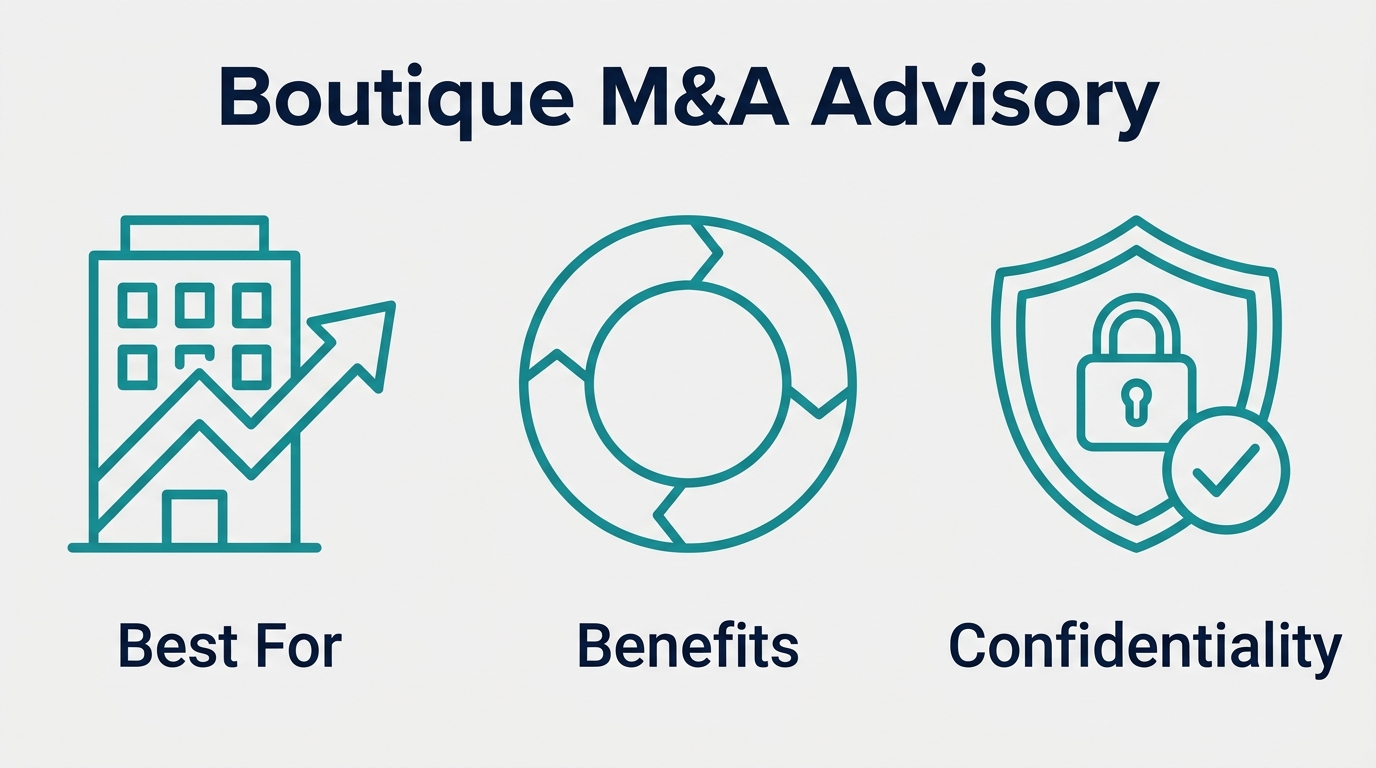
Boutique M&A Advisory infographic highlights key factors for sell-side support.
Engaging a professional advisor ensures that your sale moves efficiently from preparation to close. Our dedicated team manages the entire process, from initial teaser to final negotiations, so you can maintain focus on daily operations. With a structured approach, you minimize surprises and protect the value you’ve built.
Navigating the Sale Process with Professional Support
Our Full-Cycle M&A process covers every stage–from marketing and buyer outreach to due diligence, negotiation, and closing. We leverage a network of 4,000+ investors and our Precision Catalyst AI tool to identify the best-fit buyers. The Velocity Matrix framework ensures a rapid yet rigorous timeline. We coordinate legal and tax advisors, manage diligence, and drive negotiations while you focus on running your business. From the initial teaser document to the final purchase agreement, our team provides comprehensive support. Our data-driven approach minimizes surprises and maximizes certainty.
With these practical steps, you are ready to move toward closing. The next section covers the final transaction stages and how we can assist. Securities are offered through Finalis Securities LLC; Zaidwood Capital is not a registered broker-dealer and is unaffiliated with Finalis.
Advanced Strategies for Maximizing Your Exit
Once you have established a solid exit baseline, advanced strategies can further maximize your outcome. For business owners ready to sell my business, the difference between a good and a great transaction often lies in the deal architecture and buyer targeting approach.
As outlined by the Exit Planning Institute, a multi-year runway allows owners to prepare their business for sale by aligning personal, financial, and business goals with value drivers. The following strategies can help enhance deal terms and final proceeds.
- Phased exits with earn-outs can bridge valuation gaps between buyers and sellers. According to SIFMA, earn-outs are increasingly common in current M&A structures, allowing sellers to realize additional consideration based on post-closing performance. Our team structures contingent payments that align incentives while protecting the seller’s upside.
- Seller financing often attracts a broader buyer pool. By offering a loan for part of the purchase price, you reduce upfront capital needs and can secure a higher total payout. This also signals confidence in future cash flows.
- Proprietary buyer targeting using our Sovereign Data Nexus platform identifies institutional investors with a high probability of close. Our Precision Catalyst AI engine then matches your company’s specific attributes with investor mandates, history, and sector focus, dramatically reducing the time to find the right counterparty.
- Optimizing exit timing based on industry M&A cycles can materially increase valuations, especially when you have first improved key business valuation metrics. By analyzing SIFMA data on sector-specific deal volumes and market momentum, we help owners initiate processes when buyer appetite is strongest, creating competitive tension that often yields better terms.
These advanced strategies are core to our sell-side M&A approach, where we apply our Velocity Matrix to compress the deal timeline and Full-Cycle M&A framework to manage every aspect of the transaction. For a deeper look at how Zaidwood structures sell-side engagements, contact our advisory team.
Frequently Asked Questions About Selling Your Business
When you decide to sell my business, a thorough understanding of the process is essential. Below we address the most common questions.
How do I determine the value of my business?
A comprehensive business valuation from an M&A advisor analyzes your financials, market, and assets to establish a defensible price. This analysis carries far more credibility with institutional buyers than a broker’s opinion.
We compare the two common approaches below.
Table: Professional Valuation vs. Broker’s Opinion of Value
| Aspect | Professional Business Valuation (M&A Advisor) | Broker’s Opinion of Value (BOV) |
|---|---|---|
| Depth of Analysis | Full financial, market, and asset analysis; often includes DCF and multiple comps | High-level estimate based mainly on market comparables and limited due diligence |
| Best Use | Sell-side preparation, negotiating with institutional buyers, litigation support | Quick price check for small businesses, initial conversation starter |
| Independence | Performed by a third-party with no direct interest in the transaction | Often prepared by the broker representing the seller; potential bias |
| Buyer Credibility | Higher – buyers trust an independent valuation to set a fair price range | Lower – buyers may discount a BOV as not rigorous |
Beyond valuation, timing plays a critical role in a successful transaction.
When should I start exit planning?
Start exit planning two to three years ahead of a sale. FINRA’s alerts note that early preparation helps avoid pitfalls like poor recordkeeping and unrealistic pricing.
What should I look for in an M&A advisor?
Seek a boutique M&A firm with a robust sell-side process, strict confidentiality through NDAs and controlled information release, and experience with both strategic and financial buyers. The advisor’s understanding of valuation differences across buyer types sets realistic expectations.
Your Path to a Successful Exit
The decision to sell my business launches a multi-phase journey requiring careful preparation and strategic execution.
A robust exit planning process, aligned with the Exit Planning Institute’s Value Acceleration Methodology, transforms the sale into a continuous value-growth initiative. It begins with a professional business valuation that provides objective market insights; proprietary tools like Sovereign Data Nexus and Precision Catalyst then translate that analysis into an actionable roadmap. As a Boutique M&A and Capital Advisory Firm, we provide the guidance and resources to navigate each step toward a successful exit.
Resources


