


Medical Device capital raising
Table of Contents
Navigating Medical Device Capital Raising
Medical device capital raising presents a uniquely complex pathway that demands specialized expertise due to the sector’s rigorous regulatory and clinical milestones. At Zaidwood Capital, we guide companies through these longer-than-average financing lifecycles, leveraging our deep understanding of current Medtech venture capital trends. Industry data from PitchBook confirms that Medtech venture capital investment has shifted markedly toward later-stage rounds, concentrating capital behind de-risked assets. Further, Medical device startup valuation hinges critically on intellectual property robustness, FDA clearance status, and clear reimbursement potential–metrics our Sovereign Data Nexus tracks in real time. Understanding these dynamics sets the stage for evaluating the best funding structure for a medical device company. For specialized guidance in this space, explore our dedicated page on Drug Delivery capital raising.
1. Understanding the FDA Impact
One of the most critical factors shaping medical device capital raising is the regulatory landscape. The pathway a device takes through FDA review–either 510(k) clearance or the more rigorous PMA approval–directly influences how investors perceive risk and structure their commitments.
We see that Medtech venture capital trends increasingly demand a fully articulated regulatory strategy as a condition for deploying capital. Investors scrutinize clinical trial design and projected FDA submission timing during due diligence. When FDA-related delays or rejections occur, Medical device startup valuation can fall by an estimated 20-30%, reshaping negotiations entirely.
It is important to note that FDA clearance does not guarantee commercial success; however, it does materially reduce regulatory uncertainty and makes the company more fundable. A well-managed regulatory process, grounded in sound legal analysis from firms such as Goodwin Law, can accelerate fundraising and strengthen deal structure. Partnering with an experienced advisory firm like Zaidwood Capital Advisory can help medical device companies navigate these critical hurdles.
2. Venture Capital vs. Strategic Investment
Choosing the right partner is central to effective medical device capital raising, with each path offering distinct advantages. We see two dominant models: venture capital and strategic investment, and understanding their differences is critical for medtech founders. Recent PitchBook data reflects evolving Medtech venture capital trends that influence round sizes and deal structures.
Venture capital typically provides operational guidance and a broad network, yet it often involves significant dilution and a clear exit timeline. This path can heavily influence Medical device startup valuation as funds seek outsized returns. In contrast, a strategic investor–often a larger corporation–can unlock immediate distribution channels and boost credibility, though founders may concede some operational autonomy.
We observe that strategic investments are frequently a precursor to broader industry consolidation. Such moves naturally pave the way for healthcare mergers and acquisitions, transforming the competitive ecosystem. Our team helps clients navigate these choices, balancing ​​the resources of a corporate partner against the desire for independence.
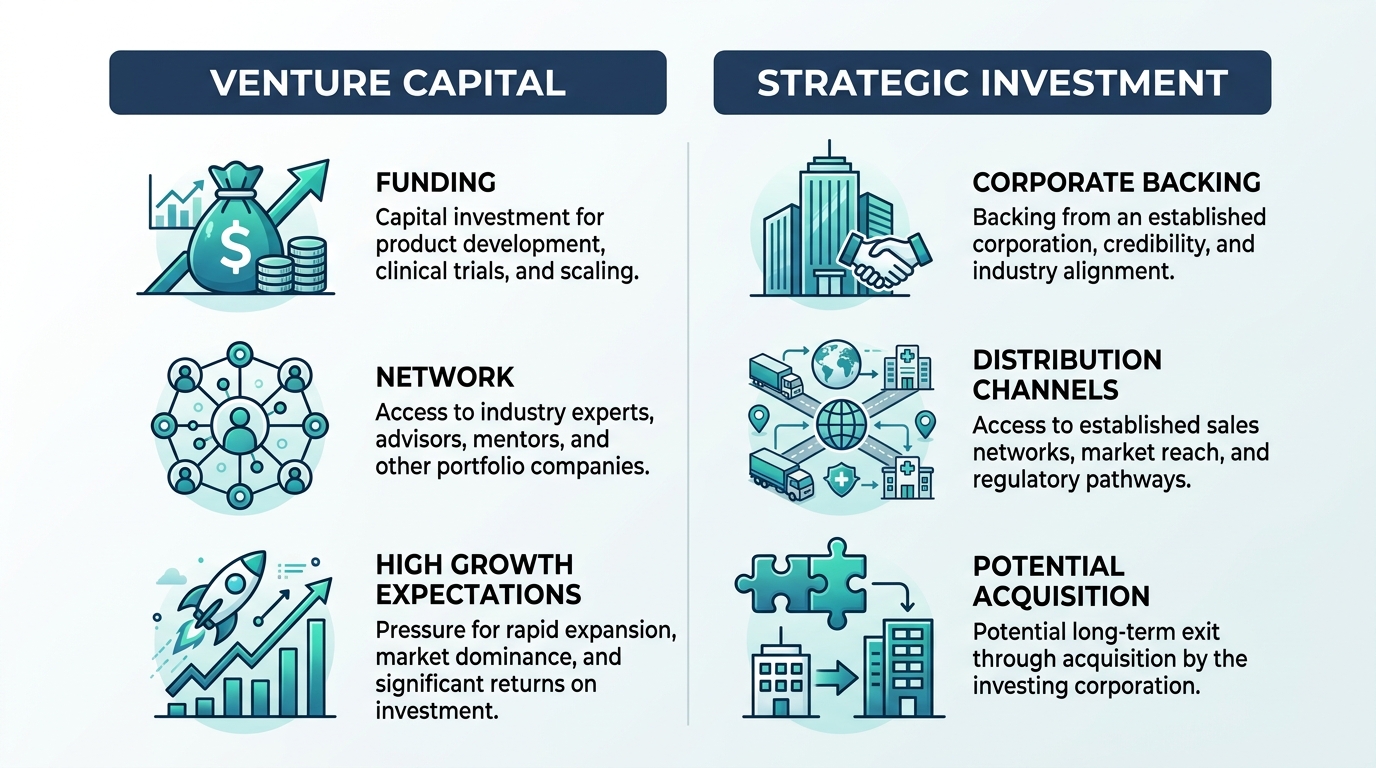
Venture capital versus strategic investment comparison.
A clear funding strategy ensures that the right capital aligns with long-term business objectives. Selecting the right investor is a pivotal step in the capital raising journey.
3. Demonstrating Market Validation
For medical device capital raising, founders should first understand what is an investment bank and how it evaluates market validation before engaging a mandate. We commonly see investors in the medtech venture capital space require objective, verifiable evidence that a product has progressed beyond concept. The following milestones represent the most persuasive forms of validation we observe when raising capital for medical devices:
- Clinical Data: Phase II enrollment of 150 patients with primary endpoint results demonstrating statistical significance (p < 0.05).
- Regulatory Milestones: FDA 510(k) clearance received Q3 2024, or Breakthrough Device Designation granted.
- Revenue Traction: Pilot sales agreements with minimum commitments ranging from $500,000 to $2 million, supported by letters of intent from three regional hospital systems.
- KOL Adoption: Evaluation agreements with key opinion leaders at two academic medical centers, with repeat purchase orders following initial pilots.
These metrics anchor a credible medical device startup valuation and demonstrate that the product addresses a genuine clinical need. With validation established, the financial model can be grounded in real traction data rather than assumptions alone.
This content is for informational purposes only and does not constitute an offer or solicitation to buy or sell any security. Investments involve risk and are not guaranteed to appreciate.
4. Crafting a Winning Pitch Deck
Once you have a capital-raising strategy in place, the next critical step is crafting a pitch deck that convinces investors to back your medical device capital raising vision. Understanding what is an investment bank is essential, as such firms often guide the pitch deck process and connect you with the right institutional partners. Your deck’s primary goal is to communicate your value proposition and secure investor interest within the first few slides.
Essential Slides for Your Medtech Pitch Deck
- Problem – Define the unmet clinical or operational need.
- Solution – Explain how your medical device addresses that need with differentiated technology.
- Market Opportunity – Present TAM, SAM, and SOM, grounded in current Medtech venture capital trends and credible data.
- Technology & IP – Describe your proprietary innovation and patent landscape.
- Regulatory Pathway – Map out FDA, CE marking, or other approval milestones.
- Business Model – Show how you will generate revenue and scale.
- Traction – Highlight clinical data, pilot studies, or early adoption metrics.
- Team – Showcase experienced leadership with relevant medtech and commercial expertise.
- Financial Projections – Provide high-level revenue forecasts and key assumptions, acknowledging Medical device startup valuation benchmarks.
Tailoring Your Deck to the Right Audience
Medtech venture capital trends show that funds prioritize clinical validation and regulatory clarity, so tailor your narrative to demonstrate de-risked milestones. Strategic partners may focus on synergies and market access, while family offices often value longer-term impact. We recommend you customize the emphasis and language of each slide to match the investor’s thesis.
According to Umbrex, a trusted source for professional pitch deck standards, adhering to clean design and a logical narrative flow significantly improves investor engagement. Their best practices advise minimal text, high-impact visuals, and data that tells a compelling story. Avoid common pitfalls such as overcrowded slides with excessive text, omission of risk disclosures, and unrealistic market sizing. These mistakes can quickly erode credibility.
As a Boutique M&A and Capital Advisory Firm, Zaidwood Capital can help refine your deck’s storytelling using tools like the Precision Catalyst for targeted investor engagement. With your polished deck ready, you can move to investor targeting and due diligence preparation–topics we cover in the next section.
5. Leveraging Non-Dilutive Funding
Beyond equity and debt financing, non-dilutive funding offers a powerful alternative in medical device capital raising, securing capital without sacrificing ownership. At our firm, a Boutique M&A and Capital Advisory Firm, we help clients integrate these opportunities into a comprehensive funding strategy. Federal grants, like the NIH SBIR and STTR programs, are prime examples. According to the National Institutes of Health (NIH), the SBIR program can award substantial non-dilutive capital, with Phase II awards reaching up to $2 million for medical device development. This is a critical tool for medical device fundraising.
In the context of Medtech venture capital trends, these grants provide strategic advantages. The SBIR program offers flexibility for pure startups, while the STTR program mandates a formal partnership with a research institution. Grants typically progress through a Phase I (~$250K over 6-12 months) for feasibility, followed by a larger Phase II (~$1-2M over two years) for development. This capital validates your technology and generates crucial preclinical data, effectively de-risking the investment for future equity rounds. Successfully securing a grant can directly improve Medical device startup valuation by providing third-party validation and reducing dilution, which in turn can position your company more favorably for a future tech mergers and acquisitions transaction.
By layering non-dilutive grants with traditional fundraising, medical device companies can build a capital structure that supports both early R&D and scaling toward an exit. However, grants are highly competitive and demand rigorous preparation. We advise consulting professional grant writers and, importantly, your legal, tax, and financial advisors before making any funding decisions.
6. Analyzing Medtech VC Trends
We observe a decisive shift in medtech venture capital trends, with later-stage rounds–Series B and C–capturing a growing share of total capital deployed in 2024-2025. According to PitchBook data, medical device capital raising dynamics now reward companies that have achieved regulatory milestones and demonstrated clinical traction.
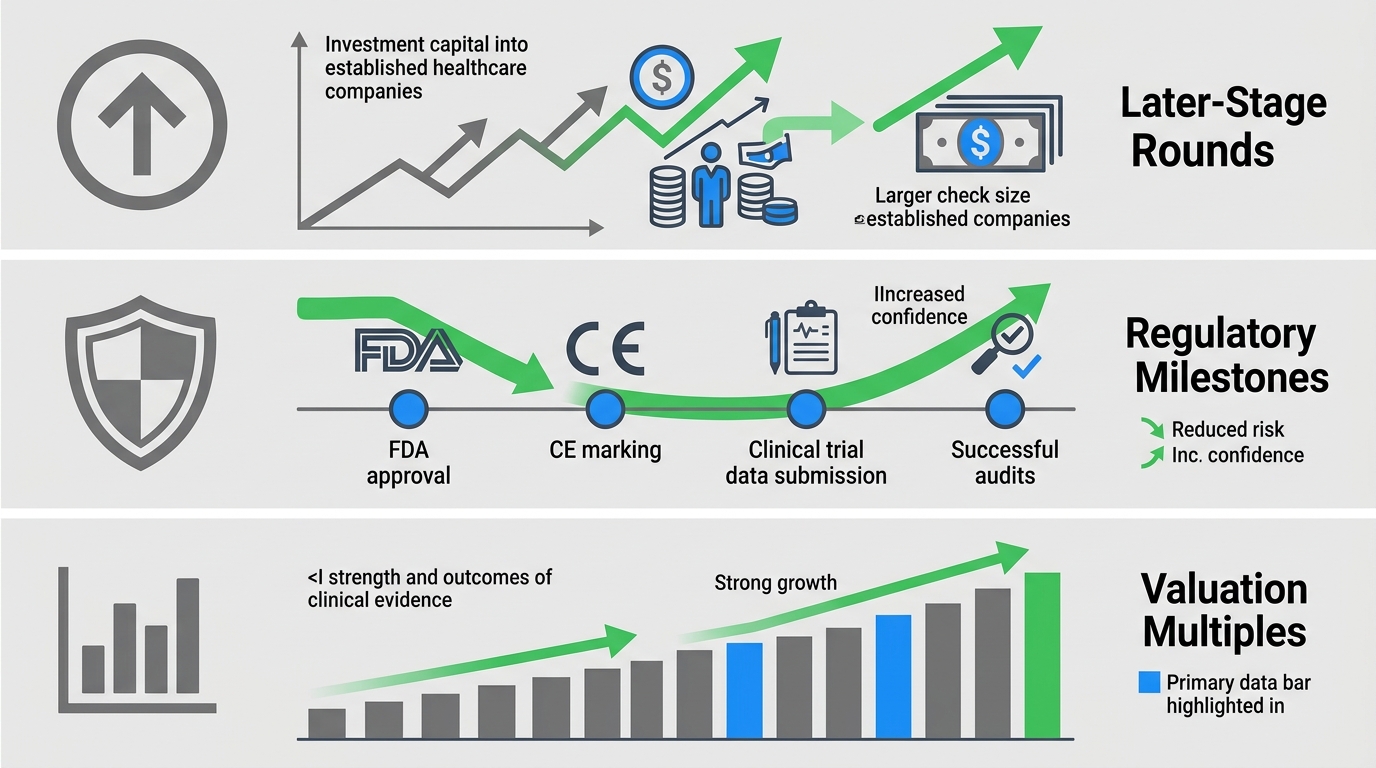
Visualization of three key medtech venture capital trends.
Medical device startup valuation multiples have compressed in early stages–seed to Series A–but remain strong for firms with validated clinical data and clear reimbursement pathways. DeepChecks analysis shows that investor criteria increasingly hinge on FDA clearance or CE marking, which de-risks medical device capital raising efforts and supports premium valuations.
For medtech companies, aligning fundraising strategy with these trends is essential. Drawing on authoritative market data, we help founders articulate their clinical and regulatory milestones, engaging later-stage investors through data-driven narratives that optimize valuations and streamline the capital raising process. Our advisory integrates up-to-the-minute VC intelligence to sharpen deal positioning.
7. Optimizing Startup Valuation
Once you have identified the right capital raising path, the next critical step is ensuring your startup’s valuation reflects its true potential. In medical device capital raising, we advise founders to leverage authoritative market data to frame their value story with precision.
- Compile a set of comparable medtech transactions from sources like PitchBook to benchmark Medical device startup valuation. According to PitchBook, private market data reveals clear valuation bands–for example, digital health companies often command higher pre-money multiples than hardware-centric device firms, a distinction that anchors your narrative in reality.
- Emphasize non-financial value drivers such as FDA clearance progress and intellectual property breadth. Strong IP portfolios and regulatory milestones materially shift investor perception, allowing your team to align with prevailing Medtech venture capital trends that reward derisking events.
- Time valuation discussions after pivotal achievements–trial data readouts or initial revenue traction–to command a premium. We caution founders against over-indexing on top-line revenue; gross margins, recurring revenue potential, and total addressable market size are equally critical to the multiple.
With a valuation strategy anchored in real-world benchmarks, you are ready to negotiate deal terms that attract the right investors.
8. Preparing Investor-Ready Materials
In medical device capital raising, well-crafted investor materials are essential once you set a target valuation. We emphasize clarity, clinical evidence, regulatory and commercialization plans to speed investor assessment.
In medical device capital raising, we produce four core documents: a concise, customized pitch deck (12 slides max) covering problem, technology, regulatory pathway (FDA/CE), clinical evidence, IP, market sizing (TAM/SAM/SOM), competitive moat, commercialization roadmap, and funding ask; a detailed business plan; pro forma financials; and a secure due-diligence data room containing filings and clinical results.
Align the deck with Medtech venture capital trends by emphasizing real-world evidence, value-based care metrics, reimbursement pathways, and defensible IP. Clearly state regulatory designations (for example, Breakthrough Device) and realistic timelines tied to clinical milestones to minimize perceived risk.
Include pro forma assumptions that reflect Medical device startup valuation benchmarks–R&D burn, regulatory milestones, reimbursement timing, and revenue ramps. Our Precision Catalyst process tightens narrative, refines models, and organizes the data room to meet due-diligence expectations.
Accelerating Your Medtech Fundraising Journey
According to PitchBook, medtech companies often spend 12 to 18 months on a single medical device capital raising campaign. We compress this timeline–often by more than half–through our Velocity Matrix rapid‑execution framework and Precision Catalyst digital‑investor‑engagement strategy, which together accelerate investor targeting, due‑diligence readiness, and closing velocity. Our team closely monitors Medtech venture capital trends to match founders with the right institutional partners–those actively seeking medical device opportunities–while our proprietary Sovereign Data Nexus provides real‑time Medical device startup valuation benchmarks that sharpen competitive positioning. By focusing exclusively on mid‑market medtech deal sizes that larger platforms often overlook, we deliver a highly tailored medical device fundraising experience. These accelerators are powered by our core advisory services, which we detail next.
Resources


