



Defense capital raising
Table of Contents
Defense Capital Raising Fundamentals
Defense capital raising is the process of securing funding for companies that serve military, dual-use, and national security markets, and it is inherently distinct from conventional fundraising. This specialized field demands navigation of rigorous regulatory frameworks, including ITAR and export controls, which shape every stage of the transaction and require a compliance-first approach from the outset.
The investor landscape is equally unique. boutique investment banking services are often essential for connecting with sources of dual-use technology venture capital, which backs innovations spanning commercial and defense applications with extended development timelines. In contrast, defense private equity investment typically targets established contractors with predictable revenue streams and clear exit paths, offering a different risk-return profile.
Given these fundamentals, adherence to ethical standards is critical. Per the CFA Institute, professional conduct and transparency are paramount when handling the sensitive information inherent to national security contracts. Boutique advisory firms deliver the specialized guidance needed to structure compliant deals and navigate these complex ethical and regulatory requirements successfully.
1. Master Due Diligence and FOCI Compliance
In defense capital raising, rigorous due diligence and Foreign Ownership, Control, or Influence (FOCI) compliance are not optional–they are the bedrock of transaction integrity.
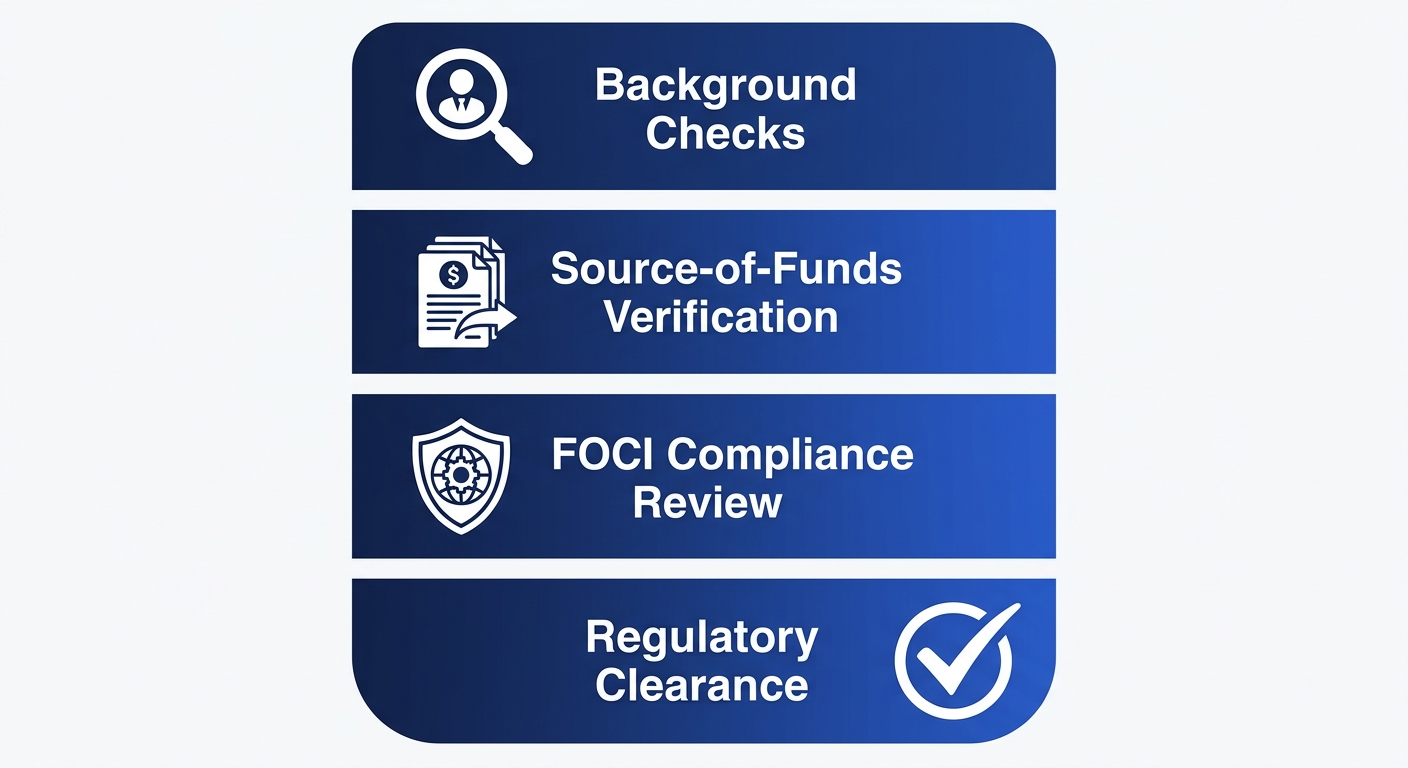
Due diligence process for defense capital raising – four key stages.
Under the oversight of the Defense Counterintelligence and Security Agency (DCSA), any company handling classified information or under foreign influence must mitigate FOCI through measures such as voting trusts or board resolutions. Failure to comply can result in security clearance denial, effectively blocking capital raising or M&A activity. Our m&a due diligence services ensure that every transaction meets the rigorous standards set by bodies such as the DCSA and FINRA. The Financial Industry Regulatory Authority (FINRA) reinforces this framework through Rule 2111 (suitability) and anti-money-laundering requirements, mandating thorough background checks and source-of-funds verification. Whether you are navigating dual-use technology venture capital or defense private equity investment, these steps protect both the target’s security clearance and the investor’s legal standing.
As a Boutique M&A and Capital Advisory Firm, Zaidwood Capital streamlines this complex terrain, allowing clients to advance with confidence.
2. Evaluate Venture Capital vs. Strategic Investment
After recognizing the critical need for capital in defense capital raising, the next step is assessing which type of investor best aligns with your company’s objectives. According to the CFA Institute, any investment evaluation should be grounded in thorough fiduciary care and due diligence, forming the foundation of a sound decision.
Venture capital investors primarily seek financial returns within a 7-10 year horizon, while strategic investors target long-term operational or technological synergies. For companies pursuing dual-use technology venture capital, this means a VC partner will typically demand less operational control, whereas a strategic corporate investor may request board seats or product-right exclusivity.
To navigate these options, understanding what is an investment bank can clarify how objective advisory support differs from direct investment. Capital horizons also differ significantly: VC firms push for liquidity events, while strategic partners in defense private equity investment often exhibit patience, viewing the relationship through a decades-long lens. The Library of Congress provides authoritative methodologies for independently validating such market comparisons and terms.
Early-stage ventures often benefit more from VC mentorship and capital, while later-stage or technology-mature firms may gain greater traction from strategic alignment. We caution that absolute outcomes are never guaranteed; each path carries distinct risks that must be measured against your company’s unique goals in defense capital raising. Once you have evaluated the VC versus strategic investment choice, the next section examines specific capital sources available to defense companies.
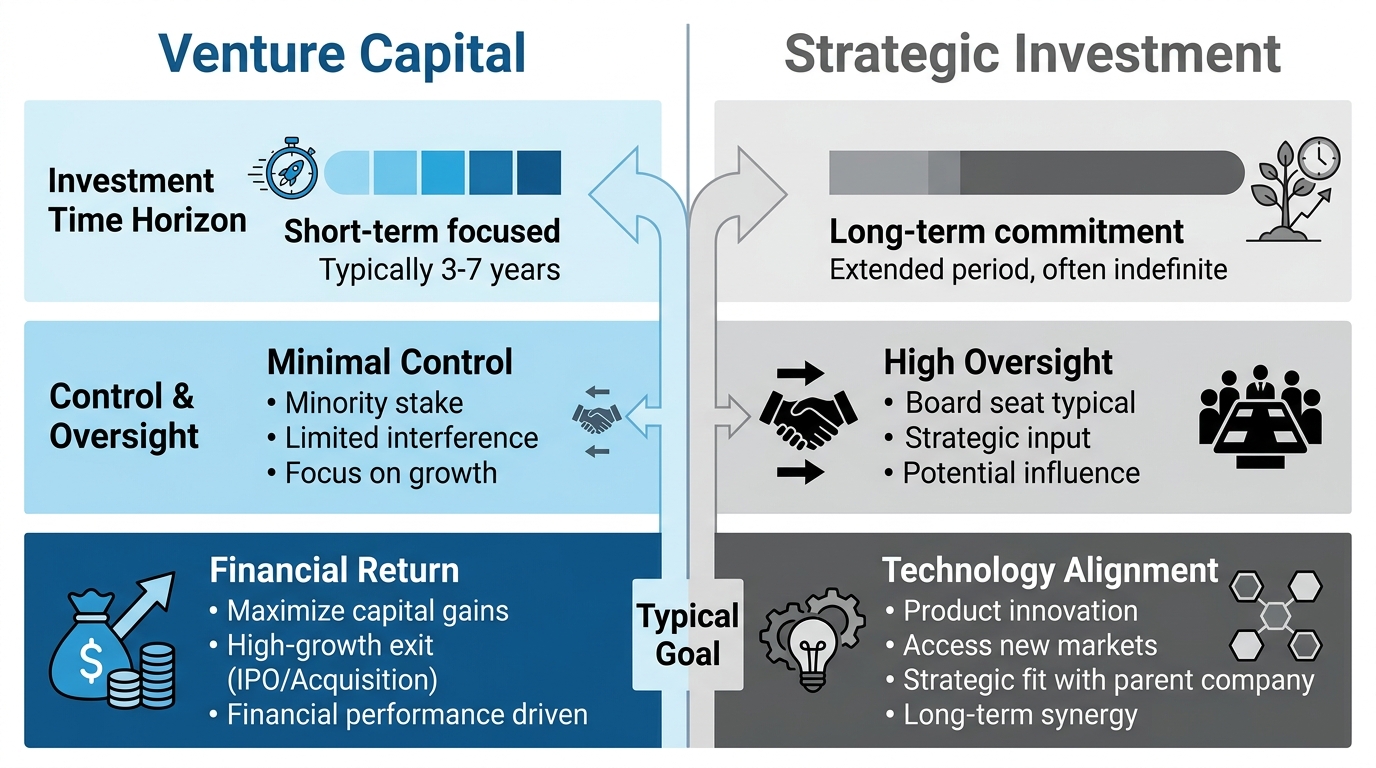
Venture capital vs strategic investment side-by-side comparison
3. Pitch Dual-Use Technology to Investors
Once you’ve identified the opportunity, securing capital requires a fundamentally different narrative in defense capital raising than a standard commercial pitch–one that underscores your venture’s dual-market resilience and national security relevance. We counsel founders to frame their story around both robust commercial revenue potential and a credible defense contract pipeline, proving viability to those focused on dual-use technology venture capital.
Addressing regulatory regimes like ITAR and export controls upfront is not a burden but a credibility signal. When you demonstrate a command of compliance infrastructure, you build immediate trust with sophisticated defense private equity investment partners. According to the ethical standards of the CFA Institute, transparent communication is the bedrock of any successful investor engagement. Use case-neutral language: reference the “potential for long-term government partnerships” rather than promising any specific award, a practice that aligns directly with FINRA’s regulatory guidance on fair dealing and avoiding misleading statements. This disciplined narrative, amplified by our Velocity Matrix methodology, positions you precisely where global allocators are looking. To learn how we streamline Aerospace and defense capital raising, connect with our team.
4. Manage Cash Flow from Government Contracts
An often overlooked factor in successful defense capital raising is cash flow stability from existing government contracts. Delayed federal payments can strain working capital and disrupt growth plans. Without predictable revenue, scaling operations and attracting investors becomes challenging. Many defense startups face this hurdle, making it critical to structure billing and financing strategically. Effectively managing these cash flows ensures contractors have the liquidity to invest in expansion and meet investor expectations.
Milestone billing aligns revenue recognition with project milestones, while progress payments provide working capital during performance. According to the Defense Counterintelligence and Security Agency (DCSA), contractors can request progress payments based on incurred costs. We also recommend using the Library of Congress business research guide to benchmark payment cycles and contract terms against industry standards. Common pitfalls–underbidding, delayed compliance submissions, and neglecting ceiling rates–disrupt cash flow and can deter investors, including those in dual-use technology venture capital.
Stable cash flow from government contracts signals operational maturity to firms pursuing defense private equity investment. Our advisory team integrates cash flow modeling into capital raising preparation to demonstrate this readiness. For contractors exploring strategic transactions to accelerate growth, our M&A due diligence services can help evaluate financial readiness.
5. Track Defense Private Equity Trends
Defense capital raising has accelerated as geopolitical tensions drive demand for next-generation defense technologies, reshaping traditional investment paradigms. The convergence of national security priorities and commercial viability is fueling robust deal flow and attracting private equity firms seeking exposure to defense and dual-use technologies.
The surge in dual-use technology venture capital reflects growing investor appetite for scalable innovations with civilian applications. Meanwhile, growth in defense private equity investment spans cybersecurity, autonomous systems, and advanced manufacturing. While tracking these defense PE trends, our energy mergers and acquisitions advisory delivers complementary insights for firms operating at the intersection of defense and energy sectors. Private equity sponsors are increasingly allocating capital to defense-focused funds.
Navigating defense private equity requires understanding the regulatory context. Financial Industry Regulatory Authority (FINRA) guidance under Rule 506(c) enables defense startups to broadly solicit accredited investors, while the CFA Institute’s Code of Ethics mandates rigorous due diligence and conflict-of-interest disclosure. Adhering to these standards is critical for maintaining investor confidence and facilitating successful capital formation. These trends set the stage for evaluating specific capital raising strategies in the next section.
6. Size the Dual-Use Technology VC Market
Within the broader landscape of defense capital raising, we identify a distinct and rapidly expanding segment: the venture capital market for dual-use technologies–innovations engineered for both commercial viability and national security applications. According to the Defense Counterintelligence and Security Agency, the U.S. government serves over 100 federal entities and manages security for more than 10,000 cleared private sector companies, a figure that serves as a powerful proxy for the scale of the addressable defense industrial base. Industry market-sizing methodologies, rooted in business research frameworks endorsed by the Library of Congress, project that annual venture investment into dual-use startups has sustained a robust compound annual growth rate exceeding twenty percent over the past five years. We view this sustained momentum as a foundational indicator of long-term sector resilience. This dynamic environment translates into a significant opportunity for specialized capital advisory, as the need for precise execution in defense private equity investment continues to mature.
Align Your Defense Capital Strategy
To navigate the complexities inherent in defense capital raising, companies must adopt a carefully aligned capital strategy. We believe alignment is more than planning–it is a rigorous methodology for connecting dual-use technology ventures with institutional investors through a framework grounded in ethics and precision.
The foundation of this alignment rests on uncompromising professional standards, such as the CFA Institute’s Code of Ethics and Standards of Professional Conduct. For firms engaged in defense private equity investment, ethical discipline is not optional–it is a prerequisite for durable trust. We integrate these standards with our proprietary resources, including the Sovereign Data Nexus for secure intelligence and the Precision Catalyst model, which systematically identifies and engages the right institutional partners. This structured methodology is especially critical for ventures seeking dual-use technology venture capital, where investor confidence depends on a meticulous, well-governed approach.
With a properly aligned strategy serving as the foundation, the focus can shift to disciplined execution and long-term partnership development.
Resources


