


Aerospace and defense capital raising
Table of Contents
Strategic Capital Raising for Aerospace and Defense Companies
For aerospace and defense companies specifically, capital raising demands a partner who understands the sector’s deeply regulated and mission-critical environment. At Zaidwood Capital Advisory Services, we deliver that specialized strategic guidance. Our approach to aerospace and defense capital raising begins by navigating the unique hurdles defense innovators face–from ITAR and EAR compliance to government contracting cycles that demand patient, knowledge-focused capital.
Our proprietary Sovereign Data Nexus scans a global network of over 4,000 institutional investors, pinpointing those with demonstrated portfolios in defense and dual-use technologies. Once identified, our Precision Catalyst digital engagement campaigns target the private equity and venture capital funds actively deploying capital into defense tech. This includes funds focused on defense technology private equity, where strategic alignment is essential for long-term value creation.
The Velocity Matrix then drives rapid execution, significantly compressing the timeline required in typical capital raise processes. This structured approach is conducted in full compliance with the regulatory framework established by the Financial Industry Regulatory Authority (FINRA), which oversees all securities offerings in the United States. It is important to note that while we facilitate strategic positioning and execution, all securities are offered through Finalis Securities LLC; Zaidwood Capital is not a registered broker-dealer.
For companies seeking funding for dual-use technology investment, our platform offers a distinct strategic fit. We combine deep sector intelligence with a methodical process, positioning defense innovators for successful outcomes without overpromising results.
Capital Stack Structuring for Hardware Startups
For hardware startups in aerospace and defense capital raising, structuring an optimal capital stack is foundational to sustainable growth. Effective Defense capital raising demands layering debt, equity, and government grants, each carrying distinct cost, dilution, and repayment characteristics. At Zaidwood Capital, our capital formation advisory leverages full-cycle M&A experience to help founders sequence these components strategically.
The following comparison outlines the primary capital stack components:
| Component | Cost & Terms | Ownership Dilution | Repayment Flexibility | Best Suited For |
|---|---|---|---|---|
| Debt Advisory / Debt Financing | Fixed interest, tied to credit profile | No dilution | Structured schedules, milestones often aligned | Firms with predictable revenue or contract backlog |
| Equity Financing | Higher cost of capital, exit-driven returns | Significant dilution | No repayment; investors share upside | R&D-heavy startups with long time to revenue |
| Government Grants / SBIRs | Non-dilutive, competitive application | No dilution | Milestone-based disbursements, no repayment | Early-stage dual-use or defense technology firms |
Debt financing typically carries interest rates of 8 to 12 percent for equipment-backed loans with no ownership dilution, an attractive profile for founders preserving equity. Equity rounds involve 20 to 40 percent dilution but supply patient capital free of repayment pressure. SBIR and STTR grants offer non-dilutive, milestone-based funding with Phase I awards around $150,000 and Phase II reaching approximately $1 million. These components are not mutually exclusive; a well-orchestrated capital stack sequences them to minimize cost of capital while preserving flexibility for future rounds.
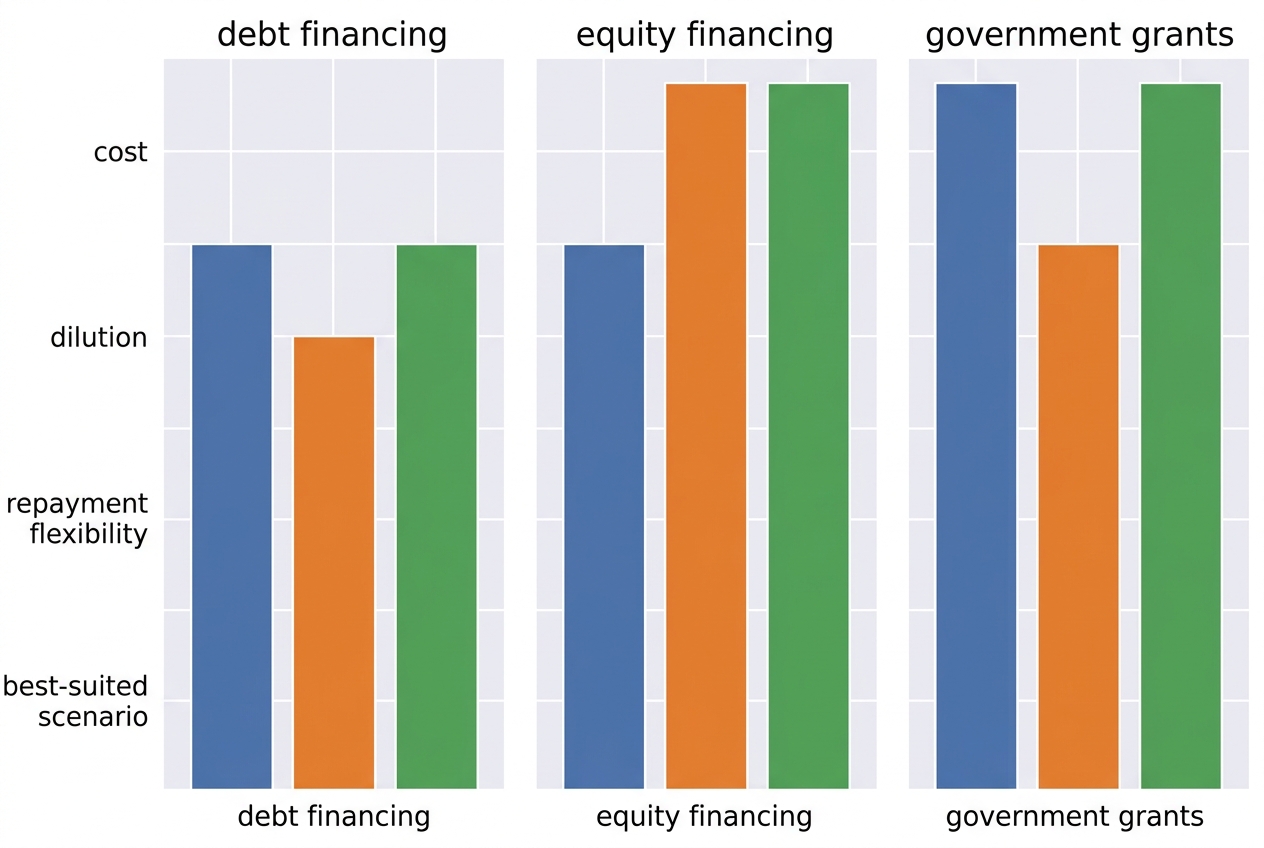
Capital stack components illustrated with color-coded comparisons
Debt advisory works best for hardware startups with predictable revenue streams or government contract backlogs. Asset-backed lending and equipment financing allow founders to fund production scaling without surrendering equity. Per FINRA guidelines on private placements, startups raising debt through accredited investors must adhere to disclosure requirements and applicable regulatory exemptions, ensuring compliance throughout the offering process.
Equity financing remains the dominant vehicle for dual-use technology investment, particularly when time to revenue spans multiple years. Defense technology private equity investors expect a clear path to scale and a defined exit horizon. While dilution is unavoidable, often 20 to 40 percent in a Series A, equity provides the runway needed to complete rigorous R&D cycles and regulatory certifications without the cash flow constraints of debt.
Government grants and SBIR contracts represent the most founder-friendly capital: entirely non-dilutive and milestone-based. These awards bridge the gap between concept validation and institutional investment readiness for early-stage dual-use firms. We recommend starting with grants for proof-of-concept, layering equity for R&D scale-up, and introducing debt only once contract revenue becomes predictable. This sequencing reduces dilution, aligns capital cost with risk profile, and positions the startup for successful subsequent rounds. Once the capital stack is defined, execution requires careful deal documentation and investor targeting, covered next.
Debt Advisory and Equity Dilution in Long-Cycle Procurements
Building on the need for capital, this section examines two specific approaches–debt advisory and equity financing–that are commonly used in long-cycle procurements. For companies engaged in aerospace and defense capital raising, understanding these options is critical to managing growth without sacrificing ownership or operational flexibility.
The Role of Debt Advisory in Long Procurement Cycles
Debt advisory firms specialize in structuring financing that aligns with the extended timelines of government contracts. Instead of relying on a single upfront capital injection, these advisors design milestone-based repayment schedules tied directly to contract payments. When a defense contractor receives a progress payment from a government agency, a portion can be allocated to service the debt, smoothing cash flow and reducing the need for external equity infusions. Asset-backed lending offers an alternative pathway for firms that have significant physical assets, such as specialized manufacturing equipment or testing facilities. By using these assets as collateral, startups can access lower-cost capital while preserving equity for future funding rounds. In our experience, this structured approach can be especially valuable for firms navigating aerospace and defense capital raising cycles, where payment delays of two to five years are common.
Balancing Equity Dilution with Growth Capital Needs
For A&D hardware startups, equity financing provides essential growth capital but carries a significant governance cost. Founders face a trade-off: raise enough to fund technology demonstrations and prototype development while minimizing the dilution of their ownership stake. One effective strategy is to sequence equity rounds, beginning with convertible instruments such as convertible notes or SAFEs (Simple Agreements for Future Equity). These tools delay valuation discussions, reducing immediate dilution until the company achieves key technical or contractual milestones. The landscape is further shaped by the growing presence of dual-use technology investment, where capital flows to technologies with both commercial and defense applications. Similarly, defense technology private equity funds have expanded their focus, targeting startups with clear paths to government procurement contracts. While these investors bring sector-specific expertise, they expect rigorous due diligence and often demand board seats, which can alter a founder’s strategic autonomy.
Institutional Due Diligence: What Investors Look For
Institutional investors apply a structured lens when evaluating defense technology firms. Three criteria dominate the assessment process. First, technology readiness level (TRL) quantifies how close a product is to deployment; most investors require at least TRL 6 for hardware and TRL 4 for software components. Second, regulatory compliance–especially adherence to ITAR (International Traffic in Arms Regulations) and export controls–is non-negotiable, as violations can shut down a company’s revenue pipeline overnight. Third, the quality of the contract pipeline, including backlog size, funding type (firm-fixed-price vs. cost-reimbursement), and relationship duration with key agencies, signals future stability. According to CFA Institute investment decision frameworks, these factors are integrated into a comprehensive risk-adjusted valuation model. Private equity and dual-use tech investors remain active in this space, but their diligence processes are thorough and unforgiving. Startups can strengthen their position by engaging professional M&A due diligence services to preemptively address gaps in compliance, IP documentation, and financial records before investor scrutiny begins.
For A&D firms, the choice between debt advisory and equity financing depends on multiple factors. The table below highlights the key differences.
| Factor | Debt Advisory | Equity Financing |
|---|---|---|
| Capital Cost | Lower cost if firm has credit capacity | Higher cost due to required returns (20-30%+ IRR) |
| Dilution Impact | None | Significant; founders lose control over time |
| Cash Flow Fit | Aligns with milestone contract payments | Requires long-term growth trajectory |
| Investor Governance | Minimal; lender covenants only | Board seats, strategic oversight |
| Procurement Cycle Suitability | Ideal for contract-heavy firms with 2-5 year cycles | Better for firms with large R&D needs before revenue |
This comparison underscores that debt advisory offers a cost-effective, non-dilutive path for firms with existing contracts, while equity financing provides growth capital at the expense of governance and control. With these financing strategies in mind, the next section explores the risks associated with international defense contracts.
Bridging Cash Gaps and Navigating Milestone Funding
Once you have secured a government contract, the next challenge is managing the cash flow timing mismatch — this is where milestone-based funding becomes essential in aerospace and defense capital raising. For founders and CFOs, aligning capital deployment with the rhythm of contract deliverables transforms a potential liquidity crunch into a manageable, strategic process. The following comparison clarifies how this approach differs from traditional models.
| Attribute | Milestone-Based Funding | Traditional Lump-Sum Funding |
|---|---|---|
| Cash Flow Timing | Aligned with contract deliverables | Upfront lump sum requires full deployment |
| Risk to Investors | Lower; capital released as progress is shown | Higher; capital at risk before milestones achieved |
| Founder Flexibility | Less flexibility; must adhere to milestones | Greater flexibility to pivot or accelerate |
| Best Use Case | Hardware startups with government contracts | Established firms with predictable cash flows |
As outlined by the International Capital Market Association’s milestone-based instrument guidelines, this side-by-side view clarifies why milestone-based structures often suit hardware startups with government contracts. The structure reduces principal-at-risk periods and gives both founders and backers a shared definition of progress.
Structuring Milestone-Based Funding Rounds
Segment a government contract into discrete funding tranches — prototype delivery, testing phase, and final production — so each capital release matches a demonstrable work scope. Size every tranche relative to the payment timeline and embed a 10-15% contingency buffer to absorb schedule slips or technical revisions. Investors evaluating milestone-based funding often require thorough background checks — our M&A due diligence services can help you prepare a clean data room. Tie investor reporting directly to contract milestones so backers see real-time evidence of progress rather than lagging financial statements. This approach keeps capital deployment disciplined and gives limited partners confidence that funds are tied to validated technical outcomes. Engaging an advisor early can streamline this process.
Bridging Cash Gaps Between Contract Payments
Invoice factoring converts a government receivable into immediate cash by selling it at a discount, while a bridge loan — typically structured for six to 12 months and secured against the anticipated payment — preserves the full receivable value at the cost of interest. For founders concerned about dilution, staggered equity draws offer a middle path: small equity injections released at each milestone instead of a single large round, which maintains tighter dilution control. Defense technology private equity firms increasingly underwrite these interim facilities, blending credit analysis with sector-specific due diligence. Whichever instrument you choose, model the cost of capital against the contract’s payment schedule so the liquidity solution doesn’t erode the net margin. A disciplined bridge strategy ensures the team stays focused on delivery rather than payroll pressure.
Engaging Dual-Use Technology Investments
Dual-use technology investment is accelerating in 2026 as institutional investors — including defense-focused venture arms and crossover funds writing checks between $2 million and $15 million — seek startups that serve both national security missions and commercial markets. Position your cap table early for a CFIUS review: any foreign investment exceeding $500,000, particularly in sensitive areas like hypersonics or advanced materials, will trigger scrutiny, so structuring inbound capital as non-controlling stakes can simplify clearance. Build a positioning checklist that aligns your product roadmap with defense and commercial demand, prepares a CFIUS-friendly ownership document, and crafts a narrative that highlights dual-use revenue streams without overpromising national security impact. Tapping defense technology private equity requires demonstrating a credible path to revenue on both sides of the government-commercial divide, and positioning your startup for dual-use capital raising is the crucial final step before engaging institutional investors.
Private Equity Roll-Ups and CFIUS Navigation for Dual-Use Technology
In the landscape of aerospace and defense capital raising, private equity roll-ups have become a strategic tool for consolidating fragmented sub-sectors and building valuation scale. These transactions involve acquiring and merging multiple smaller companies–often those developing dual-use technologies with both civilian and military applications–to create a larger, more efficient platform.
Before such a roll-up can succeed, it must navigate the rigorous review of the Committee on Foreign Investment in the United States (CFIUS). The U.S. Department of the Treasury chairs CFIUS and conducts national security evaluations of foreign investments. A dual-use technology investment typically triggers CFIUS jurisdiction when foreign entities gain ownership or access to sensitive technical data, when a company holds active contracts with defense agencies, or when foreign ownership thresholds are crossed. The process follows a set timeline: an initial 30-day review, a 45-day investigation if needed, and a presidential decision window of up to 15 days.
Investors and founders must weigh exit options in light of both CFIUS risk and strategic objectives. The table below outlines the primary paths available to defense technology firms.
| Exit Strategy | Typical Timeline | Return Potential | Operational Impact | Best For |
|---|---|---|---|---|
| Trade Sale | 6-12 months | Moderate to high, depending on strategic buyer | Ownership fully transfers | Firms with unique IP or prime defense contracts |
| IPO | 12-24 months | High; public market multiples | Public reporting and compliance burden | Mature firms with $100M+ revenue and strong governance |
| Private Equity Roll-Up | 18-36 months | High; scale creates multiple expansion | Integration and consolidation of multiple targets | Defense technology firms in fragmented sub-sectors |
In defense technology private equity, each exit avenue presents a different risk-return profile. Trade sales often appeal to strategic buyers eager to acquire proprietary intellectual property, while IPOs are reserved for well-capitalized firms that can shoulder public-company responsibilities. Roll-ups, by contrast, offer a unique opportunity to transform a scattered set of niche providers into a scaled, integrated defense platform–a consolidation play that can yield significant returns when executed in full compliance with CFIUS regulations.
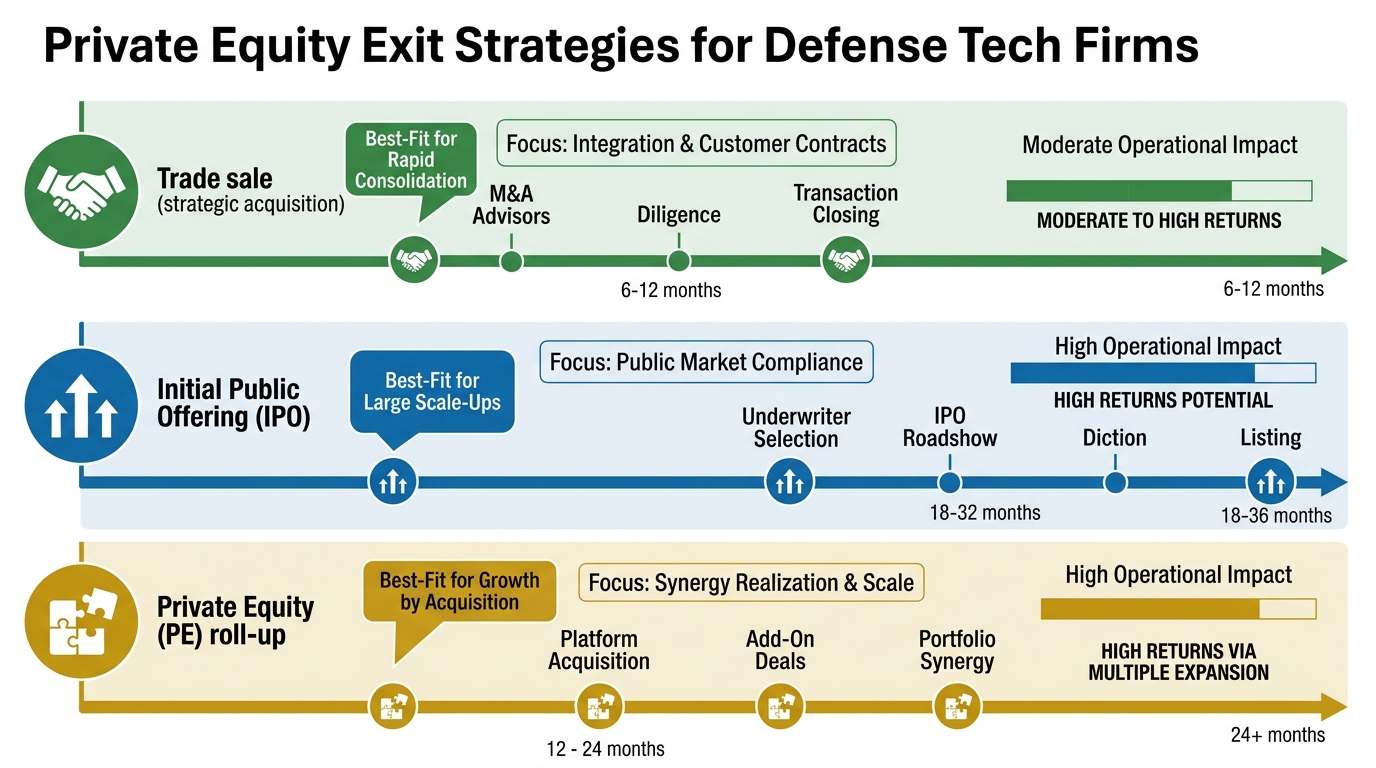
Comparison of trade sale, IPO, and PE roll-up exit strategies for dual-use tech
Zaidwood Capital, a Boutique M&A and Capital Advisory Firm, brings extensive experience in structuring roll-ups and guiding dual-use companies through CFIUS review. We provide specialized energy mergers and acquisitions advisory alongside a deep understanding of defense technology transactions, helping clients achieve exits that balance strategic value with regulatory certainty. This information is for educational purposes and does not constitute investment advice.
Common Questions on Capital Raising in Aerospace and Defense
To further address typical client concerns, capital formation in the aerospace and defense capital raising sector presents distinct challenges. As a Boutique M&A and Capital Advisory Firm, we clarify common queries below.
What types of capital raising solutions exist for dual-use technology investment? We advise dual-use companies navigating civilian and defense markets through our Full-Cycle M&A framework and Sovereign Data Nexus.
Why are private equity firms increasingly interested in defense technology private equity? Growing national security priorities and technological innovation are driving heightened private equity scrutiny of scaled defense platforms.
How do Zaidwood’s regulatory considerations affect the process? We are not a registered broker-dealer. Securities are offered through Finalis Securities LLC. Just as we excel in healthcare mergers and acquisitions, we apply structured diligence to aerospace and defense capital raising.
For a full breakdown of our process, explore our execution methodology.
Capital raising in aerospace and defense is not for the faint of heart. The sector’s unique blend of rigorous compliance, extended product cycles, and increasing focus on dual-use technology investment demands a partner who understands both the technology and the capital markets. Zaidwood Capital, a Boutique M&A and Capital Advisory Firm, brings that dual expertise. We have streamlined transactions by combining business development and financial expertise, applying a full-cycle M&A approach. Our Sovereign Data Nexus provides unparalleled market intelligence, while Precision Catalyst drives targeted investor engagement and Velocity Matrix accelerates execution timelines. Whether you are navigating defense technology private equity or seeking aerospace and defense capital raising, our process begins with a tailored assessment.
Resources


