


Fintech capital raising
Table of Contents
Fintech Capital Raising Strategies
Within the fintech sector, tailored capital raising strategies become critical for growth. At Zaidwood Capital, a Boutique M&A and Capital Advisory Firm, we understand that successful fintech capital raising requires a sophisticated blend of equity injections, including growth equity and private placements, structured to preserve founder control while fueling expansion.
Growth equity serves as a powerful catalyst for fintech companies seeking substantial expansion capital without relinquishing control. We help identify the right institutional investors to provide these growth-stage equity injections, ensuring that the capital fuels both product development and market reach. For earlier-stage ventures, carefully structured private placements allow fintech startups to raise capital from accredited investors, a process we support with the strategic documentation and secure data room management required for efficient due diligence through our Deal Vault.
Often, fintech firms benefit from a balanced approach that may include structured debt solutions alongside equity to optimize their cap tables. Our Full-Cycle M&A support, guided by the ethical standards of the CFA Institute, ensures every phase–from pitch deck creation to investor introductions–is managed with professional rigor. For more niche opportunities, such as Enterprise AI capital raising, our firm provides tailored advisory to navigate these complex funding rounds. These strategies form the foundation of a successful capital raise, which we then execute through our Precision Catalyst and Velocity Matrix tools.
Disclaimer: This content is for informational purposes only and is not an offer or solicitation to buy or sell any security. Zaidwood Capital is not a registered broker-dealer.
Essential Preparation for Fintech Capital Raising
To capitalize on opportunities in fintech capital raising, we know that meticulous preparation is the foundation of a successful campaign. Whether pursuing growth equity or private placements, fintech firms must first demonstrate regulatory readiness, financial rigor, and a compelling investor narrative before approaching institutional capital.
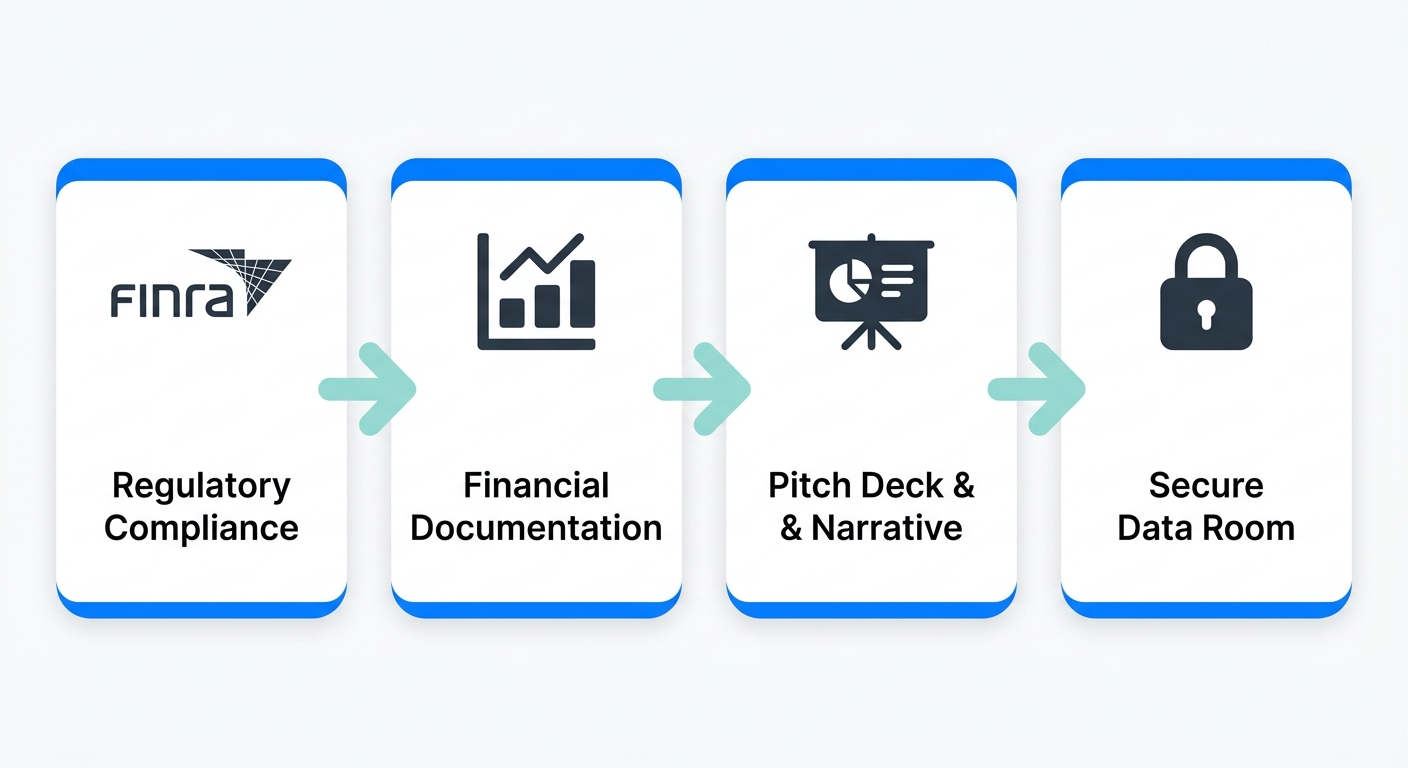
Four-step process for fintech capital raising preparation.
A critical first step is engaging securities counsel to review your offering structure against SEC and FINRA guidelines. According to FINRA, rules governing communications with the public and private placement exemptions directly affect how fintech offerings are marketed to qualified investors. We advise aligning your documentation with these regulatory frameworks early to mitigate delays.
From our experience guiding issuers through the capital raising for fintech preparation, three deliverables are non-negotiable: a compliant business plan with integrated regulatory risk analysis, auditable pro forma financial projections, and a pitch deck that transparently addresses compliance obligations. These materials, combined with a secure due diligence data room, signal institutional readiness to serious investors.
Once preparation is complete, firms can move to active fundraising with confidence. At Zaidwood Capital, our boutique investment banking services streamline fintech capital raising by combining deep regulatory knowledge with proprietary investor networks, helping founders present a refined, compliance-ready opportunity to the market.
Understand Your Capital Options: Equity, Debt, and Convertible Notes
When exploring fintech capital raising, founders must understand three core instruments, each with distinct implications for control and cash flow.
Equity involves selling an ownership stake in your company, which dilutes founder holdings but creates no repayment obligation. High-growth startups often pursue this type of growth equity to fuel expansion without immediate cash strain.
Debt is borrowed capital that must be repaid with interest, preserving full ownership but introducing fixed repayment schedules. This may suit established, revenue-generating companies that can manage regular principal and interest payments.
Convertible notes are hybrid loans that convert into equity during a future financing round, effectively delaying valuation negotiations. These are a common private placements instrument used in seed-stage transactions where agreeing on a current valuation proves difficult.
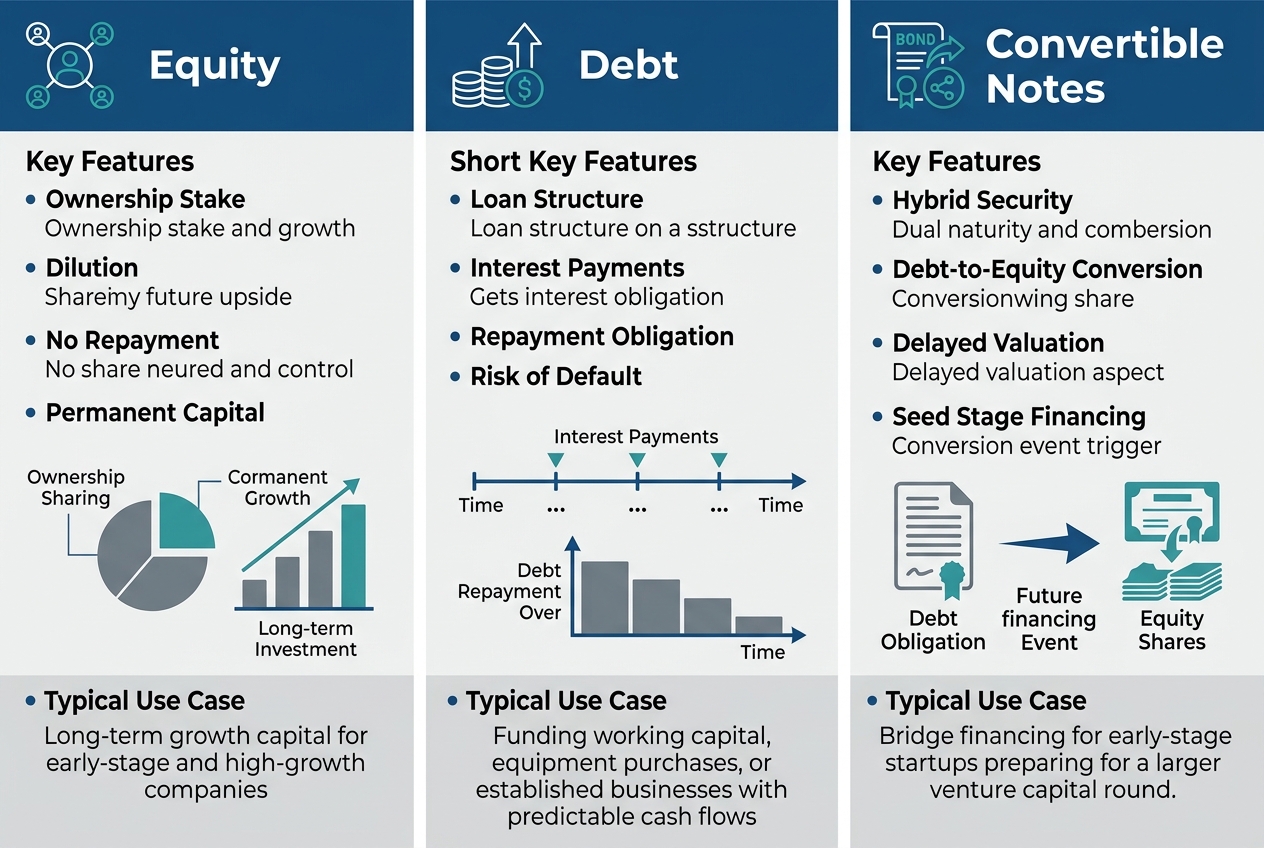
A visual guide to capital options for fintech companies.
With these basics in mind, you can begin evaluating which instrument aligns with your growth stage. For a deeper look at how firms like Zaidwood Capital facilitate these transactions, see what is an investment bank.
Build Financial Projections That Withstand Investor Scrutiny
Once you have a clear strategy, the next step is to construct financial projections that survive rigorous due diligence. We advise founders seeking fintech capital raising to anchor every line item, especially revenue growth drivers, gross margin trajectory, and operating expense leverage, in verifiable, defensible assumptions before presenting to any institution. Before diving into the details, it helps to understand what is an investment bank expects to see in deal materials.
A credible package requires a 12-month cash flow forecast paired with 3 to 5 years of projected income statements, balance sheets, and cash flows. We recommend building a sensitivity analysis that stress-tests how changes in customer acquisition cost or churn rate affect valuation. For growth equity rounds, model how unit economics improve with scale; when structuring private placements, show the precise impact of dilution on existing stakeholders. Investors will quickly discount heroic growth curves, preferring conservative, data-backed scenarios that demonstrate capital-efficient growth.
Our team works alongside clients to embed these principles directly into strategic documentation, including pro forma financials that withstand scrutiny. With solid projections in hand, you are ready to present a compelling case to investors.
Craft an Investor Pitch Deck That Tells Your Story
In fintech capital raising, your pitch deck must immediately capture the problem your company solves and why it matters now. At Zaidwood Capital, a Boutique M&A and Capital Advisory Firm, we help founders craft decks that blend storytelling with precise financial data.
We structure the deck as a narrative arc from problem to solution, with a visual slide showing unit economics. When targeting growth equity, the deck must demonstrate how capital fuels expansion. For founders considering exits, this framework also supports positioning within larger tech mergers and acquisitions initiatives.
We dedicate a slide to the team’s pedigree, highlighting prior exits or domain expertise. A use-of-funds slide maps capital to milestones without promising returns. The final slide asks directly: “We seek [amount] in growth equity to accelerate growth,” or “We are raising [amount] through a private placement.” We tailor each deck to the audience–TAM for VCs, revenue growth for PE, defensibility for strategics. Once your story is clear, you’re ready to engage investors through our network.
Structure Deal Terms for Growth Equity and Private Placements
In fintech capital raising, growth equity and private placements offer distinct structures tailored to mature, profitable companies seeking expansion capital. Unlike venture capital or buyouts, growth equity provides a minority stake with negotiated rights, while private placements–often structured under Reg D Rule 506–enable streamlined access to accredited investors. At Zaidwood Capital, we ensure these transactions balance valuation with investor protections.
Critical deal terms include liquidation preference, where non-participating structures favor founders versus participating preferences that enhance investor returns. Anti-dilution provisions, whether weighted average or full ratchet, adjust pricing to protect investors in down rounds. Board representation and drag-along/tag-along rights further define governance and exit dynamics. While term sheets remain non-binding, they establish the blueprint for definitive documentation, including confidentiality through NDAs. Understanding these mechanics is vital for planning future exits, including tech mergers and acquisitions.
As a Boutique M&A and Capital Advisory Firm, Zaidwood Capital negotiates and documents these terms to align founder vision with institutional capital requirements. This content is for educational purposes only and does not constitute legal or investment advice. Once terms are defined, the due diligence process begins in earnest.
Navigate SEC Regulations and Compliance for Capital Raising
For companies pursuing fintech capital raising, understanding the regulatory framework set forth by the Securities and Exchange Commission is not optional–it is a critical business function that, when mismanaged, leads to costly violations and deal failure. We guide clients through these complexities, ensuring their growth equity rounds and private placements proceed within a compliant structure. The most common path for private issuers is Regulation D, which provides exemptions from full SEC registration. Rule 506b permits capital raising from an unlimited number of accredited investors and up to 35 sophisticated non-accredited investors, provided there is no general solicitation. In contrast, Rule 506c allows broad marketing but mandates that all purchasers are verified accredited investors, placing the burden of rigorous, documented verification on the issuer.
FINRA, as the primary self-regulatory organization for the securities industry in the United States, provides critical oversight and regulatory guidance that shapes sound capital formation practices. The CFA Institute further reinforces this environment through its ethical standards, promoting transparency and fiduciary duty among investment professionals. At Zaidwood Capital, we translate this regulatory density into actionable strategy. We help structure offerings, prepare disclosure documentation, and coordinate with your legal counsel to confirm that every verification step is satisfied, acting as a strategic advisor without engaging in registered broker-dealer activities. This disciplined approach bridges regulatory compliance directly into confident execution.
Engage Institutional Investors Through Effective Outreach
Effective engagement is the bridge between a well-structured offering and successful fintech capital raising. We combine multi-channel digital outreach with deep institutional connectivity to ensure your opportunity reaches the right decision-makers.
- Our multi-channel model, powered by Precision Catalyst, merges targeted digital campaigns with direct introductions from our global network of institutional LPs. This coordinated approach has historically lifted response rates and replaced generic cold outreach with relevance.
- Proprietary data from Sovereign Data Nexus lets us segment investors by mandate size, sector appetite–especially growth equity–and investment stage. By matching your round to funds actively scouting fintech capital raising, we replace guesswork with precision.
- When interest firms, our secure Deal Vault reduces friction by giving institutions controlled access to due-diligence materials. Investors review documentation on their own timeline while we keep version control and confidentiality intact, a vital asset in private placements.
Once outreach yields engagement, our Velocity Matrix and Deal Vault accelerate the path to definitive agreements. Securities are offered through Finalis Securities LLC; Zaidwood Capital is not a registered broker-dealer.
Manage Due Diligence and Close the Transaction
Once investor interest is secured, we move into the operational phase of fintech capital raising, where a rigorous due diligence process validates every aspect of the business. This critical phase allows investors to verify financial statements, cap table structure, regulatory compliance including money transmitter licenses, technology architecture, and intellectual property ownership. We manage this complexity by deploying our secure data room, organizing confidential documents to facilitate efficient and secure review.
We then coordinate the signing of definitive agreements for growth equity private placements, satisfying all closing conditions before wiring funds. Legal counsel and financial advisors work in concert under our direction to execute documents properly and maintain the closing timeline. As a full-cycle M&A advisory firm, Zaidwood Capital manages the entire diligence and closing sequence, ensuring a smooth culmination of the capital raising process.
Overcoming Common Hurdles in Fintech Capital Raising
Securing fintech capital raising commitments presents a distinct set of challenges, largely because innovation frequently outpaces the regulatory and market frameworks that govern fundraising. Success requires not just a compelling product, but a strategic approach that addresses these built-in hurdles head-on. At Zaidwood Capital, we help fintech founders transform these obstacles into a structured, investor-ready narrative.
One of the most persistent friction points is regulatory complexity. Fintech companies often operate in spaces where legislation is still evolving, making traditional investors wary. The solution lies in meticulous preparation: we develop compliant, professional-grade strategic documentation, including pitch decks, business plans, and pro forma financials, that satisfy even the most rigorous due diligence demands. We use these tools to clearly frame the opportunity within a secure legal context.
Valuation misalignment can also derail promising discussions, as founders may anchor to valuations not fully supported by market reality. Our team leverages deep capital markets experience and proprietary insights from our Sovereign Data Nexus to build robust financial models and identify defensible market comparables. This creates a data-driven foundation for a realistic valuation, which is essential for attracting serious partners in growth equity and private placements. By presenting a narrative backed by verifiable data, we directly counter the investor skepticism common in a sector with a historically high failure rate. Our Precision Catalyst digital marketing methodology further validates the narrative by demonstrating tangible market traction and customer engagement.
Finally, the intense competition for institutional capital is a significant barrier. To stand out, a transaction needs velocity. We deploy our Velocity Matrix process to accelerate execution, rapidly moving a thoroughly prepared deal through our network of over 4,000 institutional and private investors and toward a successful close. Once these foundational hurdles are addressed, the path to a strategic capital raise becomes a clearly defined, manageable process rather than an unpredictable endeavor.
Mastering Fintech Capital Raising with the Right Advisory Partner
To overcome these hurdles, partnering with the right advisory firm is key. Navigating in fintech capital raising demands more than financial acumen — it requires insight into a sector where shifting regulations, rapid technological disruption, and investor scrutiny converge. We guide growth-stage companies through this complexity, leveraging a global network of institutional investors and deep capital markets experience to structure growth equity rounds and private placements that align with founder vision and market realities.
For companies pursuing specialized areas such as Enterprise AI capital raising, the right partner brings more than connectivity. Our proprietary tools — Sovereign Data Nexus for data-driven investor sourcing, Precision Catalyst for targeted engagement, and Velocity Matrix for rapid execution — create a disciplined, repeatable capital formation process. As a firm guided by CFA Institute standards, our advisory approach is anchored in the profession’s highest ethical and technical benchmarks, reinforcing the integrity that institutional investors demand.
In the next section, we detail how our proprietary deal management tools accelerate every phase of capital raising.
Resources


