



Data centre project financing
Table of Contents
The Landscape of Data Centre Project Financing
In data centre project financing, we have observed the emergence of a distinct asset class that blends traditional project debt with sophisticated capital stack engineering. This evolution reflects the sector’s maturation, where institutional investors and lenders now recognize the stable, long-term returns these critical infrastructure assets can generate. The complexity inherent in financing large-scale data centres demands a deep understanding of both conventional methods and innovative structured solutions.
At its foundation, the capital mix typically includes senior bank debt and institutional equity. These baseline components provide the bedrock for development, with lenders attracted to the contracted, utility-like cash flows of investment-grade tenants. According to the CFA Institute’s global standards for project finance analysis, rigorous risk assessment and ethical capital-raising practices are paramount when structuring these multi-jurisdictional transactions. This ensures alignment between sponsors, creditors, and investors from the outset.
Beyond this base, the digital infrastructure capital stack introduces more nuanced layers. We see mezzanine debt, preferred equity, and other structured solutions tailored specifically for the unique requirements of hyperscale developments. This evolution has given rise to a niche specialty in hyperscale data center debt advisory, which addresses the unique risk profiles, extended lead times, and specific revenue structures that generalist lenders often misprice. The capital stack for digital infrastructure requires advisors who can engineer these solutions against a backdrop of rapid technological change and tenant concentration risk.
Navigating this intricate landscape requires specialized intermediary expertise. Engaging a trusted boutique investment bank M&A advisory can streamline the evaluation of complex capital structures. As a Boutique M&A and Capital Advisory Firm, our Financial Services 3.0 approach helps clients source and structure the optimal mix of capital, from core debt to bespoke equity layers, without the conflicts inherent in larger institutions. This neutral, expert guidance is critical for securing the right terms in a sector defined by its scale and complexity.
Bankability and Key Requirements for Data Centre Project Financing
Beyond the overall capital structure, lenders focus on specific bankability criteria when underwriting data centre projects. We identify key requirements that investors and financiers prioritize to ensure successful data centre project financing.
The following table outlines the key bankability criteria that lenders evaluate when underwriting data centre project financing. Each requirement is rated by its priority in the lender’s decision-making process.
| Requirement | Description | Lender Priority |
|---|---|---|
| Sponsor Track Record and Financial Strength | Demonstrated experience in delivering large-scale data centres, balance sheet strength, and access to additional capital. | Critical |
| Power Purchase Agreements (PPAs) | Long-term contracts securing affordable and reliable power, including renewable energy components. | Very High |
| Off-Take Agreements | Pre-leased or contracted revenue streams from creditworthy tenants (e.g., hyperscalers, colocation providers). | Very High |
| ESG Compliance | Adherence to environmental, social, and governance criteria, including carbon neutrality targets and community impact. | High and Rising |
| Construction Risk Mitigation | Fixed-price construction contracts, performance bonds, and contingency reserves for delays or cost overruns. | High |
| Debt Service Coverage Ratio (DSCR) Projections | Robust financial model showing DSCR above 1.20x-1.50x under conservative assumptions. | High |
Sponsor track record is the first criterion: lenders require at least 3-5 years of large-scale data centre delivery experience. For Power Purchase Agreements, long-term PPAs, especially those incorporating renewable energy, often require structured guidance from an energy mergers and acquisitions advisory firm to align with lender requirements. Off-take agreements from investment-grade tenants such as AWS, Google, or Microsoft provide reliable revenue streams; incorporating hyperscale data center debt advisory early can optimize these contracts.
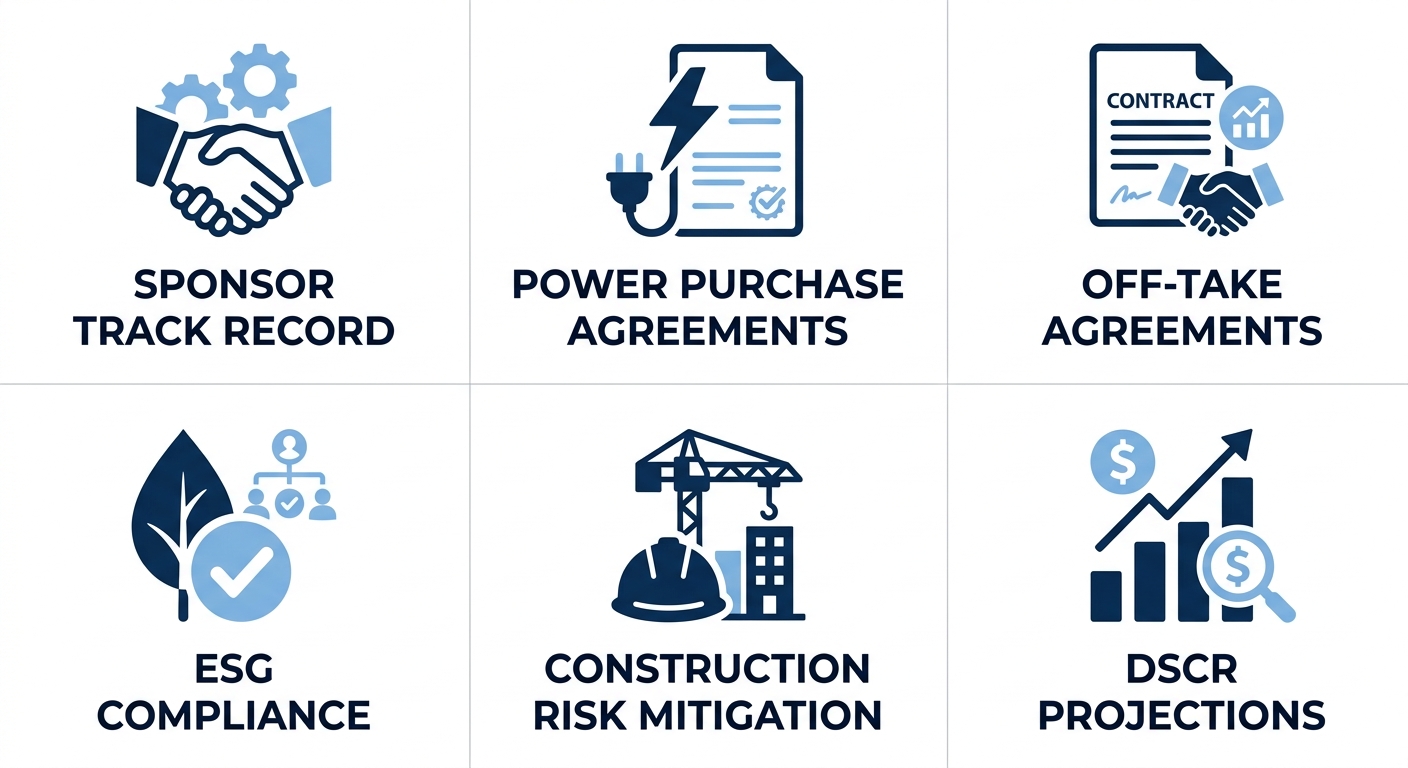
Grid of six bankability requirements for data centre financing with clean icons on a professional blue and white layout
ESG compliance is a rising priority, requiring carbon-neutrality targets, water usage efficiency, and community engagement metrics. Construction risk mitigation involves fixed-price EPC contracts, liquidated damages, performance bonds, and a 15-20% contingency reserve. Lastly, robust DSCR projections above 1.30x under stress scenarios, when backed by a well-designed digital infrastructure capital stack, align with CFA Institute benchmarks for reliability.
Ultimately, meeting these bankability criteria is a prerequisite for financing, and we at Zaidwood Capital help structure data centre project financing to meet rigorous lender expectations.
Structuring the Capital Stack and Off-Take Arrangements
Having understood the broader investment opportunity, developers and sponsors must now structure the financial framework that brings a data center project to life. In the context of data centre project financing, the capital stack and off-take arrangements are critical to securing competitive debt and attracting institutional equity. We at Zaidwood Capital guide clients through this structuring process, leveraging our deep market knowledge.
Components of the Digital Infrastructure Capital Stack
The digital infrastructure capital stack typically comprises four layers: senior debt, mezzanine debt, preferred equity, and common equity. Each layer serves a distinct purpose in balancing risk and return, with senior debt providing the lowest cost of capital and common equity absorbing the highest risk in exchange for upside. The following table summarises typical capital stack layers and their characteristics, based on market observations from the ICMA Group and CFA Institute investment standards.
| Layer | Typical Source | Interest Rate Range | Tenor | Security |
|---|---|---|---|---|
| Senior Debt | Commercial Banks / Institutional LPs | SOFR + 200-350 bps | 5-7 years | First lien on assets |
| Mezzanine Debt | Private Credit / BDCs | 12-18% | 3-5 years | Second lien |
| Preferred Equity | Family Offices / Infrastructure Funds | 10-15% preferred return | 5-7 years | Subordinate to debt |
| Common Equity | Sponsor / Institutional Equity | Target IRR 15-20% | N/A | Residual |
Senior debt, sourced from commercial banks and institutional limited partners, carries a floating rate of SOFR plus 200 to 350 basis points and a five- to seven-year tenor with a first lien on all assets. Mezzanine debt bridges the gap between senior and equity, offered by private credit funds and business development companies at fixed rates of 12 to 18 percent, typically for three to five years and secured by a second lien. Preferred equity provides a hybrid layer, often subscribed by family offices and infrastructure funds seeking a 10 to 15 percent preferred return over five to seven years, ranking subordinate to all debt. At the top, common equity from sponsors and institutional equity partners targets internal rates of return of 15 to 20 percent, bearing the residual risk but also the highest potential reward. These typical market ranges observed in recent projects help sponsors structure a balanced financing plan.
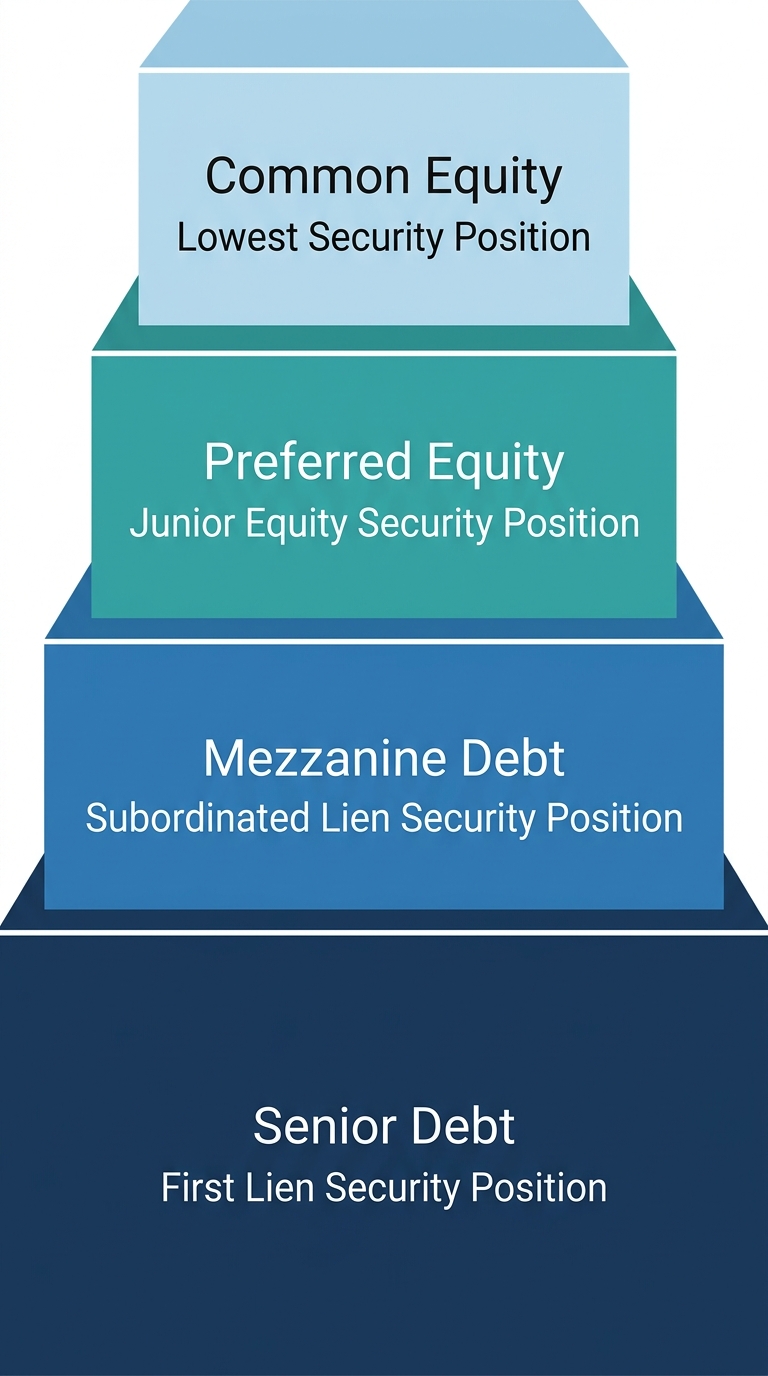
Capital stack structure for digital infrastructure financing
With the equity and debt layers in place, the reliability of cash flows becomes paramount to attract institutional lenders. This is where off-take agreements play a decisive role.
Structuring Off-Take Agreements to Attract Institutional Capital
An off-take agreement is a long-term contract–typically a lease, power purchase agreement, or capacity reservation–that provides predictable revenue streams from a creditworthy tenant or counterparty. To satisfy senior lenders, these agreements must meet minimum terms of five to seven years, feature investment-grade or equivalent counterparty credit, and include clear assignment provisions that allow the lender to step into the contract if the borrower defaults. Institutional capital providers, including pension funds and insurance companies, are drawn to data center investments precisely because such contracts de-risk cash flows, enabling lower-cost senior debt and potentially higher leverage ratios. At Zaidwood Capital, our hyperscale data center debt advisory practice helps sponsors structure and negotiate these contracts to meet lender criteria and expedite financing.
Differentiating Real Estate Financing from Project Financing
While many developers initially approach data centers as commercial real estate, the financing structure diverges significantly from traditional property loans. Three key differences stand out. First, underwriting basis: real estate financing relies on comparable sales and stabilized net operating income, whereas data centre project financing uses discounted cash flow analysis on contracted cash flows. Second, collateral: real estate loans depend on the physical asset value, but project finance may encompass contractual rights, equipment, and land. Third, risk allocation: project finance structures include a cash flow waterfall and reserve accounts to mitigate risk, while real estate debt is typically non-recourse only after completion. To complement capital stack structuring, Zaidwood Capital also provides energy mergers and acquisitions advisory for clients active in the sector.
With a well-structured capital stack and off-take framework, sponsors can proceed to the execution phase, where Zaidwood Capital’s Velocity Matrix expedites the transaction cycle, delivering the speed and precision expected of a Financial Services 3.0 advisory firm.
Navigating Data Centre Project Financing with Confidence
We navigate the complexities of data centre project financing by combining deep digital infrastructure capital stack expertise with a boutique advisory approach and tailored structuring expertise globally. Our debt advisory and structured equity solutions are powered by proprietary tools like Sovereign Data Nexus and Velocity Matrix, enabling precise execution for hyperscale and enterprise facilities. Grounded in CFA Institute standards, our method delivers the clarity and confidence sponsors need to advance complex capital decisions without overpromising outcomes.
Resources


