



Food and beverage capital raising
Table of Contents
Capital Raising Strategies for Food and Beverage Brands
In the food and beverage capital raising landscape, brands face distinct challenges tied to inventory cycles, product perishability, and the long lead times required to secure retail shelf placement. A compelling brand story paired with validated consumer demand forms the cornerstone of any successful funding effort. These sector-specific dynamics demand a tailored approach that differs markedly from technology or service-based capital formation.
Equity financing for emerging F&B brands frequently originates from specialized CPG venture capital funds that understand retail velocity and consumer trends. Securing F&B growth capital often involves targeting these niche funds, which evaluate traction through key metrics such as same-store sales velocity, gross margins, and customer acquisition costs. Angel investors with operating experience in the consumer space can also provide patient risk capital, while growth equity rounds support the capital-intensive scale-up of production and distribution networks later in a company’s lifecycle.
Debt strategies offer non-dilutive alternatives for more established brands. Asset-based lending against inventory and accounts receivable can unlock working capital tied up in the supply chain, while equipment financing supports manufacturing expansion. Structured debt facilities designed around seasonal purchasing cycles help smooth cash flow without the covenant burden of traditional bank loans, providing a bridge between production outlays and trade receivables.
Strategic considerations extend beyond financial structuring. For brands integrating sustainable sourcing or alternative proteins, similar principles apply as seen in Climate tech capital raising scenarios, where impact metrics complement traditional financial benchmarks. Any securities offering must comply with SEC exemptions such as Regulation D or Regulation A, and Zaidwood Capital operates solely as a boutique M&A and capital advisory firm, not a registered broker-dealer. Aligning with partners who understand the patience required to navigate retail cycles remains essential for long-term success.
This content is for informational purposes only and does not constitute investment advice. Securities are offered through Finalis Securities LLC; Zaidwood Capital is not a registered broker-dealer. Investments involve risk and may result in loss of principal. Consult your financial advisor before making investment decisions.
Understanding Core Financing Structures for Food and Beverage Companies
Three primary financing structures serve mid-market food and beverage capital raising in the U.S. market: growth equity, debt financing, and CPG venture capital. Under the regulatory framework of the U.S. Securities and Exchange Commission, these options are accessible through various registration exemptions, such as Regulation D for private placements, and each caters to a distinct stage of company maturity.
Financing Structure Comparison Table
The table below summarizes key differences across the three pathways:
| Feature | Growth Equity | Debt Financing | CPG Venture Capital |
|---|---|---|---|
| Investment Type | Minority equity without control | Secured or unsecured loan with interest | Equity for high-growth, early revenue |
| Typical Terms | 3-7 year horizon, board seat possible | 5-15% interest, 3-5 year amortization | 20-40% equity stake, active guidance |
| Investor Control | Limited operational control | Covenants but no board control | Significant governance rights |
| Revenue Requirements | EBITDA positive or strong growth trajectory | Consistent cash flow to service debt | >$2M ARR, >30% YoY growth |
| Best For | Established brands seeking expansion capital | Asset-heavy companies with reliable EBITDA | Early-stage brands needing distribution scaling |
Each structure serves a distinct stage and risk profile.
Growth equity, often pursued as F&B growth capital for mid-market U.S. companies, is a minority investment without operational control. Investors typically seek a 3-7 year horizon with a possible board seat. This requires EBITDA-positive or strong growth trajectory, suiting established brands seeking expansion while preserving founder control.
Debt financing offers secured or unsecured loans at 5-15% interest over 3-5 year amortization. Covenants apply but grant no board control, requiring consistent cash flow to service obligations. Asset-heavy F&B companies with reliable EBITDA use debt for equipment upgrades or working capital without giving equity.
In the U.S. CPG sector, CPG venture capital targets early-revenue brands with over $2 million ARR and 30%+ YoY growth. Investors acquire 20-40% equity along with significant governance rights, actively guiding distribution scaling. This high-risk, high-reward capital suits emerging CPG brands needing rapid market penetration.
The following infographic provides a visual overview of these financing structures, highlighting their respective features and typical applications for F&B companies.
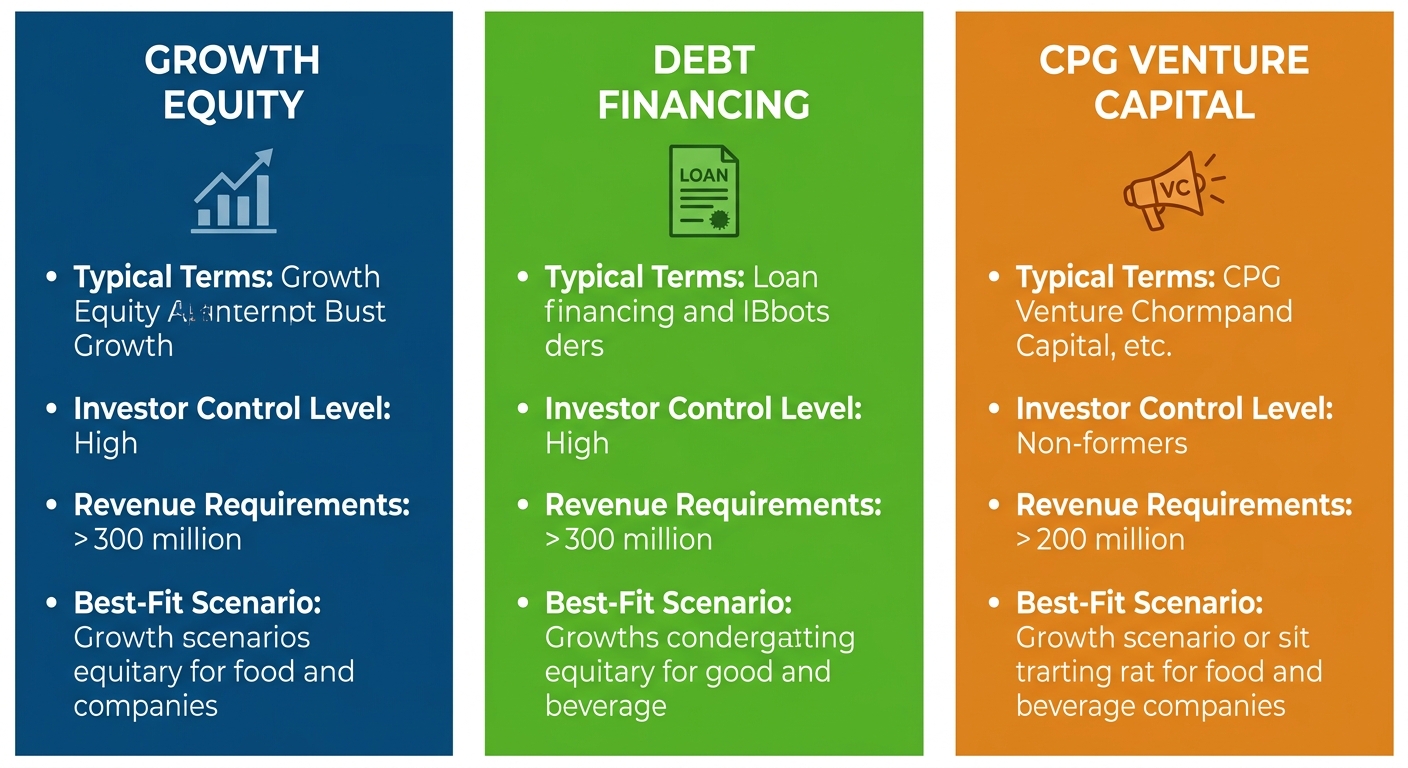
Core financing structures comparison for food and beverage companies.
Selecting the right structure depends on a company’s financial profile and growth goals–an evaluation we can facilitate. As a boutique M&A and capital advisory firm, we guide F&B companies through these options, and many benefit from boutique investment bank advisory to align their choice with long-term strategic objectives. This content is for informational purposes only and does not constitute an offer or solicitation to buy or sell any security. Securities are offered through Finalis Securities LLC; Zaidwood Capital is not a registered broker-dealer.
Key Financial Metrics and Valuation in Food and Beverage Capital Raising
Before examining the specific metrics and valuation methods that drive successful food and beverage capital raising, founders often benefit from understanding the role of financial advisors — learn what is an investment bank — who frequently guide companies through this process. To successfully raise capital, F&B founders must understand the financial metrics and valuation methods that investors use to evaluate opportunities. We draw on industry-standard methodologies, such as those outlined by the CFA Institute, to help our clients speak the same language as institutional investors.
Key Financial Metrics Investors Demand
Investors in the food and beverage sector focus on a core set of key performance indicators to assess operational health and scalability. We typically advise founders to track and present the following benchmarks:
- Gross Margin: Ideally 30-40% for consumer packaged goods brands, this reveals pricing power and production cost control.
- Same-Store Sales Growth: Mature brands commonly target 2-5% year-over-year growth from existing locations, while emerging brands show higher figures to prove momentum.
- Customer Acquisition Cost (CAC) vs. Lifetime Value (LTV): A healthy LTV/CAC ratio of 3:1 or higher signals efficient marketing spend; a direct-to-consumer brand spending $15 to acquire a customer should demonstrate at least $45 in lifetime value.
- Inventory Turns: Perishable food and beverage companies target 6-12 turns per year; fewer turns may indicate waste or sluggish demand.
- Distribution Points: Quantified as total retail doors or stock-keeping units placed, this metric correlates directly with scalability potential.
- Direct-to-Consumer Penetration: The percentage of revenue from owned channels highlights margin control and customer data ownership.
- EBITDA Margin: Mature F&B manufacturers typically operate in a 10-20% range, though high-growth brands often accept compressed margins while scaling.
- Revenue Growth Rate: Year-over-year top-line expansion demonstrates market traction.
- Unit Economics: Contribution margin per unit validates whether the core business model works before scaling.
We have found that presenting these metrics with clean historical trends and management commentary creates immediate credibility during capital raising conversations.
Valuation Approaches for Food and Beverage Companies
The CFA Institute recognizes three primary valuation methodologies applicable to private markets, and each carries distinct relevance for food and beverage companies. Understanding which method fits your profile is a cornerstone of effective food and beverage capital raising.
Discounted cash flow analysis projects future free cash flows and discounts them to present value. For stable F&B companies with predictable revenue, the terminal value often constitutes 60-80% of total enterprise value, making assumptions about long-term growth rates critical.
Comparable company analysis derives valuation multiples from publicly traded or recently transacted peers. For example, plant-based snack deals or better-for-you beverage transactions provide relevant benchmarking for brands in adjacent categories.
Precedent transactions examine completed M&A deals in the food and beverage sector to establish valuation ranges based on actual market clearing prices. This method accounts for control premiums and strategic buyer synergies that may not appear in public market data.
Asset-light F&B growth capital often commands higher revenue multiples because brands with strong consumer recognition and rapid distribution velocity deliver scalable, capital-efficient growth profiles. We help clients understand which approach aligns best with their operational reality.
Valuation Differences: Manufacturing-Heavy vs. Asset-Light
Valuation approaches diverge significantly based on the business model. The table below contrasts how manufacturing-heavy and asset-light F&B companies are typically valued.
| Metric | Manufacturing-Heavy | Asset-Light |
|---|---|---|
| Primary Valuation Method | EBITDA multiple (6-10x) | Revenue multiple (2-5x) |
| Key Value Driver | Asset utilization, contracts, margins | Brand equity, distribution velocity, recurring revenue |
| Investor Focus | EBITDA margins, capex requirements, working capital | Gross margin, customer acquisition cost, retention |
| Typical Investor | Private equity, infrastructure funds, strategic acquirers | Growth equity, CPG venture capital, family offices |
Building a Compelling Data Room
A well-prepared data room is a cornerstone of successful food and beverage capital raising. We recommend organizing the following components in a secure virtual environment, which we call our Sovereign Data Nexus:
- Audited Financial Statements: Three years of balance sheets, income statements, and cash flow statements provide the baseline credibility investors require.
- Pro Forma Projections: Detailed three-to-five-year forward-looking models with explicit growth assumptions, margin expansion drivers, and capital expenditure plans.
- Capitalization Table: A fully diluted cap table in waterfall format that clearly illustrates ownership structure and investor returns across multiple exit scenarios.
- Customer Concentration Report: A breakdown of the top five customers by revenue percentage; investors flag businesses with excessive single-customer dependency.
- Supply Chain Contracts: Agreements with copackers, ingredient suppliers, and logistics partners that demonstrate operational stability and contingency planning.
- Intellectual Property Filings: Trademarks, patents, and proprietary formulations that establish defensible competitive moats.
With these foundations in place, you are ready to approach the right investors for your capital raise.
Many CPG venture capital firms prioritize gross margin sustainability and unit economics when evaluating data room contents, which reinforces why meticulous preparation directly influences valuation outcomes.
The Capital Raising Lifecycle for Food and Beverage Companies
Navigating the capital formation journey is a pivotal undertaking for any emerging brand. For founders and executives exploring food and beverage capital raising, understanding the structured lifecycle–from identifying the right partners to finalizing legal documentation–provides a strategic advantage. As a boutique M&A and capital advisory firm, we guide companies through each phase, streamlining transactions with business development and financial expertise to secure optimal outcomes.
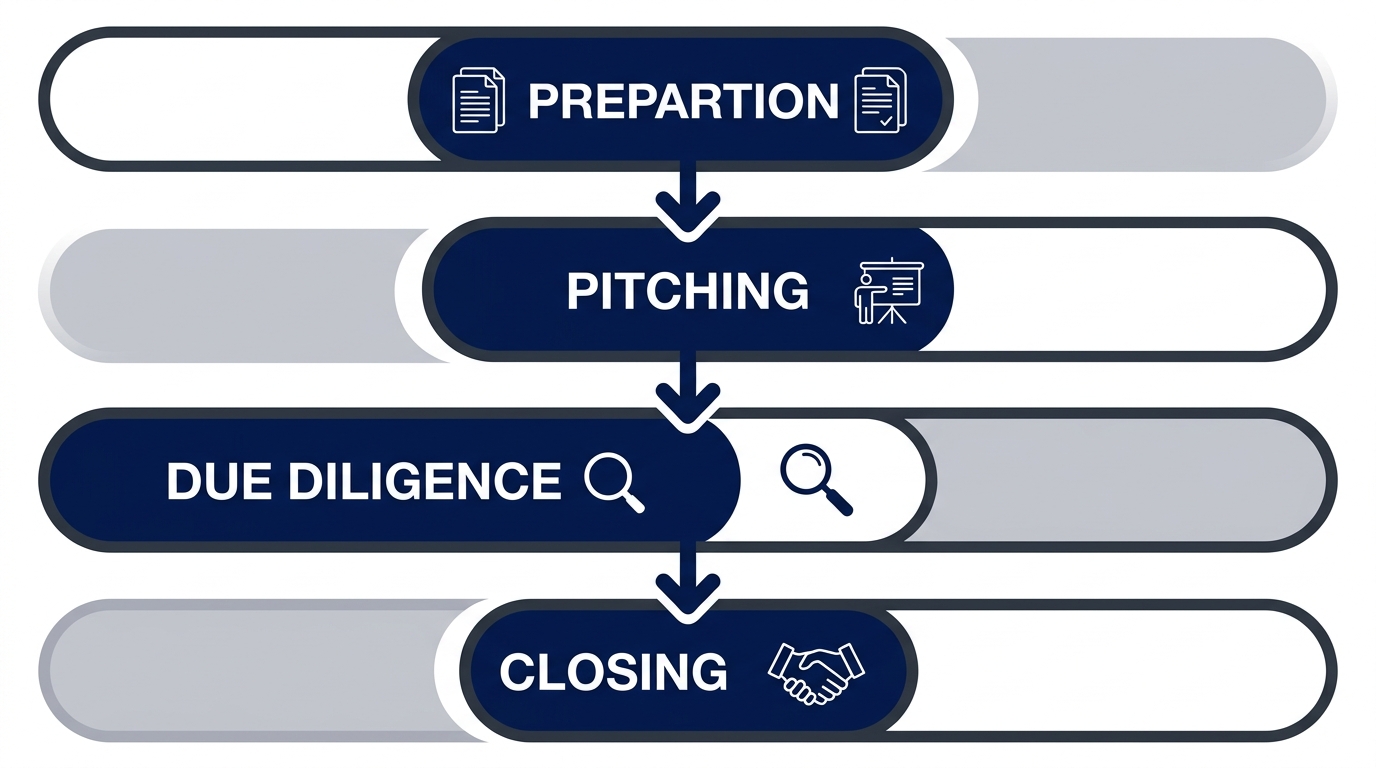
Capital raising lifecycle for food and beverage companies
Engaging with Growth Capital Providers
The first critical stage involves distinguishing among the various sources of F&B growth capital, each bringing distinct expectations and investment structures. Private equity growth funds typically deploy check sizes ranging from $10 million to $50 million and almost always require board representation to actively shape strategic direction. Strategic corporate investors, including the venture arms of multinationals like PepsiCo or Nestlé, often co-invest alongside financial sponsors and can provide invaluable distribution and operational synergies. Family offices represent a more flexible category, offering variable check sizes and considerably longer investment horizons, sometimes spanning decades. When evaluating these potential partners, it is essential to review their track records in the consumer sector, their proposed term sheets, and their cultural fit with the existing management team. This vetting process ensures alignment on both the vision and the mechanics of the partnership, setting a solid foundation for the growth phase ahead.
Pitching to CPG Venture Capital Investors
Once you have identified the right partners, the next step is crafting a compelling pitch that resonates specifically with CPG venture capital investors. A successful narrative must be anchored in irrefutable data. Begin by demonstrating robust product-market fit through metrics like trial-to-repeat purchase ratios and Net Promoter Scores. Next, highlight retail velocity, showcasing your dollar-per-store-per-week figures and velocity index to prove your product moves off shelves. The core of your financial story should be your unit economics; investors will expect to see a gross margin exceeding 40% and a healthy lifetime value to customer acquisition cost ratio. Finally, emphasize the depth of your team, spotlighting any prior exits or deep domain expertise in the consumer packaged goods space. A well-structured pitch deck, typically 12 slides, should walk investors through the problem, your solution, market sizing via TAM, SAM, and SOM, a clear product differentiation, hard sales traction data, your business model, bios of the core team, and detailed three-year financial projections along with a clear statement on the use of funds.
Closing the Deal: Documentation and Diligence
Once the investor is convinced, the final phase involves meticulous legal documentation and a thorough due diligence process. The sequence begins with a non-binding term sheet or letter of intent, which outlines the principal commercial terms. This is followed by the negotiation of definitive agreements, such as a stock purchase agreement and an investor rights agreement, which codify the binding obligations of both parties. Prior to the actual funding, several conditions precedent must be satisfied, including final board approval, the absence of any material adverse change in the business, and any necessary regulatory clearances. The funding mechanics themselves typically involve a direct wire transfer into the company’s account, though complex structures may include an escrow clawback for future earn-outs. For companies navigating this intricate phase, our M&A due diligence services streamline the review of financials, legal documents, and commercial operations, accelerating the path to a successful close within the typical 8-to-12-week venture capital timeline.
Capital Raising Process Comparison
| Stage | Growth Capital | CPG Venture Capital | Debt Financing |
|---|---|---|---|
| Preparation | Pitch deck, financial model, teaser, data room | Investor memo, product roadmap, retail traction data | Business plan, cash flow projections, collateral list |
| Pitching | Targeted outreach to PE/growth funds, initial meetings, management presentations | VC pitch meetings, demo days, accelerators | Bank/credit committee presentations, relationship manager meetings |
| Due Diligence | 4-8 weeks: financial, legal, commercial, management interviews | 6-12 weeks: customer pipeline audits, supply chain review, market validation | 2-6 weeks: credit analysis, asset appraisal, covenant review |
| Closing | SPA signing, funding conditions, board seats | Series A/B documents, warrant issuance, board representation | Loan agreement, note issuance, security filing |
This comparison underscores a critical insight: while growth capital and CPG venture rounds demand extensive commercial and market due diligence over several months, debt financing is centered on a more rapid, asset-focused credit analysis. Each path requires a uniquely tailored approach to preparation and documentation, and the choice of provider directly influences the company’s governance and strategic trajectory. This analysis is informed by foundational guidance on capital formation from the U.S. Securities and Exchange Commission.
Securities are offered through Finalis Securities LLC; Zaidwood Capital is not a registered broker-dealer. This content is for informational purposes only and is not an offer, solicitation, or commitment to buy or sell any security.
Advanced Structuring: Manufacturing-Heavy versus Asset-Light Valuation
When evaluating food and beverage capital raising strategies, the structure of your company’s operations significantly influences valuation. Founders must understand how manufacturing-heavy models, characterized by significant fixed assets and production facilities, contrast with asset-light approaches that prioritize brand value and intellectual property. These structural differences create distinct investor expectations, risk profiles, and exit pathways that shape the entire fundraising journey.
Advanced Valuation Comparison
| Factor | Manufacturing-Heavy | Asset-Light |
|---|---|---|
| EBITDA Multiple Range | 6-10x (with capex adjustment) | 10-15x (higher for pure brand platforms) |
| Primary Risk | Fixed cost leverage, commodity exposure | Brand concentration, retail dependency |
| Debt Capacity | High (tangible asset base) | Low (intangible-based collateral) |
| Exit Pathways | Trade sale to strategic acquirers or PE | IPO, SPAC, sale to larger CPG platforms |
According to the CFA Institute, manufacturing-heavy food and beverage businesses typically command EBITDA multiples in the 6-10x range, with adjustments for capital expenditure requirements that reflect ongoing investment in production infrastructure. The primary risks these companies face center on fixed cost leverage and commodity exposure, as raw material price volatility and underutilized capacity can compress margins significantly. However, their substantial tangible asset base provides meaningful advantages when seeking F&B growth capital through debt financing, as lenders can collateralize physical assets such as facilities, equipment, and inventory. We observe that these businesses often pursue trade sales to strategic acquirers or private equity sponsors, where the Full-Cycle M&A approach we employ helps navigate complex operational transitions.
Asset-light brand platforms, by contrast, generally range from 10-15x EBITDA as reported in CFA Institute data, with pure brand plays commanding the highest multiples due to their scalable business models and lower capital intensity. The risk profile shifts fundamentally toward brand concentration and retail dependency, where a single product line or distribution channel can represent existential vulnerability. These companies frequently attract CPG venture capital because their asset-light structure enables rapid scaling without proportional capital deployment. However, their limited tangible collateral constrains debt capacity, pushing capital structures toward equity financing. Exit pathways for these companies typically include IPOs, SPAC transactions, or sales to larger CPG platforms seeking brand portfolio expansion. Understanding what is an investment bank can help founders prepare for these exit scenarios by clarifying the advisory role in executing complex transactions and achieving optimal outcomes. With these valuation differences in mind, the next section explores how to tailor capital raising strategies to each model.
Frequently Asked Questions About Food and Beverage Capital Raising
Below we answer key questions on food and beverage capital raising.
What types of capital are available for F&B companies?
Companies can raise equity (VC/angel) or debt for F&B growth capital. SEC Rule 506(b) allows private sales to accredited investors. We help with strategic documentation and introductions, though we are not a registered broker-dealer.
How do companies return capital to investors?
Investors typically realize returns through acquisition, IPO, or dividends. Within CPG venture capital, strategic sales are common. A frequent exit path mirrors tech mergers and acquisitions, where a larger company acquires the brand. We position clients for such outcomes.
This information is for informational purposes only and is not an offer, solicitation, or commitment to buy or sell any security.
Scaling Your Food and Beverage Business with Strategic Capital Raising
For ambitious brands, food and beverage capital raising is a strategic enabler that transforms production capacity, inventory management, and market reach into scalable operations. The sector’s unique dynamics–tight margins, perishable goods, and substantial brand-building investment–demand a tailored approach to F&B growth capital. Founders at the seed-stage often rely on equity, while expansion-stage companies increasingly evaluate structured debt or growth equity to fund milestones like new product launches or geographic rollouts without premature dilution. The surge in CPG venture capital reflects strong consumer demand trends, yet securing capital is not a guarantee of success; it is a disciplined process of aligning a company’s lifecycle with the right capital structure. Strategic growth financing for F&B companies ultimately converts a strong concept into an enduring enterprise.
Resources


