



Climate tech capital raising
Table of Contents
Navigating Climate Tech Capital Raising from R&D to Commercial Scale
Raising capital in climate tech capital raising demands a tailored approach that aligns with distinct development milestones. We see that early-stage R&D often relies on grants and angel investors, while later growth phases require more sophisticated financing. Stanford University’s research highlights that climate ventures face significant funding gaps as they scale.
As firms progress toward commercial scale, capital needs shift toward larger equity rounds and structured debt. This may include energy transition growth equity to accelerate deployment, or climate infrastructure debt financing to fund capital-intensive projects. Navigating each stage demands precision in matching the right capital type to the maturity of the technology and the project’s risk profile. Given these complexities, a dedicated boutique investment bank advisory can help climate tech firms streamline each capital raising stage with informed, full-cycle guidance.
Before You Begin: Understanding the Climate Tech Capital Stack
Successful climate tech capital raising requires understanding the layered financing structure known as the capital stack. This stack helps founders and CFOs sequence their funding rounds effectively. We view this framework as a critical lens for mapping how different funding sources, from early equity to long-term debt, support climate ventures at each stage of maturity.
Early-stage ventures often rely on venture capital and angel investors to fund product development and initial deployment. A pre-revenue hardware startup might tap venture capital, while a commercially proven wind farm operator may consider infrastructure debt. As companies demonstrate viability, they may secure energy transition growth equity to scale manufacturing and expand market reach.
Once projects reach operational maturity, operators can access project finance and climate infrastructure debt financing. According to research by EDHEC Business School, infrastructure debt has become a standard instrument for financing large-scale climate assets, offering stable returns with attractive risk profiles to institutional investors.
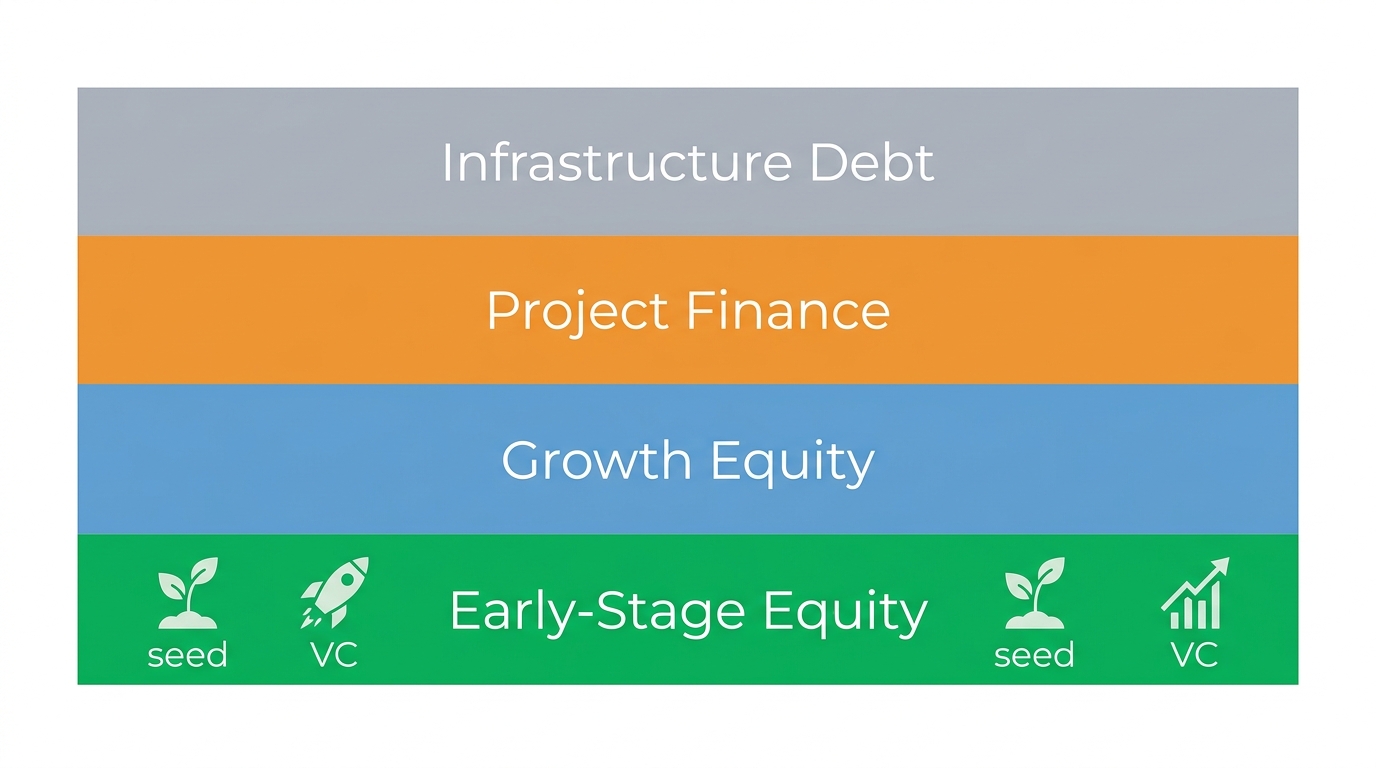
Climate tech capital stack structure overview
With this capital stack framework, climate tech capital raising becomes a more strategic exercise. We find that companies that map their capital needs to the right layer attract more aligned investors and accelerate their growth. For a deeper understanding of the advisory roles that help companies navigate each layer, see what is an investment bank.
Step 1: Diagnose Your Valley of Death Phase
Instructions
We begin every engagement in climate tech capital raising by guiding founders through a self-assessment of their current position. Use the following steps:
- Identify your technology maturity: Are you at prototype, pilot, or early deployment?
- List capital sources secured so far–grants, angel, venture capital–and pinpoint which gap remains, such as demonstration or manufacturing scale-up.
- Recognize that the Valley of Death typically spans TRL 6 (prototype demonstration) through TRL 9 (full commercial deployment), where risk remains high for traditional investors.
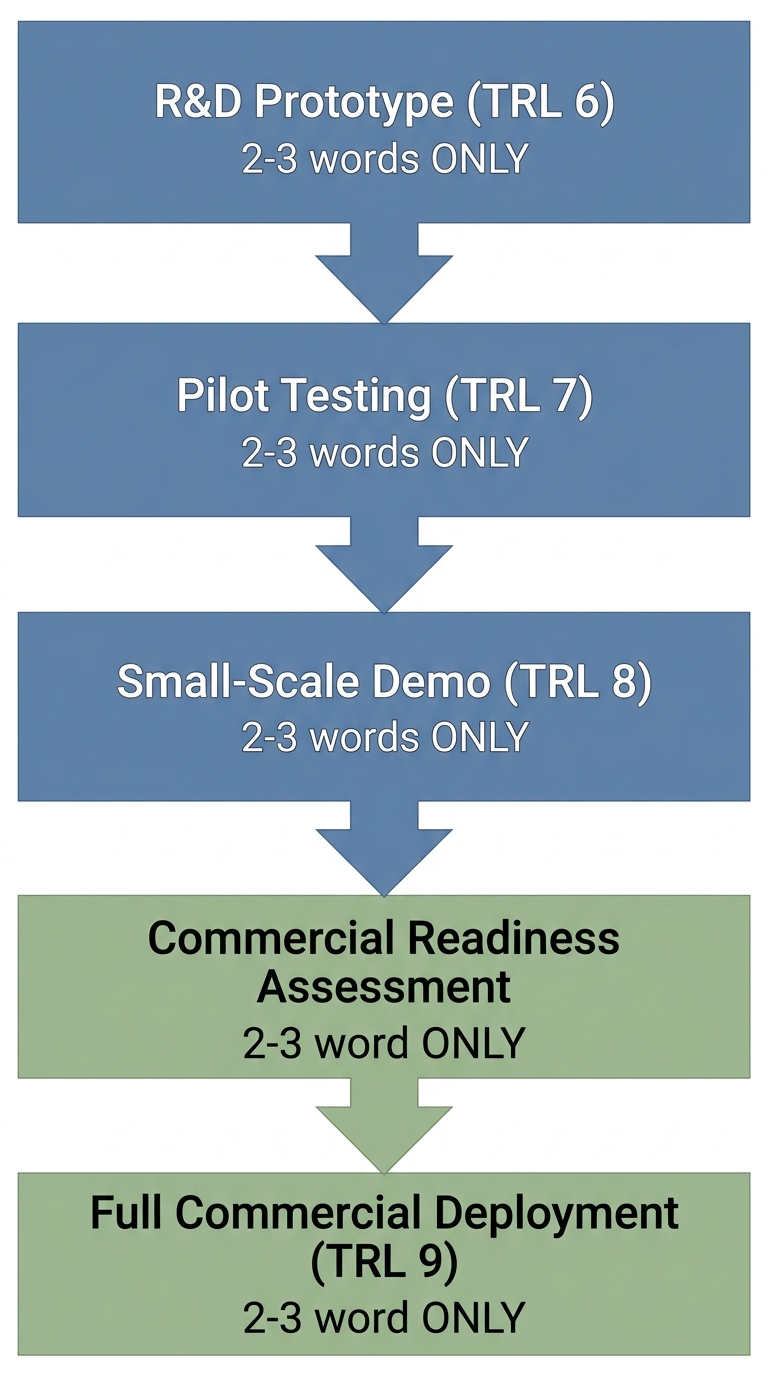
Navigate climate tech Valley of Death stages
Why It Matters
In climate tech capital raising, skipping this diagnosis leads to misaligned strategies. According to Stanford University research, climate tech companies that fail to recognize their true stage waste months pitching growth equity investors when they require non-dilutive funding. This misalignment extends development timelines and burns critical runway.
Tips
- Use milestone mapping with TRL gateways to accelerate your diagnostic.
- Understand that later stages may require energy transition growth equity or climate infrastructure debt financing.
- Once diagnosed, learn how an investment bank structures raises — what is an investment bank.
- Next, match your phase to the right capital, covered in Step 2.
Step 2: Blend Non-Dilutive and Equity Capital
Once you have assessed your capital needs, the next step is to strategically blend non-dilutive and equity capital.
Instructions
Effective climate tech capital raising demands a strategic blend of funding sources.
- Target non-dilutive grants for early-stage R&D and proof-of-concept validation.
- Raise venture capital to scale operations, expand the team, and enter the market.
- Integrate debt instruments–such as equipment financing or working capital loans–to preserve equity and fund capital-intensive milestones.
By sequencing these layers, startups maintain ownership while accessing the capital required for hardware development.
Why It Matters
For hardware-intensive climate tech, blending grants with energy transition growth equity can extend runway by 12-18 months. Stanford University research confirms that non-dilutive capital reduces dilution risk and accelerates technical milestones, making the blended approach essential. This strategy aligns funding with the sector’s long development cycles.
Tips
- Align grant application cycles with equity raise timelines to prevent cash gaps.
- Structure climate infrastructure debt financing to match milestone-based equity tranches.
- Consult financial and legal advisors for tailored capital structures.
- For cross-sector insights, see our guide on Food and beverage capital raising.
With a blended capital stack in place, the next step is to execute the raise efficiently and manage investor relationships.
Step 3: Build Growth Equity Credentials for Energy Transition
With your core technology and market validated, you now need to demonstrate commercial traction that growth equity investors can underwrite. For companies focused on climate tech capital raising, we advise assembling a verifiable set of metrics that de-risk your scaling phase.
Instructions
- Target an ARR of $5M-$10M with YoY growth exceeding 50%, as energy transition growth equity investors underwrite scale, not potential.
- Demonstrate unit economics with a gross margin greater than 60% for hardware-heavy models, or above 70% for software-enabled approaches, and a LTV/CAC ratio over 3x with a payback period under 18 months.
- Maintain a customer concentration where no single client represents more than 20% of revenue and the top three combined remain below 50%.
- Compile a traction timeline showing a completed pilot, a signed off-take agreement, and at least two quarters of recurring revenue data from early customers. Define milestones that position the company as a strong candidate for future tech mergers and acquisitions after reaching growth scale.
Why It Matters
Without these credentials, growth equity investors assign a higher risk premium, leading to a valuation gap of 30-50% or stalled rounds. Our experience shows that climate tech capital raising succeeds when founders present a data room that mirrors the diligence standards of institutional backers.
Tips
- Use pilot data reports and non-binding LOIs from offtakers as evidence of commercial de-risking.
- Project how solid unit economics can later complement equity with climate infrastructure debt financing, because EDHEC Business School research indicates that infrastructure debt often follows growth equity when credentials are strong.
Once these credentials are assembled, you are ready to approach the right growth equity investors with a compelling narrative–the topic of the next step.
Step 4: Structure Climate Infrastructure Debt Financing
For founders navigating climate tech capital raising, debt is a critical non-dilutive complement to equity. Project finance, corporate debt, and infrastructure debt funds each serve different capital structures. Project finance relies on asset-level cash flows and is common for capital-intensive facilities such as carbon capture plants. Corporate debt depends on company-wide balance sheet strength whereas infrastructure debt funds pool institutional capital specifically for long-lived real assets.
Instructions
Identify the appropriate debt instrument early. Prepare granular cash flow projections tied directly to the underlying project assets because lenders underwrite against predictable revenue. Source institutional lenders through capital advisory networks that understand energy transition risk-return profiles. According to EDHEC Business School research, infrastructure debt investors prioritize stable, contracted cash flows when evaluating climate-related projects.
Why It Matters
Debt financing allows founders to retain ownership while funding capital-intensive infrastructure. By layering climate infrastructure debt financing into the capital stack, companies reduce dilution and align long-term asset economics with patient institutional capital.
Tips
Secure off-take agreements and EPC contracts before engaging debt providers. These agreements de-risk the revenue stream and give lenders confidence in repayment. Working with a capital advisory firm familiar with infrastructure debt can be beneficial for context on how investment banks support such transactions, see how do investment banks assist with mergers and acquisitions. We then negotiate lender terms and finalize the capital structure in the next step.
Step 5: Secure Off-Take Agreements for Project Financing
Instructions
In climate tech capital raising, financial projections alone won’t convince lenders. Start by identifying creditworthy corporate buyers early. Negotiate long-term off-take agreements–typically 5-20 years–with volume commitments and floor prices. In the United States, these often take the form of Power Purchase Agreements (PPAs). Structure pricing to improve Debt Service Coverage Ratios (DSCR). Investment-grade contracts can serve as collateral, reducing equity requirements. We at Zaidwood Capital, a Boutique M&A and Capital Advisory Firm, can help structure off-take agreements to improve bankability.
Why It Matters
Off-take agreements reduce revenue uncertainty, a key hurdle for energy transition growth equity. Lenders rely on contracted cash flows to calculate DSCR; higher volumes at stable prices lower risk. Stanford University research confirms secured contracts correlate with better debt terms, improving bankability.
Tips
Begin conversations with corporate buyers early–before finalizing financial models. Anchor contracts with volume commitments and floor prices to strengthen your case for climate infrastructure debt financing. Include escalation clauses to protect against commodity swings. Our debt advisory team can help structure these provisions.
Step 6: Prepare for Growth Equity Due Diligence
Instructions
In climate tech capital raising, we assemble a meticulous virtual data room. Key documents include:
- 3-5 years of audited financial statements (income statement, balance sheet, cash flow)
- Customer contracts highlighting recurring revenue, contract length, and churn rates
- Unit economics: CAC, LTV, LTV/CAC ratio, payback period
- IP portfolio: patents, pending applications, trademarks, trade secrets, licensing agreements
- Growth projections with explicit assumptions (market size, pricing, customer growth) and alignment to growth equity metrics like ARR, gross margin, and EBITDA
We organize folders–Financials, Contracts, IP, Projections, Legal–and supply a due diligence index to expedite investor review and signal operational maturity.
Why It Matters
In climate tech capital raising, a well-structured data room shortens fundraise timelines. Energy transition growth equity investors reward this rigor–Stanford research confirms improved valuation confidence–while EDHEC’s work on climate infrastructure debt financing underscores how disciplined preparation builds investor trust.
Tips
We deploy a virtual data room with granular access controls, streamlining transactions with business development and financial expertise, to protect confidential information. With your data room prepared, you are now ready to engage growth equity investors.
Step 7: Manage the Capital Raising Process to Close
Effective climate tech capital raising demands disciplined pipeline orchestration from initial outreach to final close. We guide clients through building a segmented investor target list that matches capital type–such as energy transition growth equity or climate infrastructure debt financing–with stage-appropriate investors, a practice reinforced by Stanford University research on climate tech financing trends. Sequencing matters: we suggest starting conversations with lower-priority investors to refine the pitch before engaging lead-tier candidates, creating competitive tension that yields more favorable terms. As the process advances, we advise maintaining an indexed data room containing financial models, cap tables, and legal documentation, ensuring investors move through diligence efficiently. When negotiating term sheets, our team focuses on valuation, liquidation preferences, anti-dilution protections, board composition, and governance rights. For complex syndications, we align timelines across equity and debt partners, tracking conditions precedent through a centralized process timeline that mirrors our Precision Catalyst methodology.
Instructions
Build a segmented investor target list, sequence meetings from lower-tier to lead investors, and maintain an indexed data room with financial models, cap tables, and diligence materials. Negotiate key term sheet provisions–valuation, liquidation preference, anti-dilution, board composition–while coordinating syndication timelines between equity and debt providers using a centralized process tracker.
Why It Matters
Systematic pipeline management prevents investor fatigue and maximizes competitive tension, leading to more favorable terms and a higher probability of reaching close on schedule.
Tips
- Create a data room index and a detailed process timeline before launching outreach; update both weekly to maintain momentum.
- Leverage your advisors to field administrative diligence requests, freeing the management team to focus on relationship building.
- Run a parallel track for climate infrastructure debt financing and equity commitments to avoid last-minute syndication gaps.
Troubleshooting Common Capital Raising Challenges
Building on our overview of the capital raising landscape, it is essential to recognize the specific obstacles that frequently stall fundraising in complex sectors. A primary challenge in climate tech capital raising is investor readiness. Research from Stanford University suggests that many climate tech ventures face funding gaps not because of deficient technology, but because they lack the institutional-grade documentation and validated financial models that investors expect early in the diligence process.
Valuation mismatches often derail otherwise promising discussions. As companies negotiate energy transition growth equity, founders and investors can differ sharply on what the future revenue stream is worth today. A practical troubleshooting approach is to structure a phased capital raise, allowing subsequent tranches to be priced after key technical or commercial milestones are achieved. This bridges the gap between the entrepreneur’s vision and the investor’s need for risk mitigation.
The financing structure itself presents another layer of complexity. For many large-scale sustainable initiatives, climate infrastructure debt financing offers a compelling alternative to pure equity. Academic research from EDHEC Business School highlights that institutional capital is increasingly migrating toward infrastructure debt for renewable projects, though the complexity of these instruments demands rigorous financial modeling and transparent covenant structures to satisfy credit committees.
Beyond the numbers, a comprehensive data room is non-negotiable. Too many raises stall because critical documents are unstructured or missing. At Zaidwood Capital, our proprietary tools like the Sovereign Data Nexus and Precision Catalyst are designed to streamline due diligence by centralizing and curating your data, while the Velocity Matrix helps target the right institutional investors. None of these tools guarantee a close, but they systematically reduce friction that causes delays.
Regulatory compliance remains a foundational requirement. Every interaction with a prospective investor must carry a clear understanding that this website is for informational purposes only and is not an offer, solicitation, recommendation, or commitment to buy or sell any security. The best timing advice is to launch when your documentation is airtight and market conditions align with your sector’s investor cycle. In the next section, we detail how a Boutique M&A and Capital Advisory Firm like Zaidwood Capital can provide the hands-on expertise to methodically overcome these challenges.
Your Path to Scaling Climate Tech with a Solid Capital Stack
For ambitious companies navigating the complexities of climate tech capital raising, building a well-structured capital stack is the strategic foundation for scaling. We define this stack as the tailored combination of equity and debt designed to match a company’s lifecycle stage. Early-stage ventures requiring high growth typically rely on energy transition growth equity to fund innovation and expansion, while mature, asset-heavy projects are often better served by climate infrastructure debt financing, which provides non-dilutive capital for large-scale deployment.
At Zaidwood Capital, we design these multi-layered structures by leveraging our institutional network and proprietary tools like our Sovereign Data Nexus to precisely target the right capital providers. Our role is to optimize this mix, balancing the cost of capital with strategic flexibility to reduce unnecessary dilution. Academic research, including studies from Stanford University, reinforces the importance of this calibrated approach for bridging the critical funding gaps in climate technology.
We guide your entire capital formation journey, ensuring every layer of your stack is strategically aligned for long-term growth and market leadership.
Resources


