



Interchange Plus Pricing
Table of Contents
Interchange Plus Pricing Demystified
In the landscape of merchant services, interchange plus pricing is a transparent model that decouples the wholesale cost of processing a transaction from the processor’s service fee. At its core, this structure passes through the exact interchange fee–set by card networks like Visa and Mastercard–and adds a clearly defined payment processor markup. As a boutique M&A and Capital Advisory Firm, we regularly evaluate payment ecosystems and recognize that this clarity is critical for businesses seeking to understand their true cost of capital and operational expenses.
The model is built on two distinct layers. The first layer comprises the actual interchange reimbursement fees and card network assessments, which are non-negotiable and flow directly to the issuing bank and card brand. The second layer is the processor’s fixed markup, typically stated as a small percentage plus a flat per-transaction amount. This separation makes it easier to calculate an effective processing rate that reflects actual card mix. For high-volume merchants running mobile credit card processing operations, this structure can be particularly revealing, because the markup remains constant even as transaction volume scales.
One key consideration is that the effective processing rate can fluctuate month to month, since interchange categories vary by card type, rewards tier, and entry method. Understanding how these fees are calculated sets the stage for evaluating which pricing model aligns best with your transaction profile.
The Building Blocks of Interchange Plus Pricing
Interchange plus pricing is a merchant services model where the wholesale interchange fees set by card networks are passed through to the business at cost, then a clearly defined processor markup is added on top. At Zaidwood Capital, we see this transparent structure as foundational for growth companies and private equity sponsors who require granular visibility into every cost driver across their payment operations.
Interchange fees represent the largest component of card acceptance cost and are established by networks such as Visa, Mastercard, and Discover. These rates vary significantly based on transaction type — card-present transactions generally incur lower interchange than card-not-present transactions because they carry less fraud risk. Card category also matters substantially: standard debit cards carry the lowest interchange, while premium rewards credit cards command substantially higher rates. For debit transactions specifically, the Federal Reserve Board’s Regulation II provides the legal framework that governs fee reasonableness and routing requirements. As the authoritative government regulation, it mandates that at least two unaffiliated networks be available for processing electronic debit transactions and permits a fraud-prevention adjustment for issuers that implement approved internal policies.
The processor markup is the transparent add-on that the payment processor charges above interchange. In a typical interchange plus arrangement, this markup consists of a fixed per-transaction fee such as $0.10 plus a small basis-point add-on such as 0.05% applied to the transaction volume. This two-part structure covers the processor’s operational costs, compliance obligations, and margin while remaining fully visible on every monthly statement. Unlike flat-rate pricing where interchange and markup are blended into a single opaque percentage, interchange plus itemizes each component so businesses can see exactly how much goes to the card networks and how much goes to their processor. Understanding this payment processor markup is essential for optimizing your effective processing rate — the true net cost across all transaction types — rather than relying on a headline rate that may obscure significant variability.
Interchange Plus vs. Flat-Rate: Side-by-Side Comparison
The following comparison table illustrates how interchange plus pricing differs from flat-rate pricing across the dimensions that matter most for high-volume merchants.
| Feature | Interchange Plus | Flat-Rate |
|---|---|---|
| Pricing Model | Pass-through interchange + markup | Blended percentage (single rate) |
| Transparency | Full itemization of interchange and markup | Hidden costs inside blended rate |
| Best For | High-volume, enterprise, and growth companies | Low-volume, small businesses |
| Cost Variability | Fluctuates with interchange rates | Stable but may overcharge |
| Suitability | Businesses with high average tickets or diverse card types | Simple, predictable processing needs |
As the Transparency row makes clear, interchange plus models give merchants full line-item detail on every statement. Flat-rate providers embed interchange costs and processor profit into one rate, which offers simplicity but eliminates the ability to audit what you are actually paying the card networks versus your processor. For private equity-backed portfolio companies and mid-market firms executing high-dollar transactions, this granularity supports procurement discipline and operational benchmarking. For industries where margins are thin and transaction volumes are high — such as in healthcare mergers and acquisitions — interchange plus pricing provides the cost transparency that management teams and sponsors rely on when modeling unit economics. Understanding these building blocks sets the stage for evaluating whether interchange plus is the right choice for your business.
Interchange Rate Categories and Processor Markup
To understand interchange plus pricing, we must first break down its two components: interchange fees and processor markup. Understanding interchange rate categories is essential for any business, including those involved in tech mergers and acquisitions, where transaction volumes and values can vary widely. Each transaction processed through a card network carries a base interchange fee set by the network, and the processor adds a markup on top, creating the total cost.
Understanding Interchange Rate Categories
Card networks assign every transaction to one of several interchange tiers based on risk, card type, and processing environment. The five major categories we encounter are:
- Qualified: Standard swiped or dipped consumer credit cards with full data captured. According to Federal Reserve Bank of Richmond research, these typically cost around 1.5% of the transaction amount plus $0.10.
- Mid-qualified: Higher-risk transactions such as card-not-present consumer credit cards (e-commerce or phone orders). Rates move upward to reflect increased fraud exposure.
- Non-qualified: This tier captures corporate, purchasing, and premium rewards cards. A non-qualified interchange rate can reach approximately 2.5% plus $0.10, significantly raising processing costs.
- Debit: Regulated debit cards issued by large banks fall under the Durbin Amendment cap of 21 cents plus 0.05% per transaction. Unregulated debit (from smaller institutions) sits higher.
- Regulated: Beyond debit, other regulated categories exist for certain prepaid and government cards, each with specific caps and conditions.
A swiped consumer credit card at a retail point-of-sale lands in the qualified tier, while the same card used online (no signature or chip authentication) drops to mid-qualified. A corporate rewards card, regardless of processing method, often hits the non-qualified tier because of the higher interchange built into those card products.
Differentiating Percentage and Per-Transaction Markups
With the interchange portion fixed per transaction category, the variable a processor can quote is its markup. Under an interchange-plus model, the payment processor markup appears in two common forms:
- Percentage markup: A small fraction of the transaction dollar value — for example, 0.10% of a $5,000 transaction equals $5.00. Total cost = interchange rate + markup rate times transaction amount.
- Per-transaction fee: A flat dollar amount per authorization — for instance, $0.10 per transaction. Total cost = interchange fee (often a percent plus a fixed amount) + per-transaction fee.
The table below compares the two common processor markup models.
Percentage Markup vs. Per-Transaction Fee Comparison
| Feature | Percentage Markup | Per-Transaction Fee |
|---|---|---|
| Cost Driver | Transaction volume (dollar amount) | Number of transactions (count) |
| Best For | High-value transactions, low volume | Low-value transactions, high volume |
| Example Cost | 0.10% of $5,000 = $5.00 | $0.10 per 50 transactions = $5.00 |
| Effect of Batch Size | No impact from batch count | Rises linearly with transaction count |
| Typical Markup Range | 0.05% – 0.30% | $0.05 – $0.25 per transaction |
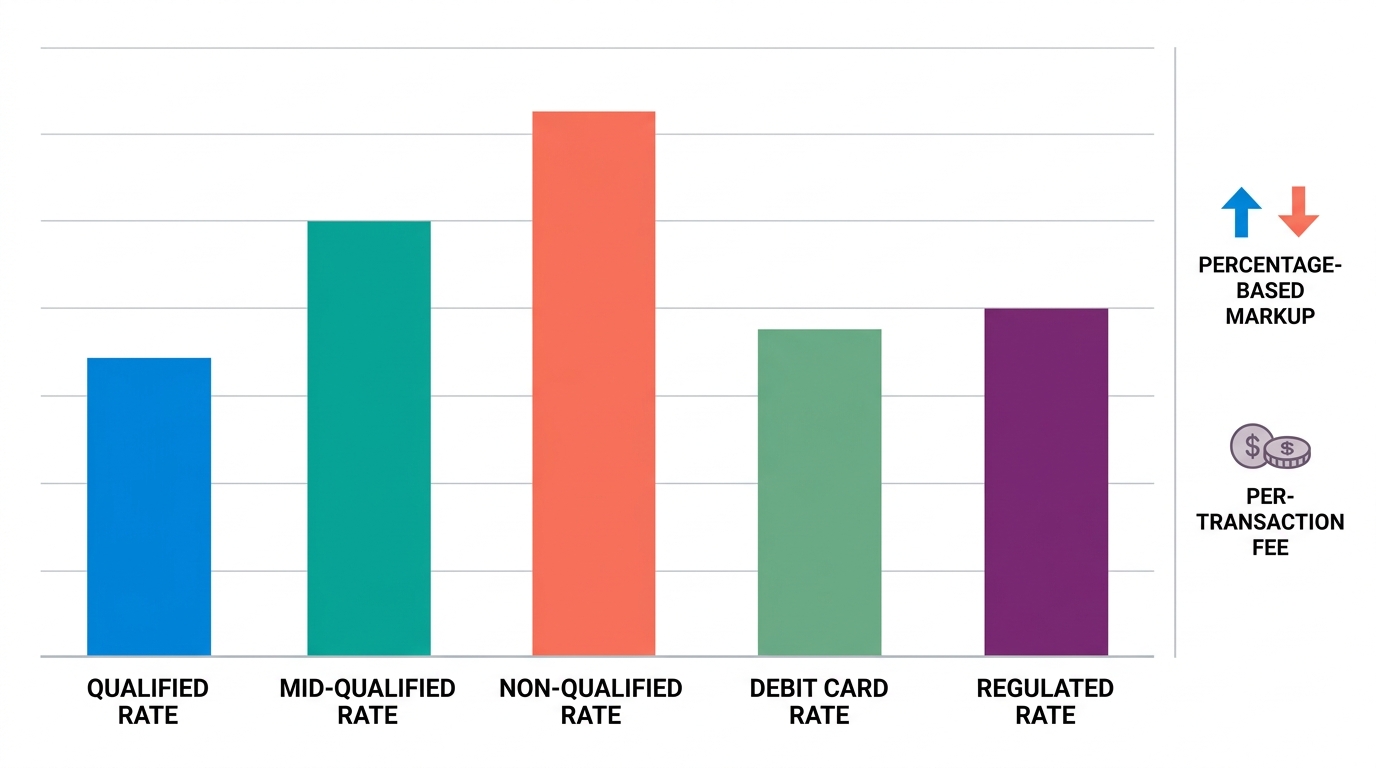
Comparison of interchange rate categories and processor markup structures
The chart above visualizes how interchange tiers differ in cost and how the two markup structures behave. Choosing the right markup model requires analyzing your typical transaction profile — both average ticket size and monthly volume.
How Transaction Mix Affects Effective Processing Rate
A common mistake is accepting a single quoted markup without considering the card mix flowing through a business. The effective processing rate your business pays is the weighted average of interchange plus markup across all transaction types. If 60% of your sales come from regulated debit (low interchange) and 40% from corporate rewards cards (high interchange), the blended cost will be quite different from a merchant that sees mostly qualified consumer credit cards.
Quoting only a flat percentage markup — say, 0.20% — ignores the fact that different card categories carry vastly different base interchange costs. The Federal Reserve Bank of Richmond’s analysis confirms that the Durbin Amendment’s debit cap significantly lowers costs for certain merchants, but the benefit varies widely based on the proportion of large-bank debit cards in their mix. To estimate your true effective processing rate, we recommend mapping out your recent transaction data by card type and applying the applicable interchange tiers along with your negotiated markup. Only then can you see whether a percentage-based or per-transaction-based markup yields the lowest overall cost for your specific business profile.
Auditing Your Merchant Statement and Negotiating Markups
Now that you understand the interchange-plus model, the next step is to audit your merchant statement to confirm you are actually receiving that pricing. A thorough review helps you identify hidden costs and ensures your payment processor markup is fair and competitive.
Step-by-Step Statement Audit
To begin, secure a recent monthly processing statement and focus on the line-item detail where interchange categories are listed. In true interchange plus pricing, each transaction should clearly show a passthrough interchange cost and a separate processor fee. Follow these steps to verify accuracy:
- Locate the interchange category column. Look for common e-commerce codes like CPS E-Commerce or CPS Card Not Present, and card-present codes such as CPS Retail or Regulated Debit. Debit card transactions specifically fall under Regulation II, which, according to the U.S. Federal Reserve Board, caps fees for large issuers at approximately 22 cents plus a small ad valorem component.
- Verify the passthrough rate. Using a public interchange table from your card network, confirm the rate passed through on your statement matches the published rate for that transaction category. If you see a single, blended rate with no separate interchange detail, you are likely not on an interchange-plus model and cannot verify your true cost.
- Check for downgrades. A standard rewards card transaction should not be coded as a premium tier unless specific criteria apply. Incorrect qualification is a primary source of inflated fees.
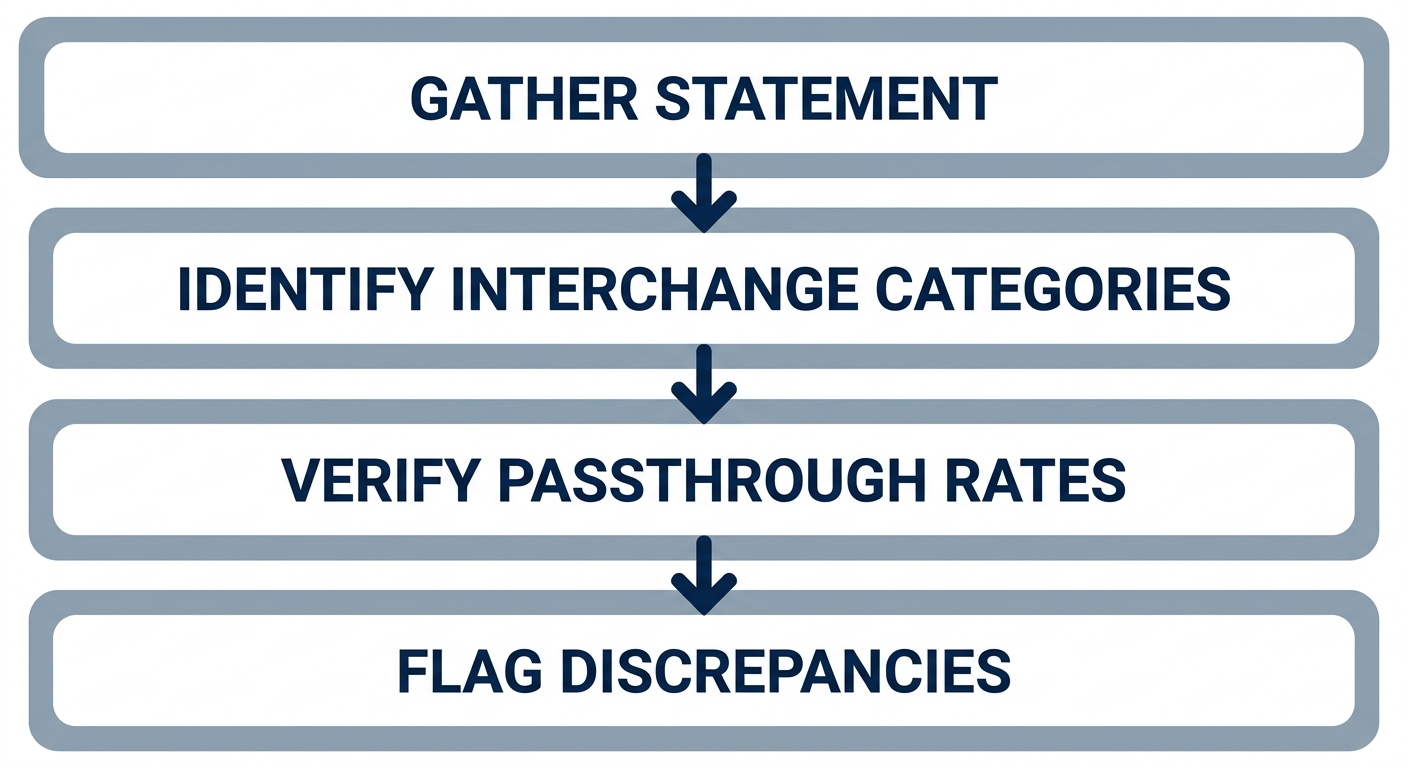
Four-step merchant statement audit process
Identifying Hidden Fees and Blended Rates
Beyond the core interchange and processor markup, several ancillary fees can silently increase your effective processing rate. These line items may be embedded in a monthly summary or listed as service charges. We consistently advise clients to scrutinize statements for these common cost drivers:
- Monthly minimum fees: A set charge applied if total transaction fees do not reach a contractual threshold, which effectively raises your average processing cost on low-volume months.
- PCI compliance and statement fees: Annual or monthly charges for PCI DSS compliance programs and basic statement delivery, which are often negotiable or waivable.
- Incorrect qualification rates: Debit cards regulated under the Federal Reserve’s caps should not post as standard consumer rewards cards; this misclassification inflates the processor’s markup considerably.
- Account termination fees: Some contracts include early termination charges that lock you into a high payment processor markup long-term, limiting your ability to switch to a more competitive provider.
Effective Processing Rate: E-Commerce vs. Card-Present
The comparison below outlines how an effective processing rate–the total fees divided by total sales–differs between e-commerce and card-present environments. These rates are influenced primarily by risk profiles and regulatory frameworks, including the Federal Reserve Regulation II routing provisions.
| Feature | Interchange Plus | Flat-Rate |
|---|---|---|
| Pricing Model | Pass-through interchange + markup | Blended percentage (single rate) |
| Transparency | Full itemization of interchange and markup | Hidden costs inside blended rate |
| Best For | High-volume, enterprise, and growth companies | Low-volume, small businesses |
| Cost Variability | Fluctuates with interchange rates | Stable but may overcharge |
| Suitability | Businesses with high average tickets or diverse card types | Simple, predictable processing needs |
Effective Processing Rate and Business Valuation
While interchange plus pricing separates the interchange fee from the payment processor markup, an effective processing rate blends these components into a single, actionable metric. As a boutique M&A and capital advisory firm, Zaidwood Capital defines the effective processing rate as the total cost of payment acceptance divided by total transaction volume, expressed as a percentage. This blended cost reflects the true transaction fee burden a company bears, smoothing out the variability of individual card types and settlement structures.
This metric differs fundamentally from the itemized view that interchange-plus pricing provides. Rather than tracking the discrete pieces–interchange, assessments, and payment processor markup–the effective rate offers a holistic snapshot of payment acceptance cost. We recommend monitoring this figure monthly because a rising effective rate, without a corresponding increase in average order value, directly compresses net profit margins.
Healthy Effective Processing Rates by Business Type
| Feature | Percentage Markup | Per-Transaction Fee |
|---|---|---|
| Cost Driver | Transaction volume (dollar amount) | Number of transactions (count) |
| Best For | High-value transactions, low volume | Low-value transactions, high volume |
| Example Cost | 0.10% of $5,000 = $5.00 | $0.10 per 50 transactions = $5.00 |
| Effect of Batch Size | No impact from batch count | Rises linearly with transaction count |
| Typical Markup Range | 0.05% – 0.30% | $0.05 – $0.25 per transaction |
For B2B companies, the target effective processing rate sits between 0.5% and 1.2%. These organizations benefit from large invoice amounts spread across fewer transactions, often paid with lower-interchange corporate cards. In contrast, B2C e-commerce merchants face a higher benchmark range of 1.5% to 2.5%, driven by card-not-present surcharges, consumer rewards cards, and elevated chargeback risk. Enterprise entities typically experience a blended range of 0.8% to 1.4%, influenced by mixed transaction profiles, negotiated volume discounts, and custom routing logic.
Frequently Asked Questions About Interchange Plus Pricing
What is interchange plus pricing?
Interchange plus pricing means you pay the non-negotiable interchange fees set by card networks, plus a fixed payment processor markup we help you negotiate.
How does it differ from flat-rate or tiered pricing?
Flat-rate bundles all costs into one blended fee, obscuring the processor spread. Interchange plus separates the base interchange from the payment processor markup, offering greater transparency.
Who benefits most?
High-volume merchants benefit most, as the transparent structure lowers the effective processing rate. It’s also ideal for businesses in transition, such as those navigating healthcare mergers and acquisitions, where transaction clarity drives value.
What affects your effective processing rate?
Your effective processing rate shifts with your transaction mix–debit versus credit cards, card type, and average ticket size–so the net processing cost varies month to month.
Optimize Payment Processing for Business Growth
Beyond top-line growth, smart cost management–starting with payment processing–sets the stage for higher valuations. We counsel clients to audit their interchange plus pricing structure, as it directly influences cash flow predictability and EBITDA, two metrics central to M&A valuation. This model, pairing an interchange fee with a fixed payment processor markup, is the most transparent framework, offering clarity that tiered models obscure.
The Case for Interchange Plus
A lower effective processing rate–calculated as (total fees / total processing volume) × 100–signals operational efficiency. The three core components to monitor are interchange fees, assessments, and processor markup. We view this as a Precision Catalyst: fine-tuning these levers strengthens the financial profile that investors scrutinize, making the business more attractive to buyers. This Velocity Matrix approach transforms payment economics into a clear M&A readiness signal.
Resources


