



Cannabis Merchant Services
Table of Contents
Why Cannabis Businesses Require Specialized Merchant Services
The legal cannabis industry operates in a unique financial paradox that standard payment processors cannot navigate. Despite state-level legalization, cannabis remains illegal under the federal Controlled Substances Act, which forces traditional banks and merchant account providers to classify the entire sector as high risk. This classification leads to widespread account closures and denials, leaving many operators without reliable payment infrastructure. The Federal Deposit Insurance Corporation (FDIC) oversees deposit insurance and bank supervision, and most institutions avoid cannabis clients to prevent jeopardizing their federal standing. The Financial Crimes Enforcement Network (FinCEN) issued detailed guidance in 2014 that established a framework for banking marijuana-related businesses, but the compliance burden remains substantial. Financial institutions must file suspicious activity reports (SARs) under a three-tiered system, a requirement that standard processors simply will not undertake. Consequently, many cannabis operators are forced into cash-heavy models that create serious safety vulnerabilities and operational inefficiencies. This is why cannabis companies turn to providers specialized in high risk payment processing, where underwriting expertise and compliance infrastructure are purpose-built for this regulatory landscape. Only specialized cannabis merchant services can bridge the gap between federal scrutiny and commercial necessity, which is why we deliver tailored payment and capital solutions for this underserved market.
Essential Preparation for Cannabis Merchant Services
The path to securing reliable payment processing in cannabis merchant services begins long before any application is submitted. At Zaidwood Capital, we guide clients through the foundational steps that demonstrate operational integrity and regulatory awareness to prospective acquirers.
A critical starting point is aligning with federal guidance. We advise businesses to thoroughly review the Financial Crimes Enforcement Network’s (FinCEN) 2014 guidance on Bank Secrecy Act (BSA) obligations, which outlines mandatory Suspicious Activity Report (SAR) filing and enhanced due diligence expectations for marijuana-related businesses. Similarly, the Office of the Comptroller of the Currency (OCC) provides a regulatory framework for banks, emphasizing the need for robust internal compliance programs.
From this understanding, practical groundwork can begin. Verifying that your state cannabis license is active and fully compliant is a prerequisite for any legitimate high risk merchant processing application. Beyond licensing, establishing an internal compliance infrastructure — including transaction monitoring protocols and employee training on cannabis-specific regulations — is essential. We also recommend preparing a detailed business narrative that clearly explains your legal status, revenue sources, and operational controls.
Finally, exploring alternatives like ACH payment processing often requires the same rigorous preparation. Once these compliance and operational foundations are set, businesses are far better positioned for the next stage. For firms exploring adjacent sectors, our energy mergers and acquisitions advisory services provide complementary strategic support.
Understanding Compliance and Regulatory Risks
Beyond operational risks, compliance and regulatory failures represent another critical dimension in M&A due diligence. The Financial Crimes Enforcement Network (FinCEN) sets anti-money laundering (AML) standards that acquisition targets must satisfy, and the agency imposes substantial civil penalties for non-compliance. For example, FinCEN recently assessed a $125 million penalty against a financial services firm for recidivist Bank Secrecy Act violations. The U.S. Department of Justice (DOJ) similarly prosecutes securities fraud, insider trading, and false disclosures that can surface during a target’s regulatory history review. Our team screens for past enforcement actions, ongoing investigations, and gaps in compliance infrastructure, verifies remedial actions and assesses remediation plans, ongoing monitoring controls, and board-level compliance governance structures periodically to help acquirers avoid post-acquisition liability and reputational harm. Our comprehensive m&a due diligence services incorporate rigorous compliance vetting against regulatory benchmarks.
Gathering Required Documentation for Approval
The first step in securing regulatory approval for any energy M&A transaction is gathering the required documentation. Engaging energy mergers and acquisitions advisory services early can help identify exactly what regulators like FinCEN will require.
To satisfy AML and beneficial ownership reporting obligations, parties must compile a current and certified package. A specialized energy mergers and acquisitions advisory firm can guide the organization of these documents:
- Beneficial ownership information (BOI) as defined under the Corporate Transparency Act — including names, addresses, and identification for each beneficial owner, where applicable per FinCEN’s latest rulings.
- The target’s and acquirer’s AML compliance policies and transaction monitoring procedures, with dates and signatures.
- The letter of intent (LOI) and purchase agreement, highlighting any regulatory conditions.
- Audited financial statements and tax returns for the last three years for both parties.
- Pre-merger notification filings (e.g., Hart-Scott-Rodino) if the transaction size triggers a requirement.
- Comprehensive due diligence reports covering legal, financial, and operational risks.
- Proof of financing commitment letters and source of funds documentation when external financing is involved.
- All documents must be current, certified where required, and organized in a compliant data room for regulator review.
Once assembled, the documentation should be housed in a secure, regulator-ready data room according to FinCEN standards. With the right energy sector M&A guidance, companies can ensure completeness and accelerate the path toward approval. Once all documents are certified and in place, the review process can move forward efficiently.
Comparing Cashless ATM and ACH Payment Solutions
In the context of healthcare mergers and acquisitions, we often evaluate payment ecosystems for clients in cannabis merchant services and other sectors requiring high risk merchant processing. Understanding the mechanics of settlement is critical.
Functionally, these solutions diverge. A Cashless ATM mimics a traditional debit withdrawal with PIN entry, settling instantly. In contrast, ACH payment processing operates as a batch electronic bank transfer. While electronic ACH transactions typically carry higher chargeback risk, Cashless ATMs provide a terminal-based alternative for high-risk retail, reducing immediate reversals.
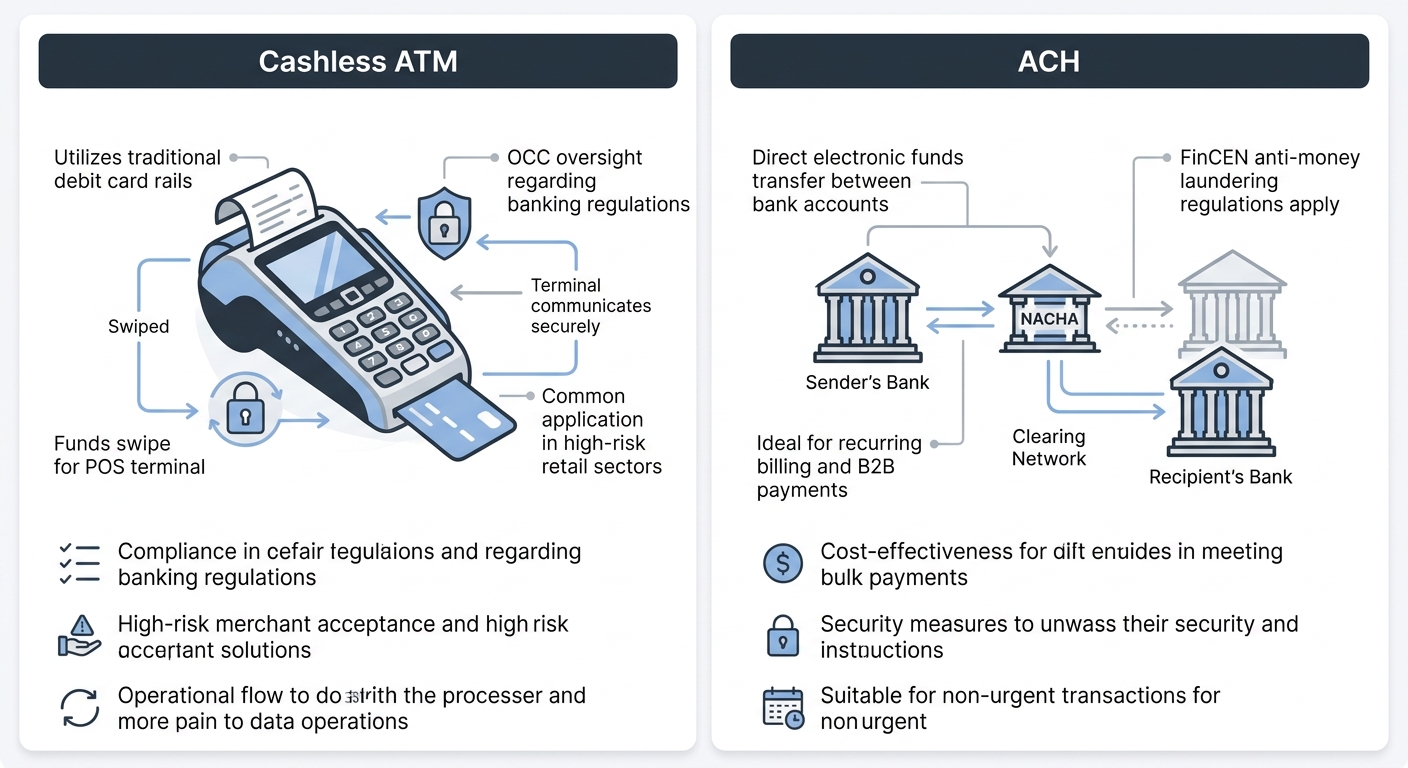
Clear comparison of Cashless ATM and ACH payment solutions
From a regulatory standpoint, Cashless ATMs generally fall under the oversight of the Office of the Comptroller of the Currency (OCC). For high-risk payment processing, ACH compliance is primarily enforced by the Financial Crimes Enforcement Network (FinCEN) to combat money laundering. This analysis is informational and not investment advice; it simply clarifies the operational frameworks for cannabis merchant services.
Selecting a High-Risk Merchant Processor
For high-risk sectors like cannabis, CBD, or forex, choosing the right merchant processor is critical to financial stability and future M&A readiness. When evaluating cannabis merchant services, compliance with federal regulations should be the primary filter.
To identify a reliable partner for high risk merchant processing, prioritize processors that:
- Are registered as Money Services Businesses (MSBs) and maintain FinCEN-mandated BSA/AML programs.
- Partner with FDIC-insured banks to offer pass-through coverage on settlement reserves, safeguarding your funds.
- Support ACH payment processing as a lower-cost alternative to card networks, especially valuable for recurring billing in subscription models.
- Avoid processors that promise guaranteed approvals — such claims often signal inadequate risk controls.
Selecting a compliant processor now can smooth future healthcare mergers and acquisitions by ensuring clean financial records. (This content is for informational purposes only and does not constitute an offer or solicitation. Consult advisors before making investment decisions.)
Navigating the Application and Approval Process
Navigating the approval process in cannabis merchant services requires coordination with federal regulatory frameworks from the Office of the Comptroller of the Currency and the U.S. Department of Justice. A complete application typically spans 4 to 8 weeks across initial submission, compliance review, and underwriting.
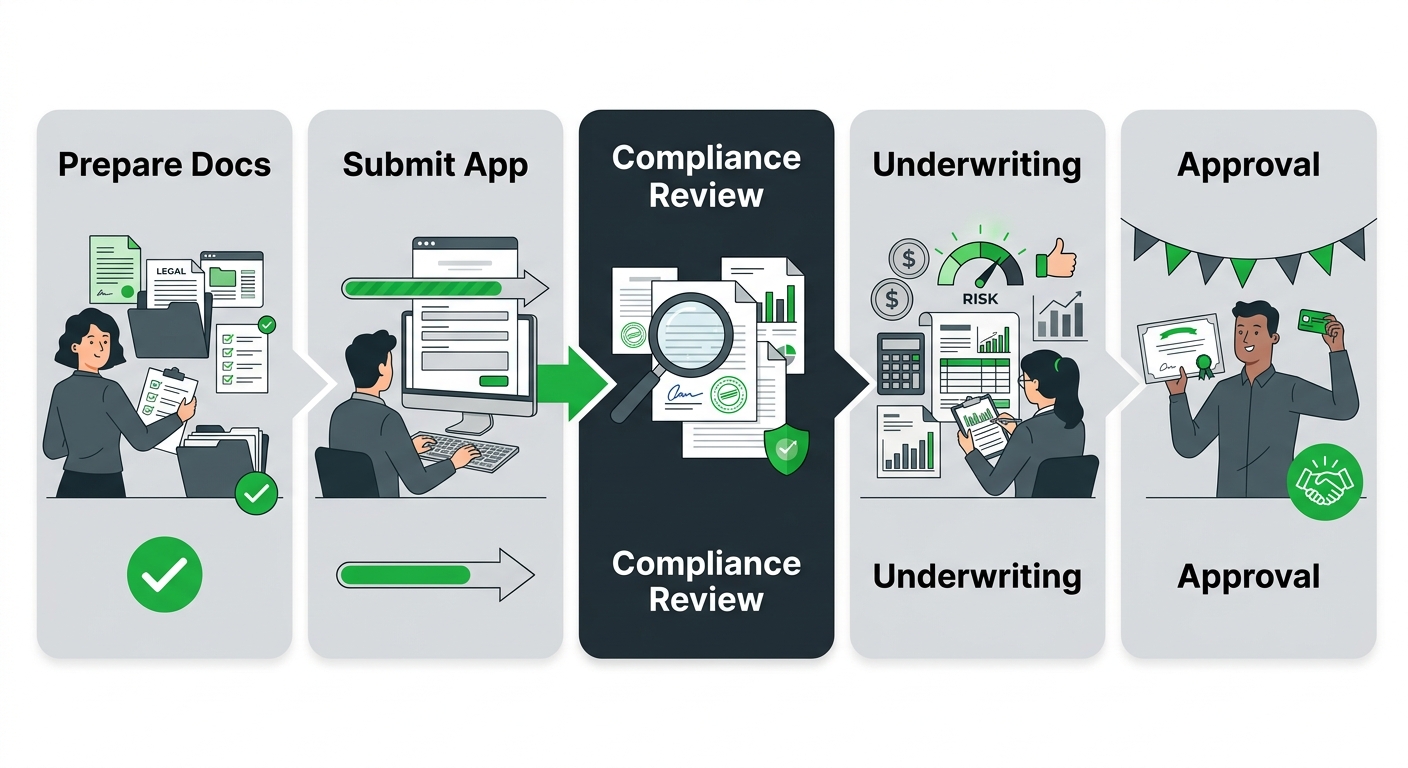
Cannabis merchant account application process in five steps.
Mandatory documentation includes a valid state cannabis license, business formation documents, two years of financial statements, a compliance plan covering BSA/AML policies, and processing history. OCC-regulated banks require enhanced due diligence under the 2014 FinCEN guidance, including Suspicious Activity Report filings. The DOJ’s enforcement stance, shaped by the 2013 Cole Memo and subsequent rescissions, influences bank willingness to underwrite cannabis accounts.
In our view, additional scrutiny applies for high risk merchant processing and with ACH payment processing. Applicants must demonstrate robust internal controls and transaction monitoring. We underscore that each application is evaluated on its own merits, and approval is never guaranteed. This content is for informational purposes only. Compliance remains foundational to any successful setup in cannabis merchant services.
Integrating Payment Processing with Your POS System
When operating in the cannabis merchant services space, integrating payment processing with a point-of-sale system demands careful attention to both technology and regulatory compliance. We help clients evaluate API compatibility, terminal connectivity, and secure data flow while maintaining strict PCI standards.
Given federal banking constraints, high risk merchant processing arrangements must incorporate reliable ACH payment processing and adhere to Bank Secrecy Act requirements. The Federal Deposit Insurance Corporation (FDIC) dictates merchant account safety standards, and the Office of the Comptroller of the Currency (OCC) sets risk management expectations for non-bank payment systems. As a boutique advisory, we perform thorough due diligence–vetting processor compliance, negotiating favorable terms, and aligning integration architectures with operational goals–so that the solution is both functional and resilient.
By leveraging our capital markets expertise, we guide clients toward integration strategies that balance innovation with regulatory prudence without ever acting as the payment processor itself.
Maintaining Compliance and Avoiding Account Shutdowns
For businesses leveraging cannabis merchant services, maintaining regulatory compliance is the single most critical factor in preventing account shutdowns. We advise our clients that the Financial Crimes Enforcement Network (FinCEN) requires cannabis-related businesses to file Suspicious Activity Reports (SARs) under three categories–marijuana limited, marijuana priority, and marijuana termination–which serve as the baseline for banking transparency. The U.S. Department of Justice’s enforcement priorities, as outlined in federal guidance, directly influence whether financial institutions will retain a cannabis merchant. These priorities compel rigorous customer due diligence, including verification of state licensure, ownership structure, and source of funds–a reality of high risk merchant processing that demands unbroken vigilance. To avoid abrupt account closures, implement ongoing transaction monitoring; anomalies in ACH payment processing or deposit patterns can trigger SAR reviews. Maintain open communication with your payment processor’s compliance team and update them on any licensing or operational changes. Failure to file accurate SARs or to provide requested documentation leads to immediate account termination and an inability to open new accounts, so continuous compliance is non-negotiable.
Common Cannabis Merchant Service Issues and Resolutions
Many cannabis businesses encounter significant obstacles when seeking reliable cannabis merchant services in the U.S. because federal illegality prompts most traditional banks to deny standard accounts. This forces operators to rely heavily on cash or turn to high risk merchant processing platforms that understand the industry’s unique compliance burden.
The Financial Crimes Enforcement Network (FinCEN) issued its foundational 2014 guidance on marijuana banking, which remains the primary regulatory framework for financial institutions serving cannabis-related businesses. Under that framework, banks must file Suspicious Activity Reports and categorize accounts based on a four-tiered priority system. Despite this federal guidance, many FDIC-insured institutions remain cautious; the Federal Deposit Insurance Corporation (FDIC) provides deposit insurance, but banks face heightened scrutiny and the potential loss of that insurance if they fail to manage cannabis-related risks effectively.
The most common payment processing issues include sudden account termination, excessive reserve requirements that strain cash flow, elevated chargeback risks, and limited payment options at the point of sale. Without access to familiar credit card networks, a cannabis retailer can quickly find itself locked out of mainstream commerce, making cannabis merchant services a persistent operational hurdle.
Strategic resolutions start with partnering with specialized processors that are comfortable with the cannabis vertical. Implementing a rigorous compliance program, including accurate SAR reporting aligned with FinCEN’s categories, demonstrates institutional maturity. Many operators also integrate ACH payment processing or e-check solutions as stable alternatives to card-based payments, reducing chargeback exposure while maintaining reliable settlement.
Our team at Zaidwood Capital helps clients evaluate and structure their financial operations so that they qualify for the right payment partnerships. With our expertise in business development and capital raising, we guide cannabis operators toward compliant, sustainable banking solutions that support long-term growth.
Gathering Required Documentation for Approval
Assembling the right documentation is the critical first move in securing M&A and capital-raising approvals. For transactions in heavily regulated niches, particularly in cannabis merchant services, FinCEN guidelines demand exceptionally thorough records. Our m&a due diligence services include a systematic review of the following essential categories:
- Beneficial Ownership Information: Verifying individuals with 25% or more ownership or control, as mandated by FinCEN’s Customer Due Diligence rule.
- Entity Verification: Business licenses and articles of incorporation to prove legal standing.
- Financial Health: Two to three years of audited financial statements demonstrating transaction capability.
- Transaction Specifics: Term sheets, letters of intent, and comprehensive source-of-funds statements.
- High-Risk Addenda: For high risk merchant processing, additional items like cannabis business licenses and AML policies are required.
Each element aligns with FinCEN’s risk-based approach, scaling depth with transaction complexity. A complete package directly shortens approval timelines and curtails regulatory risk. We further reinforce transparency by reviewing data in ACH payment processing, ensuring clean fund flows.
Resources


