

Table of Contents
The Evolving Landscape of Alternative Investments
The alternative investments 2026 landscape is undergoing a profound shift as investors look beyond traditional stocks and bonds to private equity, real assets, and hedge funds, driven by technology, rising institutional demand, and regulatory changes. The rapid expansion of tech mergers and acquisitions is fundamentally reshaping how institutions access these asset classes, a trend we detail in our 2026 guide. CFA Institute research confirms that institutional allocations to alternative investments have swelled, reflecting the sector’s maturation and growing mainstream acceptance. In this shifting environment, our boutique advisory approach—anchored by proprietary capabilities such as the Precision Catalyst, Velocity Matrix, and Sovereign Data Nexus—enables us to deliver Full-Cycle M&A execution that helps clients capture value across complex alternative transactions.
1. Private Equity Returns
In the 2026 alternative investments landscape, private equity stands out as a leading asset class delivering capital appreciation through active company management. We see returns generated by acquiring undervalued businesses, improving operations, and exiting at higher valuations.
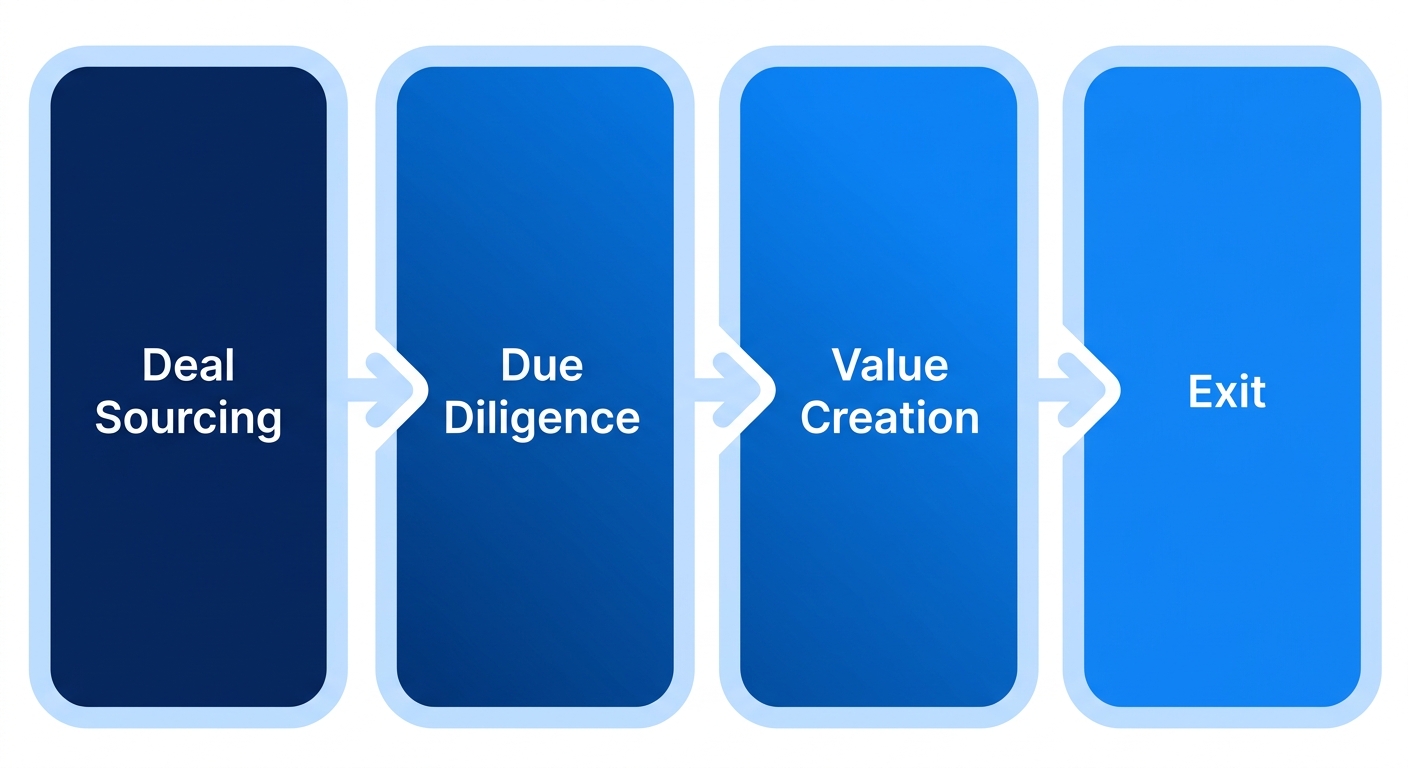
Four-stage buy-side M&A process flow for private equity returns
Our Boutique M&A and Capital Advisory Firm follows a Full-Cycle M&A process that begins with rigorous target screening and due diligence. We then focus on operational value creation, financial restructuring, and strategic positioning to boost earnings and enhance exit multiples. To understand the mechanics, it helps to know what is an investment bank. Investment banks provide deal flow, debt advisory, and execution support — critical levers that directly shape IRR and MOIC. Over a typical holding period of 5 to 7 years, these disciplined activities compound private equity returns.
IRR measures the time-weighted return on invested capital, while MOIC captures the total value generated relative to the initial investment. Over the past decade, the asset class has delivered high single-digit to low double-digit IRRs, though future results are not guaranteed.
As we assess the 2026 alternative investments market, private equity’s illiquidity premium and active management continue to anchor diversified portfolios.
2. Hedge Fund Diversification
Within the landscape of alternative investments 2026, hedge fund diversification stands out as a vital strategy. This approach spreads investment exposure across multiple hedge funds, strategies, and asset classes to lower overall portfolio risk and improve risk-adjusted returns.
Institutional investors, including pension funds and endowments, embrace hedge fund diversification to access uncorrelated return streams and mitigate portfolio volatility. By allocating across diverse strategies, they reduce sensitivity to any single market event or fund-specific downturn. While not a guarantee against losses, this diversification aims to enhance the consistency of risk-adjusted performance over time.
As the alternative investments 2026 opportunity set expands, such diversification becomes increasingly relevant for maintaining resilient portfolios. We at Zaidwood Capital, a boutique M&A and capital advisory firm, support hedge funds in these diversification efforts through capital formation advisory, connecting them with a broad network of institutional and private investors. Our equity, debt, and structured solutions help build diversified investor bases without providing investment advice. By leveraging proprietary data, we facilitate access to limited partners that align with each fund’s strategic goals, strengthening their ability to pursue diverse investment mandates.
This capital raising capability is a cornerstone of our advisory practice, enabling hedge funds to navigate the evolving alternative investment landscape with greater flexibility.
3. Real Assets Stability
Beyond growth potential, investors evaluating alternative investments 2026 also seek stability—and real assets like revenue based financing offer exactly that. Revenue-based financing qualifies as a real asset because it is secured by a company’s ongoing revenue stream rather than equity or fixed debt. Its repayment mechanism links directly to monthly top-line performance: payments rise in strong months and contract during weaker periods, which naturally aligns cash flows for both the issuer and the investor. Unlike traditional debt, there is no fixed monthly burden, reducing default risk and creating a more resilient asset across economic cycles.
We enhance this stability through our Sovereign Data Nexus, a proprietary engine that analyzes revenue predictability and cash flow sustainability before structuring any deal. This data-driven approach—part of Financial Services 3.0 and Precision Catalyst—helps us identify companies with robust recurring revenue profiles, reducing volatility. The result tends to deliver reliable performance while also providing portfolio liquidity advantages we explore next.
4. Venture Capital Growth
Building on early-stage capital, the next major milestone for many growth companies is venture capital growth—specifically Series A funding. In the alternative investments 2026 landscape, institutional investors seek high-growth opportunities through venture capital, making Series A a pivotal round for scaling companies.
Zaidwood Capital’s FAQ defines Series A as the first institutional round for startups with validated product-market fit, enabling scaling, team expansion, and market entry. Typical investors include venture capital firms, corporate venture arms, and angel syndicates, each with distinct return expectations and involvement levels.
As a Boutique M&A and Capital Advisory Firm offering full-cycle M&A and transactions advisory, Zaidwood Capital structures Series A transactions using our Sovereign Data Nexus platform to identify aligned investors and our Velocity Matrix framework to shorten deal timelines. We prepare strategic documentation and manage confidential deal rooms to streamline due diligence. Securities are offered through Finalis Securities LLC; Zaidwood Capital is not a registered broker-dealer. In the context of alternative investments 2026, Series A serves as a critical entry point for institutional investors seeking high-growth exposure.
5. Infrastructure Resilience
One critical dimension of this trend is infrastructure resilience: the ability of grids, networks, and physical assets to withstand climate events, cyber threats, and supply chain disruptions. With alternative investments 2026 increasingly targeting durability, energy companies face pressure to modernize while raising capital for upgrades.
Our Boutique M&A and Capital Advisory Firm guides energy companies through full-cycle M&A engagements that prioritize resilience-boosting transactions. Drawing on Zaidwood Capital’s expertise, including our internal guidance on selecting M&A advisors for energy companies, we evaluate infrastructure vulnerabilities and structure deals that fund grid modernization, cybersecurity hardening, and supply chain redundancy. The Sovereign Data Nexus, our proprietary data and analysis platform, identifies optimal transaction structures and surfaces hidden risks in target assets.
In the 2026 alternative investment landscape, infrastructure resilience is a value driver that our Full-Cycle M&A approach helps unlock — without overpromising outcomes. We facilitate capital formation and strategic partnerships that fortify energy infrastructure for long-term stability.
6. Family Office Frameworks
Family office frameworks provide a structured approach to managing multi-generational wealth, encompassing an investment policy statement, asset allocation strategy, governance structure, and performance reporting. As these frameworks evolve, alternative investments 2026 have become a central pillar, with family offices increasingly allocating to private equity, real estate, hedge funds, and venture capital to drive diversification and enhance returns.
Within these frameworks, a disciplined due diligence process—often modeled on investment banking best practices—evaluates each opportunity through financial modeling, including discounted cash flow and precedent transaction analyses. This rigor ensures that alternative asset classes are integrated in a manner consistent with the family’s risk tolerance and long-term goals.
We, as a Boutique M&A and Capital Advisory Firm, complement family office capabilities by providing M&A advisory, capital formation, and deal execution support. Our team leverages a structured three-phase approach—deal sourcing, due diligence, and closing—to help families navigate complex alternative investments within their existing governance frameworks, ensuring each transaction aligns with their strategic objectives.
Building Your 2026 Alternative Investment Strategy
With a clearer view of the landscape, building your alternative investments 2026 strategy requires a forward-looking approach. Evolving inflation, interest rates, and geopolitical shifts demand diversification across private equity, real estate, or venture capital.
A solid strategy starts with assessing your risk tolerance and investment horizon. Diversify across alternative categories such as private equity and real assets, and conduct rigorous due diligence on illiquidity risks and fee structures. Understanding how each asset class responds to 2026 market pressures is crucial. Monitor regulatory and market developments continuously. As you build your alternative investments 2026 approach, integrate professional-grade analysis to evaluate opportunities.
All investments involve risk, including potential loss of principal. We encourage aligning your strategy with rigorous professional standards. The chartered financial analyst certification from the CFA Institute represents a commitment to ethical, research-driven analysis. Following such standards, a Chartered Financial Analyst certification can bolster your strategy’s credibility.