

Table of Contents
Understanding Post-Merger Integration
Post-merger integration is the disciplined process of combining two organizations’ operations, cultures, and systems to capture the synergies identified during the deal. The real value of any merger is realized here, not at closing. As a boutique M&A advisory firm, we guide clients through this critical phase, ensuring that strategic objectives translate into operational reality.
The work begins the day the deal closes and unfolds across planning, execution, consolidation, and optimization phases. Primary goals include achieving projected financial synergies, aligning leadership and culture, and maintaining business continuity. Integration success is measured by speed to synergy and retention of key talent. A successful merger depends on thorough planning during merger due diligence that directly informs the integration roadmap.
Our Full-Cycle M&A advisory covers every stage of post merger integration, leveraging proprietary tools like the Velocity Matrix for rapid execution and the Sovereign Data Nexus for secure, data-driven decision-making. This combination prepares companies to combine effectively without disrupting core operations. With a clear understanding of integration, we can now examine how meticulous due diligence sets the foundation for this critical phase.
Preparing for Post-Merger Integration
Post-merger integration (PMI) preparation begins during due diligence, not after the deal closes. Early alignment between merger objectives and the deal rationale is critical. Merger due diligence findings shape the integration roadmap and are essential to readiness.
Three actions anchor a structured post-merger integration plan:
- First, set clear integration objectives tied to both revenue and cost synergies, using synergy tracking frameworks to measure progress.
- Next, assemble a dedicated integration team comprising functional leads from both the acquirer and the target.
- Finally, establish transparent communication protocols for all stakeholders, ensuring consistent updates.
These steps translate due diligence findings into actionable integration plans and lay the foundation for professional guidance.
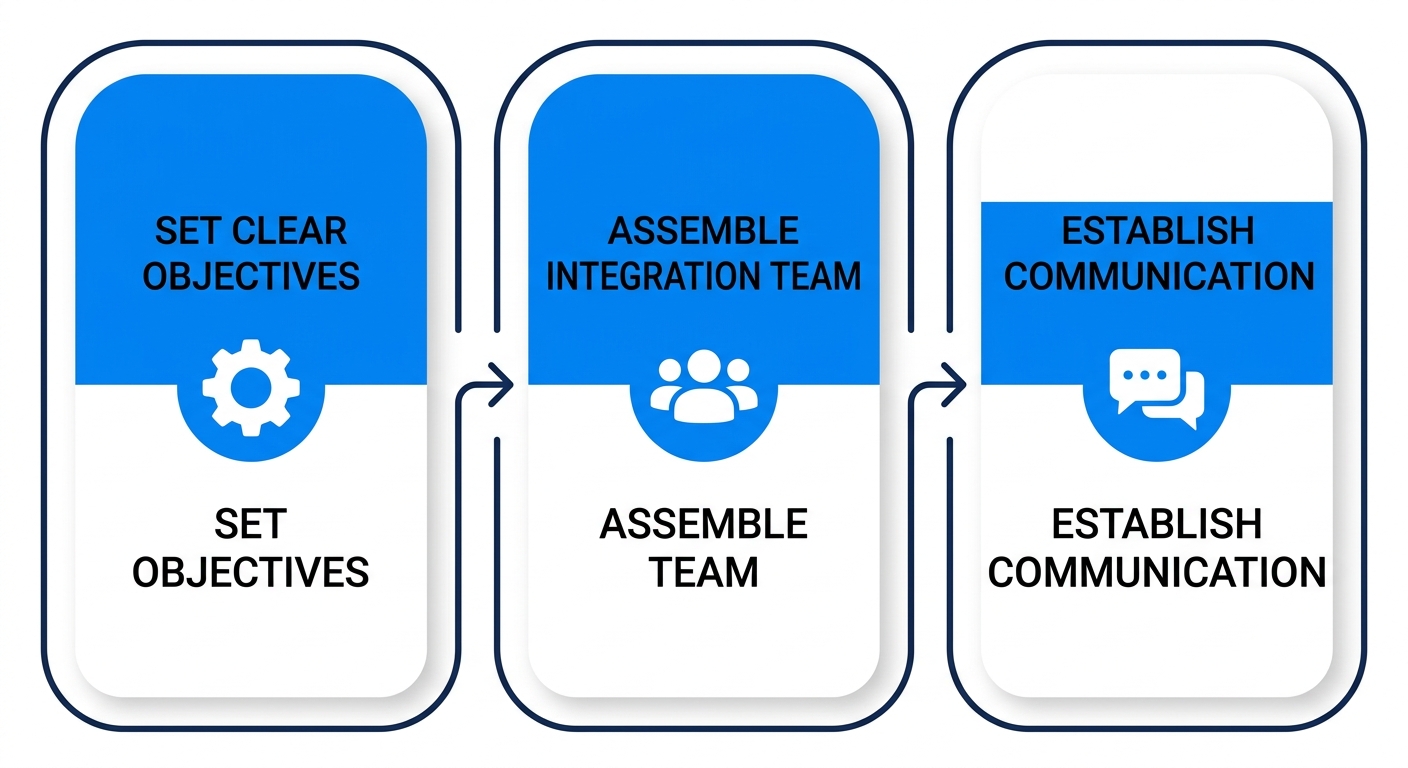
Process flow for post-merger integration preparation in three steps
Zaidwood Capital, a Boutique M&A and Capital Advisory Firm, reinforces this early-stage work as part of our Full-Cycle M&A services. Partnering with us—see what is an investment bank—ensures that integration preparation benefits from deep capital markets experience and proprietary data tools. (Zaidwood Capital is not a registered broker-dealer.)
With these building blocks in place, organizations can move to the execution phase, where dedicated integration teams drive synergies.
Define a Clear Integration Vision and Strategy
Post-merger integration requires a clear vision to align leadership and capture synergies. As a Boutique M&A and Capital Advisory Firm, we outline three steps that begin during the merger due diligence phase.
Instructions
- Engage both leadership teams to define the merger’s strategic rationale—whether for market expansion, technology acquisition, or cost synergies.
- Document quantifiable synergy targets, such as reducing combined operational costs by 15% within 12 months.
- Create a phased timeline with quick wins in the first 30–60 days and long-term milestones over 12–24 months.
Why It Matters
Without a clear strategy, teams risk conflicting priorities, scope creep, and resource misallocation that undermine value drivers. This clarity keeps the entire organization focused on capturing intended synergies and avoids wasting resources on non-essential initiatives.
Tips
Use a shared scorecard to track alignment across both organizations. Engage deal advisors (legal, financial, operational) early to uncover regulatory or cultural challenges that could obstruct post-merger integration. By involving them early, you identify blind spots before they derail the integration process.
Conduct a Thorough Cultural Assessment
Instructions
We recommend a structured post merger integration cultural assessment in three steps. First, survey leadership and employees from both organizations to surface unspoken norms and points of resistance. Next, map cultural differences using the Hofstede and Cameron-Quinn frameworks. Finally, identify quick culture wins—joint town halls or shared rituals—that build early trust and momentum.
Why It Matters
Culture clash remains a primary driver of integration failure. Early diagnosis preserves talent, reduces attrition risk, and protects the strategic logic of the merger. Our internal M&A guide confirms that companies that embed cultural diligence alongside financial and legal merger due diligence capture value faster and sustain team engagement.
Tips
Cultural integration should never be an afterthought. Allocate a dedicated workstream from day one. As part of a Full-Cycle M&A approach, treating culture as a standalone track rather than a sub-task of HR ensures the assessment receives the rigor and attention it demands.
Align Due Diligence Findings with Integration Plans
To ensure post merger integration proceeds smoothly, we must systematically map due diligence outputs to execution workstreams. Drawing on our full-cycle M&A experience, we transform raw findings into structured action.
Instructions
- Create a crosswalk linking legal, financial, operational, and IT diligence categories to corresponding integration workstreams.
- Flag high-priority items surfaced during merger due diligencesuch as regulatory gaps, contract renegotiations, or system migrations.
- Assign specific owners and firm deadlines to every identified gap or risk; this accountability prevents post-close drift.
Why It Matters
Closing the gap between diligence and execution prevents costly rework and protect the deal’ underlying assumptions. Analysis become actionable only when owners are named and timelines are set.
Tips
Use a single source of truth—a secure diligence vault—o track findings from discovery through resolution. This central repository keep all stakeholders aligned and ensures nothing fall through the cracks as the merger novel to integration execution.
Establish Transparent Communication and Change Management
In the post merger integration process, transparent communication serves as the foundation for maintaining trust and momentum across all stakeholders. After setting the integration structure and governance, the next priority is establishing a disciplined communication cadence that keeps everyone aligned.
Instructions
Develop a weekly all-hands cadence for the integration team and bi-weekly workstream updates. Segment audiences into employees, customers, and investors with tailored messages for each group. Appoint a change management lead to proactively address resistance and celebrate quick wins that build momentum.
Why It Matters
Poor communication is the number one cited cause of merger failure, eroding trust and slowing execution. Effective change management is a cornerstone of post merger integration, preventing the uncertainty that can derail even well-planned transactions.
Tips
Overcommunicate using multiple channels including email, intranet, and live sessions to reinforce alignment. Repetition of key messages using consistent terminology keeps everyone rowing in the same direction.
With clear communication channels in place, the integration team can proceed to execute the milestone plan with stakeholder buy-in.
Set Up Integration Metrics and Key Milestones
Once the integration strategy is set, the next step is to define how you will measure success in post-merger integration. Our approach recommends three concrete actions to establish accountability from day one.
Instructions
- Define 3–5 top-line success metrics. Target revenue synergies through cross-sell revenue goals, cost savings from operational overlap reductions, employee retention measured by voluntary turnover rate, and customer satisfaction tracked via NPS scores.
- Establish baseline data before integration begins. Pull internal financials, HR records, and customer surveys at least 30 days prior to kickoff, anchoring every metric in pre-transaction reality following merger due diligence.
- Set milestone checkpoints at 30, 60, and 90 days. Each interval requires a prebuilt dashboard comparing actuals against baseline, enabling rapid course correction through our Velocity Matrix framework.
Why It Matters
Measurable targets in post-merger integration create accountability and surface risks early. When revenue synergy targets, cost reduction milestones, and retention benchmarks are tracked transparently, small deviations become visible before they escalate into crises that threaten deal value.
Tips
Share a single scorecard across all workstreams to align teams around the merger’s shared objectives. A unified view, grounded in our Full-Cycle M&A approach, reinforces common purpose and accelerates collective progress.
With your metrics and milestones in place, you are ready to deploy the Velocity Matrix for rapid execution.
Execute Operational Integration Efficiently
Execution is where the post-merger integration thesis is validated; speed and precise coordination prevent value leakage during this critical phase. Our team works from a pre-agreed integration blueprint to move swiftly from planning into concrete action.
Instructions
We prioritize a phased rollout for critical systems, integrating ERP finance modules first, followed by HR and CRM platforms. Standardizing high-velocity processes like procurement and order-to-cash captures immediate cost synergies in any merger. Finally, we redeploy top performers to the highest-impact workstreams—customer retention and financial integration leads—to safeguard the deal’s core value drivers.
Why It Matters
Operational integration directly tests the planning assumptions. A disciplined, rapid execution framework prevents the value erosion that causes 70% of deal underperformance, turning integration from a risk into the engine of realized growth.
Tips
Maintain a centralized integration playbook that codifies decision-making rules across all geographies. This reduces friction and guards against scope creep, ensuring the team stays focused strictly on the top three value drivers identified pursuant to merger due diligence findings. Past performance does not guarantee future results.
Monitor Progress and Make Agile Adjustments
Once integration execution is underway, it is critical to monitor progress and make data-driven adjustments. According to Zaidwood Capital’s industry analysis, agile post merger integration monitoring enables rapid course correction, a practice we recommend for navigating the complexities of any merger.
Instructions
- Conduct weekly integration steering committee reviews with representatives from both legacy organizations to track milestones, resource allocation, and risk items.
- Implement a rapid issue-escalation process that identifies critical blockers and routes them to the integration lead within 24 hours for triage and resolution.
- Perform a formal post-integration audit at the 6-month and 12-month marks to document lessons learned, assess synergy realization and update the integration roadmap.
Why It Matters
Real-time monitoring helps prevent small deviations in timeline, budget or cultural alignment from compounding into major failures. When we catch issues early, we enable swift course correction that supports informed decisions and protects deal value.
Tips
Appoint an independent integration auditor who reports directly to the steering committee. Where relevant, this auditor should review merger due diligence insights to provide objective progress assessments untethered by internal biases. These monitoring practices lay the groundwork for a sustainable integration culture that maximizes deal value.
Navigating Common Post-Merger Integration Challenges
Once the deal is signed, the real work begins: integrating two distinct organizations. In our experience, the complexities of post-merger integration often catch even seasoned leaders off guard. We at Zaidwood Capital understand that realizing the full value of a transaction demands a structured, insightful approach that goes far beyond the financial modeling and negotiation phases.
Our comprehensive guide to tech mergers and acquisitions explores these hurdles in depth, but a few stand out as consistently challenging. Chief among them is cultural integration. A frequently underestimated challenge, harmonizing two distinct corporate cultures requires clear, consistent communication and a deliberate alignment of core values from day one to prevent employee friction and a loss of productivity.
Operational integration presents another significant layer of complexity. Harmonizing disparate systems, internal processes, and reporting structures without disrupting business continuity is a delicate balancing act. We recommend a phased approach that prioritizes critical functions first, allowing for smoother transitions and less strain on management and staff. Thorough merger due diligence can help identify many of these operational risks early, but the hands-on work of combining operations remains a central challenge of any merger.
Finally, technology integration is often the most tangible source of friction. A successful strategy for data migration and IT system consolidation is non-negotiable. Leveraging dedicated capabilities, such as our proprietary Sovereign Data Nexus, can ensure secure data access and integrity during these critical transitions. Underpinning all this is the need for talent retention and clear role definition, a structure that reduces uncertainty and can help mitigate the flight of key personnel.
A lack of leadership alignment is the single greatest pitfall we see, which is why our advisory role focuses on providing structured guidance through these turbulent waters, helping leaders present a unified front and steer their new, combined organization toward its strategic future.
Achieving Integration Success with Zaidwood Capital
In emerging-market M&A, post-merger integration is the critical bridge between deal signing and value realization. Zaidwood Capital’s proprietary trend analysis confirms that fragmented regulations, currency swings of 10–20%, and information asymmetries make disciplined integration a prerequisite for success. Without a data-driven framework, even carefully negotiated deals can unravel during the handoff.
Our approach turns this challenge into a competitive advantage. The Sovereign Data Nexus delivers real-time global data feeds that track integration milestones, flag emerging risks, and empower deal teams to intervene before small issues escalate. Precision Catalyst aligns investors, management, and on-the-ground teams through digital stakeholder mapping, maintaining cohesion throughout the integration lifecycle. The Velocity Matrix then accelerates timelines by weeks without compromising legal, regulatory, or financial merger due diligence. Critically, our full-cycle model plans integration during due diligence—not as an afterthought—so every deal decision is informed by post-close realities. This integration-first philosophy helps clients avoid the delays and value erosion that commonly arise when integration is treated as a closing formality.
By embedding discipline from day one, Zaidwood Capital turns post-merger integration into a predictable, value-creating process. Our integration methodologies adhere to the highest industry standards, as reflected in CFA Institute resources. With our support, clients convert integration complexity into measurable, strategic outcomes.