



Steps To Sell A Business
Table of Contents
Understanding the Journey of Selling Your Business
Deciding to sell business is one of the most consequential milestones any founder faces, and at Zaidwood Capital we understand the weight of that decision. The journey blends deep emotional reflection with rigorous financial strategy, and understanding the steps to sell a business before you begin can dramatically reduce uncertainty and improve outcomes.
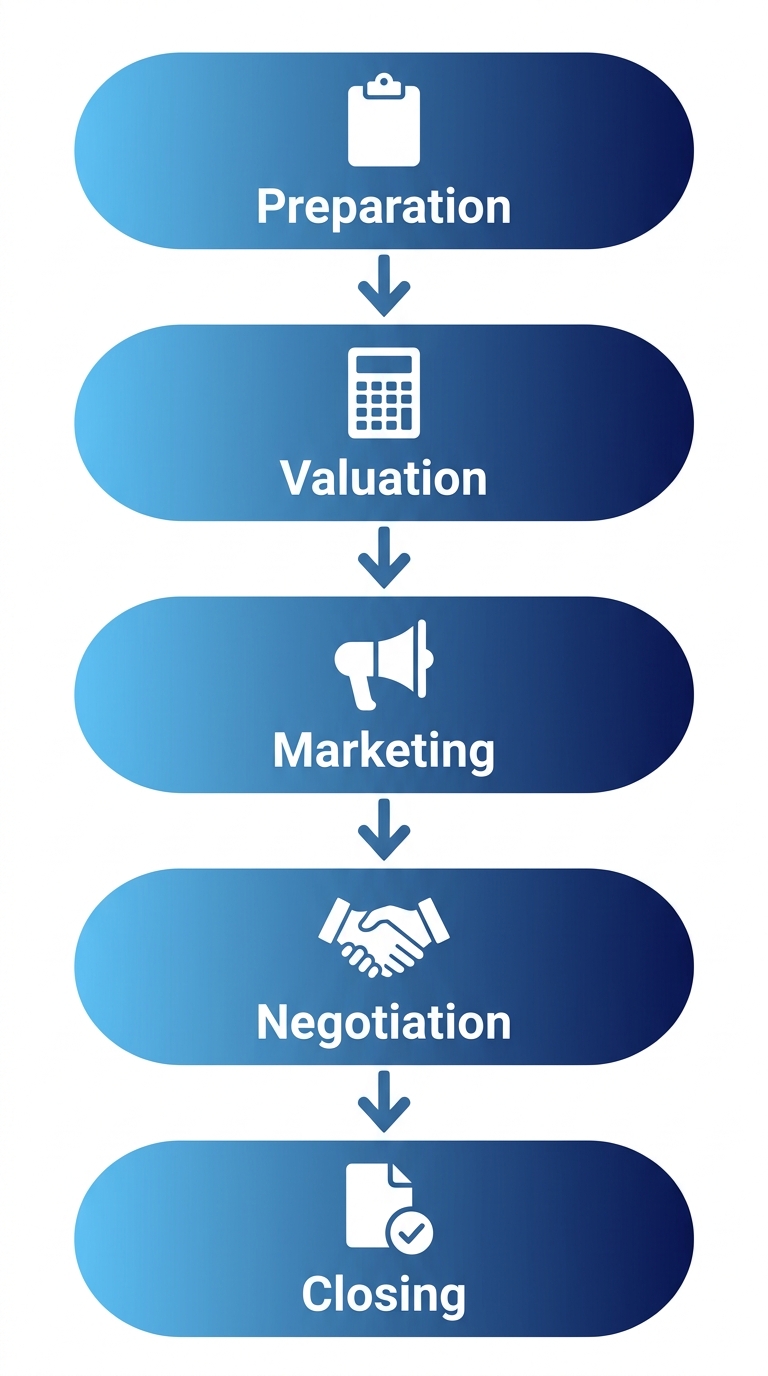
Five-phase process for selling your business from preparation to closing.
While the steps to sell a business can vary, the process typically unfolds across five distinct stages. It starts with preparation, where you organize financial records, operations, and legal documents — a foundation that often includes a thorough sell-side due diligence review. Valuation follows, applying proven business valuation methods to establish a realistic price range rooted in market data and earnings. With a clear value in hand, marketing the opportunity to a curated pool of buyers, negotiating terms, and ultimately closing the transaction complete the cycle. According to data from the U.S. Chamber of Commerce, this entire journey can span six to twelve months, although each transaction is unique.
Throughout each phase, professional expertise can make the difference. We recommend engaging a capital advisory firm early to streamline the process, surface hidden value, and navigate negotiations with confidence.
The first concrete step after preparing your business is understanding its worth, which we cover next in valuation.
Business Sale Fundamentals: Valuation and Preparation
Understanding the essential steps to sell a business begins with a rigorous valuation that establishes the company’s true economic worth. From our base in West Palm Beach, we help owners nationwide prepare the financial foundation that attracts qualified buyers and sets the stage for a successful transaction.
For small businesses with revenue under $5 million, Seller’s Discretionary Earnings (SDE) measures the cash flow available to a single owner after adding back the owner’s salary, personal perks, and non-essential expenses–items a new owner could eliminate. This metric provides a straightforward view of financial performance when an active owner is central to daily operations. Current SDE multiples for 2025 typically range from 1.5x to 3.5x, according to the American Society of Appraisers, reflecting the owner-operator dependency of these enterprises.
For mid-market companies with revenue between $5 million and $100 million, EBITDA–earnings before interest, taxes, depreciation, and amortization–is the standard. It isolates operating performance, suitable for professionally managed entities. The two business valuation methods serve distinct audiences: SDE fits owner-dependent firms, while EBITDA aligns with institutional buyers. Preparing a defensible EBITDA requires three years of tax returns, a current P&L, and balance sheet; our Sovereign Data Nexus platform normalizes these figures by stripping out non-recurring items and adjusting for fair market management salaries.
The table below contrasts SDE and EBITDA across key dimensions, helping owners select the right basis depending on their company’s size and ownership structure.
SDE vs EBITDA Comparison Table
| Aspect | SDE | EBITDA |
|---|---|---|
| Definition | Cash flow to single owner after add-backs | Earnings before financing, tax, depreciation |
| Typical Use Case | Businesses <$5M revenue, owner-operator | Companies $5M-$100M, professional management |
| Key Adjustments | Owner salary, perks, personal expenses | Non-recurring items, fair rent, management salaries |
| M&A Relevance | Main street, small business valuations | Middle-market M&A, institutional buyers |
| 2025 Multiples | 1.5-3.5x SDE | 4-8x EBITDA |
Completing sell-side due diligence is the next critical step. sell-side M&A advisory experts normalize non-recurring items, confirm financial statement accuracy, and assess legal and operational risks. Following FINRA guidelines, this review minimizes surprises and buyer pushback, strengthening the seller’s negotiating position.
The table above clarifies when each metric applies, ensuring owners align with buyer expectations. For owners following the steps to sell a business, choosing the right valuation approach is the foundation of a successful exit.
The infographic below highlights the contrast between owner-focused SDE and institutionally driven EBITDA.
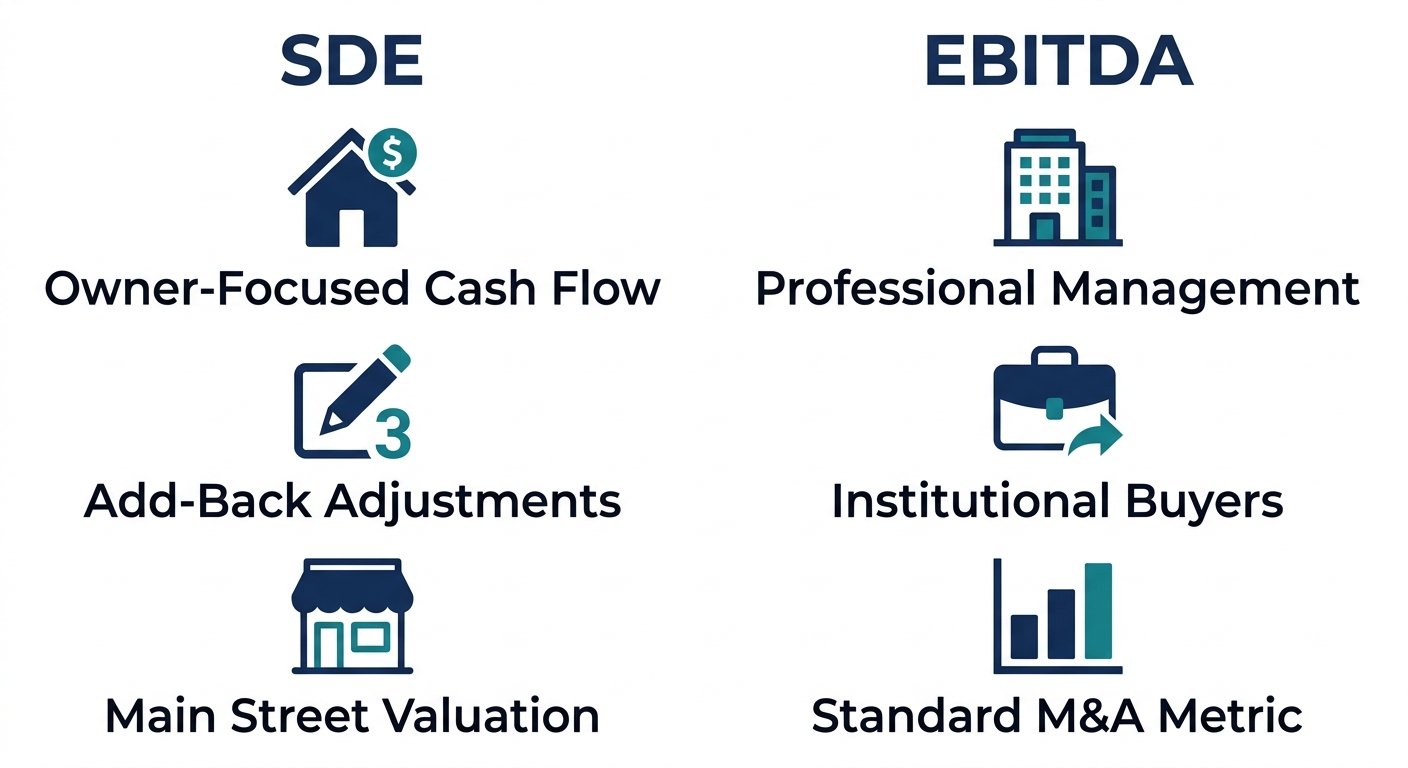
SDE vs EBITDA: Two key valuation approaches for business sales
Engaging a boutique M&A advisory firm early in the valuation process ensures the financial data is structured to attract the right buyers. At Zaidwood Capital, we coordinate a structured sell-side due diligence review, leveraging our full-cycle advisory capabilities.
Securities are offered through Finalis Securities LLC. Zaidwood Capital is not a registered broker-dealer and is unaffiliated with Finalis.
The Full M&A Lifecycle: Strategy to Closing
Now, let’s walk through the full M&A lifecycle from start to finish. For business owners beginning to explore the steps to sell a business, understanding how to sell my business requires a full-cycle approach that spans strategic positioning, rigorous due diligence, and precise negotiation.
Phase 1: Strategic Positioning and Marketing
Our sell-side m&a process begins with strategic positioning, where we prepare the company for an optimal transaction. As a Boutique M&A and Capital Advisory Firm, we deploy comprehensive business valuation methods to anchor the asking price and identify value drivers. Before launching to market, we guide clients through operational housekeeping and financial clean-up to address any red flags that could dilute value. Using our proprietary Sovereign Data Nexus platform, we analyze a network of over 4,000 institutional investors and strategic buyers to build a prioritized list of acquirers aligned with the company’s industry, growth trajectory, and deal-size preferences. We then craft a Confidential Information Memorandum (CIM) that presents historical financials, operational metrics, and market opportunities while strictly maintaining confidentiality. Initial outreach uses a blind teaser to protect the seller’s identity, and the full CIM is released only after executing a non-disclosure agreement. Our outreach strategy leverages the Precision Catalyst AI-driven engagement engine to initiate confidential conversations with qualified buyers, ensuring the business is matched with the most appropriate acquirers for a competitive process.
Phase 2: Due Diligence Management
Once a buyer submits a Letter of Intent, the focus shifts to due diligence. Effective sell-side due diligence begins well before the buyer’s review. We advise sellers to prepare a comprehensive virtual data room containing organized historical financials, tax returns, customer contracts, supplier agreements, and operational data. Engaging a Quality of Earnings (QofE) provider early validates the adjusted EBITDA and reinforces the asking price. Throughout the process, we coordinate responses to buyer information requests, working to prevent surprises that can lead to price re-trades. This proactive approach is grounded in industry standards.
To help sellers appreciate the distinct perspective each side brings, the table below contrasts sell-side and buy-side due diligence. It draws on FINRA’s due diligence standards and SIFMA’s M&A best practices.
| Aspect | Sell-Side | Buy-Side |
|---|---|---|
| Timing | Conducted before the market launch to prepare the seller | After LOI execution; buyer leads the process |
| Purpose | Identify and fix issues early to justify asking price | Validate assumptions and uncover risks before closing |
| Key Documents | Quality of Earnings report, tax returns, customer contracts, financial statements, operational data | Full virtual data room, QofE audit, legal review, background checks |
| Common Red Flags | Unresolved customer concentration, owner dependency, inconsistent financials | Declining EBITDA, hidden liabilities, weak management depth, lawsuits |
As the table illustrates, sell-side due diligence is about preparation and defense; buy-side diligence is about verification and discovery. By front-loading the work–resolving customer concentration risks, auditing financials, and ensuring contractual continuity–sellers substantially lower the probability of a re-trade. We guide our clients through each step, leveraging our Velocity Matrix to accelerate the timeline without compromising thoroughness. By treating sell-side due diligence as a strategic asset rather than a burden, sellers can preserve deal value and shorten the path to closing.
Phase 3: Negotiation and Closing
With due diligence findings absorbed, we move to negotiating the definitive purchase agreement. The Letter of Intent (LOI) is the first critical milestone, where we negotiate key economic terms–purchase price, payment structure (cash, stock, or earnout), and exclusivity periods–to protect our client’s interests. Once the LOI is signed, we collaborate with legal counsel to draft the definitive agreement, addressing representations and warranties, indemnities, and post-closing obligations. Our Full-Cycle M&A approach ensures that every term aligns with the seller’s liquidity and risk tolerance. We structure escrows and earnouts to balance buyer protection with seller access to proceeds, and craft transition service agreements that support a smooth handover. We also coordinate detailed transition planning to preserve customer, employee, and supplier relationships. Throughout this phase, the Velocity Matrix helps compress timelines while maintaining rigor. We orchestrate all parties–legal, accounting, and business teams–to drive toward a successful, timely close.
Understanding these interconnected steps to sell a business gives owners the clarity to navigate each phase with confidence. In the following articles, we’ll dive deeper into marketing strategy, due diligence preparation, and negotiation tactics, equipping you with the tools to execute a successful transaction.
Practical Steps to Prepare Your Business for Sale
When you decide to sell business, the groundwork you lay before ever meeting a buyer will have a dramatic impact on the speed, certainty, and value of the transaction. At Zaidwood Capital, we guide owners through the essential steps to sell a business so that every part of the process works in your favor. The two areas where preparation pays the greatest dividend are financial documentation and operational readiness. By addressing both, you build buyer confidence and position your company for a smooth, value-maximizing exit.
Organizing Financial Documentation
Financial documents tell the story of your company’s past performance and future potential. Buyers and their advisors scrutinize this information to apply various business valuation methods, so accuracy and completeness are critical. Begin by assembling the last three years of income statements, balance sheets, and cash flow statements — ideally audited or reviewed — to establish a credible baseline. Gather three to five years of corporate and personal tax returns, along with any extensions, amended filings, and correspondence with tax authorities. Prepare a three-to-five-year financial projection that clearly states the assumptions behind your growth rates, margin trends, and capital expenditures.
Normalization adjustments are a must. Review your historical earnings and strip out discretionary or one-time expenses — such as the owner’s personal travel, above-market charitable contributions, or non-recurring legal settlements — that would obscure the true earning power of the business. The American Society of Appraisers’ business valuation standards emphasize that normalization provides a clearer picture of sustainable cash flow, which is exactly what a buyer needs to see.
As part of the broader steps to sell a business, organizing financial documentation involves more than producing raw numbers; it requires presenting them in a structured, stage-appropriate format. The following table, informed by the U.S. Chamber of Commerce’s M&A Toolkit, illustrates how documentation requirements evolve from pre-marketing through closing.
| Document Type | Pre-Marketing | Due Diligence | Closing |
|---|---|---|---|
| Financial Statements (P&L, Balance Sheet, Cash Flow) | 3 years of audited or reviewed statements | Updated monthly statements, reconciliations | Final closing statements, working capital adjustments |
| Tax Returns (Corporate & Personal) | 3-5 years of filed returns | Extensions, amended returns, tax authority correspondence | Final tax clearance letters, carryforward schedules |
| Financial Projections | 3-5 year forecast with key assumptions | Monthly/quarterly updates, scenario analysis | Final budget for post-close period |
| Key Contracts (Customer, Supplier, Lease) | Summary of top 10 customer contracts | Full contract copies, assignment provisions, change-of-control clauses | Consent and assignment letters, transition service agreements |
As the table makes clear, early-stage materials are high-level summaries that help market the business, while later-stage documents become granular and legally binding. Meticulous preparation at each phase reduces the risk of delays or renegotiations that can erode deal value. Beyond the core financials, compile summaries of your top 10 customer contracts for the pre-marketing phase and retain full copies — along with all assignment provisions and change-of-control clauses — for due diligence. This disciplined approach not only accelerates the buyer’s review but also signals that your business is well managed and ready for acquisition.
Enhancing Operational Readiness
A financially sound business can still stumble if day-to-day operations are overly dependent on the owner or riddled with unresolved legal issues. Conducting sell-side due diligence on your own operations helps you identify and correct weaknesses before a buyer ever sees them. Start with a legal and regulatory audit: verify that all permits, licenses, and compliance filings are current, and resolve any outstanding disputes or enforcement actions. Next, shift key responsibilities from the owner to a capable management team. Promoting a COO or hiring a general manager not only strengthens daily oversight but also demonstrates that the business can run successfully without you.
Clean up the balance sheet by aggressively collecting overdue receivables, paying down short-term debt, and disposing of obsolete inventory. A lean, working-capital-efficient position is far more attractive to acquirers. Review real estate, equipment, and intellectual-property leases for change-of-control clauses that could trigger consent requirements or termination rights; addressing these early prevents last-minute roadblocks. Finally, draft a transition services agreement that outlines the post-sale support you will provide — training, introductions to key clients, or ongoing advisory work — so buyers can underwrite a seamless handover.
In our experience, partnering with a capital advisory firm like Zaidwood Capital, a Boutique M&A and Capital Advisory Firm headquartered in West Palm Beach, Florida, gives owners the hands-on support needed to methodically prepare operations for inspection. We help you pre-package the answers buyers will demand, from a documented management structure to a clean legal and regulatory profile, so that diligence proceeds without surprises.
Once your financials are in order and your operations are streamlined, you can confidently approach the next phase: engaging with qualified buyers and moving toward a successful close.
This content is for informational purposes only and is not an offer, solicitation, recommendation, or commitment to buy or sell any security or financial product. Securities are offered through Finalis Securities LLC; Zaidwood Capital is not a registered broker-dealer. Investments involve risk and are not guaranteed to appreciate. Past performance does not guarantee future results.
Advanced Strategies and Common Seller Mistakes
When considering the steps to sell a business, mid-market owners often overlook the critical importance of a structured valuation approach. Employing the right business valuation methods is the first step toward maximizing deal value. Industry standards from the Securities Industry and Financial Markets Association (SIFMA) and the Financial Industry Regulatory Authority (FINRA) emphasize that sound valuation practices form the foundation of any successful M&A transaction. Our proprietary platform, Sovereign Data Nexus, enables us to apply these methods with precision, but understanding the fundamentals empowers you to make informed decisions. The table below, Common Valuation Methods for Mid-Market Sales, breaks down these approaches.
| Method | Approach | Best For | Limitations |
|---|---|---|---|
| Market Approach | Comparable company analysis and precedent transactions | Companies with reliable public peers or recent M&A comparables | Requires sufficient transaction data; may not reflect unique assets |
| Income Approach (DCF) | Discounted cash flow based on projected future earnings | High-growth businesses with predictable cash flow | Highly sensitive to growth assumptions and discount rate; can be speculative |
| Asset Approach | Net asset value (fair market value of assets minus liabilities) | Asset-heavy businesses (manufacturing, real estate, capital-intensive) | May undervalue intangible assets like brand, goodwill, customer relationships |
Each method carries distinct strengths and limitations; a professional advisor can help select the appropriate approach.
With the right valuation framework in hand, sellers must also avoid these common missteps:
- Emotional overvaluation: Owners often set an inflated price based on personal attachment, scaring off qualified buyers. An objective third-party valuation aligns expectations with market reality.
- Skipping sell-side due diligence: Buyers will conduct rigorous financial and operational scrutiny; sellers who prepare early turn due diligence into a leverage-building exercise.
- Accepting the first offer: Without competitive tension, sellers leave significant value on the table. A managed auction process typically yields stronger terms.
- Delaying advisory assembly: Many owners wait too long to engage specialists. A structured sell-side m&a advisory engagement ensures every phase–from valuation to negotiation–is guided by seasoned professionals.
Ultimately, a disciplined approach to the steps to sell a business transforms complexity into a strategic liquidity event. By partnering with a boutique m&a advisory firm, owners gain access to deep investor networks and tools like our Precision Catalyst engine, which mitigates execution risk. At Zaidwood Capital, a Boutique M&A and Capital Advisory Firm in West Palm Beach, we combine our Velocity Matrix execution framework with Sovereign Data Nexus to deliver superior outcomes. The right advisor not only helps you avoid costly mistakes but also uncovers hidden value that traditional methods may overlook.
Frequently Asked Questions About Selling Your Business
Top Questions About Selling Your Business
As a Boutique M&A and Capital Advisory Firm based in West Palm Beach, we guide sellers through the steps to sell a business. Here are answers to common questions.
How long does it take to sell a business? Typically 6-12 months, though timelines vary. For a detailed guide, see our how to sell my business page.
What is the role of an M&A advisor? We provide strategic guidance and access to our extensive investor network without guaranteeing specific outcomes.
What is sell-side due diligence? A critical review of financials, governed by FINRA and SIFMA standards. Sell-side due diligence helps buyers validate your business. Securities are offered through Finalis Securities LLC; Zaidwood Capital is not a registered broker-dealer.
What are common seller mistakes? Overvaluing the business is a frequent error. We use proven business valuation methods to establish realistic expectations and attract serious buyers.
What happens post-sale? Sellers typically provide transition support for 3-6 months. When you’re ready to sell business, our experienced advisors are here to assist.
Ready to start? Contact us.
Charting Your Path to a Successful Business Sale
When considering the steps to sell a business, a well-structured path is essential. According to SIFMA, recent M&A activity underscores the importance of a disciplined approach. The sale journey progresses through thorough preparation, precise valuation using business valuation methods, rigorous sell-side due diligence, strategic negotiation, and a successful closing. We break down each of these phases in detail below, offering actionable insights and best practices. Our team at Zaidwood Capital, leveraging decades of combined advisory experience, provides the trusted support to guide you through every stage.
Resources


