


How To Sell My Business
Table of Contents
Selling Your Business: Key Steps for a Successful Exit
If you’re wondering how to sell my business successfully, a structured approach is critical. The sale process typically demands 6-12 months of preparation, valuation, and marketing. Early expertise paves the way for a seamless exit.
As Sofer Advisors notes, preparation starts 6-12 months ahead by organizing financials and tax returns. Understanding your EBITDA multiples–a core valuation metric–sets realistic expectations. We identify potential acquirers: strategic buyers (competitors, partners) may pay a premium; financial buyers (private equity) focus on cash flows. A confidential, advisor-led process with NDAs protects operations.
Partnering with a Boutique M&A Advisory Firm brings dedicated attention, deep industry insight, and a curated buyer network. Our full-cycle approach guides every milestone, simplifying complexity.
For those exploring how to sell my business, expert guidance transforms complexity into a clear, achievable path. Valuation is a critical first step; we explore it further below.
Essential Preparation Before Listing Your Business
Once you understand the sale process, the critical groundwork begins. Before you learn how to sell my business, thorough preparation ensures your company attracts the right buyers.
As a Boutique M&A and Capital Advisory Firm, we guide sellers from preparation to closing. For a complete roadmap, see our Steps To Sell A Business guide.
According to BizBuySell, the largest online marketplace for buying and selling businesses, prepared sellers receive significantly more attention from qualified buyers.
- Gather three to five years of clean financial statements–profit and loss, balance sheets, tax returns–and ensure personal expenses are separated.
- Engage Zaidwood Capital’s business valuation services to set a defensible price and understand how EBITDA multiples apply to your industry.
- Prepare a confidential information memorandum (CIM) that highlights financial performance, growth potential, and competitive strengths.
- Resolve any legal or compliance issues, such as licenses, permits, and contract disputes, and review key contracts–leases, supplier agreements, employee contracts.
- Document operational synergies that appeal to strategic buyers, positioning your business as a highly attractive acquisition target.
Addressing these areas builds buyer confidence and positions your business for a successful sale.
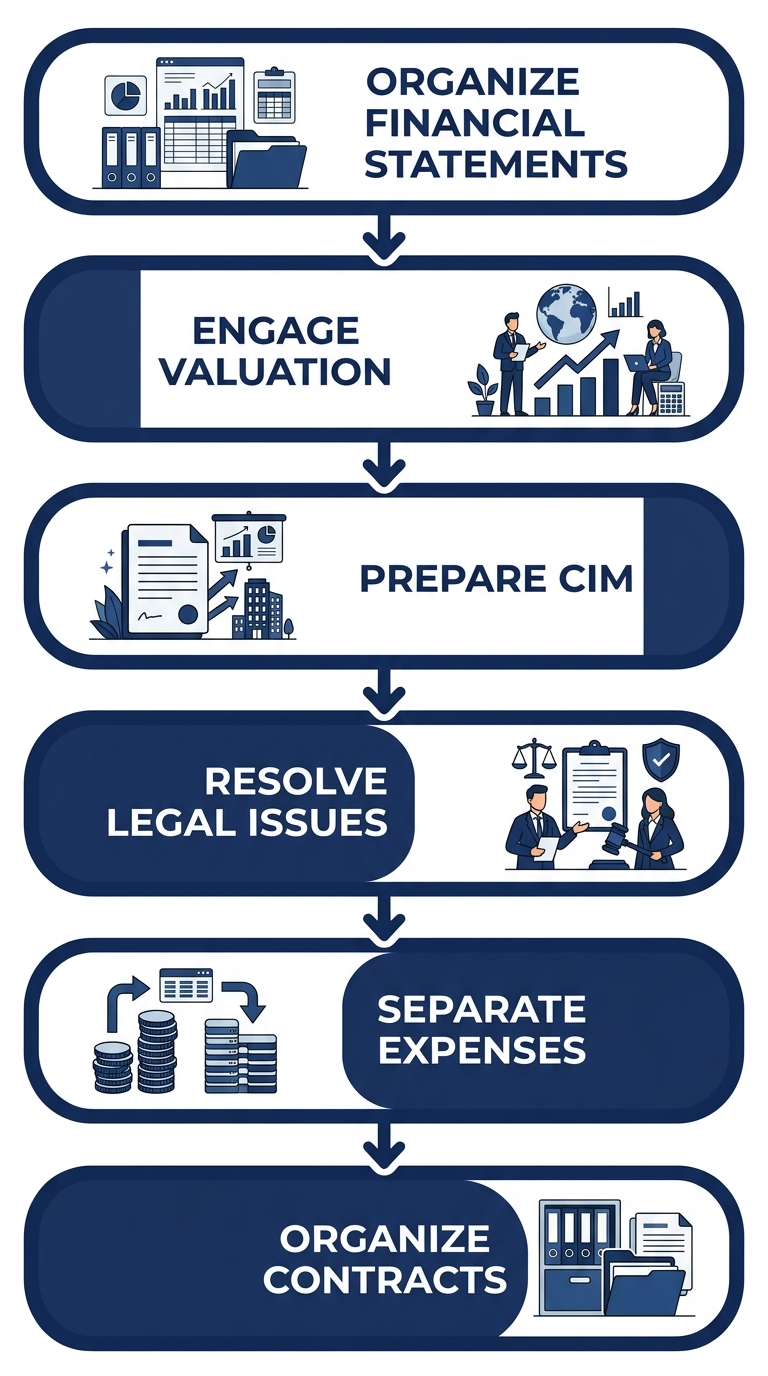
Essential preparation stages before listing your business for sale.
With these preparations in place, your business stands out to serious buyers. Our team ensures all details are covered, then we guide you into the marketing phase–maximizing exposure to strategic acquirers.
Evaluate Your Business Readiness
If you are exploring how to sell my business in the US market, the essential first step is a rigorous readiness evaluation. This self-assessment will clarify where your company stands before engaging with potential acquirers.
We recommend analyzing at least three years of historical financial statements and identifying EBITDA-normalizing adjustments. A realistic picture of earnings, backed by industry-typical EBITDA multiples, gives you a data-driven foundation. Equally important is evaluating your management team’s depth and any key-person dependencies that could concern buyers.
Strategic buyers look for complementary businesses that offer geographic expansion, product line synergies, or new customer access. Our proprietary Sovereign Data Nexus platform can benchmark your readiness against aggregated market data, but no tool can guarantee a transaction outcome. Readiness is a starting point, not a promise.
With a clear view of your company’s strengths and gaps, the next step is to engage an advisor who can translate readiness into a compelling value narrative for the right strategic buyers.
Determine Your Business Valuation
Once your financials are in order, the next critical step in how to sell my business is determining its fair market valuation. An accurate figure grounds negotiations in objective market reality rather than emotional attachment. We recommend searching the BizBuySell sold-business database for 3-5 comparable transactions in your industry and region, such as similar businesses sold in West Palm Beach within the last 12 months. This comparative exercise reveals the prevailing EBITDA multiples, typically ranging from 2x-6x for smaller mid-market companies, and gives you a data-backed starting point.
Strategic buyers often justify paying a premium of 20-30% above standard multiples because they can unlock synergies with their existing operations. Identifying potential acquirers who fit that profile before you list can materially influence your pricing strategy. Pricing too high scares away qualified buyers, while pricing too low leaves significant value on the table. Use objective market data to find the sweet spot.
While self-research on platforms like BizBuySell is valuable, Zaidwood Capital’s Business Valuation Services deliver a full-cycle, data-backed opinion that strengthens your negotiating position. Once your valuation is set, you are ready to Sell Business with confidence.
Prepare Financial Documents and a Data Room
Once you have a clear valuation, the next critical step in understanding how to sell my business is preparing comprehensive financial documents and a secure data room. We recommend gathering the following:
- Profit and loss statements (3-5 years), balance sheets, and cash flow statements.
- Tax returns, accounts receivable aging, debt schedules, and key contracts.
- Three-year financial projections.
Create a virtual data room with folders for Financials, Legal, Operations, IP, and HR. Require NDAs from all prospective buyers before granting access. In line with BNY Mellon’s institutional standards, we deploy our Sovereign Data Nexus to build a secure repository. We recommend including a summary of key metrics like revenue growth and EBITDA multiples to guide buyers. Strategic buyers often scrutinize contracts and operational data, so completeness is essential–this meticulous organization is central to how to sell my business. Throughout the sale process, we continuously update the data room, ensuring readiness for due diligence. With a well-organized data room, you are ready to approach potential buyers.
Identify and Approach Strategic Buyers
Once you understand the difference between buyer types, the next step for business owners researching how to sell my business is to identify and approach strategic acquirers who align with your value drivers. A well-executed sell-side m&a strategy begins with pinpointing strategic buyers — companies that acquire for operational synergies, not just financial return. These include competitors, suppliers, and complementary businesses.
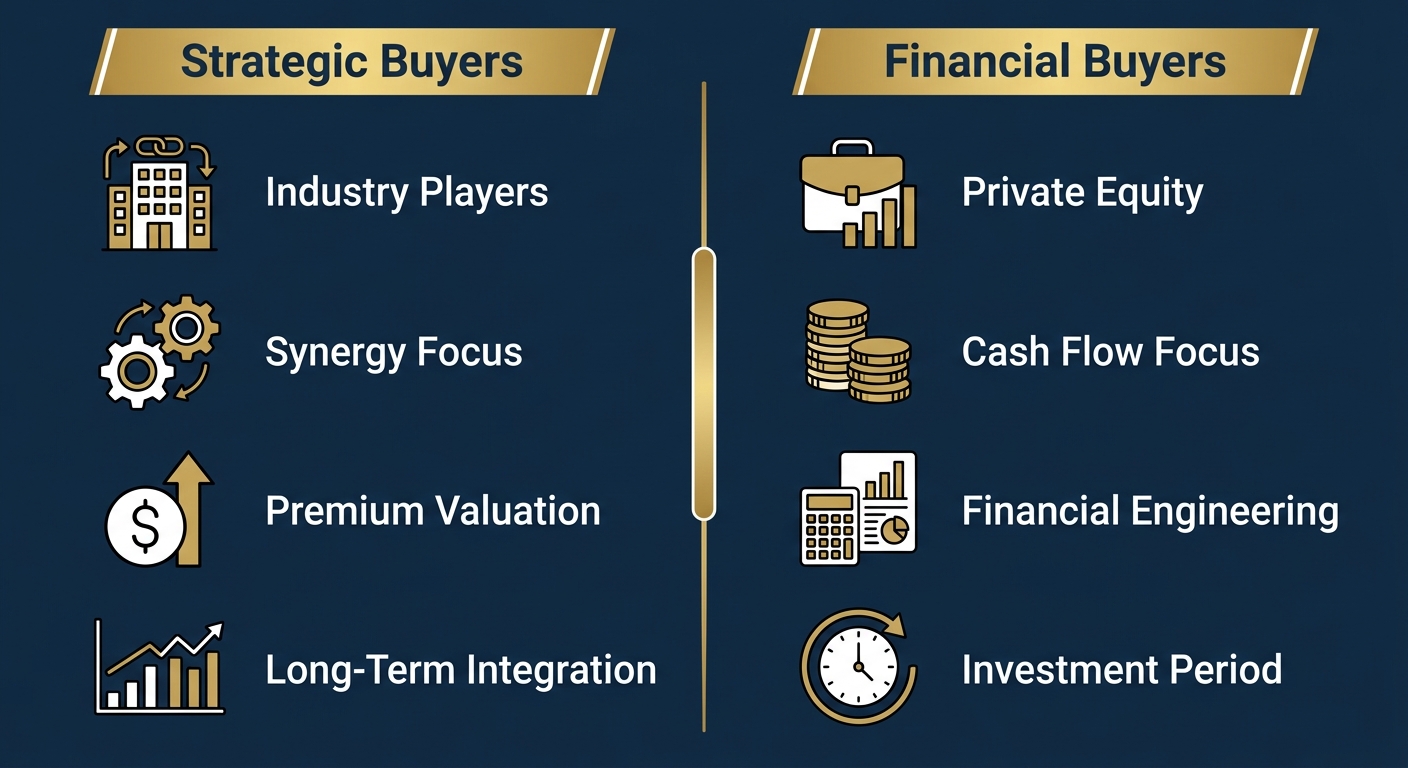
Comparison of strategic and financial buyer types for M&A advisory.
We use three methods to identify these buyers: mining industry transaction databases; tapping our network of over 4,000 institutional investors; and employing our AI-driven matchmaking tool, Precision Catalyst, to pinpoint fit. Confidentiality is critical: we present your opportunity via a one-page teaser that omits your company name before disclosing detailed materials.
Our approach then unfolds in two phases: first, we initiate contact through a warm introduction or trusted advisor; second, we provide a customized executive summary highlighting strategic fit. We emphasize how your assets — customer base, technology, geography — and attractive EBITDA multiples align with the buyer’s growth objectives. We never quote a price initially. After securing interest, attention turns to valuation and engagement terms.
Maintain Confidentiality During Marketing
For business owners researching how to sell my business, confidentiality is a top concern. The possibility of sensitive details reaching competitors, employees, or the public can derail a sale before it begins. From our headquarters in West Palm Beach, we embed discretion into every phase of our sell-side engagement — because protecting your proprietary information is central to our process, not an afterthought.
Our approach begins with our Sovereign Data Nexus, where we pre-qualify buyers before any confidential data is shared. We require signed non-disclosure agreements as a standard first step, then release only anonymized, high-level information. Buyer vetting includes rigorous financial capacity assessments and strategic alignment — evaluating whether parties are strategic buyers who understand EBITDA multiples, institutional investors, or qualified acquirers. Detailed operational and financial data is revealed only after a buyer passes qualification. Every step is designed to maintain rigorous confidentiality while still creating access to the right acquirers.
Navigate Due Diligence and Negotiation
Once you have prepared your business for sale, navigating due diligence and negotiation is the next critical phase. For any owner exploring how to sell my business, these stages require careful preparation and skilled representation.
Due diligence typically spans 30 to 60 days and involves a thorough review of your financial records, customer contracts, employee agreements, and intellectual property. We help sellers organize all documentation in a virtual data room before going to market, streamlining the buyer’s review and protecting sensitive information. Our advisors manage the process so you can focus on running your business while we safeguard your interests.
Negotiation covers valuation, deal structure, and post-sale terms. Valuation often centers on EBITDA multiples for your industry; we benchmark your business against comparable transactions to strengthen your position. Understanding strategic buyers, who may pay a premium for synergies, versus financial buyers is essential. Our team represents you during these discussions, negotiating indemnification and transition assistance to secure favorable outcomes. We guide you through each step to ensure your goals are met without unnecessary risk.
Close the Transaction
With a signed LOI in hand, the next phase of how to sell my business shifts to closing. Our team immediately activates the final due diligence protocol, where the buyer verifies financials, contracts, and regulatory standing. This confirmatory review ensures every disclosed detail is accurate before funds change hands.
We then coordinate the legal documentation–including the definitive purchase agreement and all required disclosure schedules–while the buyer finalizes funding through cash, third-party debt, or equity. The purchase price is typically anchored to industry EBITDA multiples, and strategic buyers may introduce earn-outs, transition assistance, or performance conditions to align post-sale risks.
Zaidwood Capital’s Full-Cycle M&A methodology orchestrates the closing timeline so that ownership transfers efficiently. Once the transaction funds, our advisors remain at your side to guide the post-sale transition and preserve the value you’ve built, and protect your legacy.
Overcoming Common Obstacles in the Sale Process
Even with a clear process, obstacles frequently emerge for those exploring how to sell my business. Valuation misalignment, confidentiality breaches, and buyer identification challenges can stall momentum and erode value. These hurdles are common but not insurmountable with the right approach.
Unrealistic valuation expectations can derail a transaction before it begins. Sellers often anchor on emotional worth rather than market reality. Grounding price in actual EBITDA multiples and recent transaction data prevents overpricing that deters qualified buyers. An independent, third-party valuation early in the process provides objective benchmarks that align expectations and protect deal momentum.
Protecting confidentiality is a central challenge in how to sell my business. Leaks about a pending sale can alarm employees, customers, and suppliers, eroding business stability. Requiring signed nondisclosure agreements before releasing any sensitive data is non-negotiable. A controlled virtual data room with tiered access limits exposure. OffDeal, an M&A resource, notes that selective, discreet buyer outreach further safeguards confidentiality and preserves deal integrity.
Not all buyers are equal. Strategic buyers often pursue synergies and premium multiples, while financial buyers focus on returns. Pre-qualifying each prospect for intent and capability prevents wasted time and confidentiality leaks. Our enterprise ai capital raising platform matches sellers with vetted strategic acquirers, cutting months off the search and reducing the risk of engaging unqualified parties while preserving deal confidentiality.
Addressing these hurdles head-on with proactive planning and seasoned advisory support ensures a faster, more successful sale. Engaging experienced M&A advisors early helps anticipate and navigate these challenges.
Your Path to a Successful Exit
For most founders, figuring out how to sell my business begins a journey that demands preparation, precision, and the right advisory partner. At Zaidwood Capital, we guide growth-stage and middle-market companies through every stage of a structured exit as a Boutique M&A and Capital Advisory Firm.
Our Full-Cycle M&A approach combines proprietary intelligence tools–Sovereign Data Nexus for data-driven insights and Precision Catalyst for AI-powered investor matchmaking–with a deep institutional network of over 4,000 investors representing more than $15 billion in committed capital. We pair that reach with the Velocity Matrix rapid-execution framework, helping owners frame valuation multiples that resonate with acquisition-minded buyers and drive efficient timelines without sacrificing diligence rigor.
Connect with Zaidwood Capital Advisory Services to begin structuring your path forward. In the sections ahead, we break down each phase of the transaction lifecycle so you can move from contemplation to a successful close with confidence.
Resources


