



What is Series C Funding
Table of Contents
Understanding Series C Funding and Its Strategic Role
What is Series C funding? Series C funding represents the fourth institutional funding round for mature startups with strong recurring revenue and validated business models, positioning them for aggressive scaling or an eventual IPO or acquisition. At Zaidwood Capital, a Boutique M&A and Capital Advisory Firm, we recognize this stage as a critical inflection point where growth equity financing propels companies into new markets and strategic acquisitions. Unlike Series A and B rounds, which fund product development and initial market entry, a Series C round is late-stage growth capital that emphasizes profitability, operational efficiency, and preparation for a liquidity event.
The strategic use of Series C capital, often ranging from $50 million to over $100 million, typically includes expanding into international territories, acquiring complementary businesses, strengthening the balance sheet, and building out a seasoned executive team. These investments aim to de-risk the company before a public offering or sale. Series C valuation multiples are often benchmarked against public company comparables, reflecting the company’s reduced risk profile and strong revenue visibility. According to SIFMA, the Securities Industry and Financial Markets Association, late-stage venture capital activity has grown as institutional investors seek opportunities with lower volatility and clearer paths to exit.
Typical institutional investors for Series C include late-stage venture capital firms, private equity funds, sovereign wealth funds, and pension funds, all of which prioritize capital preservation and steady growth. For many firms, Series C serves as the final private round before an IPO, aligning the company’s long-term strategic roadmap with public market expectations. At Zaidwood Capital, our deep institutional relationships often help bridge the gap between late-stage growth companies and select providers of large-scale capital.
The Purpose and Mechanics of Series C Funding
If you’ve been asking what is Series C funding, it’s a later-stage financing round that mature startups pursue to accelerate growth, expand globally, or prepare for an IPO or strategic sale. At Zaidwood Capital, we understand that Series C Funding represents a critical shift from proving product-market fit to dominating markets and driving toward an exit.
Series C rounds typically raise $50 million to over $200 million, with valuations ranging from $250 million to north of $1 billion, depending on sector dynamics. Although Series C valuation multiples tend to be higher than earlier stages, they reflect a proven revenue model and clear path to profitability. Proceeds are generally directed toward M&A, international expansion, scaled R&D, and balance-sheet fortification to fuel sustained hypergrowth.
The investor profile changes dramatically: institutional investors for Series C rounds include pension funds, endowments, and sovereign wealth funds, joined by growth equity firms, hedge funds, and crossover investors bridging public and private markets. Such backers look for de-risked business models and clear exit timelines. In our experience, they provide not only capital but also strategic networks that can accelerate a company’s path to an IPO or acquisition.
To illustrate how Series C differs from earlier rounds, the table below compares key dimensions:
| Series A | Series B | Series C | |
|---|---|---|---|
| Primary Objective | Product-market fit and initial traction | Scale operations and market expansion | Dominate market, prepare for exit or IPO |
| Typical Raise Size | $2M – $15M | $15M – $50M | $50M – $200M+ |
| Key Investor Types | Seed VCs, Angel Investors, Accelerators | Growth VCs, Corporate Venture Arms | Institutional Investors, Growth Equity, Hedge Funds, Crossover Funds |
| Valuation Range | $10M – $50M | $50M – $250M | $250M – $1B+ |
| Use of Proceeds | Product development, initial hiring, customer acquisition | Sales scaling, new markets, operational infrastructure | M&A, global expansion, R&D scaling, balance-sheet strength |
The table starkly illustrates the escalation in ambition and scale. While Series A focuses on achieving product-market fit with modest raises, Series C rounds fund market domination and exit preparation at valuations that often exceed $1 billion. The investor profile also transforms from early-stage venture firms to deep-pocketed institutional and crossover funds that underwrite late-stage risk with rigorous due diligence. This progression underscores why a meticulously prepared data room, robust financial projections, and a compelling growth narrative are essential for attracting Series C capital from sophisticated institutional investors.
Securities offerings at this stage are subject to oversight by the Financial Industry Regulatory Authority (FINRA), which sets investor accreditation and disclosure standards. Companies raising Series C must adhere to these regulations to maintain transparency. As a boutique M&A and capital advisory firm, Zaidwood Capital guides clients through these requirements without acting as a registered broker-dealer, ensuring every raise aligns with regulatory best practices.
With a solid understanding of Series C mechanics, the next step is to examine the strategic considerations that underpin successful later-stage rounds and the pathways to a successful exit.
How Series C Funding Differs from Earlier Financing Rounds
To understand what is series c funding, it helps to compare it with earlier rounds. While Series A and B focus on proving product-market fit and scaling operations, Series C targets market leadership and exit readiness. At Zaidwood Capital, we advise growth-stage companies through this pivotal inflection point, leveraging deep capital markets knowledge.
How Series C Builds on the Foundation of Series A and B
Series A financing, typically the first institutional round, is designed to help startups find a repeatable business model and prove product-market fit. Series B rounds, on the other hand, provide capital to scale operations, expand teams, and accelerate revenue growth once that fit is confirmed. By contrast, Series C capital is raised when a company has already demonstrated strong traction and is poised for market leadership. Unlike earlier stages such as series a funding, which focused on product-market fit, Series C investors often emphasize strategic metrics like revenue run rate, customer acquisition efficiency, and a clear path to profitability. This progression reflects a maturation from validating the business model to executing a plan that can withstand public-market scrutiny. Companies at this stage frequently aim to dominate their sector, expand internationally, or consolidate through acquisitions, all while building a financial profile that attracts institutional-scale investors. At Zaidwood Capital, we help founders articulate this maturity in their investor narratives, ensuring they present the compelling growth trajectory that Series C backers demand.
Investor Composition and Expectations at the Series C Stage
At the Series C stage, the investor landscape changes dramatically. While early-stage rounds are dominated by venture capital funds focused on product and growth metrics, Series C rounds attract a broader set of institutional investors. Companies attract larger institutional investors for series C rounds, including growth equity firms, hedge funds, crossover funds, and corporate venture arms, each bringing distinct expectations and due diligence standards.
The following table summarizes the key investor types active in Series C rounds, their typical check sizes, motivations, due diligence depth, and value-add beyond capital.
| Growth Equity Firms | Venture Capital Funds (Late-Stage) | Hedge Funds & Crossover Funds | Corporate Venture Capital (CVC) | |
|---|---|---|---|---|
| Typical Check Size | $20M – $100M+ | $15M – $75M | $25M – $200M+ | $10M – $50M |
| Primary Motivation | Ownership and governance influence | Portfolio growth and exit timeline | Pre-IPO positioning and public-market crossover | Strategic partnership and technology access |
| Due Diligence Depth | Extensive — includes detailed financial, legal, and commercial review | Thorough — focuses on growth metrics, unit economics, and market size | Rigorous — emphasizes financial modeling, valuation sensitivity, and exit scenarios | Moderate to thorough — emphasizes strategic fit and IP value |
| Value-Add Beyond Capital | Board seats, operational guidance, M&A pipeline | Network effects, follow-on funding, recruiting support | Public-market insight, large syndicate coordination, exit preparation | Channel partnerships, distribution, technology integration |
Note: Check sizes and investor profiles reflect typical US-based late-stage rounds; actual participation varies by company traction and market conditions.
These investors impose a more rigorous due diligence process compared to earlier rounds. While Series A and B diligence often focuses on unit economics, growth potential, and team capabilities, Series C diligence delves into detailed financial modeling, valuation sensitivity, and exit scenarios. Consequently, investors scrutinize Series C valuation multiples closely, ensuring that the company’s growth trajectory justifies the premium. According to SIFMA, institutional investor activity in late-stage venture financing has expanded, reflecting a maturing ecosystem where disciplined capital deployment is paramount.
Strategic Capital Deployment for Market Leadership
Series C capital is deployed with a clear objective: to secure market leadership and prepare for an eventual exit, via IPO or strategic sale. Common uses include M&A to consolidate fragmented markets, international expansion, and scaling R&D that deepens competitive moats. Companies also strengthen their balance sheets, increasing cash reserves to weather market volatility and signal financial stability to public-market investors. To attract the right institutional investors and negotiate favorable terms, they must demonstrate sustainable unit economics and a trajectory that supports strong Series C valuation multiples. For founders exploring what is series c funding, the capital often serves as the last private round before a liquidity event, so every dollar is allocated toward maximizing enterprise value. At Zaidwood Capital, we leverage our Velocity Matrix execution framework and Sovereign Data Nexus platform to identify optimal M&A targets, model international expansion scenarios, and structure transactions that align with long-term strategic goals. This disciplined approach ensures that the capital raised is deployed efficiently, minimizing dilution while accelerating the path to market dominance.
These distinctions set the stage for understanding how companies navigate the Series C process.
Disclaimer: This website is for informational purposes only and is not an offer, solicitation, recommendation, or commitment to buy or sell any security or financial product. Securities are offered through Finalis Securities LLC; Zaidwood Capital is not a registered broker-dealer and is unaffiliated with Finalis. Investments involve risk and are not guaranteed to appreciate; investors may lose all or part of their investment. Prospective investors should conduct their own due diligence and consult legal, tax, and financial advisors and, where appropriate, a registered representative. Past performance does not guarantee future results. Corporate logos do not represent endorsements.
Preparing Financials, Pitch Decks, and Data Rooms for Your Series C Raise
Understanding what is series c funding means recognizing that preparation for this late-stage round must meet institutional standards. The comparison table below highlights how documentation requirements escalate from earlier rounds, underscoring the need for a full diligence repository.
| Series A | Series B | Series C | |
|---|---|---|---|
| Pitch Deck | Problem/solution, early traction, founding team | Growth metrics, market size, competitive moat | Financial model, unit economics, strategic vision, exit scenarios |
| Financial Projections | Simple 3-statement model, 12-month forecast | Detailed P&L, cash-flow, and KPIs with 2-3 year outlook | Full 3-statement model with scenario analysis, sensitivity tables, and dept/equity structure |
| Data Room | Basic legal docs, cap table, IP assignment | Customer contracts, product roadmap, competitive analysis | Full diligence repository: legal, financial, commercial, technical, HR, compliance |
| Investor Presentation | Founder-led narrative, 10-12 slides | Management team presentation, 15-18 slides | Institutional-quality roadshow deck with detailed appendix, 20-25 slides |
Series C investors expect a level of sophistication that goes beyond earlier stages–detailed financial models, a comprehensive data room, and a polished narrative. The process can be broken into three key phases as illustrated below.
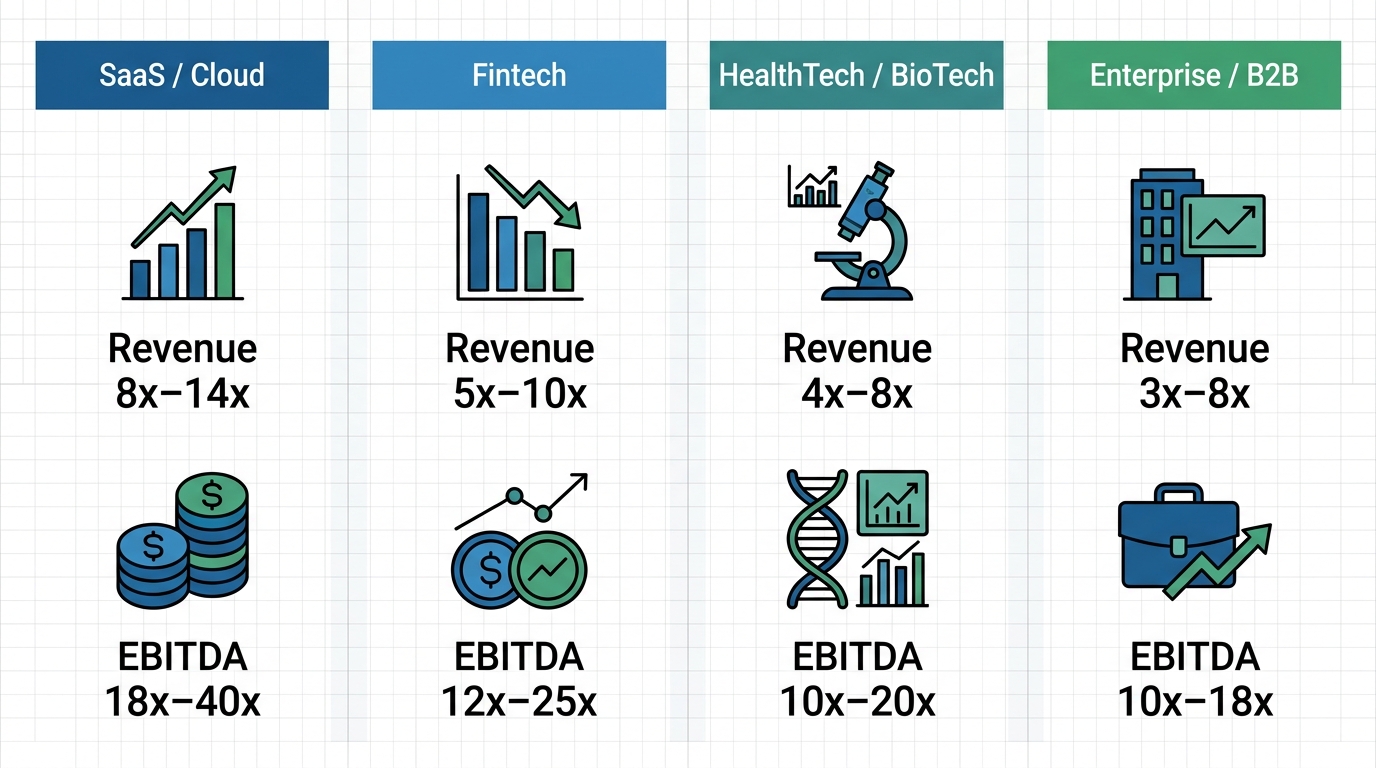
Series C valuation multiples for SaaS/Cloud, Fintech, HealthTech, and Enterprise B2B sectors.
Series C preparation process with three key stages
Building Investor-Ready Financial Projections
To secure institutional capital, a full three-statement financial model with scenario analysis and sensitivity tables is no longer optional. We recommend building a detailed profit and loss statement, balance sheet, and cash flow forecast spanning three to five years. Key metrics such as annual recurring revenue (ARR), gross margin, net revenue retention (NRR), and customer acquisition cost (CAC) must be clearly defined and linked to operational drivers. Understanding current Series C valuation multiples provides a baseline for the round’s expected size and dilution. Sensitivity analysis should model best-case, base, and worst-case scenarios, demonstrating how the business performs under varying growth rates, churn, and burn assumptions. This rigor shows investors that management is disciplined, that the unit economics are sustainable, and that the company can scale efficiently. Additionally, the model should incorporate the intended use of proceeds, mapping out how the capital will accelerate key initiatives–whether geographic expansion, product development, or sales team build-out. A well-constructed financial model not only convinces investors but also serves as an internal compass for capital allocation.
Crafting a Compelling Pitch Deck and Data Room
With a solid financial foundation, the next step is to craft a compelling narrative in a roadshow deck of 20 to 25 slides, backed by a detailed appendix. Beyond standard slides on traction and market size, institutional investors want to understand the company’s strategic vision, competitive moat, and potential exit paths. Founders should clearly articulate how their technology, network effects, or distribution advantages create a sustainable barrier to competition. Equally critical is the data room–a secured, comprehensive repository that covers legal documents, customer contracts, intellectual property filings, HR policies, and compliance certifications. Organizing it logically and using a virtual data room with granular access controls can dramatically reduce friction during due diligence. A well-structured data room signals operational maturity and can compress the diligence timeline from weeks to days. We recommend preparing a diligence request checklist in advance so that when investors ask for information, it is readily available. Completeness and transparency here build the trust necessary to close a deal.
Navigating Investor Outreach, Diligence, and Negotiation
Outreach to institutional investors for series C requires a targeted list of growth-equity and late-stage venture firms, family offices, and corporate venture arms. Warm introductions through trusted networks or advisors are far more effective than cold outreach. We at Zaidwood Capital, as a Boutique M&A and Capital Advisory Firm, leverage our global network to connect founders with the right investors. Throughout due diligence, responsiveness is paramount. A thorough data room is only useful if the team can quickly provide additional documents, answer questions, and arrange management calls. Adherence to regulatory standards–such as those outlined by FINRA–is essential for all marketing materials and disclosures. It is important to note that securities are offered through Finalis Securities LLC; Zaidwood Capital is not a registered broker-dealer and is unaffiliated with Finalis. Investments involve risk and are not guaranteed to appreciate.
When the term sheet arrives, the negotiation phase begins. While tech M&A advisory costs are a consideration, having an experienced advisory team can materially improve the terms. We help founders evaluate liquidation preferences, anti-dilution provisions, board seats, and valuation mechanics, ensuring the structure aligns with long-term growth objectives rather than short-term capital needs. The right term sheet sets the stage for a successful partnership with institutional investors.
Series C Valuation Multiples and Institutional Investor Expectations
To understand what Series C funding entails, it is essential to examine the valuation multiples and institutional investor expectations that define this stage. Late-stage funding rounds demand rigorous financial metrics and strategic alignment with market benchmarks. These benchmarks illuminate the capital-intensive nature of scaling operations and the premium investors place on recurring revenue models.
The following table illustrates typical revenue and EBITDA valuation multiples across key technology sectors for late-stage (Series C+) companies, based on SIFMA market data.
| Median Revenue Multiple | Median EBITDA Multiple | YoY Multiple Trend | |
|---|---|---|---|
| SaaS / Cloud | 8x – 14x | 18x – 40x | Stable to slightly contracting (2024-2025) |
| Fintech | 5x – 10x | 12x – 25x | Moderate compression due to regulatory focus |
| HealthTech / BioTech | 4x – 8x | 10x – 20x | Expanding with AI-enabled diagnostics and platforms |
| Enterprise / B2B | 3x – 8x | 10x – 18x | Stable, growth-rate dependent |
SaaS/Cloud revenue multiples remain the highest at 8x-14x, reflecting predictable recurring revenue and high gross margins. Fintech multiples face moderate compression as heightened regulatory scrutiny weighs on valuations. HealthTech/BioTech multiples are expanding with the rise of AI-enabled diagnostics and platform models. Enterprise/B2B multiples are stable and highly dependent on growth rate. These ranges are illustrative median figures; actual Series C valuation multiples depend on growth rate, margin profile, and market conditions.
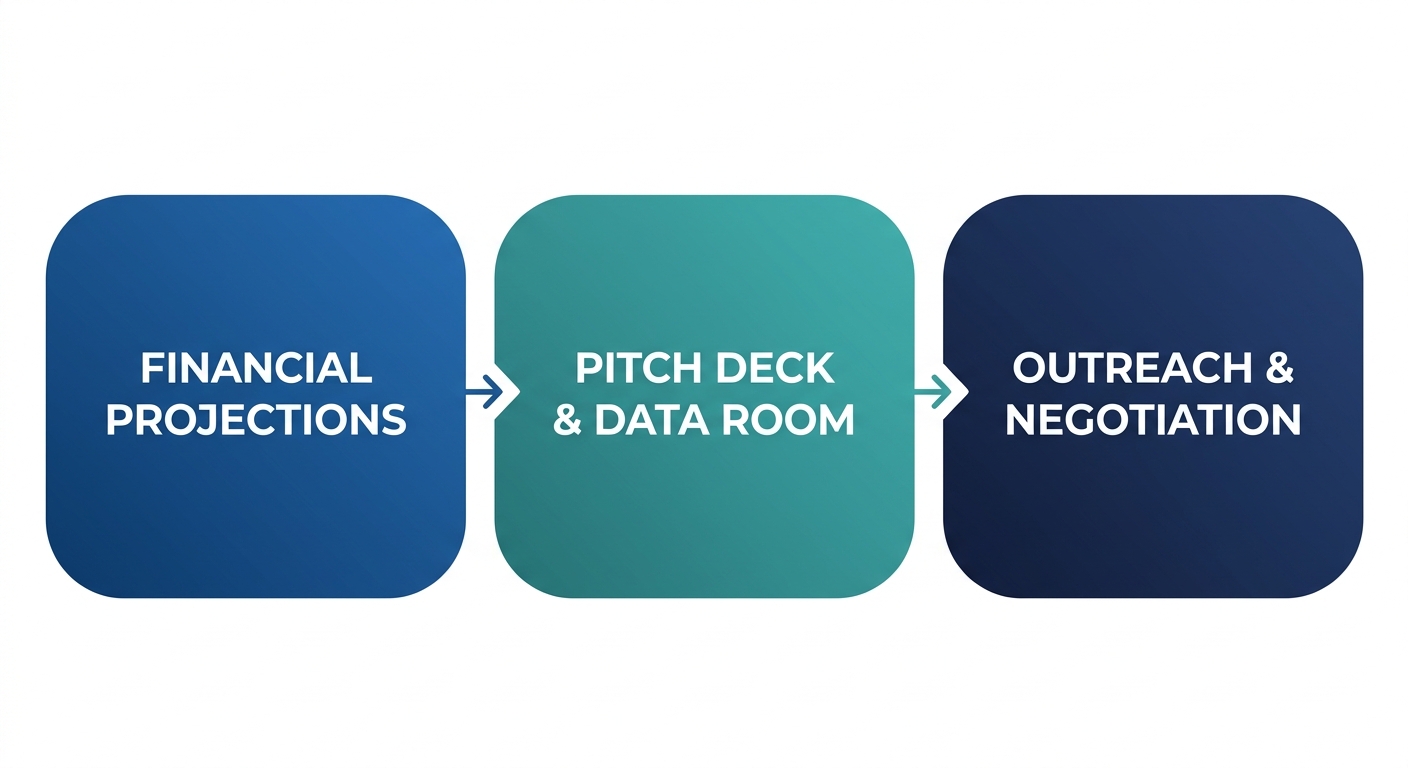
Series C preparation process with three key stages
Series C valuation multiples for SaaS/Cloud, Fintech, HealthTech, and Enterprise B2B sectors.
The infographic highlights the significant variation in valuation multiples across sectors, reinforcing how sector dynamics shape investor appetite.
Institutional investors for Series C rounds prioritize sustainability of growth, total addressable market size, and unit economics–particularly the LTV/CAC ratio and cash burn efficiency. They expect clear exit potential and robust financial controls before committing capital. Investors also scrutinize revenue growth trajectory, gross margin profiles, and capital efficiency. Companies demonstrating strong unit economics and a clear path to profitability earn premium valuations at this stage. According to SIFMA capital markets data, late-stage funding multiples are anchored to these performance metrics, demanding demonstrable traction and scalable operations from companies seeking growth capital.
Understanding these valuation multiples helps companies benchmark the cost of advisory engagements, as technology M&A advisory fee models are often structured around deal complexity and valuation metrics. At Zaidwood Capital, a Boutique M&A and Capital Advisory Firm, we leverage these benchmarks to structure engagements that align with our clients’ growth trajectories. These valuation metrics and investor expectations establish the baseline for how companies can position themselves effectively in a Series C fundraising process.
Common Questions About Series C Funding
Now that we’ve covered the basics of what is series C funding, let’s answer common questions about the investor landscape.
How do hedge funds and private equity firms participate in Series C fundraising?
Hedge funds and private equity firms typically enter as lead investors or large limited partners in Series C rounds, bringing substantial capital and strategic guidance. These transactions must comply with SEC Regulation D exemptions for accredited investors, overseen by FINRA, the self-regulatory organization for securities firms in the U.S. Companies planning an eventual exit often consider technology M&A advisory costs alongside their Series C positioning.
What is the role of crossover funds in securing a Series C round?
Crossover funds invest in late-stage private companies ahead of an IPO, adding public-market credibility and providing larger check sizes. Their participation attracts institutional investors for series C, signaling that the company is on track for a successful public offering. This dynamic often influences Series C valuation multiples as growth metrics are benchmarked against public peers.
Understanding these investor roles sets the stage for the Series C fundraising process.
Partnering with Experienced Capital Advisors for Series C Success
For companies exploring what is Series C funding, it represents a growth-stage round requiring significant institutional capital. Partnering with an experienced Boutique M&A and Capital Advisory Firm is essential for navigating this complex landscape. Our proprietary data platform, Sovereign Data Nexus, and AI-driven matchmaking, Precision Catalyst, enable precise identification of aligned institutional investors for series C. With access to over 4,000 investors and $15B+ in capital, we provide strategic guidance on Series C valuation multiples and deal structuring without making guarantees. Through our Velocity Matrix execution framework, we help growth-stage companies accelerate Series C success.
Resources


