

Table of Contents
- Strategic Evaluation of PLM Software for Manufacturing Executives
- 3DEXPERIENCE PLM
- Siemens Teamcenter
- PTC Windchill
- PLM Software Comparison: Features, Cost, and Integration Capabilities
- Aligning PLM Investment with Your Capital and M&A Goals
Strategic Evaluation of PLM Software for Manufacturing Executives
Beyond deal structure, manufacturing executives must strategically evaluate PLM software before a transaction closes. At Zaidwood Capital, a Boutique M&A and Capital Advisory Firm, we believe PLM software selection is a due diligence imperative, not a post-closing afterthought, because it directly shapes integration readiness and long-term value creation.
When evaluating PLM software, we emphasize three core criteria: data interoperability with legacy ERP systems through robust PLM ERP integration, scalability to accommodate combined operations, and strict alignment with the target company’s product data governance. Solutions such as 3DEXPERIENCE PLM demonstrate the need for cloud-based collaboration and data sovereignty—insights we derive from our Sovereign Data Nexus platform to validate technical compatibility. This structured approach ensures the chosen PLM environment supports not only current product workflows but also the expanded data landscape after a merger.
The chosen PLM system becomes a cornerstone of post-merger integration, enabling seamless data continuity and operational synergy across merged entities. A harmonized PLM-ERP ecosystem reduces integration friction and preserves the value creation timeline that manufacturing executives expect from the transaction. We incorporate this evaluation into our due diligence framework to mitigate integration risk.
Ultimately, we embed PLM evaluation early in our Full-Cycle M&A process precisely to safeguard post merger integration outcomes and accelerate strategic value realization.
3DEXPERIENCE PLM
As Zaidwood Capital’s own educational resources highlight, effective post merger integration hinges on consolidating operations and data—a challenge 3DEXPERIENCE PLM directly addresses. This Dassault Systèmes cloud-based product lifecycle management solution serves as a modern plm software platform that unifies product data, workflows, and stakeholders across the product lifecycle. Our team views 3dexperience plm as a strategic instrument to standardise bills of materials (BOMs), engineering changes, and document management across merging entities, reducing data duplication and accelerating integration timelines.
Beyond core PLM functions, plm erp integration synchronises financial, supply chain, and manufacturing data by connecting the unified product record to enterprise resource planning systems. This connectivity can help management teams achieve:
- Reduced data duplication and improved data governance
- Faster time-to-market for combined product portfolios
- Enhanced cross-team collaboration and process harmonisation
By embedding these capabilities within a post-merger integration framework, we help clients realise operational synergies more efficiently. We also support regulated industries with secure compliance. While no platform guarantees completely risk-free integration, 3DEXPERIENCE PLM provides a digital backbone that can materially reduce friction and deliver a single source of truth for product data, allowing leadership to focus on strategic growth rather than system reconciliation.
Siemens Teamcenter
In the plm software landscape, Siemens Teamcenter is a premier platform from Siemens Digital Industries Software for global product development teams. As a cloud-capable PLM solution, it manages product data across the entire lifecycle—from design to retirement. By centralizing product information, it creates a single source of truth for globally distributed teams, supporting consistent decision-making and efficient collaboration.
When merging two companies, disparate product data and engineering processes can stall integration. Teamcenter’s centralized repository consolidates previously siled design files, bills of materials, and documentation, eliminating duplicate effort and conflicting revisions. Its version and change management capabilities ensure that every stakeholder accesses up-to-date information, while its PLM-ERP integration connects engineering data with financial and supply chain systems. In the broader PLM software landscape, where alternatives like 3DEXPERIENCE PLM also operate, Teamcenter’s unified architecture can accelerate the standardization of processes across newly combined organizations.
IT system fragmentation—a challenge Zaidwood Capital frequently identifies in post-merger engagements—can be mitigated by Teamcenter’s unified data fabric, which spans engineering, manufacturing, and service domains. This consolidation reduces data silos and duplicate work, accelerating synergy capture. For a deeper look at how such PLM platforms smooth post-merger integration, refer to our merger integration FAQ.
PTC Windchill
PTC Windchill is a premier PLM software for product lifecycle management, excelling in product data management, BOM management, and engineering change control. As a market-leading product lifecycle management platform, Windchill centralizes critical product information, enabling cross-functional teams to collaborate with accuracy and speed. Windchill can be deployed on-premises or in the cloud, supporting the growth of technology companies.
Key features of Windchill include:
- Centralized product data management
- Bill of Materials (BOM) management and variant configuration
- Engineering change control and version tracking
- Role-based access and audit trails
Beyond core PLM capabilities, Windchill’s PLM ERP integration capabilities allow seamless data synchronization with enterprise systems such as SAP and Oracle. By bridging engineering and manufacturing data flows, companies achieve a single source of truth from design to production, reducing errors and accelerating time-to-market.
In regulated industries like aerospace, automotive, and medical devices, Windchill’s compliance features and audit trails support strict regulatory requirements. For companies pursuing M&A readiness, the platform’s data governance becomes a strategic asset. In our experience advising tech companies, Windchill’s centralized, audit-ready product data streamlines due diligence, helping acquirers assess the integrity of a target’s product portfolio. For companies evaluating PLM platforms, 3DEXPERIENCE PLM offers a collaborative environment centered on 3D design, whereas Windchill prioritizes robust data management and ERP integration.
PLM Software Comparison: Features, Cost, and Integration Capabilities
Product lifecycle management (PLM) software is a strategic investment that must align with an organization’s industry, existing ERP infrastructure, and growth plans. In our work with manufacturing clients, we often see PLM-ERP integration as a critical factor. For companies exploring M&A or operational improvements, the right PLM choice can reduce integration complexity and unlock post-transaction synergies. Three of the most widely adopted PLM platforms—3DEXPERIENCE, Teamcenter, and Windchill—showcase distinct strengths across key evaluation criteria. The table below compares their PLM-ERP integration depth, cost of implementation, industry focus, scalability, and deployment model to help decision-makers narrow the field.
| Features | 3DEXPERIENCE PLM | Siemens Teamcenter | PTC Windchill |
|---|---|---|---|
| PLM-ERP Integration | Deep integration with DELMIA Apriso and SAP; strong for aerospace. | Industry-leading ERP connectors (SAP, Oracle); mature PLM-ERP integration. | Native integration with PTC ThingWorx for IoT, plus ERP adapters. |
| Cost of Implementation | Higher upfront license fees; full-suite deployment can exceed $1M. | Modular pricing; scalable from mid-market to enterprise ($200K–$2M). | Subscription-based; starting ~$50K/year for small teams. |
| Industry Focus | Best for aerospace & defense (Airbus, Boeing use cases). | Strong in automotive, industrial machinery, and aerospace. | Popular in medical devices, electronics, and discrete manufacturing. |
| Scalability | Designed for large enterprises; cloud options available. | Highly scalable on-prem and cloud; supports 1–10K+ users. | Scalable via PTC Cloud; good for mid-market growth. |
| Cloud / On-Premise | Offers both; 3DEXPERIENCE platform is cloud-native. | On-premise legacy; cloud via Teamcenter X (SaaS). | Cloud-first (Windchill+); on-premise available. |
We observe that PLM-ERP integration maturity varies significantly: 3DEXPERIENCE PLM excels in aerospace through DELMIA Apriso and SAP, while Teamcenter provides battle-tested connectors for SAP and Oracle environments. Windchill differentiates with native IoT integration via ThingWorx. Cost estimates, drawn from publicly available benchmarks, range from subscription-based entry points for small teams to multi-million-dollar enterprise deployments—but organizations should request current vendor quotes for precise pricing. Industry focus also guides selection: 3DEXPERIENCE dominates aerospace and defense, Teamcenter is the workhorse for automotive and industrial machinery, and Windchill is favored in medical devices and electronics. Scalability spans from small engineering teams to global enterprises with 10,000+ users; both cloud and on-premise deployment models are available, though mid-market firms may find Windchill’s cloud-first model more practical. Based on these trade-offs, the next section explores which PLM software aligns best with common business scenarios.
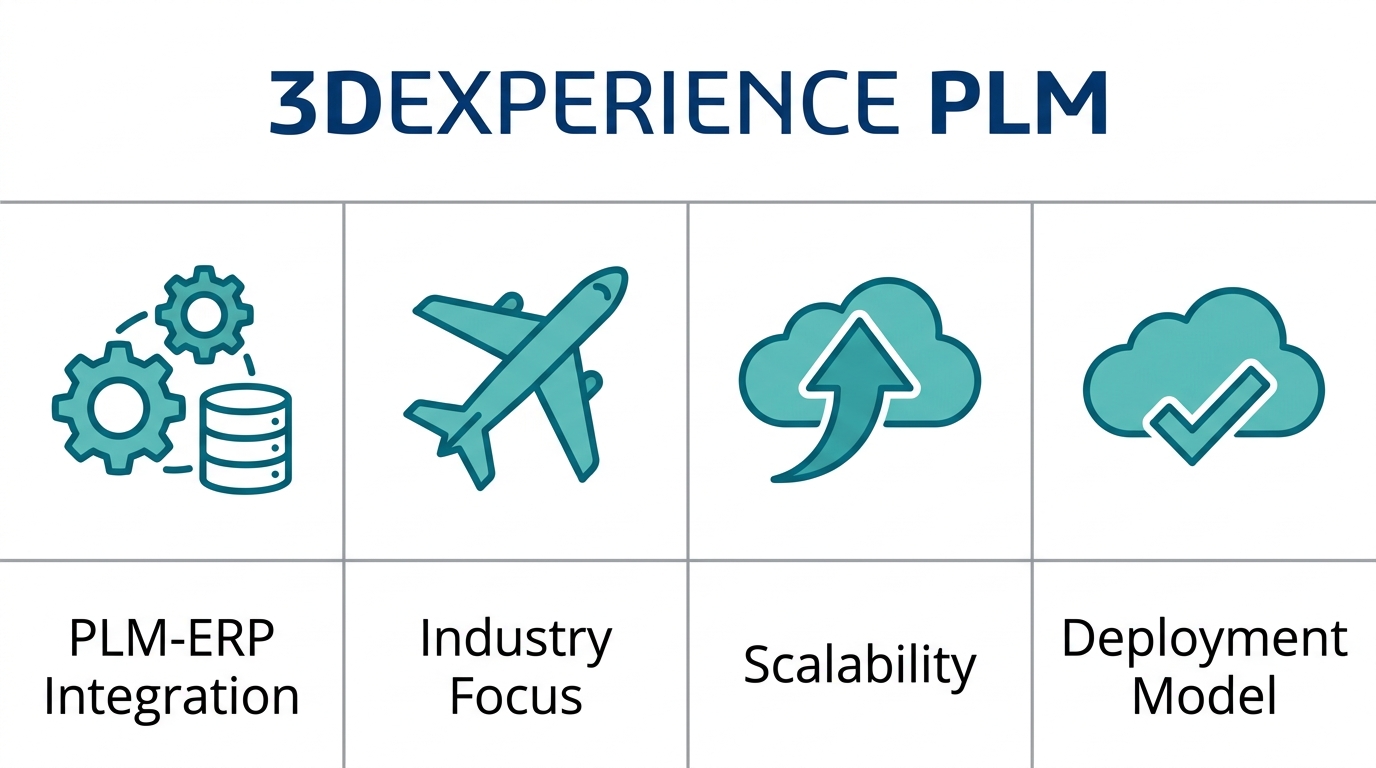
3DEXPERIENCE PLM features comparison infographic with four key areas.
Aligning PLM Investment with Your Capital and M&A Goals
Yet even the best PLM software requires a capital strategy aligned with your M&A goals. At Zaidwood Capital, we view product lifecycle management technology as a strategic asset. Its full value is realized only when integrated into a broader corporate development plan, from pre-deal positioning to post-merger integration.
For PLM ERP integration, capital needs extend beyond software licensing to data migration and system compatibility. Platforms such as 3DEXPERIENCE PLM illustrate the substantial capital commitment required. Our Sovereign Data Nexus and Precision Catalyst identify the right capital sources, including growth equity, venture capital, asset-based lending, to fund your PLM project. The Velocity Matrix then compresses due diligence and accelerates deal execution, ensuring your PLM investment aligns with M&A momentum.
Institutional investors increasingly apply SIFMA treasury clearing compliance standards when evaluating a target’s PLM stack. By leveraging our Sovereign Data Nexus platform, we pre-qualify your investment profile against these rigorous financial-technology criteria, reducing friction during due diligence and deal negotiation.
Our team applies the Velocity Matrix to ensure your PLM investment moves from plan to execution. Reach out to learn how.