

Table of Contents
The Rise of Private Equity Continuation Funds
Private equity continuation funds have become a mainstream liquidity solution, allowing general partners to transfer assets into a new fund they manage and extend the hold period. These gp-led secondary transactions have risen in response to prolonged exits, valuation gaps, and challenging IPO or sale routes.
Single-asset continuation vehicles concentrate this approach on one high-performing company that needs additional time and capital to reach its full value. The rise of private equity continuation funds has transformed the secondary market from a distressed niche into a deliberate institutional portfolio management tool.
Sponsors evaluating these structures can access experienced capital advisory services to support evaluation and execution. As a Boutique M&A and Capital Advisory Firm, we provide guidance without promising any specific outcome, drawing on the approach detailed in our Capital Advisory FAQ. We help clients navigate continuation fund complexities and align strategies with long-term value creation.
Setting the Stage for Continuation Fund Analysis
In today’s liquidity-constrained market, private equity continuation funds have become an increasingly vital solution within gp-led secondary transactions. By creating a new vehicle to hold an existing portfolio asset, a GP can offer limited partners liquidity without a full exit, while maintaining exposure to the asset’s upside potential. Single-asset continuation vehicles, in particular, have gained traction as a means to extend hold periods and inject growth capital in a market where traditional exit paths may be delayed.
However, the structural complexity of these continuation funds demands rigorous evaluation. Key considerations—due diligence, alignment of interests between GPs and LPs, and pricing valuation—must be assessed through a specialized advisory lens. A mere financial review is insufficient; without a Full-Cycle M&A perspective, stakeholders risk misaligned incentives or mispriced assets.
As a Boutique M&A and Capital Advisory Firm, Zaidwood Capital approaches continuation fund analysis with a disciplined, Full-Cycle M&A framework. Our process integrates market intelligence with deep transactional expertise, ensuring that every transaction is scrutinized for strategic fit, risk factors, and value creation. In the following sections, we break down the critical analytical pillars that define prudent decision-making in this space.
Understanding Continuation Fund Mechanics
Private equity continuation funds are a strategic mechanism that helps fund managers extend ownership of portfolio companies beyond a traditional fund’s term. Through our educational resources, we explain how a continuation fund—a newly created vehicle—purchases one or more assets from an existing fund, giving investors a liquidity option without a full exit.
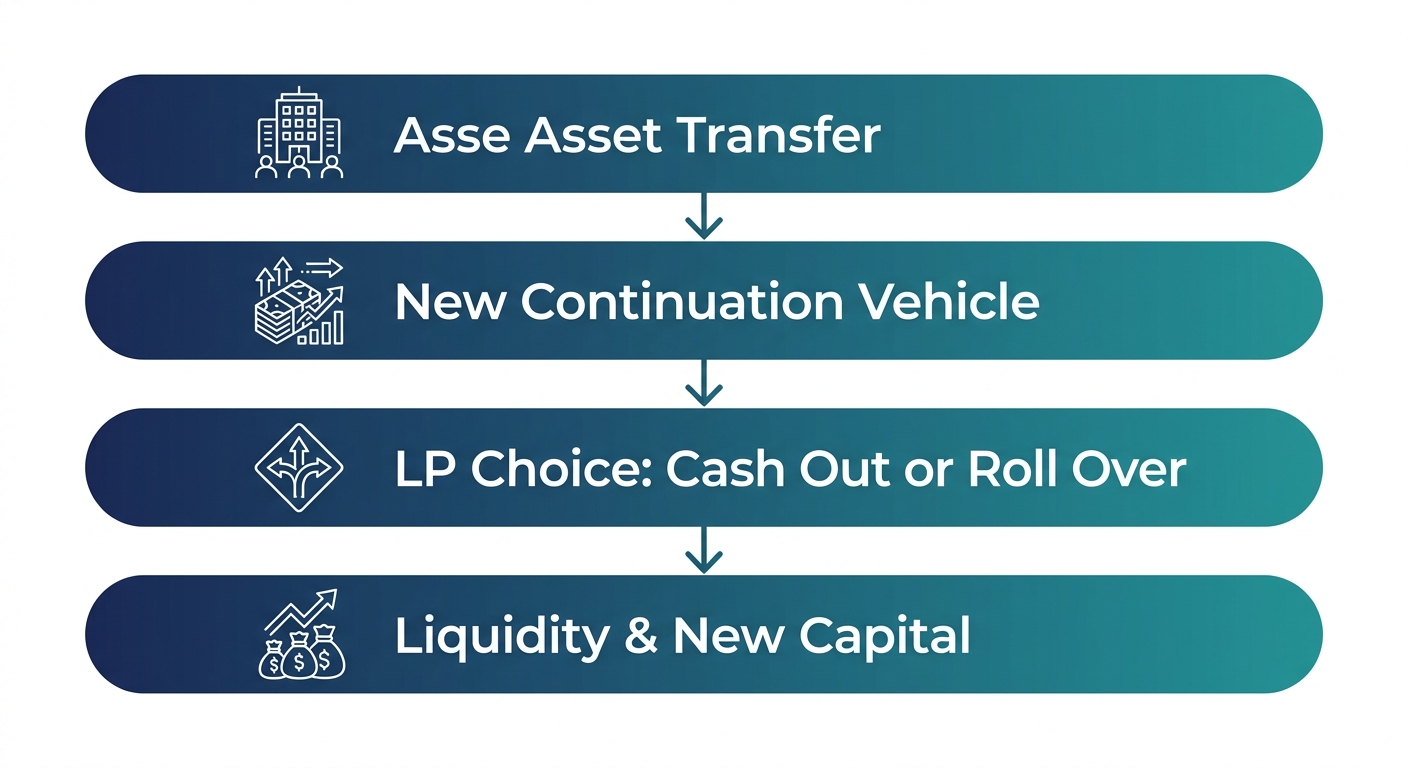
In a gp-led secondary transaction, the general partner orchestrates the sale of selected assets from a legacy fund to the continuation vehicle. Existing limited partners are offered a clear choice: cash out their interest at fair market value or roll their pro-rata stake into the new fund, preserving exposure to the asset’s future potential. The vehicle is typically capitalized by both rolling LPs and fresh capital from new institutional investors.
A common structure is the single-asset continuation vehicle, which holds only one portfolio company. This design is often used for a manager’s highest-conviction assets that need additional time or growth capital to reach full value. Continuation fund structures have grown in popularity as a flexible alternative to a mandatory sale or IPO, delivering a measured liquidity event while maintaining alignment with the asset’s long-term story.
GP-Led Secondary Transaction Structures
Private equity continuation funds represent one of the most prominent categories of GP-led secondary transactions in the market today. These structures allow general partners to retain high-quality portfolio assets beyond the original fund term while providing partial liquidity to existing limited partners.
A single-asset continuation vehicle focuses on one high-performing portfolio company. The GP transfers that company into a newly created vehicle, and existing LPs choose between selling their interest for cash or rolling their exposure into the new structure at a valuation-based price. Single-asset continuation vehicles concentrate capital behind a proven asset where the GP sees continued upside.
Multi-asset continuation funds, sometimes called portfolio continuation vehicles, group several fund investments together. This approach extends the hold period for a collection of quality assets while raising fresh capital from new and returning investors. As described in our CADE FAQ, these GP-led secondary transactions typically include an independent valuation process and special LP negotiation to address the natural conflict of interest created when a sponsor sits on both sides of the trade. Executing these structures effectively is where dedicated secondary advisory expertise comes into play.
Single-Asset Continuation Vehicles Explained
Within private equity continuation funds, single-asset continuation vehicles (SACVs) represent a specialized structure. As outlined in our CADE FAQ, an SACV enables a general partner (GP) to move a single, high-performing portfolio company from an existing fund into a new vehicle.
In gp-led secondary transactions, establishing an SACV serves a dual purpose. It provides existing limited partners (LPs) with the option to obtain liquidity while allowing the GP to retain management of an asset poised for further growth. We structure these transactions to align interests for the next phase of value creation.
Unlike multi-asset continuation funds that pool several portfolio companies, an SACV focuses exclusively on one asset. This concentrated approach simplifies governance and permits the design of tailored capital structures. By isolating a single investment within an SACV, GPs can more precisely target operational improvements and exit timing for that specific company.
Benefits Driving the Popularity of Continuation Vehicles
Private equity continuation funds have gained popularity because they unlock capital efficiency, extend asset ownership, and offer liquidity on tailored terms. Through gp-led secondary transactions, sponsors create vehicles that hold high-quality companies beyond a typical fund life, giving existing LPs a choice to exit or roll over.
From our perspective, a key driver is capital efficiency: private equity continuation funds allow a sponsor to raise new capital without the full roadshow of a traditional fund, preserving deal momentum. At the same time, these vehicles let managers support high-performing portfolio companies through additional growth cycles, avoiding a sale forced by a fund’s sunset date.
For limited partners, these structures provide a liquidity option: exit at a transparent price or roll into a vehicle that continues to back a proven asset. Single-asset continuation vehicles concentrate that strategy on one high-conviction company, attracting institutional investors who prefer exposure to an established operation rather than a blind pool.
However, these benefits come with structural considerations explored next.
Risks and Key Considerations for Continuation Funds
Although continuation funds can provide liquidity and continuity, they introduce several important risks and considerations in private equity continuation funds. In gp-led secondary transactions, the GP sits on both sides of the deal, representing existing and new investors, which creates inherent conflicts of interest that LPs must weigh carefully before electing their options.
Valuation risk is a central concern in single-asset continuation vehicles. The underlying assets are often illiquid and difficult to value, and the valuation may rely on manager estimates or third-party opinions, which can materially affect LP economics and exit outcomes.
LPs also face liquidity trade-offs, often with limited time to decide whether to roll over, sell, or receive a distribution, and the terms may differ meaningfully between those elections. Alignment of interests and fund governance require close scrutiny, including the role of the LP Advisory Committee, fee structures, co-investment opportunities, and ongoing information rights.
These structures are complex and demand thorough LP due diligence, including evaluation of the manager’s track record, the underlying asset quality, and the final vehicle terms. Private equity investments involve risk, including the possible loss of principal, and no outcome is guaranteed. This content is for informational purposes only and does not constitute an offer, solicitation, or recommendation to buy or sell any security. Zaidwood Capital is not a registered broker-dealer; securities are offered through Finalis Securities LLC.
Understanding these risks is the first step; in the next section, we outline how our team advises on continuation-fund strategies.
How Continuation Funds Deliver Liquidity to Limited Partners
Private equity continuation funds are a growing source of liquidity for limited partners. As explained in Zaidwood Capital’s capital advisory FAQ, these structures allow a general partner to move a high-potential asset from an existing fund into a new vehicle, creating a liquidity event for LPs who choose to sell. The GP creates a new investment vehicle, often called a continuation fund, to hold the asset, offering existing limited partners either liquidity or the opportunity to maintain their exposure.
Through gp-led secondary transactions, LPs are typically offered a choice: sell their interest into the new entity and receive cash, or roll over their stake to maintain exposure. A third-party valuer or secondary market process sets the pricing, ensuring an arm’s-length transaction. This mechanism differs from a traditional IPO or trade sale, offering an alternative when an asset may not be ready for a full exit but has a strong growth runway.
Single-asset continuation vehicles focus on a single portfolio company, giving LPs concentrated exposure while the GP retains control to drive further value creation. This can be a strategic alternative to a forced sale, extending the hold period while providing potential liquidity.
A Decision Framework for Evaluating Continuation Opportunities
As the secondary market expands, private equity continuation funds gain traction, and a disciplined evaluation framework is essential to distinguish strong opportunities from structural risks. Our CADE methodology anchors this process with five core criteria:
Sponsor alignment — is the GP rolling meaningful capital alongside LPs? Asset quality — does the underlying business have a credible multi-year growth thesis? Valuation discipline — is there independent support and evidence of an unforced sale? Structural terms — are rollover rights, liquidity provisions, and governance protections adequate? Realistic liquidity alternatives — how does the continuation offer compare with a traditional sale process?
When evaluating a single-asset continuation vehicle, concentrated exposure demands stricter valuation governance and GP scrutiny than a diversified multi-asset continuation structure. For GP-led secondary transactions, our CADE framework uses the same five dimensions to test the strength of the opportunity.
Applying this framework consistently marks the starting point, and our CADE FAQ provides the full checklist we use. No framework eliminates risk — investors should work with professional advisors.
Troubleshooting Common Continuation Fund Challenges
Sponsors navigating in private equity continuation funds often discover that the transaction introduces practical challenges requiring proactive management. Drawing on our work with middle-market managers, we see several recurring pain points that, with the right approach, can be systematically resolved.
- The most persistent challenge in private equity continuation funds is the protracted LP consent timeline that catches GPs off guard. Early, structured outreach and a dedicated data room at least 60 days ahead of the process align LP expectations and accelerate the consent process.
- In gp-led secondary transactions, valuation disagreements frequently erode LP confidence. Independent appraisals and fairness opinions provide objective benchmarks that satisfy fiduciary duties and reduce transactional friction, without implying the firm provides those services.
- Governance risks — such as perceived self-dealing — can derail a continuation fund. Best practice includes early LPAC consultation, robust limitation-of-liability provisions, and rigorous re-underwriting of the underlying assets to strengthen alignment, not guarantee outcomes.
- In single-asset continuation vehicles, sponsors face distinct complexities such as assuming existing debt, negotiating minority LP rollover and participation rights, and preparing for granular asset-level diligence. Addressing these early prevents cascading surprises at closing.
For deal-tested, question-by-question answers spanning the full continuation process, consult our CADE FAQ. As a Boutique M&A and Capital Advisory Firm, we stand ready to support you with practical, transaction-informed guidance at every stage.
This content is for informational purposes only and does not constitute an offer or solicitation; securities are offered through Finalis Securities LLC, and Zaidwood Capital is not a registered broker-dealer and is unaffiliated with Finalis.
Navigating the Continuation Fund Landscape with Confidence
Confident navigation of the continuation fund landscape is a product of education, preparation, and clear-eyed evaluation—not a promise of certain returns. For private equity continuation funds, that means understanding the strategic rationale for these structures and the importance of disciplined due diligence. This approach enables both GPs and LPs to approach transactions with informed judgment rather than speculation.
Confidence in GP-led secondary transactions, for example, comes from scrutinizing valuation methodologies, verifying alignment of interests between GPs and LPs, and demanding transparency throughout the process. Single-asset continuation vehicles, while a distinct structural variant within the broader GP-led secondary market, require the same rigorous attention to valuation, governance, and LP protections. Across the private equity continuation fund landscape, rigorous assessment of these factors builds a foundation for confident decision-making.
As a Boutique M&A and Capital Advisory Firm, Zaidwood Capital provides Full-Cycle M&A guidance to clients evaluating continuation fund structures—without acting as a registered broker-dealer or offering broker-dealer services directly. For deeper educational answers, we invite you to explore our CADE FAQ, where we address common questions about continuation asset deal execution. Above all, we encourage you to conduct your own due diligence and consult legal, tax, and financial advisors before acting on any information presented here.