

Table of Contents
- NAV Financing in Private Equity: A Strategic Primer
- What is NAV Financing and How It Works in Private Equity
- Key Terms and Structures of NAV Loan Agreements
- Using NAV Financing to Support Private Equity Distributions and Liquidity
- Advanced Strategies: Fund-Level Leverage and Asset-Backed Credit Facilities
- Top Questions About NAV Financing in Private Equity
- Looking Ahead: The Evolving Role of NAV Financing in Private Equity
NAV Financing in Private Equity: A Strategic Primer
NAV financing in private equity has emerged as a powerful fund-level leverage tool, allowing general partners to borrow against the net asset value of their portfolio companies rather than relying on single-asset collateral. Lenders underwrite the facility based on the diversified portfolio’s mark-to-market value, advancing a percentage of the fund’s NAV through a tailored borrowing-base structure. This approach provides liquidity without forcing the sale of underlying assets.
Sponsors use NAV facilities to fund follow-on acquisitions, accelerate limited partner distributions, support shareholder redemptions, extend fund hold periods, or capitalize continuation vehicles—all while preserving asset ownership. By borrowing at the fund or SPV level, general partners secure flexible capital that avoids triggering asset sales or disrupting portfolio operations. This fund-level debt allows managers to meet liquidity needs without compromising long-term investment strategies.
Unlike asset-backed credit facilities that are secured by specific tangible collateral such as equipment, inventory, or accounts receivable, NAV facilities rely on the mark-to-market value of a diversified portfolio of investments. This structural difference shifts underwriting focus from individual asset quality to the fund’s overall net asset value, providing a more flexible capital solution.
For a closer look at how these facilities fit within the broader spectrum of business acquisition financing, explore our dedicated resource. Our advisory team helps sponsors structure NAV transactions that align with their fund’s liquidity and growth objectives.
NAV financing in private equity is a fund-level, asset-backed credit facility secured by a fund’s net asset value—the fair market value of its portfolio companies—rather than by limited partner capital commitments. Net asset value (NAV) is calculated by subtracting liabilities from the aggregate valuation of holdings and is typically reported quarterly. Lenders, such as specialty finance or private credit firms, evaluate the portfolio, apply a haircut, and extend a loan at an advance rate usually between 20% and 40% of NAV. Interest is priced as a spread over SOFR, and the facility is governed by financial maintenance covenants like loan-to-value (LTV) and interest coverage ratios. NAV financing is thus a form of fund-level leverage, and these asset-backed credit facilities give GPs liquidity without calling additional LP capital.
Common uses of NAV loan proceeds include:
- Funding follow-on investments in existing portfolio companies
- Returning capital or making distributions to limited partners
- Providing bridge liquidity for general corporate purposes
- Accelerating the pace of new acquisitions
- Supporting continuation vehicles
While NAV financing offers flexibility, it increases fund-level gearing, which can amplify both gains and losses. The facility is not risk-free and covenants such as LTV limits may be tested during market downturns.
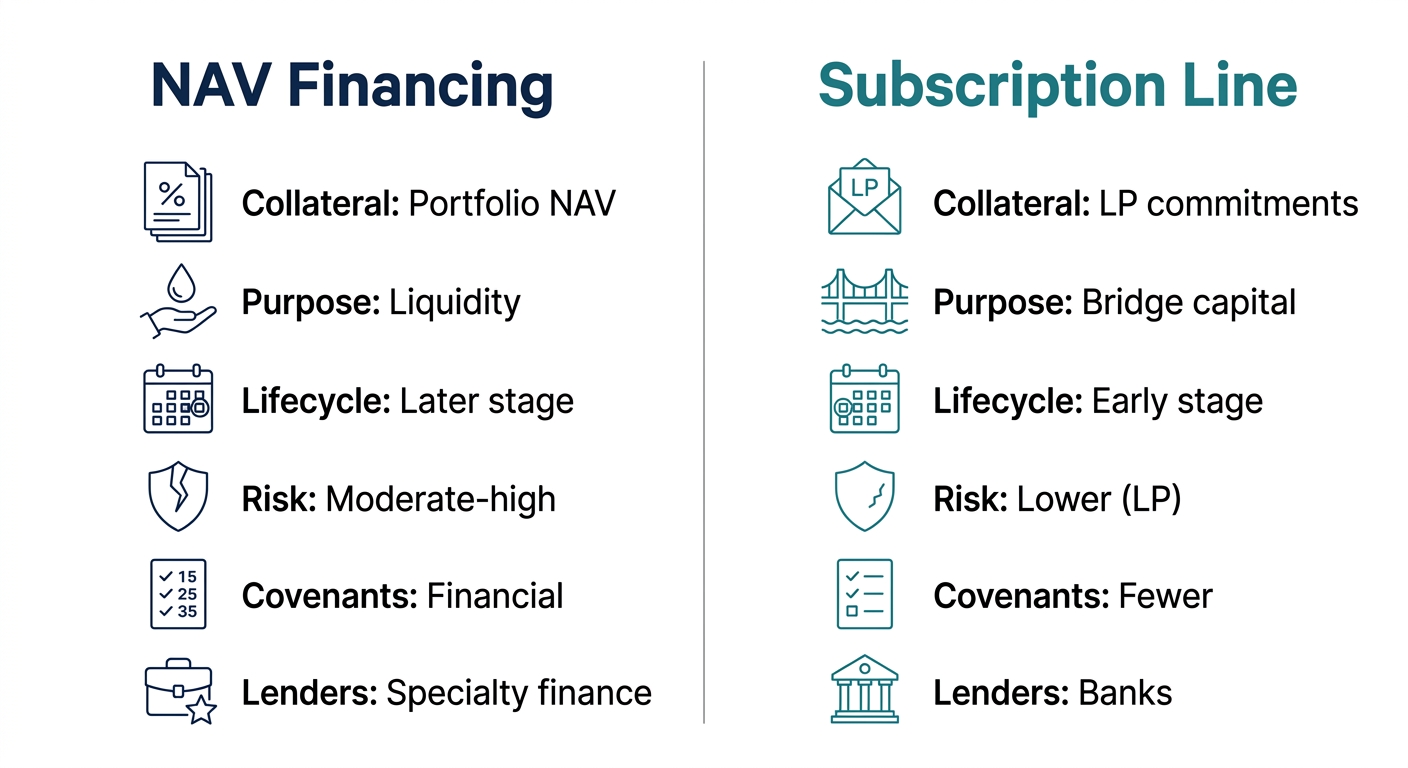
NAV facilities differ materially from subscription line financing, which is secured by unfunded LP commitments rather than portfolio equity. The table below highlights the key distinctions.
| Feature | NAV Financing | Subscription Line Financing |
|---|---|---|
| Underlying Collateral | Fund’s net asset value (portfolio companies) | Limited partner capital commitments |
| Purpose | Liquidity, distributions, bridge financing | Bridge capital calls, early investments |
| Typical Advance Rate | 20–40% of NAV | Up to 90% of unfunded commitments |
| Interest Rate Level | Moderate to high (spread over SOFR/LIBOR) | Lower (typically lower spread) |
| Covenants | Financial maintenance covenants (LTV, etc.) | Fewer financial covenants |
| Usage in Fund Lifecycle | Later stage, post-investment period | Early stage, during commitment period |
| Lender Types | Specialty finance, private credit funds | Banks, institutional lenders |
As the table shows, the most decision-relevant differences lie in collateral type—portfolio NAV versus LP commitments—and lifecycle timing: NAV facilities are used post-investment, while subscription lines are prevalent early in the commitment period. A subscription line typically offers a wider advance rate and lower interest spread but carries fewer financial covenants, reflecting its lower asset risk.
As a boutique M&A and capital advisory firm, Zaidwood Capital advises on fund-level debt structures, including NAV credit facilities, as part of its broader debt advisory and business acquisition financing services. Our team evaluates the optimal capital stack to align with a fund’s stage, portfolio composition, and liquidity objectives.
This website is for informational purposes only and is not an offer, solicitation, recommendation, or commitment to buy or sell any security or financial product. Securities are offered through Finalis Securities LLC; Zaidwood Capital is not a registered broker-dealer and is unaffiliated with Finalis. Investments involve risk and are not guaranteed to appreciate; investors may lose all or part of their investment. Prospective investors should conduct their own due diligence and consult legal, tax, and financial advisors. Past performance does not guarantee future results.
Key Terms and Structures of NAV Loan Agreements
A NAV loan agreement is a fund-level leverage facility secured by the net asset value (NAV) of a private equity fund’s portfolio rather than a single asset. Within nav financing in private equity, these asset-backed credit facilities allow general partners to access capital for liquidity, follow-on investments, or bridge financing without disposing of portfolio companies.
Understanding NAV Loan Structures
NAV facilities typically fall into three structures. A term loan provides a one-time draw, often with amortizing payments or a bullet maturity, making it suitable for bridge financing or known liquidity needs. A revolving credit facility offers borrow/repay flexibility, allowing sponsors to manage working capital and timing differences and is often used for ongoing portfolio support. A hybrid structure combines a revolver with a term loan, delivering a committed liquidity base plus a longer-dated tranche for strategic uses. Fund-level leverage structures are tailored to the fund’s cash flow profile and investment horizon; asset-backed credit facilities of this kind differ from traditional subscription lines because they rely on the portfolio NAV rather than uncalled capital commitments. We observe that the choice depends on the fund’s objectives, asset mix, and the lender’s comfort with diversification.
Market participants vary widely in their risk appetite and structuring preferences. The following table summarizes typical loan terms by lender type in the NAV financing market.
| Lender Type | Advance Rate Range | Typical Maturity | Interest Rate Spread | Key Covenants |
|---|---|---|---|---|
| Bank / Institutional Lender | 20–30% | 2–4 years | S+200–400 bps | Financial covenants, LTV maintenance, borrowing base |
| Specialty Finance Provider | 25–40% | 3–5 years | S+350–550 bps | LTV tests, minimum NAV, concentration limits |
| Private Credit Fund | 30–45% | 3–7 years | S+400–700 bps | Covenant-lite or covenant-loose, potential PIK features |
| Insurance Company | 25–35% | 5–10 years | S+250–450 bps | Strict covenants, rating triggers, diversified pool requirements |
Evaluating these lender profiles helps sponsors match the facility structure to the fund’s risk-return profile and specific capital needs. Understanding how each provider underwrites risk is essential when appraising the covenants and advance rates that govern NAV loan agreements.
Critical Covenants and Advance Rates
In nav financing in private equity, advance rates typically range from 20–45% of portfolio NAV, driven by several key factors:
- Portfolio diversification across geographies, sectors, and vintage years
- Underlying asset liquidity and exit visibility
- Mark-to-market frequency and valuation methodologies
- Sponsor track record and quality of the investor base
Financial covenants act as protective measures that maintain lender oversight. Common covenants include:
- Loan-to-value (LTV) maintenance tests requiring the borrowing base to stay within a preset threshold
- Minimum NAV floor that triggers a default if breached
- Borrowing base certificates submitted quarterly or more frequently
- Concentration limits that cap exposure to any single asset or sector
- Liquidity and cure rights granting the borrower time to remedy a breach
Interest rate spreads are quoted as a margin over SOFR. Private credit funds often offer covenant-lite or covenant-loose terms that may include payment-in-kind (PIK) features, providing greater flexibility at a higher cost. Sponsors must weigh covenant rigidity against the operational freedom needed to execute their strategy effectively.
Negotiating Terms with Lenders
When we advise clients on NAV loan negotiations, we emphasize several levers that drive long-term value. LTV cushions—the difference between the advance rate and actual borrowing—provide headroom against valuation volatility; negotiating wider cushions reduces the risk of a covenant breach. Cure rights specify the time allowed to rectify a default, and longer cure periods offer operational breathing room. Maturity extensions and margin step-downs incentivize strong performance; a step-down clause can reduce the spread if the fund meets certain metrics, aligning lender and borrower interests.
Advance-rate true-ups allow the borrowing base to adjust periodically based on updated NAVs, which is critical in volatile markets. We also recommend clarifying which financial covenants are tested—and how often—to avoid surprises. While covenant-lite or covenant-loose structures can provide operational flexibility, they often come at a premium. Lenders evaluate fund-level leverage by examining portfolio diversification, cash flow coverage, and sponsor track record; presenting a well-diversified portfolio with a history of strong exits strengthens the negotiating position. By focusing on these terms, sponsors can tailor fund-level leverage to support their investment goals without sacrificing downside protection.
Using NAV Financing to Support Private Equity Distributions and Liquidity
NAV financing in private equity has become a pivotal tool for middle-market fund managers seeking to enhance liquidity and accelerate returns. As a boutique M&A and capital advisory firm, we advise general partners on structuring net asset value financing solutions that unlock capital without requiring immediate asset sales, helping funds navigate complex distribution and liquidity challenges.
Facilitating Early Distributions via NAV Facilities
NAV facilities are loans secured by the overall net asset value of a fund’s portfolio rather than a single portfolio company, enabling liquidity tied to a diversified asset base. General partners increasingly use these fund-level leverage tools to accelerate distributions to limited partners well ahead of anticipated exit timelines. By borrowing against the fund’s net asset value, GPs can return capital to LPs without prematurely selling portfolio holdings, thereby improving the fund’s IRR and demonstrating stronger early performance.
From the LP’s perspective, early distributions translate into faster return of capital and greater reinvestment optionality, which are particularly attractive in an environment where exit timelines can stretch unpredictably. Since the loan is a fund-level obligation, it does not dilute LP interests or require them to inject additional capital. We have observed that middle-market sponsors, especially those with mature portfolios, often turn to NAV-based credit lines to bridge the gap between value creation and exit realization, providing LPs with tangible liquidity events while preserving upside potential in remaining assets.
Enhancing Fund Liquidity in Volatile Markets
Market volatility can strain investor relationships when funds issue repeated capital calls to support portfolio companies or meet near-term obligations. Asset-backed credit facilities, such as NAV loans, offer an effective way to mitigate call fatigue by providing a reservoir of capital that is accessible without tapping LP commitments. In practice, a fund can draw on a revolving NAV facility, effectively borrowing against fund assets, to cover working capital needs, fund tuck-in acquisitions, or manage operational shortfalls, all while avoiding the administrative burden and potential friction of frequent capital calls.
These subscription-backed facilities also serve as a critical buffer when exit markets become illiquid or when fund-level leverage from other sources is constrained. By maintaining a flexible line of credit secured by the fund’s diversified net asset value, GPs can navigate periods of uncertainty with confidence, ensuring that portfolio companies have the resources they need to continue executing value creation plans. For middle-market sponsors, this approach preserves alignment with LPs and keeps the fund on track to meet its long-term objectives.
Real-World Use Cases and Practical Examples
Practical applications of net asset value financing demonstrate its versatility. The table below summarizes common use cases and how NAV facilities support each:
| Use Case | How NAV Financing Supports It | Typical Structure | Benefits |
|---|---|---|---|
| Accelerate Distributions | Provides liquidity to LPs without selling portfolio assets | Term loan secured by fund NAV | Faster returns to LPs, improved fund IRRs |
| Fund Add-On Acquisitions | Supplements equity for bolt-on deals without new capital calls | Revolving or term facility allocated to specific portfolio company | Enables synergetic growth, enhances value creation |
| Bridge Liquidity Gaps | Covers operating expenses or capital needs during delays in exits or fund closings | Short-term revolving facility | Maintains operations, avoids distress |
| Support GP Commitments | Provides financing for GP co-investment or management company capital | Term loan with recourse to GP entity or personal guarantee | Aligns GP incentives, preserves personal capital |
We apply our boutique advisory expertise to structure these solutions for middle-market sponsors, tailoring terms to fund profiles and distribution goals. Our team’s experience includes advising on NAV-backed revolvers for add-on acquisitions and term facilities that accelerate LP distributions.
Investments involve risk and are not guaranteed. Securities are offered through Finalis Securities LLC; Zaidwood Capital is not a registered broker-dealer and is unaffiliated with Finalis.
Advanced Strategies: Fund-Level Leverage and Asset-Backed Credit Facilities
NAV financing in private equity allows funds to borrow against their net asset value, providing liquidity for distributions or post-investment-period needs. Fund-level leverage structures encompass subscription lines, NAV-based facilities, hybrid/umbrella facilities, and asset-backed securitization, each with distinct collateral and risk profiles.
The table below compares the four primary fund-level leverage structures.
| Leverage Type | Collateral Basis | Typical Use | Risk Profile | Structural Example |
|---|---|---|---|---|
| NAV-Based Facility | Fund net asset value (portfolio) | Liquidity, distributions, post-investment period | Moderate-high (portfolio risk) | Term loan secured by entire fund NAV |
| Subscription Line | Limited partner capital commitments | Early stage, bridge to capital calls | Lower (LPs credit risk) | Revolving facility backed by LP commitments |
| Hybrid / Umbrella Facility | Combination of NAV and subscription | Full fund lifecycle, flexible draw | Tailored risk allocation | Multi-tranche facility with different collateral pools |
| Asset-Backed Securitization | Specific portfolio assets or receivables | Large-scale liquidity, off-balance sheet | Varies (asset quality) | Special purpose vehicle issuing notes backed by assets |
Subscription lines rely on limited partner capital commitments, offering lower risk given the creditworthiness of the LP base. Lenders typically structure these as revolving facilities with advance rates tied to remaining unfunded commitments, giving managers the agility to close investments before capital calls are processed.
Hybrid or umbrella facilities combine NAV and subscription collateral into a single multi-tranche structure. This approach allocates risk across different pools, supporting flexible draws throughout the fund lifecycle while allowing lenders to tailor covenants and concentration limits to each collateral class.
Asset-backed credit facilities, such as securitizations, transfer specific portfolio assets or receivables into a special purpose vehicle that issues notes to investors. This off-balance-sheet structure can unlock large-scale liquidity, though risk hinges on asset quality and cash-flow predictability.
In our capital advisory practice, we help sponsors and management teams evaluate which fund-level leverage structure aligns with their investor base, portfolio composition, and capital strategy. We consider advance rates, covenant headroom, and lender collateral positions to structure facilities that support a fund’s lifecycle without over-leveraging. All fund-level leverage magnifies both gains and losses, and investments involve risk, including possible loss of principal. This content is for informational purposes only and is not an offer to buy or sell any security; Zaidwood Capital is not a registered broker-dealer and securities are offered through a third-party broker-dealer.
Selecting the right structure is only the beginning — after securing a facility, fund managers must maintain lender alignment and monitor covenant headroom as portfolio values and capital call cycles evolve.
Top Questions About NAV Financing in Private Equity
Below, we answer the most common questions about NAV financing in private equity.
What is NAV financing in private equity?
NAV financing in private equity is a credit facility secured by a fund’s portfolio and backed by its diversified investments.
How does NAV financing differ from traditional fund-level leverage?
Traditional fund-level leverage, such as subscription lines, relies on uncalled capital commitments. NAV financing, instead, is backed by portfolio value, a distinct form of fund-level leverage.
What are asset-backed credit facilities in the context of NAV financing?
These asset-backed credit facilities are structured at the fund level, used for add-on acquisitions, follow-on investments, or investor distributions.
What are the key risks of NAV financing for a fund and its investors?
NAV financing increases leverage, potentially diluting or subordinating LP returns. Portfolio performance is not guaranteed to cover repayment, adding risk to the capital structure.
Looking Ahead: The Evolving Role of NAV Financing in Private Equity
NAV financing in private equity is maturing from bespoke transactions into a more standardized and increasingly mainstream liquidity tool. Fund-level leverage now extends well beyond traditional subscription lines, with investors demanding greater transparency and granular due diligence. Simultaneously, asset-backed credit facilities are gaining traction as lenders refine their underwriting models for portfolio-level exposures. We view these developments as a natural response to sustained institutional inflows, heightened distribution pressures, and extended holding periods amid higher capital costs. Our boutique M&A and capital advisory team helps sponsors navigate these evolving structures.