


Growth Equity
Table of Contents
Growth Equity as a Catalyst for Strategic Expansion
To understand why growth equity is such a potent force, it helps to first review What Is Growth Equity. This positions growth equity as a critical catalyst for strategic expansion. At its essence, growth equity is a form of expansion capital that fuels maturing companies with proven business models, enabling them to scale without sacrificing founder control.
Growth equity acts as a minority investment, typically ranging from 10 to 30 percent equity, which injects capital for market expansion, product development, or strategic acquisitions. Unlike venture capital, which bets on early-stage experimentation, or buyout capital, which transfers majority ownership, growth equity takes a passive minority stake. This structure allows founders to retain control while gaining the resources and expertise of institutional investors. It is the rocket fuel for an already successful engine, accelerating growth while preserving the entrepreneurial vision. This capital injection accelerates market entry, product innovation, and strategic acquisitions while strengthening balance sheets.
These investors contribute more than just funding: they bring operational expertise, deep industry networks, and strategic guidance that help companies navigate scaling challenges. That catalytic effect is at the core of Zaidwood Capital’s growth equity advisory approach, where we connect maturing businesses with the right minority investors and provide the full-cycle M&A support needed to turn expansion capital into sustainable, long-term value. The result is a more resilient, better-capitalized company poised for long-term success.
Growth Equity Versus Venture Capital and Leveraged Buyouts
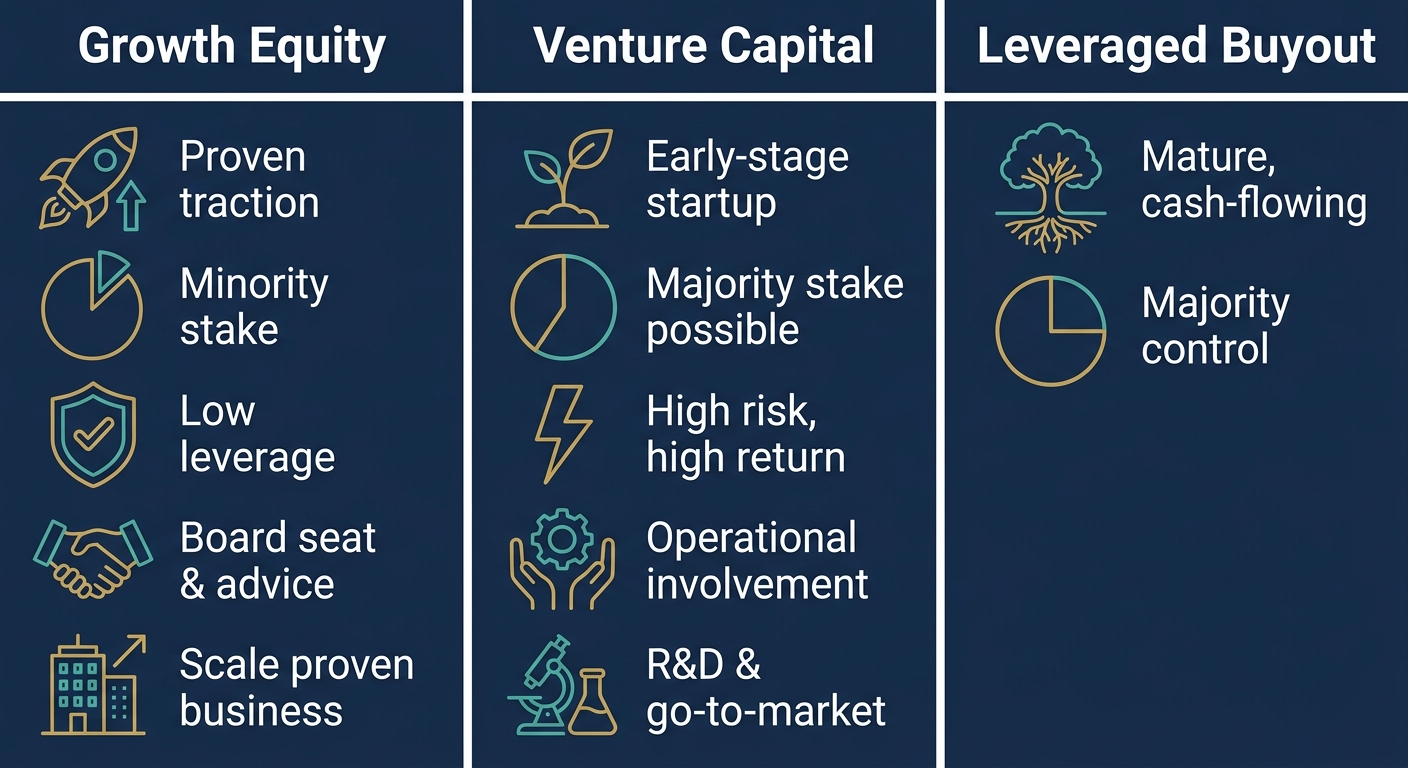
Growth equity occupies a distinct space between early-stage venture capital and control-oriented leveraged buyouts. When evaluating funding options for a growth-stage company, understanding Growth Equity Investment against venture capital and leveraged buyouts is critical. Our comparison highlights how each strategy serves different company needs and risk profiles.
| Dimension | Growth Equity | Venture Capital | Leveraged Buyout |
|---|---|---|---|
| Investment Stage | Growth-stage companies with proven traction | Early-stage startups with unproven business models | Mature, cash-flow-positive companies |
| Ownership Stake | Minority stake (usually 20%-40%) | Minority to majority stake (often 20%-50%) | Majority or full ownership (usually >50%) |
| Debt Usage | None to low leverage | Minimal debt | High debt levels (60%-90%) to fund the acquisition |
| Investor Involvement | Board seat and strategic guidance | High involvement, often operational | Active control – management replacement typical |
| Risk / Return Profile | Moderate risk, moderate return (2-4x multiple) | High risk, high return (10x+ multiple on some deals) | Low risk (on secured assets), moderate yield |
| Primary Use Case | Scale proven business, expand into new markets or products | Develop product-market fit, fund R&D and initial go-to-market | Acquire company, restructure operations, exit via sale or IPO |
Investment stage: growth equity backs companies with proven traction and revenue, while venture capital funds early-stage startups and leveraged buyouts require mature, cash-flow-positive firms.
Ownership structures differ markedly. Growth equity takes a minority investment that preserves founder autonomy, venture capital’s stake can range from minority to majority, and leveraged buyouts almost always acquire full control.
Debt usage is a key differentiator: growth equity relies on equity with little to no leverage, whereas leveraged buyouts are heavily debt-financed and venture capital uses minimal debt.
Involvement levels vary: growth equity investors contribute strategic guidance via a board seat, venture capitalists may be operational, and LBO investors exercise active control with potential management replacement.
Risk-return profiles: growth equity offers moderate risk and 2-4× returns; venture capital carries high risk with potential 10×+ multiples; leveraged buyouts have lower risk backed by secured assets.
Growth equity scales proven businesses into new markets as expansion capital. Venture capital funds product-market fit and initial go-to-market, while leveraged buyouts acquire and restructure companies for later exit.
Each strategy serves a distinct purpose. Growth equity fits companies needing scale without sacrificing control, while VC fuels innovation and LBOs restructure mature firms. We help clients navigate these choices to find the right capital solution. Our Growth Equity Advisory practice applies these insights to each engagement.
Comparing Growth Equity, Venture Capital, and Leveraged Buyouts
Evaluating Growth Equity Readiness: Metrics, Ownership, and Governance
Understanding what growth equity entails is the first step; the next is determining whether your company meets the criteria investors use. As a Boutique M&A and Capital Advisory Firm, we at Zaidwood Capital guide founders through this readiness evaluation. A boutique M&A advisory can provide the analytical framework needed to align with investor expectations and surface the key quantitative and qualitative signals that matter most.
Key Metrics Growth Equity Investors Evaluate
Growth equity investors focus on a handful of financial and operating indicators that demonstrate scalability and market traction. For companies seeking expansion capital, we typically see annual recurring revenue (ARR) ranging from $5 million to $50 million or more, paired with year-over-year revenue growth of 20-100%. These thresholds confirm product-market fit and predictable revenue streams. Gross margins are closely scrutinized–software companies should show 60% or higher, while service-oriented firms need at least 30%–as they reveal whether unit economics are fundamentally healthy. Net dollar retention (NDR) above 110% signals that existing customers are expanding, which reduces dependence on new logo acquisition and derisks future growth. The customer acquisition cost payback period, ideally under 12 months, reflects sales and marketing efficiency, while an improving EBITDA margin or a clear path to profitability assures investors that the business can sustain momentum without taking on burdensome debt. Investors typically target companies that meet the thresholds shown in the table below.
| Metric | Growth Equity Threshold | What It Signals |
|---|---|---|
| Annual Revenue Run-Rate (ARR) | $5M-$50M+ | Product-market fit is confirmed; revenue is predictable. |
| Revenue Growth Rate (YoY) | 20%-100% | The company is expanding rapidly and needs capital to sustain momentum. |
| Gross Margin | 60%+ (software); 30%+ (services) | Unit economics are healthy and scalable. |
| Net Dollar Retention (NDR) | ≥110% | Existing customers are expanding, reducing acquisition risk. |
| CAC Payback Period | <12 months | Sales and marketing efficiency is strong. |
| EBITDA Margin (or Path to Profitability) | Positive or improving toward break-even | The business can sustain growth without dilutive debt. |
These benchmarks are not absolute filters, but they anchor the conversation. When a company demonstrates strength across most indicators, it becomes a compelling candidate for growth equity and can negotiate from a position of confidence.
Ownership Stake and Debt Structures in Growth Equity
A defining feature of growth equity is that investors acquire a minority ownership stake–typically 20-40% of the business–rather than pursuing a controlling position. This minority investment structure allows founders to retain operational control while accessing the capital needed to scale. Unlike leveraged buyouts, where debt financing is central to the transaction and can burden the company with repayment obligations, growth equity does not rely on debt to fuel expansion. The capital infusion is pure equity, which aligns investor returns with the company’s long-term appreciation rather than with interest payments. For founders, this means the relationship is built on shared growth incentives. We often advise clients that the absence of debt reduces financial risk and preserves cash flow for strategic initiatives, making it a natural fit for high-growth companies that want to extend their runway without sacrificing ownership control.
Governance Rights and Board Control
Even with a minority stake, growth equity investors seek governance provisions that protect their capital. The typical request includes one or two board seats, which give investors a formal voice in strategic direction without granting day-to-day control. In addition, they negotiate veto rights over major decisions–such as mergers and acquisitions, dividend declarations, and the incurrence of debt–to ensure that significant corporate actions align with their interests. Information rights are equally standard, requiring monthly or quarterly financial reporting that gives investors transparency into performance and emerging risks. Founders can negotiate these terms thoughtfully. We recommend defining a narrow list of veto matters, limiting board seats to a manageable number, and setting reporting cadences that are practical for your finance team. This approach maintains investor confidence while preserving the founder’s ability to run the business. Once a company meets these benchmarks, the next step is to engage with potential investors–a process that we at Zaidwood Capital help streamline through tailored capital formation strategies.
How to Raise Growth Equity: A Step-by-Step Strategy
In the era of Financial Services 3.0, growth equity has emerged as the preferred capital source for high-growth companies seeking to scale without surrendering control. Once you confirm growth equity suits your trajectory, follow this strategic, step-by-step framework — refined through our work with growth-stage businesses across the U.S. and from our base in West Palm Beach. The process breaks into three distinct phases:
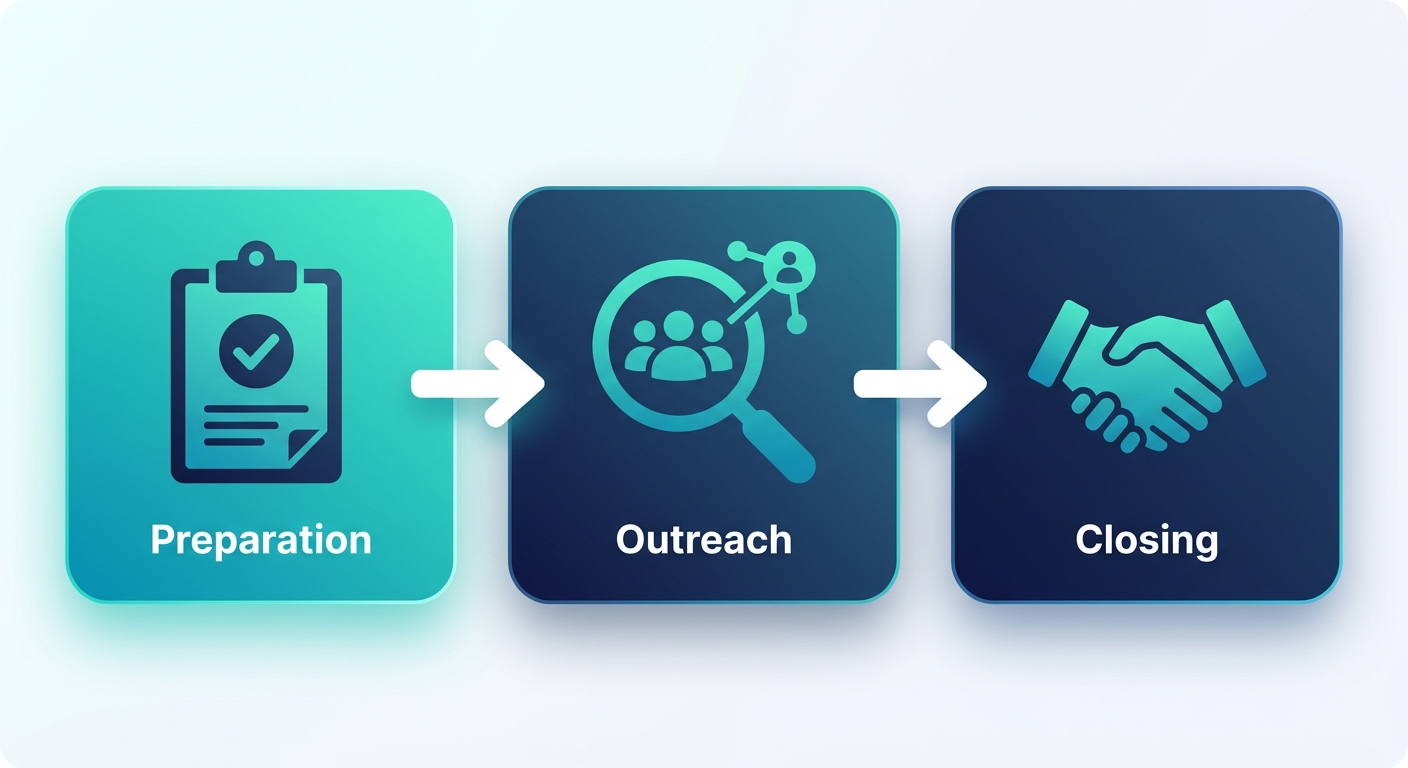
Three-step growth equity raising process from preparation to closing
We will guide you through each stage, drawing on our firm’s proprietary tools and decades of capital advisory experience.
Preparing Your Company for a Growth Equity Raise
Before approaching investors, your company must present a compelling, data-backed growth story. Start with these essential steps:
- Clean financial statements – Prepare audited or reviewed financials with three-year projections and a current cap table.
- Customer acquisition metrics – Document key SaaS or unit economics: CAC, LTV, churn rates, and payback periods.
- Competitive landscape analysis – Map your market position and defensible moats.
- Investor-ready data room – Use our Sovereign Data Nexus platform to organize, secure, and share critical documents in a format investors expect.
- Growth narrative – Articulate why now, how expansion capital will be deployed, and the measurable milestones you will achieve.
Expansion capital through a minority investment allows you to retain control while accelerating scale. To help you self-assess which use case fits your growth plan, the table below outlines typical expansion capital applications by sector and suitability.
| Use Case | Capital Requirement | Typical Sector | Suitability for Growth Equity |
|---|---|---|---|
| Geographic Expansion | $5M-$20M | Tech, Healthcare, Consumer | High – proven model, new market entry |
| Product Line Extension | $3M-$15M | SaaS, Biotech, Industrials | Moderate – requires R&D spend but builds on core |
| Acquisition (Add-on / Bolt-on) | $10M-$50M+ | All sectors | High – accelerates scale via M&A; typical growth equity use |
| Working Capital / Operational Scaling | $2M-$10M | Logistics, Manufacturing, Retail | Moderate – focuses on efficiency rather than growth |
| Sales & Marketing Scale-up | $2M-$8M | SaaS, Fintech, E-commerce | High – directly funds revenue acceleration with measurable ROI |
Each use case carries distinct capital requirements and risk profiles. Geographic expansion, for instance, typically demands $5M-$20M and suits companies with a proven model entering new markets — a high-suitability scenario for growth equity. Sales and marketing scale-up, with its direct link to revenue acceleration, also ranks highly. Product line extensions or working-capital needs may require more careful structuring to align with investor return expectations. Our team uses these frameworks to help founders select the optimal growth path before initiating outreach.
Navigating the Investor Outreach and Diligence Process
In this phase, identifying the right capital partners becomes critical. Our Precision Catalyst engine leverages AI to match your company’s profile with a curated subset of our 4,000+ institutional investor network. This digital engagement tool accelerates the initial outreach by surfacing investors whose thesis aligns with your stage, sector, and growth trajectory. Once introductions begin, the Velocity Matrix framework helps you manage due diligence efficiently. By mapping document requests to a clear timeline and prioritizing investor questions, we compress the typical diligence cycle without sacrificing thoroughness. Founders should anticipate requests for detailed financials, IP audits, customer contracts, and market studies — and be prepared to host management presentations and site visits. Throughout, we act as your deal quarterback, keeping the process on track and mitigating friction while helping you evaluate term sheets and align on valuation expectations.
Closing the Deal and Post-Investment Considerations
Closing a growth equity round requires careful attention to legal and structural details. Typical terms for a minority investment include a 15% to 40% equity stake, a board seat (or observer rights), standard information rights, and anti-dilution protections. We work alongside your legal and financial advisors to negotiate terms that balance investor protections with your long-term vision. After the close, establish a 12- to 24-month post-investment business plan with measurable milestones. Regular investor reporting builds trust and opens doors to future capital. Remember: growth equity investments involve risk and are not guaranteed to appreciate. Securities are offered through Finalis Securities LLC; Zaidwood Capital is not a registered broker-dealer. Prospective investors should conduct their own due diligence and consult their own advisors. With the capital in place, you can now focus on executing your growth plan — and next we explore how to maximize the value of that partnership.
Advanced Considerations: Minority Investments and Exit Horizons
While the basic structure of non-controlling stakes sets the stage, advanced considerations around exit horizons demand closer scrutiny. In growth equity transactions, minority investments are often structured with a clear path to liquidity, but the nuances of exit timing and control can significantly impact returns, and liquidity planning should begin early.
Typically, minority investments target a 5- to 7-year exit horizon, though company growth trajectories and market conditions can compress or extend that timeline. Common liquidity events include an IPO, acquisition by a strategic buyer, a secondary sale to another investor, or a recapitalization that returns capital while preserving the stake. However, minority investors rarely control exit timing directly; they must align with majority shareholders or negotiate protective provisions such as tag-along or drag-along rights. For investors seeking alternative avenues, emerging markets M&A can offer distinct liquidity pathways that may accelerate or diversify exit options.
Beyond timing, valuation at exit presents inherent challenges. Minority stakes often face liquidity discounts and are susceptible to market cycle fluctuations. When raising expansion capital, minority investors should also consider how that capital will be used to build enterprise value, as execution risk can alter exit outcomes. Without a controlling interest, minority investors may have limited influence over strategic decisions that affect exit valuation. Zaidwood Capital, as a Full-Cycle M&A boutique, helps structure minority investments with clear exit strategies, aligning interests and embedding protective mechanisms, while never implying guaranteed outcomes. As a Boutique M&A and Capital Advisory Firm, we emphasize that past performance does not guarantee future results and that exit success depends on preparation, market conditions, and prudent structuring.
These dynamics directly inform the strategic exit planning process, which we cover next in our discussion of full-cycle M&A approaches.
Frequently Asked Questions About Growth Equity
What is growth equity?
Growth equity is a minority investment providing expansion capital to mature companies without relinquishing majority control.
How does growth equity differ from venture capital or a buyout?
Venture capital backs early-stage high-risk startups; buyouts acquire majority control. Growth equity funds growth-stage companies while founders retain governance.
What are typical uses of growth equity funding?
Companies use growth equity to scale operations, enter new markets, develop products, or finance acquisitions while preserving ownership.
How does Zaidwood Capital advise on growth equity transactions?
As a Boutique M&A and Capital Advisory Firm, we use Sovereign Data Nexus and Precision Catalyst to match companies with institutional investors. For a deeper look at our process, visit our m&a advisory faq.
Positioning Your Company for Growth Equity Success
After grasping the advantages of growth equity, companies must position themselves to attract investor interest. This means rigorously assessing recurring revenue, gross margins, and unit economics to prove scalability. Founders should craft a compelling use-of-funds narrative that ties expansion capital to revenue growth, not just operational costs, while strengthening management teams and board composition to signal governance readiness. A defensible competitive moat, whether proprietary technology or market share, differentiates your company in a crowded minority investment landscape. As a Boutique M&A and Capital Advisory Firm, our team helps refine these elements to connect you with the right institutional partners.
Resources


