



Investment Bank Due Diligence
Table of Contents
Understanding Investment Bank Due Diligence
In the dynamic world of mergers and acquisitions, Investment Bank Due Diligence serves as a cornerstone for secure transactions. At Zaidwood Capital, we define due diligence as a systematic investigation process that verifies the financial health, legal compliance, and operational viability of potential deals. This transaction verification process mitigates risks and supports informed decision-making for our clients seeking capital advisory services.
As a leading M&A advisory firm, we integrate due diligence throughout buy-side and sell-side mandates to ensure deal viability. Drawing from our $24.4 billion aggregate transaction volume, our full-cycle approach aligns with CFA Institute standards, emphasizing ethical investigations that uncover hidden liabilities and opportunities. For instance, in one anonymized cross-border acquisition, our risk assessment in banking identified overstated assets, enabling renegotiated terms that preserved client value. These practices reduce exposure while fostering value creation, much like the comprehensive checklists and timelines we employ to streamline reviews.
Looking ahead, our due diligence focuses on critical areas such as financial due diligence for revenue validation and legal due diligence for compliance checks. By addressing these fundamentals, we empower clients to navigate complex M&A landscapes with confidence, setting the foundation for successful outcomes. Our structured approach reduces surprises and accelerates informed decision timelines effectively consistently.
Fundamentals of Due Diligence in Investment Banking
Investment Bank Due Diligence forms the cornerstone of mergers and acquisitions transactions, enabling firms like Zaidwood Capital to safeguard client interests through meticulous analysis. At Zaidwood, we draw on our aggregate $24.4 billion in transaction volume across more than 300 deals to deliver full-cycle advisory services that emphasize precision and integrity. This process uncovers potential risks and validates opportunities, ensuring informed decision-making for buy-side and sell-side mandates.
Due diligence in investment banking encompasses a comprehensive review to assess a target’s viability. Financial due diligence scrutinizes historical financial statements, revenue streams, and future projections to confirm economic soundness. Legal due diligence evaluates contracts, regulatory compliance, and potential liabilities to mitigate exposure. Together, these pillars prevent costly oversights, such as undisclosed debts or pending litigations, that could derail deals.
In banking processes, financial and legal due diligence components interlink seamlessly to provide a holistic view of transaction risks. Financial analysis often reveals discrepancies that trigger deeper legal probes, like verifying asset titles tied to cash flows. This synergy, as highlighted in the CFA Institute’s practical skills modules on valuation techniques, ensures balanced insights that align with strategic goals, drawing from coordinated reviews of projections and compliance documents.
Overview of Due Diligence Components in Investment Banking
This table compares core due diligence areas, highlighting financial and legal focuses for M&A transactions.
| Component | Financial Due Diligence | Legal Due Diligence |
|---|---|---|
| Primary Focus | Financial health and projections | Compliance and contracts Legal risks and liabilities |
| Key Tools | Balance sheets, cash flow analysis | Document review, IP audits Regulatory filings |
The synergies between these components drive transaction success by integrating financial projections with legal safeguards, reducing surprises post-closing. At Zaidwood, our integrated approach coordinates these reviews from inception to completion, leveraging insights from the American Bar Association on strategic M&A to minimize liabilities while maximizing value, as seen in our handling of midsize company acquisitions where coordinated due diligence streamlined post-merger integrations.
Financial due diligence involves examining a company’s past performance to forecast sustainability. Key elements include validating revenue recognition through audited statements and analyzing debt structures for hidden obligations. For instance, in a recent anonymized deal, we identified overstated assets via cash flow discrepancies, averting a multimillion-dollar write-down. A standard Due Diligence Checklist aids this process:
- Review balance sheets for liquidity ratios.
- Assess income statements for revenue authenticity.
- Project future cash flows using scenario modeling.
- Evaluate working capital trends for operational efficiency.
This banking risk review, per CFA standards, employs tools like discounted cash flow analysis to substantiate valuations, ensuring clients receive accurate M&A verification fundamentals.
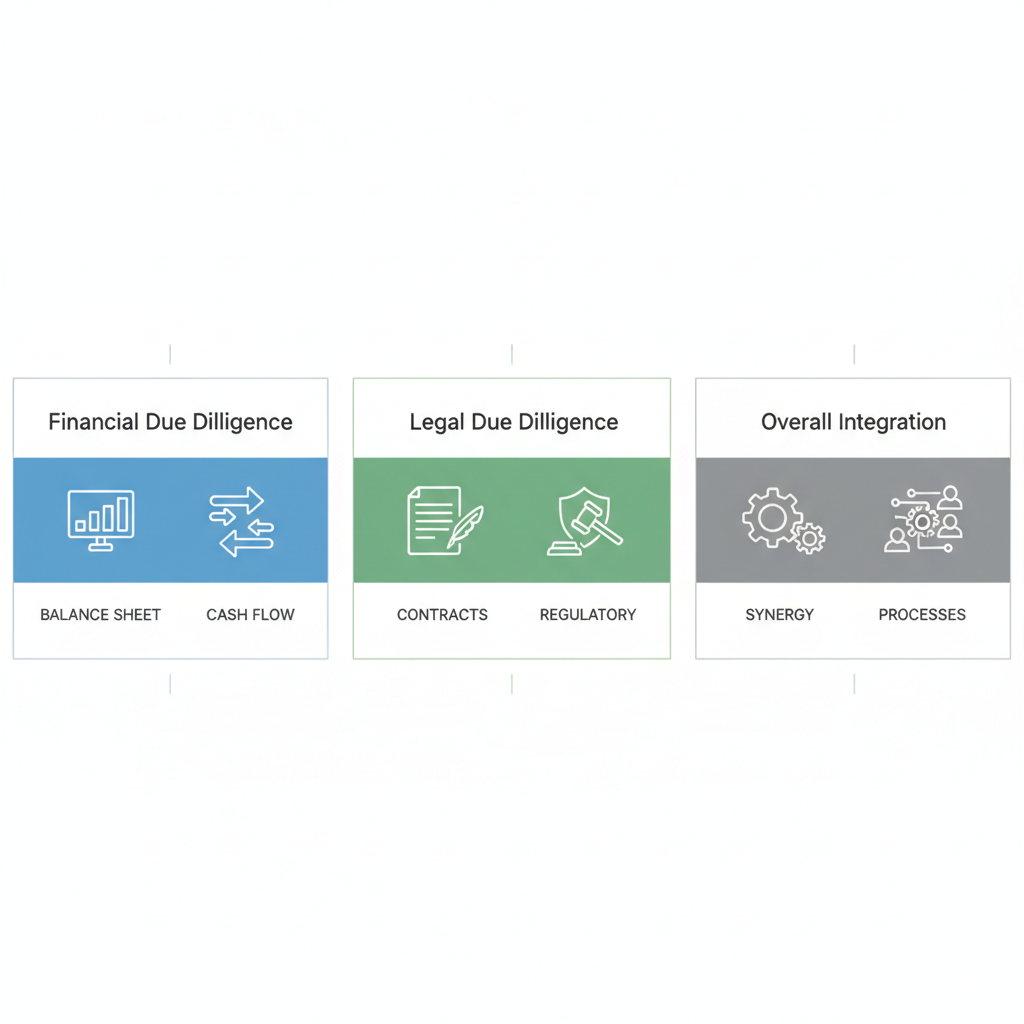
Visual overview of due diligence fundamentals in investment banking
Legal due diligence focuses on uncovering contractual pitfalls and regulatory hurdles that could impose liabilities. It covers litigation histories, intellectual property ownership, and adherence to laws like antitrust regulations. In one past engagement, thorough title reviews exposed encumbrances on key assets, prompting renegotiations. Essential steps include:
- Auditing material contracts for termination clauses.
- Conducting IP audits to confirm ownership.
- Reviewing regulatory filings for compliance gaps.
- Assessing litigation risks through docket searches and interviews.
Drawing from ABA insights on efficient M&A, this process coordinates with in-house teams to address gaps cost-effectively, fostering secure transactions.
At Zaidwood, we integrate these fundamentals into full-cycle mandates, blending financial and legal insights for streamlined advisory. This approach not only answers core queries on due diligence scopes but also prevents oversights, delivering robust outcomes for our clients in complex deals.
Deep Dive into Investment Bank Due Diligence Processes
At Zaidwood Capital, we specialize in Investment Bank Due Diligence, providing full-cycle advisory services that uncover risks and opportunities in mergers and acquisitions. Our M&a Due Diligence Services integrate financial and legal reviews to support clients across buy-side and sell-side mandates. Drawing from our network of over 4,000 investors and $24.4 billion in transaction volume, we ensure thorough in-depth transaction scrutiny tailored to complex deals.
Conducting Financial Due Diligence in M&A
We begin financial due diligence by granting access to virtual data rooms, where we gather historical financial statements, tax returns, and future projections. This data collection phase involves verifying the accuracy of balance sheets and income statements through ratio analysis, such as debt-to-equity and EBITDA margins, to normalize earnings and identify non-recurring items.
Next, we perform detailed analysis using tools like discounted cash flow models to validate revenue streams and assess working capital needs. For instance, in a hypothetical acquisition of a mid-sized tech firm, we would scrutinize customer contracts for recurring revenue stability while flagging any contingent liabilities. Banks coordinate with forensic accountants to detect discrepancies, ensuring projections align with market trends noted in governance analyses from sources like Harvard Law School Forum.
The process concludes with synthesis, where we prepare a comprehensive report highlighting valuation adjustments and synergy potentials. This step-by-step approach mitigates overpayment risks, adapting seamlessly for buy-side buyers seeking growth opportunities or sell-side sellers optimizing exit values. Our expertise streamlines these techniques, leveraging proprietary data for precise financial modeling.
Navigating Legal Due Diligence Frameworks
Legal due diligence starts with reviewing corporate documents, including articles of incorporation, bylaws, and title searches to confirm ownership structures. We conduct IP audits to verify patents and trademarks, alongside examinations of employment contracts for key personnel retention clauses and potential severance obligations.
Central to this phase is assessing regulatory compliance, such as antitrust filings under the Hart-Scott-Rodino Act and adherence to industry-specific rules like Dodd-Frank for financial institutions. In our review, we identify litigation risks by analyzing pending lawsuits and historical disputes, drawing insights from American Bar Association resources on strategic M&A transactions that emphasize minimizing liabilities through specialist engagement.
Banking compliance audits form a core element, where we evaluate material contracts for change-of-control provisions and ensure no undisclosed encumbrances. For a cross-border deal, this might involve scrutinizing international filings to avoid jurisdictional pitfalls. We coordinate with external counsel to draft risk memos, recommending mitigations like indemnification clauses. This framework protects clients by uncovering hidden legal exposures that could derail transactions.
Financial and legal due diligence often overlap in procedural synergies, where shared data rooms facilitate simultaneous reviews and expert consultations. This interconnected approach allows for holistic risk assessment, as financial projections must account for legal contingencies like ongoing compliance costs.
| Step | Financial Focus | Legal Focus |
|---|---|---|
| 1. Data Collection | Gather financial statements and projections | Collect contracts and filings; Review corporate documents |
| 2. Analysis | Validate revenues and identify discrepancies | Assess liabilities and compliance; Identify litigation risks |
| 3. Reporting | Prepare findings report with recommendations | Draft legal opinion on risks; Recommend mitigations |
This comparison underscores the complementary nature of these processes, where financial validation informs legal liability assessments. At Zaidwood Capital, we streamline them through our Velocity Matrix, integrating AI-assisted reviews and a dedicated team for efficiency, reducing timelines by up to 30% as seen in recent trends from Harvard analyses on bank M&A governance.
Integration of Processes for Comprehensive Analysis
We integrate financial and legal due diligence in full-cycle reviews by establishing cross-functional teams that synchronize findings from the outset. For example, revenue validations from financial analysis directly feed into legal contract reviews for enforceability, creating a unified risk profile.
In buy-side scenarios, we emphasize opportunity identification, while sell-side focuses on liability minimization. The table below highlights key adaptations:
| Aspect | Buy-Side Adaptation | Sell-Side Adaptation |
|---|---|---|
| Focus | Growth synergies and valuation upside | Clean title and maximum disclosure |
| Tools | Projections modeling with legal vetting | Compliance audits pre-report |
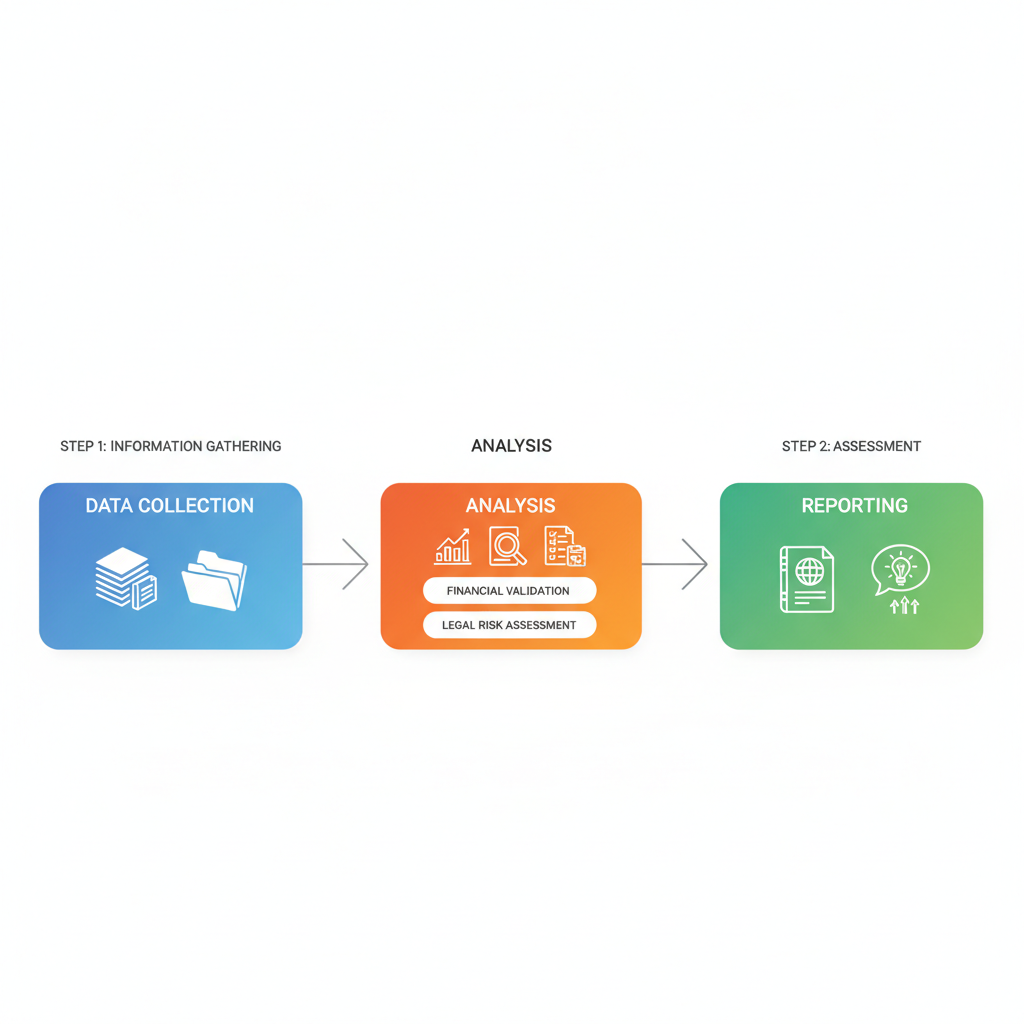
Three-step due diligence process for M&A advisory
Practical Insights on Due Diligence Implementation
At Zaidwood Capital, we emphasize practical implementation of investment bank due diligence to support informed M&A decisions. Our full-cycle due diligence services streamline the verification process for clients, ensuring thorough reviews of financial and legal aspects. This approach helps identify risks early, aligning with best practices from industry standards like those outlined by the CFA Institute.
Applying Financial Due Diligence Checklists
We begin financial due diligence by applying structured checklists that guide comprehensive audits of target companies during acquisitions. A key checklist includes reviewing balance sheets for asset valuations, assessing working capital adjustments, and normalizing revenue streams to exclude one-time gains. For instance, auditors verify accounts receivable aging and inventory turnover ratios to uncover potential overstatements.
| Finding Type | Financial Examples | Legal Examples |
|---|---|---|
| Overstated Assets | Inflated revenues from one-time gains | Pending lawsuits or contract breaches |
| Tax Issues | Unrecorded liabilities | Ownership conflicts |
Executing Legal Due Diligence in Practice
Executing legal due diligence requires a methodical checklist to navigate merger complexities and mitigate risks effectively. We start with corporate structure reviews, examining organizational documents, shareholder agreements, and governance protocols for compliance. Next, we assess regulatory approvals, including antitrust filings and industry-specific licenses, to ensure seamless integration.
Practical steps involve scrutinizing contracts for indemnities, termination clauses, and zoning restrictions that could impede operations. Common risks uncovered include IP ownership disputes or undisclosed litigation, which may necessitate escrow provisions or warranties in the purchase agreement. Merger compliance practices, informed by CFA best practices, emphasize title searches and litigation histories to protect buyer interests.
Throughout, financial services advisory plays a pivotal role in aligning legal findings with broader transaction objectives at Zaidwood Capital.
Real-World Timelines and Deliverables
In practice, investment bank due diligence timelines typically span 4-8 weeks, varying by deal complexity and side. Buy-side efforts often extend to 6-8 weeks for exhaustive reviews, while sell-side preparations compress to 4-6 weeks to maintain momentum.
| Aspect | Buy-Side Duration | Sell-Side Duration |
|---|---|---|
| Financial Review | 4-6 weeks | 3-5 weeks |
| Legal Review | 5-7 weeks | 4-6 weeks |
| Overall Process | 6-8 weeks | 4-6 weeks |
Advanced Strategies in Investment Bank Due Diligence
In the realm of Investment Bank Due Diligence, advanced strategies elevate the process beyond basic checks to uncover nuanced opportunities and risks in high-stakes mergers and acquisitions. At Zaidwood Capital, we employ sophisticated techniques to support institutional clients navigating complex deals. These approaches integrate cutting-edge financial modeling, cross-jurisdictional legal frameworks, and data-driven insights, ensuring comprehensive evaluations that drive value in today’s dynamic markets.
Advanced financial due diligence forms the cornerstone of our toolkit, incorporating scenario modeling and ESG integration to forecast outcomes under various economic conditions. We build intricate financial models that simulate stress tests, aligning with regulatory demands like those outlined in the Dodd-Frank Act. According to insights from the Harvard Law School Forum on Corporate Governance, effective risk management in M&A requires such strategic planning amid heightened supervisory scrutiny, a principle we uphold to mitigate uncertainties and optimize returns.
Shifting to legal due diligence, we address international nuances such as cross-border regulations and compliance with evolving standards like the Volcker Rule. Our strategic compliance reviews ensure seamless navigation of antitrust issues and disclosure requirements across jurisdictions. By delving into these layers, we help clients avoid regulatory delays, as highlighted in Harvard’s analysis of 2013 bank mergers, where thorough legal vetting proved essential for transformative outcomes.
| Aspect | Buy-Side Focus | Sell-Side Focus |
|---|---|---|
| Risk Assessment | Post-merger integration risks | Disclosure completeness for valuation maximization |
| Expert Involvement | Specialized financial modeling | Vendor due diligence reports for legal structuring advice |
This comparison underscores how buy-side efforts prioritize integration challenges, while sell-side focuses on transparent disclosures to bolster valuations. At Zaidwood Capital, our network of over 4,000 institutional investors provides unparalleled verification, enabling us to handle these complexities with precision. For example, in adaptive strategies involving debt advisory services, we integrate fairness opinions to validate terms, creating sustainable value.
Frequently Asked Questions on Due Diligence
1. What is the role of due diligence in investment banking? Due diligence verifies target company information, mitigating risks and informing valuation. We coordinate reviews to align with strategic goals, leveraging our network for efficient execution.
2. Why is financial due diligence important in investment banking? It uncovers revenue discrepancies, debt obligations, and cash flow issues, preventing overpayment. Our process ensures accurate financial modeling, protecting buyer interests.
3. What risks does legal due diligence reveal for buyers? Per American Bar Association insights, it identifies litigation, compliance gaps, and IP disputes. We engage specialists to minimize liabilities in strategic M&A.
4. What is a typical due diligence timeline? For midsize deals, it spans 4-8 weeks, depending on complexity. We streamline with external providers like ALSPs for timely, cost-effective results.
Key Takeaways on Investment Bank Due Diligence
- Fundamentals and Processes: Thorough financial due diligence evaluates assets, liabilities, and cash flows to ensure financial health.
- Legal Scrutiny: Legal due diligence verifies compliance, contracts, and regulatory adherence, mitigating litigation exposure.
- Risk Mitigation and Value Creation: These core banking safeguards identify synergies and operational efficiencies, driving post-merger success.
At Zaidwood Capital, our $24.4B in transaction experience underscores full-cycle advisory strengths. As the Harvard Law School Forum notes on M&A governance, ongoing regulatory adaptation remains vital for financial institutions’ thriving. Explore our capital advisory services to navigate your next mandate.
Resources


