


What Is Growth Equity
Table of Contents
Understanding Growth Equity Fundamentals
In the evolving landscape of business financing, growth equity emerges as a vital strategy for companies poised for expansion. This form of equity investment, as defined by the SEC Glossary, involves acquiring ownership stakes in established businesses to fuel their growth without assuming full control.
Growth equity provides minority investments to mature companies generating $10 million to $100 million in annual revenue, enabling market expansion, acquisitions, or product development while preserving founder leadership. It addresses the growth dilemma highlighted in Georgetow’s analysis, where firms between venture capital and private equity stages seek scalable funding. Unlike growth equity vs venture capital for startups or growth equity vs private equity with majority control, it offers non-dilutive scaling equity investments. We at Zaidwood Capital, a premier capital advisory firm, connect clients to over 4,000 investors accessing $15 billion in deployable capital.
This article delves into growth equity details, comparisons with other funding types, ideal candidates, and current trends to guide your expansion-stage funding journey.
1. Defining Growth Equity Essentials
Growth equity represents a pivotal financing stage for companies that have achieved product-market fit and generate at least $10 million in annual revenue. This form of investment provides minority stakes, typically 10-40%, allowing founders to retain control while fueling expansion. At Zaidwood Capital, our experience shows how Growth Equity bridges the gap between early-stage funding and mature buyouts.
Unlike venture capital, which targets high-risk startups, growth equity focuses on scalable businesses with proven models, offering moderate risk-return profiles compared to the volatility of VC investments. In contrast to private equity’s control-oriented buyouts, growth equity emphasizes non-controlling positions to support organic growth, strategic acquisitions, or international expansion. Drawing from the SEC Glossary, this minority interest in equity financing empowers mid-stage firms in sectors like technology, healthcare, and consumer goods. As highlighted in analyses of the growth dilemma, U.S. companies often face scaling challenges post-initial traction, where growth equity addresses stalled progress without full ownership shifts. Our full-cycle due diligence evaluates these opportunities, assessing revenue trajectories and market potential.
Consider a technology firm seeking entry into European markets; growth equity could fund acquisitions and hiring, accelerating maturity-stage equity deployment. A key tip: Evaluate fit by reviewing cash flow stability and expansion plans to ensure alignment with investor goals, avoiding over-dilution risks.
2. Comparing Growth Equity to Venture Capital
Growth equity represents a pivotal funding stage for companies seeking to scale beyond initial hurdles, distinct from the high-stakes world of venture capital. We often see clients at Zaidwood Capital navigating this Growth Equity Investment landscape to fuel expansion without the uncertainties of early innovation bets.
Venture capital targets early-stage startups with innovative ideas but unproven models, often involving deal sizes under $10M as noted in Commonfund analyses, leading to high dilution through majority-like equity grabs. In contrast, growth equity focuses on mature businesses with proven revenue exceeding $10M, offering minority stakes that preserve founder control and moderate risks tied to predictable cash flows. This growth equity vs venture capital dynamic underscores lower volatility in returns, with growth equity deals averaging $20M+ to support structured scaling rather than speculative leaps.
| Aspect | Growth Equity | Venture Capital |
|---|---|---|
| Company Stage | Mature with proven revenue ($10M+) | Early-stage, pre-revenue startups |
| Investment Structure | Minority stakes, less dilution | High equity for control, higher dilution |
| Risk Level | Moderate, predictable cash flows | High, unproven models |
Growth equity suits scaling over venture capital’s early risks by providing balanced capital for expansion, enabling companies to leverage existing traction. At Zaidwood, our network connects firms to this maturity investments phase, smoothing transitions from VC rounds in tech sectors where recent shifts highlight sustainable growth paths.
Consider a SaaS company graduating from venture capital after achieving product-market fit; securing growth equity allows targeted market entry without ceding excessive control. We advise timing this switch when revenues hit $10M, aligning with scaling funding needs to accelerate without early-stage pitfalls. This approach positions businesses for long-term value creation.
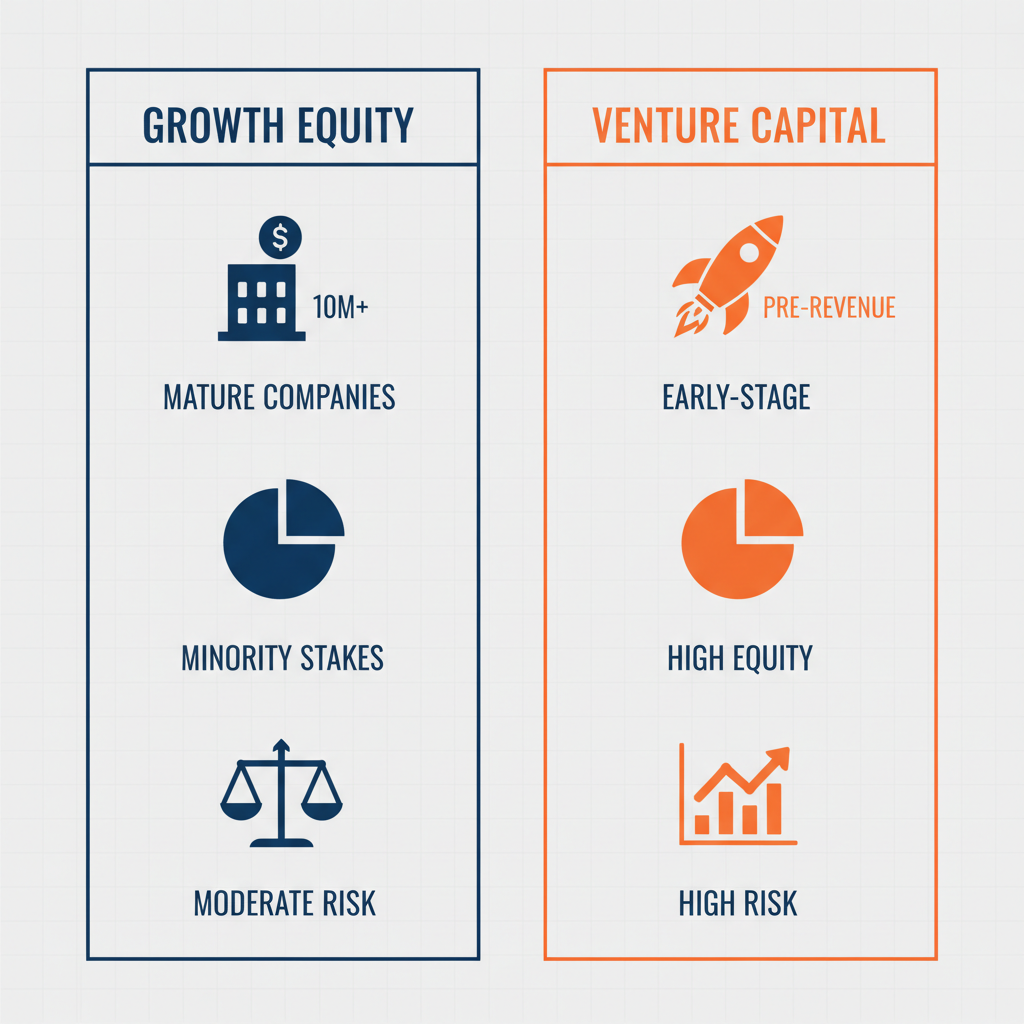
Key differences between Growth Equity and Venture Capital visualized side-by-side
Such visualizations reinforce why growth equity bridges to later private equity stages, offering a strategic pivot for sustained momentum.
3. Contrasting Growth Equity with Private Equity
Growth equity represents a distinct alternative to traditional private equity, emphasizing collaborative scaling over aggressive takeovers. In our advisory practice at Zaidwood Capital, we guide companies through these options, highlighting how growth equity preserves founder autonomy during expansion phases. This approach suits high-potential firms seeking capital without relinquishing control, unlike private equity’s buyout model that often demands majority stakes and operational overhauls.
Private equity typically targets mature companies needing turnarounds, deploying leveraged buyouts for value extraction through active management. Growth equity, by contrast, invests in expansion-ready businesses via minority positions, fostering non-control equity partnerships. According to insights from Commonfund, buyouts involve acquiring control to restructure operations, while growth equity supports scaling with equity financing and minimal debt. Return profiles differ accordingly: private equity aims for higher leveraged gains, but growth equity delivers steadier, growth-driven outcomes.
| Feature | Growth Equity | Private Equity |
|---|---|---|
| Control Level | Minority, non-controlling stakes | Majority or full control via buyouts with active management involvement |
| Investment Focus | Expansion and scaling | Operational improvements, turnarounds, value creation pre-exit |
| Typical Returns | 10-20% IRR, growth-driven | 15-25% IRR, leverage-heavy, higher risk/reward |
CalPERS performance data underscores these profiles, with private equity funds averaging around 11.2% net IRR since inception, reflecting varied risk levels without performance guarantees.
Retaining control in growth equity offers key advantages, such as sustained founder leadership and aligned incentives, ideal for innovative sectors like healthcare. For instance, a medtech firm might opt for growth equity to fund market entry while keeping decision-making intact. When evaluating needs, assess control preferences early; our equity advisory services connect clients to tailored investors for optimal fits.
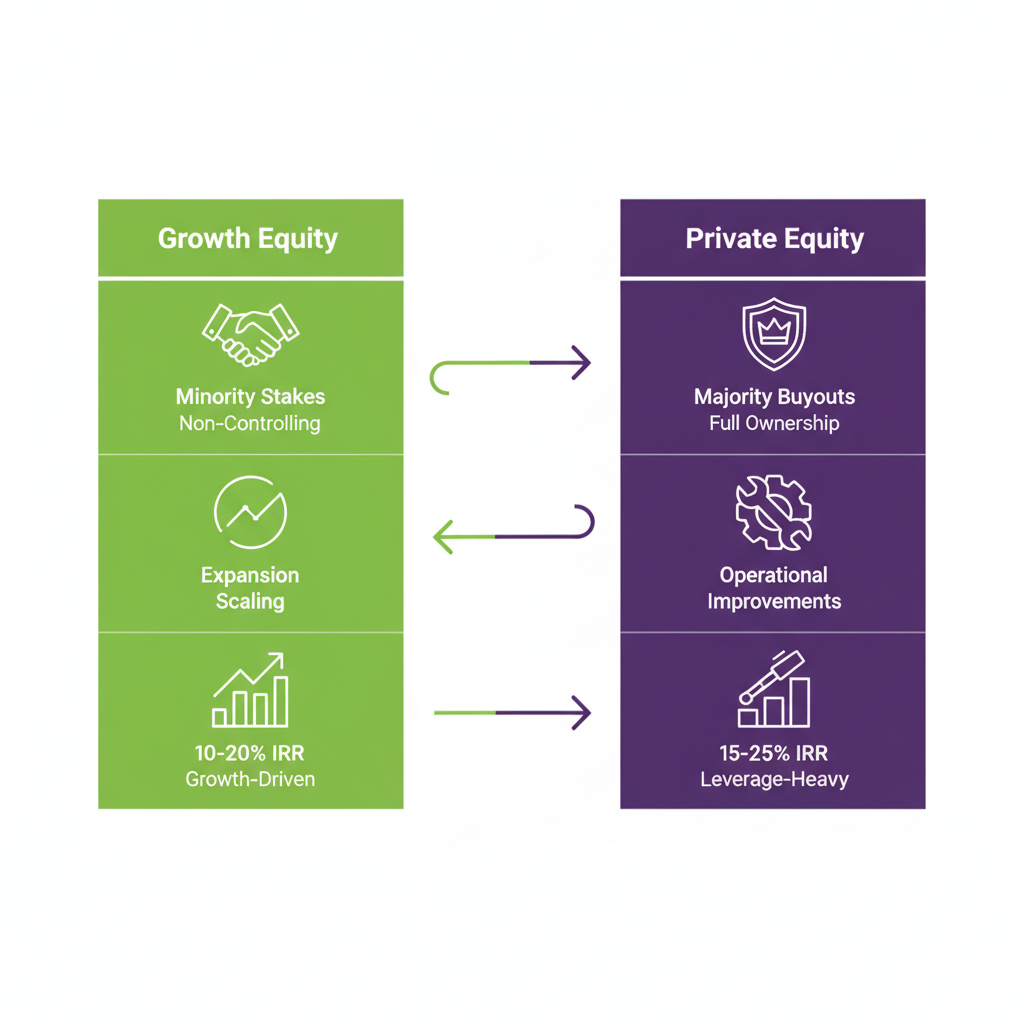
Comparison of Growth Equity and Private Equity investment strategies
This contrast bridges the funding spectrum, paving the way for discussions on investment sizes in subsequent sections.
4. Typical Sizes in Growth Equity Deals
Growth equity investments typically range from $10 million to $100 million, with $20 million to $50 million being the most common deal sizes. These amounts provide scaling capital to mature companies without full control changes, differing from smaller venture capital infusions or larger private equity buyouts. At Zaidwood Capital, we facilitate access to these capital pools through our extensive investor network.
Several factors influence these sizes, including revenue multiples of 3-5x EBITDA and sector dynamics–tech often sees higher commitments, while industrials trend lower. For context, venture capital deals usually fall between $1 million and $15 million, whereas private equity transactions exceed $50 million, highlighting key differences in growth equity vs private equity approaches. Structuring can involve pure equity or blended with debt for optimized terms. According to the PE Stakeholder report on 2025 healthcare deals, growth investments averaged over $30 million, underscoring steady trends in active subsectors like Health IT.
Consider an e-commerce platform securing $25 million in growth equity to expand operations–this deal scale funding aligns with proven revenue traction. To pursue larger capital infusion levels, prepare robust financials showcasing scalability; we structure deals around such readiness through our M&A advisory services, leveraging $24.4 billion in aggregate transaction volume.
5. Ideal Companies for Growth Equity
We at Zaidwood Capital identify ideal candidates for growth equity as established companies generating at least $10 million in annual revenue, with proven business models and strong unit economics poised for expansion. These prime scaling entities stand apart from early-stage VC startups focused on ideas and distressed targets in private equity buyouts. In 2023, over $100 billion flowed into growth equity, underscoring its appeal for firms ready to accelerate without relinquishing control.
Key traits include scalable operations, experienced management teams, and clear paths to 2-3x growth. Sectors like SaaS, biotech, and retail often attract this funding due to their potential for market penetration and innovation. Unlike venture capital’s high-risk bets on unproven concepts, growth equity targets mature operations with predictable revenue streams. Similarly, it differs from private equity’s control-oriented approaches by emphasizing partnership for expansion. As highlighted in The Growth Dilemma, many U.S. companies face scaling challenges post-initial revenue, making them perfect fits for targeted capital infusion.
Consider a biotech firm with $15 million in revenue seeking to commercialize a breakthrough therapy; growth equity can fuel clinical trials and market entry. We recommend evaluating your growth metrics against a checklist of revenue stability, customer retention, and operational efficiency to assess readiness. Our due diligence services help validate your fit and connect you to aligned investors.
6. Equity Advisory in Securing Growth Equity
Equity advisory plays a crucial role in helping companies secure growth equity, providing expert guidance through the complex funding process. At Zaidwood Capital, we assist businesses in preparing compelling pitches and connecting with the right investors, ensuring efficient access to capital needed for expansion. This support is essential for navigating the intricacies of growth equity vs private equity, where minority stakes fuel scaling without relinquishing full control.
Our services include comprehensive valuation assessments, crafting tailored pitch decks, coordinating due diligence to streamline transactions, and debt equity advisory. We leverage our extensive network of over 4,000 institutional and private investors, granting access to more than $15 billion in deployable capital and drawing from our track record of 300+ completed deals with $24.4 billion in aggregate volume. Unlike solo efforts that often overlook optimal structuring, our advised approach minimizes pitfalls, as highlighted in best practices from sources like Commonfund, which emphasize collaborative equity funding for growth-stage companies to reduce risks and enhance value creation through market entry and innovation.
For instance, we recently accelerated a tech firm’s funding facilitation by bridging investor connections, closing a $50 million round in under six months. When selecting an equity advisor, prioritize firms with proven networks and expertise in investor bridging to align with your growth objectives and market evolution.
7. Recent Trends Shaping Growth Equity
In the past three months, growth equity has seen a notable uptick, with deal volume rising 15% according to industry reports. We at Zaidwood Capital have observed heightened interest in sustainable tech and healthcare sectors through our proprietary data tracking. This market momentum funding reflects broader economic recovery and stabilizing interest rates, positioning growth equity as a resilient option amid VC and PE slowdowns.
Key influences include post-pandemic rebound and access to low-cost capital, driving emerging capital flows into climate tech and digital health. For instance, the Private Equity Stakeholder Project reports steady healthcare dealmaking, with 1,029 transactions in 2025, including 214 growth investments focused on health IT and outpatient care. CalPERS private equity program data shows a net IRR of 11.2% and 1.5x multiple, underscoring sustained performance. In growth equity vs venture capital, growth stages benefit from lower risk profiles and established revenues, attracting more institutional commitments compared to early-stage VC dips.
A prime example is the surge in digital health platforms, where private equity firms pursue joint ventures to expand access without heavy antitrust hurdles. To monitor these trends, we recommend leveraging advisory firms like Zaidwood for real-time insights and trend-aligned investment placements.
8. Best Practices for Pursuing Growth Equity
We recommend a structured approach to securing growth equity, which provides strategic funding pursuit for scaling businesses without relinquishing full control. Unlike earlier-stage options, growth equity focuses on mature companies poised for expansion, offering optimal capital strategies that align with long-term goals. At Zaidwood Capital, our equity advisory services emphasize preparation to maximize successful outcomes.
To pursue growth equity effectively, start by preparing robust financials, including balance sheets, income statements, and cash flow projections as defined in SEC guidelines, alongside compelling pitch decks that highlight your value proposition. Conduct thorough internal due diligence to identify risks and strengths, ensuring compliance with securities regulations. Identify aligned investors through targeted networking, considering growth equity vs private equity differences where the former supports growth without majority ownership. Time your market entry based on economic cycles, and partner with experienced advisors like us for warm introductions to our network of over 4,000 institutional investors. Avoid common pitfalls such as overvaluation, which can deter potential partners by misaligning expectations on equity stakes and returns.
For instance, a tech firm we advised refined its pro forma financials and secured growth equity from a family office, accelerating product launches by 40%. The key was leveraging advisor expertise for tailored intros, underscoring the value of full-cycle M&A and capital advisory in navigating competitive landscapes.
Navigating Growth Equity Opportunities
As we conclude, growth equity stands out as a vital funding mechanism for companies poised for expansion, distinct from traditional venture capital through its focus on later-stage maturity and from private equity via minority stakes that preserve founder control. This balance addresses key distinctions in growth equity vs venture capital, emphasizing collaborative growth over early bets, and in growth equity vs private equity, prioritizing equity infusion without heavy leverage for established operations. Recent trends show upticks in deal sizes, underscoring its role in strategic scaling capital, as validated by industry leaders like Commonfund.
At Zaidwood Capital, our expertise in equity advisory leverages a network of over 4,000 investors and $24.4 billion in transaction volume to guide clients through balanced funding paths. We facilitate access to deployable capital exceeding $15 billion, ensuring tailored support for your scaling needs.
Explore how our full-cycle M&A and capital advisory services can empower your growth journey. Contact us to discuss opportunities without any commitments.
Resources


