

Table of Contents
- Navigating Professional Employer Organizations for Business Growth
- Fundamentals of Professional Employer Organizations
- Key Advantages of Implementing a PEO Solution
- Co-Employment Mechanics in PEO Partnerships
- Selecting and Implementing Your Ideal PEO Provider
- Strategic Insights for PEO-Driven Business Success
Navigating Professional Employer Organizations for Business Growth
In today’s competitive landscape, small businesses often grapple with complex HR demands that divert focus from core operations. A Professional Employer Organization (PEO) emerges as a vital HR outsourcing partner, adopting a co-employment model where the provider manages essential functions like payroll, benefits, and compliance. This arrangement allows business owners to access enterprise-level resources without the overhead of an in-house HR department.
For small businesses, including those in sectors like restaurants facing seasonal staffing fluctuations, a PEO for small businesses or a PEO for restaurants can alleviate administrative burdens significantly. Restaurant owners, for instance, benefit from streamlined payroll during peak seasons, ensuring compliance with labor laws while maintaining cash flow. At Zaidwood Capital, we integrate PEO evaluation into our strategic consulting services, helping clients align HR outsourcing with broader capital strategies for sustainable growth. Industry trends, as detailed in the HR outsourcing guide from SHRM, show that a substantial portion of small businesses—approximately 40%—adopt PEOs to enhance compliance and efficiency.
This introduction sets the foundation for exploring PEO fundamentals, benefits, operational mechanics, and selection criteria in the sections ahead, empowering business owners to make informed decisions.
Fundamentals of Professional Employer Organizations
We recommend that businesses exploring HR solutions begin with a solid understanding of Professional Employer Organizations (PEOs) and how they integrate into operational strategies. This foundational knowledge enables leaders to evaluate options effectively, particularly when aligning with comprehensive advisory services like those offered by Zaidwood Capital for due diligence and financial planning.
Defining PEO and Co-Employment Models
A Professional Employer Organization (PEO) represents a form of professional employment outsourcing where the PEO enters into a co-employment arrangement with client businesses. In this model, the PEO assumes responsibility as the employer of record for administrative HR functions, such as payroll processing, benefits administration, and tax compliance, while the client retains control over day-to-day employee management and operations. This differs from traditional HR outsourcing, which typically involves third-party providers handling specific tasks without altering employment status.
Co-employment distinguishes itself from joint employment by focusing on shared administrative duties rather than operational control. Under IRS and Department of Labor (DOL) guidelines, co-employment ensures that the PEO and client company have clearly delineated roles, reducing the risk of misclassification issues. For instance, the PEO manages workers’ compensation filings and ensures adherence to federal regulations, allowing small businesses to mitigate compliance burdens.
Client responsibilities include hiring, firing, and directing work, while the PEO handles:
- Payroll and tax withholdings
- Employee benefits enrollment
- Regulatory reporting
The PEO assumes:
- HR administration and compliance oversight
- Risk management for employment practices
- Benefits negotiation with carriers
Addressing common misconceptions, liability in co-employment is shared based on control, but the PEO’s expertise often shields clients from direct exposure, as supported by PEO advantages disadvantages analyses showing up to 30% risk reduction in compliance violations. Zaidwood FAQ resources highlight real-world structures where this model enhances stability without eroding client autonomy.
PEO Applicability for Small Businesses and Specific Industries
PEO for small businesses proves invaluable for those lacking internal HR infrastructure, enabling access to Fortune 500-level benefits like comprehensive health plans and retirement options at scaled rates. This HR co-employment solutions approach streamlines operations, allowing owners to focus on growth rather than administrative hurdles. For companies with fewer than 50 employees, PEOs address challenges like fluctuating payroll and regulatory navigation, fostering scalability.
In industries with unique HR needs, such as hospitality, PEO for restaurants offers tailored support for variable staffing patterns common in seasonal or shift-based environments. Restaurants often face high turnover and compliance demands around overtime and safety standards; a PEO can centralize these functions, reducing administrative costs by 20-40% according to industry benchmarks. For example, a mid-sized diner chain might use a PEO to manage seasonal hires’ benefits without disrupting cash flow, ensuring DOL compliance during peak periods.
Other sectors, like construction or retail, benefit similarly from PEOs handling workers’ compensation in high-risk settings. We at Zaidwood Capital integrate PEO due diligence into our full-cycle advisory, evaluating providers to align with strategic financial planning and optimize outcomes for mid-market clients navigating these transitions.
Initial Cost Considerations in PEO Adoption
Adopting a PEO involves pricing structures typically based on a percentage of gross payroll, ranging from 2-10% depending on services selected and company size. This model covers comprehensive HR outsourcing, including payroll, benefits, and compliance, with administrative service-only options at the lower end for basic needs. Factors influencing costs include employee count, industry risk profile, and benefit complexity; for instance, high-deductible health plans may lower premiums through PEO bargaining power.
Small businesses often see the highest value in bundled packages, where economies of scale yield savings on individual components like 401(k) administration, potentially offsetting fees entirely via reduced internal overhead. Zaidwood FAQ insights note that initial setup fees, averaging $500-$2,000, cover contract customization, but ongoing costs correlate with payroll volume—e.g., a $1 million annual payroll at 4-6% equates to $40,000-$60,000 yearly.
To address ‘How much does a PEO typically cost for HR outsourcing?’, consider variables like geographic location and customization; we recommend thorough vendor evaluation during due diligence to ensure alignment with financial goals, avoiding hidden fees in termination clauses or add-on services.
Key Advantages of Implementing a PEO Solution
Small businesses often face challenges in managing HR functions effectively, but partnering with a Professional Employer Organization (PEO) can transform these operations. Our clients at Zaidwood Capital frequently see how a PEO delivers substantial value by streamlining administrative burdens and enhancing employee satisfaction. From cost reductions to regulatory peace of mind, the advantages are clear and measurable, particularly for sectors like restaurants where seasonal demands add complexity.
Enhanced Benefits and Payroll Efficiency
Statistics show that businesses using outsourced HR benefits save up to 27% on employee packages through group purchasing power. PEOs handle payroll processing with automated systems, ensuring accurate tax filings and direct deposits while minimizing errors that plague manual methods. This efficiency extends to benefits administration, where employer of record services provide access to comprehensive health, dental, and retirement plans at rates unattainable for small firms individually.
For instance, a restaurant chain might leverage these services to offer competitive perks during peak hiring seasons, boosting retention without inflating overhead. We have observed clients reduce administrative time by 50%, allowing teams to prioritize customer service over paperwork. This streamlined approach not only cuts costs but also elevates overall workforce morale through reliable, high-quality benefits.
Compliance and Risk Mitigation Benefits
Regulatory compliance represents a major hurdle for small businesses, with non-adherence potentially leading to fines exceeding $10,000 per violation according to SHRM data. PEOs mitigate these risks by assuming co-employment responsibilities, including workers’ compensation claims and adherence to DOL and IRS guidelines. Through regular updates and expert audits, they shield clients from evolving labor laws, transferring much of the liability away from the business owner.
In practice, this means fewer sleepless nights worrying about audits or lawsuits. For a growing restaurant operation, a PEO ensures seasonal staff onboarding complies with wage and hour rules, avoiding costly penalties. Our advisory work at Zaidwood integrates these protections, helping firms navigate complexities with confidence and focus on sustainable expansion rather than legal pitfalls.
Comparing PEO models to traditional in-house HR highlights why many small businesses opt for outsourcing. This evaluation underscores efficiencies in time, cost, and risk, enabling informed decisions tailored to operational needs.
| Benefit Category | PEO Model | In-House HR | Impact on Small Businesses |
|---|---|---|---|
| Payroll Administration | Automated processing with expert oversight | Manual handling prone to errors | Reduces errors by 80%; saves 20-30 hours/month |
| Benefits Access | Group rates for comprehensive plans | Limited individual negotiations | Lowers costs by 10-20%; attracts top talent |
| Compliance Support | Shared liability and updates | Full client responsibility | Mitigates fines; ensures DOL/IRS alignment |
The table illustrates PEOs’ clear edges in automation and shared expertise, particularly in cost savings and risk reduction. For small businesses, these wins translate to financial stability and operational agility, as supported by SHRM insights on reduced error rates and compliance burdens.
Such comparisons reveal how PEOs empower firms to allocate resources strategically, fostering long-term resilience without the pitfalls of internal management.
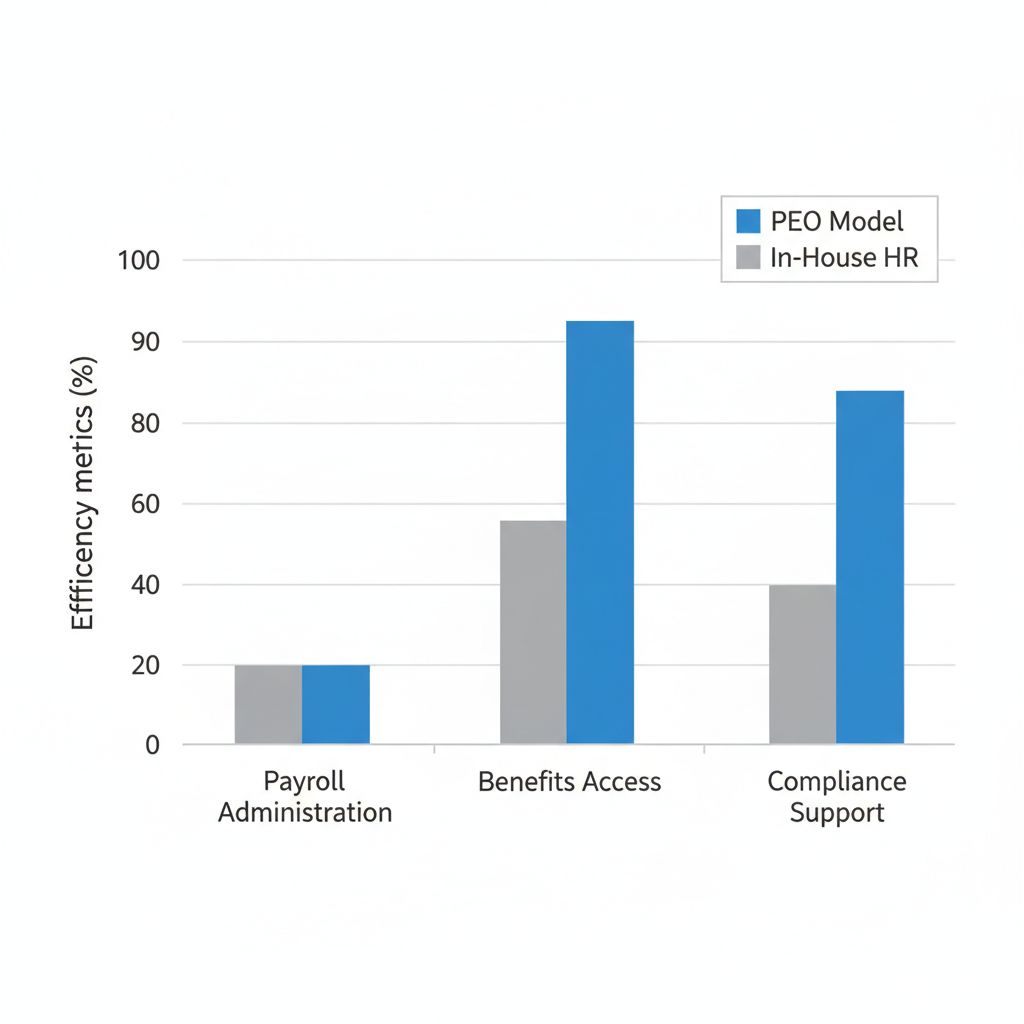
PEO model benefits versus in-house HR efficiency comparison chart
This visual reinforces the tangible gains, showing PEO superiority across key metrics and aiding stakeholders in assessing fit for their unique challenges.
Strategic Growth Support Through HR Outsourcing
By offloading HR tasks, PEO for small businesses unlocks time for core activities, with studies indicating up to 50% faster employee onboarding. This outsourcing allows leaders to concentrate on revenue-generating strategies, such as menu innovation or market expansion in competitive sectors. Zaidwood Capital’s advisory services complement this by aligning PEO selections with financial due diligence, ensuring seamless integration for optimal growth trajectories.
Consider a restaurant utilizing PEO for restaurants to manage variable staffing during holidays; compliance and payroll automation free up resources for targeted investments. We assist clients in evaluating PEO selection questions to match solutions with business goals, enhancing scalability. Ultimately, this partnership drives efficiency and positions firms for accelerated development without HR distractions.
Co-Employment Mechanics in PEO Partnerships
In the joint employer model, a professional employer organization (PEO) steps in as a co-employer for administrative purposes, allowing small businesses to leverage expert HR support while retaining operational control. This HR administration partnership streamlines compliance and efficiency, particularly for sectors like restaurants facing variable staffing needs. We guide clients through these mechanics to ensure seamless adoption.
Daily Operations and Shared Responsibilities
Under co-employment, clients maintain authority over core functions such as hiring, firing, and day-to-day management, while the PEO assumes responsibility for administrative HR tasks. This division fosters a collaborative framework where businesses focus on growth without the burden of routine compliance.
Key shared responsibilities include:
- Employee Relations: Clients handle performance evaluations and disciplinary actions, but PEOs provide policy templates and training resources to align with legal standards.
- Recordkeeping and Reporting: PEOs manage employee files, benefits documentation, and regulatory filings, ensuring accuracy across federal and state requirements.
- Risk Management: While clients oversee workplace safety, PEOs conduct audits and offer liability insurance coverage to mitigate shared exposures.
For PEO for small businesses, this model reduces administrative overhead by up to 30%, according to industry benchmarks, allowing owners to prioritize strategic initiatives. In practice, a restaurant chain might delegate shift scheduling documentation to the PEO while directing daily operations, illustrating the balance in daily workflows.
Payroll and Benefits Implementation Process
The payroll and benefits process begins with contract signing, followed by a structured onboarding phase to integrate employee data securely. PEOs handle the complexities of remittance, W-2 issuance, and benefits negotiation, ensuring timely execution.
Implementation unfolds in these steps:
- Data Migration: Transfer employee records, including hours and deductions, within 2-4 weeks, addressing transition challenges like legacy system compatibility.
- Payroll Cycles: PEOs process bi-weekly or shift-based runs, remitting taxes and direct deposits; for PEO for restaurants, this accommodates variable hours from tipped staff.
- Benefits Enrollment and Compliance: Enroll in group plans negotiated at scale, monitor ACA and FLSA adherence, and generate quarterly reports.
Drawing from compliance workflows, setup timelines average 45 days, as noted in Zaidwood’s resources, enabling quick stabilization. A restaurant example involves syncing point-of-sale data for accurate overtime calculations, demonstrating practical efficiency without disrupting service.
Integration with Business Advisory Services
Zaidwood Capital enhances PEO operations by aligning them with broader financial strategies, including debt advisory to support capital planning for HR expansions. Our expertise ensures PEO adoption complements funding needs, such as financing workforce growth during mergers.
This integration involves:
- Strategic Assessment: Evaluate PEO fit against business goals, identifying synergies with cash flow projections.
- Customized Execution: Coordinate onboarding with financial modeling to optimize costs, leveraging our network for tailored solutions.
- Ongoing Monitoring: Track PEO performance metrics alongside advisory benchmarks for sustained alignment.
By citing process efficiencies from our FAQ resources, we highlight how advisory integration reduces setup frictions, fostering long-term operational success. For instance, a small restaurant group might pair PEO implementation with debt structuring to fund seasonal hiring, showcasing our role in holistic guidance.
Selecting and Implementing Your Ideal PEO Provider
Choosing the right professional employer organization (PEO) can streamline HR functions for small businesses, allowing focus on core operations like growth in the restaurant sector. At Zaidwood Capital, we guide clients through this process, ensuring selections align with strategic objectives such as capital efficiency and compliance. This section outlines key evaluation steps, implementation tactics, and the value of expert advisory support to maximize PEO benefits.
Essential Questions for PEO Evaluation
When evaluating PEO options, asking targeted questions reveals alignment with your business needs. We recommend focusing on costs, services, customization, and support to make informed HR provider selection decisions.
- What is your pricing model, including payroll percentages and setup fees? Understanding transparent structures prevents hidden expenses that affect cash flow.
- How do you handle compliance with industry regulations, such as labor laws for restaurants? This ensures risk mitigation in dynamic sectors.
- Can services be customized for small businesses, like benefits packages tailored to seasonal staffing?
- What level of customer support is available, including dedicated account managers?
- How does your technology platform integrate with existing systems for seamless payroll and benefits management?
- What experience do you have with PEO for small businesses in similar industries?
- How do you measure success, such as error rates in payroll processing?
These questions, drawn from SHRM recommendations, help prioritize providers that offer robust, scalable solutions. For instance, a PEO with strong compliance expertise can reduce legal exposures, a critical factor for operations in regulated environments.
The following table compares key selection criteria, emphasizing priorities for small enterprises:
| Criteria | Key Considerations | Importance for Small Businesses | Zaidwood Advisory Input |
|---|---|---|---|
| Cost Structure | Payroll percentage, setup fees | High – impacts cash flow | Due diligence on transparent pricing |
| Compliance Expertise | Experience with industry regs | Critical for risk avoidance | Integration with financial planning |
| Technology Platform | User-friendly payroll/benefits portals | Essential for efficiency | Custom solutions via consulting |
Based on SHRM white papers and our FAQs, this framework highlights how cost and compliance weigh heavily for resource-constrained firms. Post-selection, applying these insights through customized vetting ensures the PEO supports long-term viability without straining budgets.
Transitioning from evaluation, effective implementation solidifies these choices. By addressing potential challenges early, businesses can achieve smoother HR outsourcing implementation and measurable improvements in operational efficiency.
Implementation Strategies for Success
Successful PEO deployment requires structured phases to minimize disruptions. We assist clients in PEO for small businesses by outlining assessment, contract negotiation, transition, and ongoing review.
Begin with an internal assessment: Map current HR processes and identify pain points, such as payroll delays in high-volume restaurant settings. Next, negotiate contracts that include clear service-level agreements on response times and error resolution.
During transition, co-manage payroll for 1-2 cycles to verify accuracy, aiming for error rates below 1%. Train staff on the new platform to foster adoption. For ongoing management, schedule quarterly reviews to track metrics like cost savings and employee satisfaction.
Tips for restaurant-specific customizations include flexible benefits for shift workers and integration with scheduling software. Annual renewals offer opportunities for optimization, ensuring the PEO evolves with business growth. Integrating these steps with broader financial strategies enhances overall resilience.
Leveraging Advisory Expertise in PEO Choices
Expert guidance elevates PEO decisions from transactional to strategic. At Zaidwood Capital, our consulting role encompasses full-cycle due diligence in provider vetting, from initial screening to contract analysis, drawing on insights from our post resources.
We help align PEO selections with capital objectives, such as using debt advisory for funding expansions while outsourcing HR. For PEO for restaurants, this means compliance strategies that support scalable operations without diluting focus on revenue growth.
Our approach includes risk assessments and performance benchmarking, ensuring providers meet benchmarks like those in SHRM frameworks. By partnering with us, small enterprises gain tailored recommendations that integrate HR efficiencies with financial planning, fostering sustainable success. This advisory layer not only addresses immediate needs but also positions businesses for future opportunities in competitive markets.
Strategic Insights for PEO-Driven Business Success
In summary, a PEO represents a powerful solution for businesses seeking streamlined HR management through co-employment models that handle payroll, benefits, and compliance responsibilities. Key benefits include significant cost savings—often 20-30% on administrative overhead—and enhanced regulatory adherence, allowing companies to focus on growth. By leveraging these services, organizations mitigate risks while accessing expert talent management without building internal teams.
Co-employment operates seamlessly, with the PEO acting as the employer of record for administrative duties, while businesses retain control over day-to-day operations. Best practices for selection involve evaluating provider expertise, technology integration, and scalability to match specific needs. For PEO for small businesses and PEO for restaurants, these solutions prove particularly vital in navigating labor-intensive environments and seasonal fluctuations. At Zaidwood Capital, we integrate PEO strategies with our full-cycle advisory services, including emerging markets M&A, to support outsourcing for scalability and strategic HR partnerships that fuel expansion. As highlighted in our resources, such integrations can yield overall efficiency gains of up to 25%, underscoring our expertise in compliance and growth.
We invite you to explore how these insights can transform your operations—reach out for a tailored consultation at your convenience. Looking ahead, evolving HR landscapes demand adaptive approaches; partnering with us ensures your business thrives amid change.
This website is for informational purposes only and is not an offer, solicitation, recommendation, or commitment to transact. Not investment advice—consult your legal, tax, and financial advisors before making decisions.
Resources
- Explore Emerging Markets M&A Opportunities with Zaidwood Capital
- Get Expert Debt Advisory for Growth and M&A Funding
- Understand Debt vs Equity Advisory for Optimal Capital Choice
- Leverage Debt Advisory for Efficient M&A Funding Solutions
- Discover Top US Private Equity Firms and Strategies
- Secure Capital with Boutique US Debt Advisory Expertise
- Implement Advanced Debt Advisory Strategies for 2026 M&A
- Evaluate PEO Advantages and Disadvantages for HR Management
- Ask These 5 Questions to Select the Right PEO
- Guide to Effective HR Outsourcing Strategies and Management