

Table of Contents
The Critical Role of AI Due Diligence in Modern M&A
AI due diligence in M&A has become the strategic linchpin of modern dealmaking. As transaction volumes surge and data complexity multiplies, traditional manual reviews not only risk missing critical risks but also prolong timelines that sellers and buyers can no longer afford.
Today’s M&A environment demands analytic depth that legacy checklists can’t match. AI-powered due diligence scans thousands of contracts, financials, and operational data points to surface hidden liabilities, validate assumptions, and compress weeks of analysis into hours—turning information asymmetry into a decisive advantage.
As a Boutique M&A and Capital Advisory Firm, our M&A advisory services layer human judgment with proprietary data analytics and an AI-enhanced deal-matching engine refined across 300+ transactions. Yet no technology can substitute for the groundwork that precedes it—that hands-on preparation is where we turn next.
Essential Preparations for AI Due Diligence
Once the critical role of AI due diligence is clear, buyers must translate that insight into concrete action. At Zaid Wood Capital, our Full-Cycle M&A advisory process begins by ensuring every buyer moves into diligence with a disciplined framework.
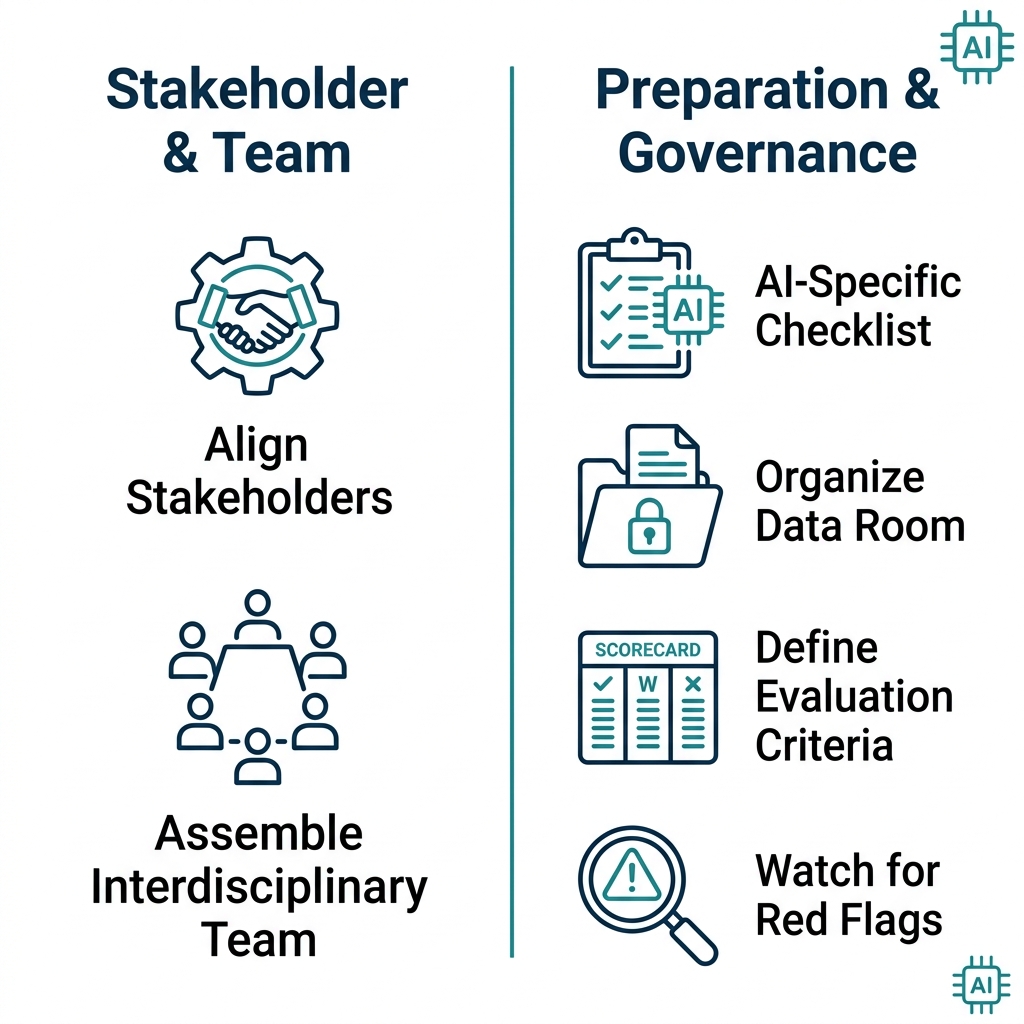
- Align internal stakeholders and articulate the strategic rationale for acquiring the AI target before any document review begins.
- Assemble an interdisciplinary diligence preparation team: AI/technical leads, data science, legal and regulatory counsel, financial advisors, and integration leads.
- Build a pre-diligence checklist covering data provenance and licensing, model documentation and training-data lineage, infrastructure and cloud architecture, and retention of key technical personnel.
- Define objective evaluation criteria and a weighted scorecard to ensure consistent assessment from the first management meeting onward.
- Prepare the data room: organize versioned documentation, execute NDAs, and establish clear access controls.
- Flag early-stage red flags: undocumented models, gaps in data rights, and concentrated vendor or talent dependency.
With these preparations complete, the diligence team is positioned to undertake a focused evaluation of the target’s underlying AI infrastructure and technology stack.
Assessing AI Infrastructure and Technology Stack
Following the essential preparations for AI due diligence, our focus now turns to the target’s AI infrastructure and technology stack. In this stage, we verify that the AI stack is scalable, maintainable, and cost-justified. We analyze cloud deployment choices and cost alignment; assess MLOps maturity through model versioning, CI/CD, drift monitoring, and retraining pipelines; and surface technical debt from fragile data pipelines or key-person dependence on a lone engineer. We scrutinize vendor and open-source dependencies—including licensing terms, API reliance on LLM providers, lock-in hazards, and exit costs—and require scalability evidence such as load tests, latency benchmarks, and failover mechanisms. We judge post-acquisition integration ease: can the stack cleanly interface with the acquirer’s systems? At Zaidwood Capital, we draw on internal frameworks like the Velocity Matrix and Precision Catalyst to structure this review and expose hidden risks that could erode deal value. Once the technology stack has been assessed, the natural next step is ‘Evaluating Data Assets and Quality’.
Evaluating Data Assets and Quality
Once the target’s technical stack has been mapped, the next test is the quality of the data that fuels its AI. At Zaidwood Capital in West Palm Beach, our proprietary data platform drives a structured framework to stress-test a target’s data assets during this stage of diligence.
We map the complete data landscape — transactional systems, data warehouses, data lakes, third-party feeds, and any siloed datasets. Data quality. We validate accuracy, completeness, consistency, timeliness, and integrity through sample checks rather than relying on management assertions. AI readiness. We confirm training data is properly labeled, examine historical datasets for bias, and verify that data volume and variety are sufficient for the target’s stated AI use cases. Governance and rights. We verify the target owns or holds valid licenses for its data, trace data lineage, and ensure privacy compliance endures through a change of control.
Even the strongest data position holds limited value without the right team to extract insights.
Analyzing AI Talent and Team Capabilities
A strong data estate is only as valuable as the people who can build from it. As we move beyond data assets, due diligence shifts to the target’s AI team structure, key-person risk, and ability to operate models in production.
- Map the AI operating model: verify whether a central team or embedded pods own the roadmap and who controls model priorities.
- Build a role-by-role skills inventory across data engineering, ML research, applied science, MLOps, and domain expertise and test it against the AI roadmap.
- Identify individuals who materially contributed to core models; confirm employment, IP-assignment, non-compete, and confidentiality agreements, and examine the lead AI builder’s institutional knowledge and succession or knowledge-transfer plan.
- Look beyond titles: assess turnover history, equity vesting schedules, retention arrangements, and team culture for post-close commitment.
- Require evidence of production-ready model governance—retraining cadence, monitoring, documentation, and maintenance rituals.
These findings inform valuation and integration planning.
Reviewing Algorithmic Assets and IP
After evaluating a target’s AI talent, we shift focus to the technical core—proprietary algorithms and the intellectual property that protects them.
- Evaluate algorithmic originality and scalability: the codebase relies on third-party services, open-source libraries, or external APIs that could constrain operations or create licensing obligations.
- Verify IP ownership and chain of title, including patents, copyrights, trade secrets, and employment or contractor assignment agreements, to confirm the seller holds clean, transferable rights.
- Assess data governance: we review data collection, usage rights, and compliance with privacy regulations like GDPR or CCPA.
- Check for algorithmic bias, explainability gaps, and regulatory risks—issues that can undermine market acceptance or draw scrutiny from regulators.
- Document any IP encumbrances, ongoing litigation, licensing disputes, or exclusivity constraints that could affect deal terms or future commercialization.
These reviews can be supported by proprietary technology platforms—our own Precision Catalyst, detailed on our website, is designed to accelerate analysis of algorithmic assets and IP documentation.
Leveraging Technology-Led Due Diligence Tools
The same technology-first mindset we apply to reviewing algorithmic assets and IP extends naturally to our due diligence toolkit. At Zaidwood Capital in West Palm Beach, our proprietary data platform, Precision Catalyst AI, and Velocity Matrix framework bring AI-driven analysis to every stage of deal evaluation.
These tools accelerate document review, data-room analysis, and financial modeling while flagging material risks—such as contractual red flags or revenue concentration—far earlier than manual processes. They surface hidden opportunities by benchmarking target-company metrics against broad market data, and they allow our team to focus on nuanced judgment rather than repetitive data extraction. This combination of speed and human expertise enables more confident go/no-go decisions.
Ultimately, it is this technology-led approach that uncovers the technical debt, integration complexities, and other hidden liabilities that we examine in detail next.
Identifying Technical Debt and Integration Risks
While technology-led due diligence accelerates data gathering, interpreting what the data reveals about technical debt and integration risks demands specialized judgment. Technical debt encompasses deferred maintenance, outdated codebases, undocumented dependencies, and over-reliance on legacy systems—all of which can escalate post-close integration costs.
In our advisory work, we focus on bridging data signals with practical assessment. Buyers commonly evaluate these integration risk categories:
- System interoperability and architectural incompatibility
- Data migration complexity and quality
- Cybersecurity exposure and regulatory compliance gaps
- Cultural and process mismatch between buyer and target
We surface these risks through engineering interviews, codebase audits, and dependency mapping as part of a standard due diligence workflow. Early identification often improves deal structuring—for example, by informing purchase price adjustments or indemnification provisions—without promising specific outcomes. By quantifying these qualitative factors, buyers gain a clearer picture of how technical debt impacts value, laying the groundwork for AI-driven valuation discussions we explore next.
How AI Impacts Valuation in Middle-Market M&A
Once technical debt and integration risks are identified, the valuation question becomes how these findings—and AI-driven data—change the price. AI-enabled analysis reshapes valuation by surfacing revenue-quality signals, customer dynamics, and integration costs traditional due diligence overlooks.
For middle-market SaaS and services targets, AI can normalize margins and quantify net revenue retention, providing a data-driven basis for adjusting the purchase multiple. This replaces generic multiples with a precise unit-economic view.
AI mines unstructured data to surface customer concentration and churn risk, letting buyers model recurring revenue quality more accurately than traditional diligence would allow.
AI also flags integration costs and technical debt that can erode deal returns, linking directly to the technical vulnerabilities we identified earlier. Zaidwood Capital’s proprietary platform and Precision Catalyst let us stress-test these valuation assumptions, though AI never replaces buyer judgment or due diligence.
These valuation dynamics create practical diligence challenges we now address.
Troubleshooting Common AI Due Diligence Challenges
While AI can sharpen valuation insights, as the previous section explored, deploying AI-assisted due diligence presents practical pitfalls that must be actively managed. One common obstacle is incomplete or siloed target-company data. Without proper data hygiene, these tools amplify noise rather than signal. To mitigate this, we inventory data quality early, address data-room gaps, and segment our AI analysis by reliability before drawing any conclusions that could affect a transaction’s outcome. Another risk is hallucinated outputs that fabricate findings. Without rigorous cross-checking, such fabrications can distort deal valuations and misinform negotiation strategies. Our process requires verifying every AI-generated claim against source documents and mandates human sign-off before a finding influences a valuation. AI models may also inherit bias from their training data, so we treat model confidence levels as advisory only and require that all material decisions be validated by a seasoned professional. Confidentiality and compliance are equally critical. Deal data must stay within compliant tools, and proprietary information is never exposed to public AI models. Our secure data room environment, underpinned by our proprietary data platform and rigorous access controls, keeps sensitive client information protected throughout the due diligence cycle. We deploy the technology strictly as a decision-support layer, not a replacement for professional judgment, aligning with our full-cycle advisory role. Addressing these practical challenges is the indispensable first step toward making AI adoption sustainable, which naturally leads to the next section on future-proofing M&A.
Future-Proofing M&A with AI Due Diligence
While the challenges covered in the preceding section are real, they are solvable. The lasting strategic advantage of ai due diligence in m&a, however, is its capacity to future-proof transactions—shifting due diligence from a reactive verification exercise to a proactive, intelligence-gathering process. This approach provides acquirers with the foresight to assess not only current value but also long-term resilience, positioning them to act decisively in any economic environment. At Zaidwood Capital, we operationalize this through our proprietary data platform, the Velocity Matrix rapid-execution framework, and Precision Catalyst AI-driven matchmaking that connects clients with the right institutional investors. These integrated capabilities help structure smarter, faster deals. Qualified investors and business owners are invited to explore our M&A Due Diligence and M&A Advisory services to see how we can support their next transaction.
Start Your AI-Powered Due Diligence
Now that you have a complete framework for AI due diligence in M&A—covering everything from assembling an interdisciplinary preparation team to future-proofing your transactions—the next step is putting these insights into practice. Zaidwood Capital’s advisory services bring together proprietary data analytics, the Precision Catalyst AI-driven matchmaking platform, and the Velocity Matrix execution framework to help buyers and investors move from theory to confident execution. Rather than navigating data quality checks, technical debt assessments, and talent retention risks alone, our team can support every phase of your due diligence process. With a network of over 4,000 investors and access to $15 billion in capital, we offer the reach and rigor middle-market transactions demand. Our approach combines advanced technology with the seasoned judgment of former operators and investment bankers. If you are ready to strengthen your next acquisition with AI-driven diligence, contact us to explore how we can help you execute.