

Table of Contents
The Foundations of Family Office Liquidity Management
Effective family office liquidity management strategies ensure that sufficient cash and near-cash assets are available to meet obligations—capital calls, operating expenses, and strategic investments—without disrupting long-term portfolio allocations. This foundational discipline balances near-term liquidity needs with the family’s overarching wealth preservation goals.
Capital call liquidity management is a critical concern, given that private equity and venture funds require sudden capital injections. At the same time, uneven cash flows from operating businesses underscore the need for disciplined family office treasury management to maintain adequate buffers without sacrificing returns.
Institutional-grade advisory services, such as debt advisory and equity liquidity solutions, help family offices optimize their liquidity position. We draw on $24.4B+ in aggregate transaction volume and a network of over 4,000 global investors, aligned with ICMA guidelines, to provide solutions like global lending services. In the sections that follow, we’ll explore how these strategies are structured to meet the unique demands of family offices.
1. Tiered Liquidity Buckets for Stability
In family office liquidity management strategies, we define tiered liquidity buckets as a framework that segments assets by accessibility, ensuring that near-term obligations can be met without liquidating long-term holdings.
- Operational: immediate access cash for expenses and capital calls.
- Reserve: 30- to 90-day instruments, such as commercial paper.
- Strategic: longer-term investments for planned growth.
This structure anchors capital call liquidity management by pre-positioning funds before drawdowns occur. Family office treasury management relies on cash flow forecasting to calibrate each bucket, mitigating forced liquidation risk. As Zaidwood Capital’s educational materials note, commercial and industrial loans are a prime example of a short-term vehicle that fits naturally within the reserve tier, offering working-capital support while protecting longer-horizon assets.
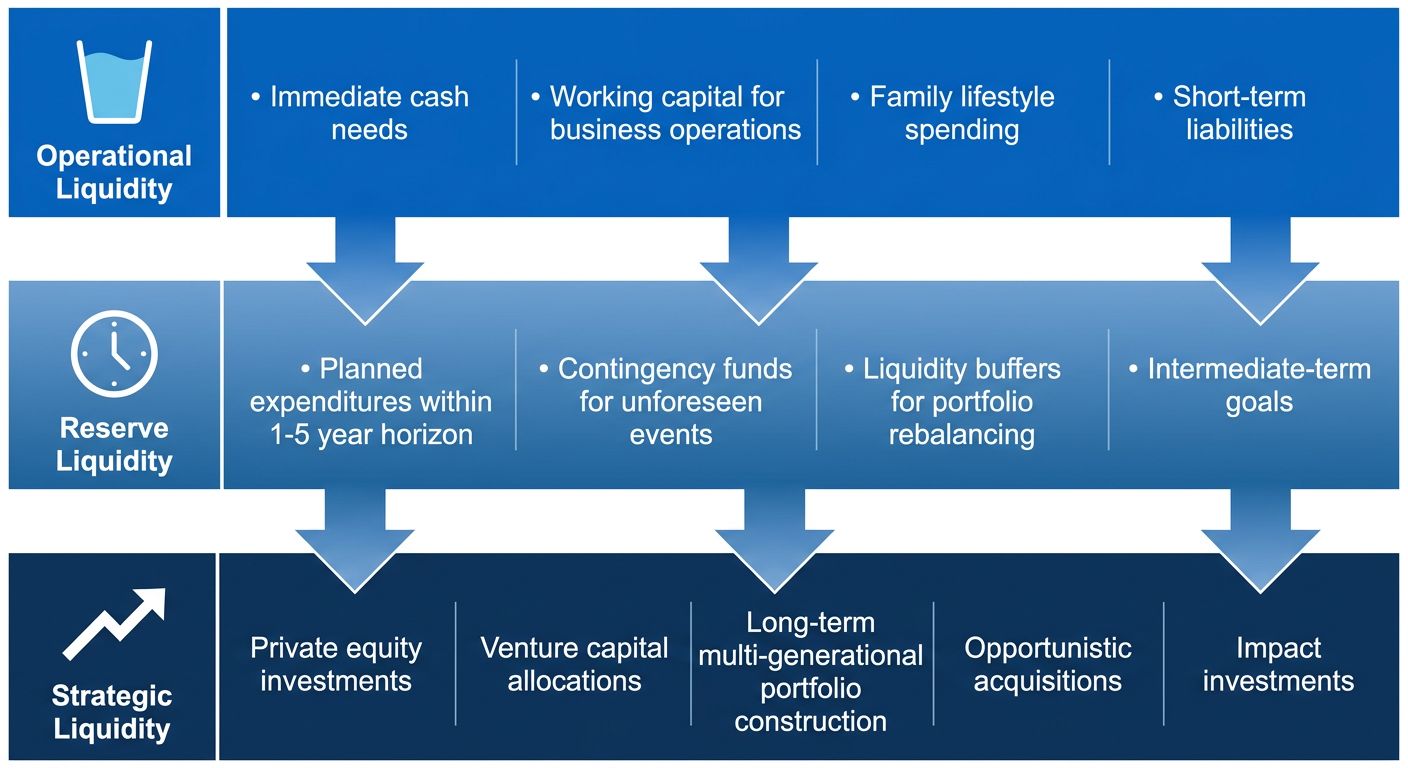
Tiered liquidity buckets for family office stability
Ultimately, robust family office liquidity management strategies align each bucket with anticipated calls and contingencies — a principle Zaidwood Capital’s liquidity management best practices reinforce. In the next section, we detail the asset classes assigned to each tier.
2. Private Equity Liquidity Solutions
Building on our advisory platform, private equity liquidity solutions help investors access capital without selling assets. They are essential in family office liquidity management strategies, where preserving long-term investments during short-term cash needs is critical.
A key driver of private equity liquidity strategies for family offices is capital call liquidity management. When a general partner calls capital, limited partners must fund commitments promptly. Liquidity demands also arise in other scenarios:
- Addressing uneven cash flows
- Funding opportunistic co-investments
- Covering tax or estate obligations
- Rebalancing portfolios without disruption
Through our Equity Advisory practice, we leverage the Velocity Matrix and our network of over 4,000 institutional investors with $15 billion in available capital to source liquidity solutions tailored to specific needs. Our full-cycle M&A and capital formation expertise allows us to design facilities that meet family office treasury management objectives, providing cash when required without disrupting strategic portfolios. Every engagement is custom-quoted, and no outcome is guaranteed.
This integrated approach to liquidity sets the stage for our debt advisory services, which provide the leverage for growth. This discussion is for informational purposes only and is not investment advice. Securities are offered through Finalis Securities LLC.
3. Managing Illiquidity Premiums Effectively
Effective family office liquidity management strategies begin with a clear understanding of what an illiquidity premium represents — the additional return investors demand for holding assets that cannot be quickly converted to cash without meaningful price concessions. At Zaidwood Capital, we emphasize that capturing this premium requires deliberate planning rather than passive acceptance. Successful liquidity management for family offices involves constructing portfolios with calibrated exposure across liquidity tiers, ensuring that long-duration commitments are matched with patient capital and clearly defined holding periods.
We recommend rigorous assessment of illiquidity premiums through historical data analysis and liquidity discount models, which help quantify the expected compensation for reduced marketability. A disciplined approach to family office treasury management incorporates capital call liquidity reserves — cash or near-cash allocations specifically designated to meet drawdown requests from private investment commitments. This capital call liquidity management framework protects portfolios from forced selling and preserves the integrity of the long-term investment strategy.
Industry best practices established by the International Capital Market Association provide valuable guidance on bond market liquidity and transparency standards. We incorporate these principles when advising on portfolio construction, recognizing that liquidity conditions evolve across market cycles. Educating stakeholders about the relationship between illiquidity and expected returns, and maintaining adequate liquidity buffers for capital calls, positions family offices to earn meaningful premiums while sustaining operational flexibility across full-cycle market environments.
4. Capital Call Liquidity Management
Effective capital call liquidity management is a cornerstone of capital call liquidity management for family offices and institutional investors. A capital call is a formal request from a fund manager requiring investors to fulfill their committed capital obligations. Our role is to help clients meet these requests on time without disrupting cash flow or long-term investment returns.
We approach capital call liquidity strategies with three primary tools: maintaining a dedicated cash buffer, arranging a capital call line of credit, and structuring committed capital facilities. At Zaidwood Capital, our capital call financing solutions are specifically designed for family offices and private investors, as detailed in our Capital Call Financing FAQ. Unlike standard commercial and industrial loans—which are typically used for operating expenses or expansion and rely on asset-based or cash-flow lending—capital call financing is purpose-built for short-term bridging until called capital is distributed.
This disciplined approach to family office treasury management helps investors avoid forced asset sales, default penalties, and missed opportunities. In the next section, we examine practical steps to implement these liquidity safeguards.
5. Dividend Recapitalization for Diversification
Family office liquidity management strategies often incorporate dividend recapitalization, a transaction where a company borrows to pay a dividend to its owners. This provides partial liquidity, letting family offices meet capital call liquidity management requirements or implement family office treasury management initiatives without selling underlying holdings. Freeing up capital in this way enables reinvestment across new asset classes, enhancing portfolio diversification and resilience.
We also weigh the illiquidity premium inherent in private market investments. Zaidwood Capital’s FAQ highlights that limited partners demand a premium for reduced liquidity, shaping how we approach recapitalizations. Funding can come from sources like commercial and industrial loans, distinguishing this method from a full exit or secondary sale. By preserving ownership while accessing capital, family offices maintain ongoing alignment with management and redeploy proceeds strategically. This technique is one of several recapitalization tools we use to balance liquidity with long-term portfolio objectives.
6. Treasury Management Best Practices
To move from theory to practice, family offices should adopt proven family office liquidity management strategies, as outlined in our treasury management resources.
- Prioritize cash flow forecasting with a rolling six-month horizon and monthly updates to anticipate liquidity needs, proactively manage upcoming capital calls, and avoid unexpected funding gaps.
- Diversify counterparty risk by maintaining banking relationships with at least three independent institutions, reducing concentration risk and ensuring access to liquidity during market disruptions.
- Develop a formal family office treasury management policy that includes liquidity stress testing under multiple market scenarios, such as interest rate spikes or capital call surges.
- Use capital call liquidity management as a strategic tool to cover short-term funding gaps without forced asset sales, preserving long-term portfolio value.
- Leverage treasury management software or real-time dashboards for consolidated visibility into cash positions, portfolio liquidity, and committed capital calls.
These practices build a resilient liquidity framework; the next section explores advanced treasury technology solutions.
7. Optimizing Private Equity Allocations
Optimizing private equity allocations requires robust family office liquidity management strategies that balance the pursuit of the illiquidity premium with the need for accessible capital. At Zaidwood Capital, we see the illiquidity premium adding 2–3% to long-term returns, but it demands careful liquidity planning. Private equity commitments inherently involve multi-year lock-ups and unpredictable capital calls, so families must develop a clear liquidity strategy for family offices. Effective capital call liquidity management involves forecasting cash outflows and maintaining dedicated reserves to meet drawdowns without disrupting operating budgets or forcing premature asset sales.
In our experience at Zaidwood Capital, family office treasury management plays a central role in ensuring that PE commitments align with overall portfolio liquidity. Diversifying commitments across vintage years and fund strategies mitigates concentration risk and smooths cash flow demands. We advise family offices to set allocation targets based on their investment horizon and liquidity constraints, not solely on return expectations. With these optimization principles, family offices can move to execute their private equity strategy confidently.
8. Leveraging Capital Advisory Expertise
Given these complexities, leveraging our Full-Cycle M&A and capital advisory expertise becomes essential. When designing in family office liquidity management strategies, we assess asset composition and cash flow profiles to select appropriate financing instruments.
Through our full-cycle advisory process, we help family offices and companies prepare for the rigorous institutional qualification procedures associated with asset-based lending and cash flow financing. As outlined in our internal FAQ, this includes compiling audited financials, three-to-five-year cash flow projections, and detailed business plans that demonstrate creditworthiness. For capital call liquidity management, such financing can provide committed credit lines that support fund contributions without forcing asset sales.
Our treasury management advisory, grounded in the best practices shared in our Treasury Management FAQ, strengthens family office treasury management by introducing disciplined cash flow forecasting, efficient working capital management, and strategic deployment of liquidity reserves. We work to ensure that surplus cash is invested in line with the family office’s risk tolerance and near-term cash needs.
Zaidwood Capital’s institutional network—connecting to over 4,000 investors with more than $15 billion in deployable capital—can be structured to support both capital call liquidity management and ongoing treasury requirements.
With this advisory support, family offices can build resilient liquidity strategies aligned with long-term objectives.
Building a Resilient Liquidity Framework for Your Family Office
To address capital efficiency challenges in family office liquidity management strategies, we recommend structuring a resilience framework across distinct tiers. Begin by segregating operational, reserve, and growth liquidity to align cash flows with investment horizons. A disciplined treasury function underpins effective capital call liquidity management, ensuring obligations are met without forced asset disposals.
- Maintain a contingency reserve equal to 10–15% of committed capital to cover unexpected drawdowns.
- Embed SEC regulatory updates into risk assessments, staying current with evolving compliance expectations.
- Use capital call financing as a bridge, preserving invested assets during liquidity events.
- Benchmark your approach against international wealth management firms to refine family office treasury management protocols.
A robust framework transforms liquidity from a constraint into a strategic advantage for multi-generational wealth stewardship.
Resources
- Learn How to Qualify for Asset-Based Lending and Cash-Flow Financing
- Discover the Best International Wealth Management Firms for 2026
- Find Commercial and Industrial Loans for Growth Without Dilution
- Explore Advance Rates and Loan-to-Value in Asset-Based Lending
- Structure Venture Debt to Scale Without Dilution
- Learn How to Prepare Commercial Loan Documentation
- Learn How Asset-Based Lending Works with Receivables and Inventory
- Explore ICMA’s Standards for International Capital Markets
- Discover SEC Updates on IPO Modernization and Investor Resources