


How To Raise Capital For A Business
Table of Contents
Raising Capital for Your Growth-Stage Business
If you are a growth-stage founder exploring how to raise capital for a business, you are likely considering venture capital or private equity. Unlike friends-and-family or angel rounds, growth-stage fundraising attracts institutional investors who write larger checks and expect board-level governance.
In venture capital, Series A, B, and C rounds reward proven traction; through private equity growth equity, investors focus on scaling already-profitable models. According to SIFMA, member firms collectively manage over $75 trillion in assets, reflecting the deep institutional pools that growth-stage companies can tap.
As a Boutique M&A and Capital Advisory Firm, Zaidwood Capital leverages Sovereign Data Nexus to surface hidden investor targets, Precision Catalyst for AI-driven matching, and Velocity Matrix to compress deal timelines. Our network of 4,000+ investors and access to $15B+ in capital connects your business to the right growth partner.
Ready to accelerate your growth? Visit our dedicated resource to Raise Capital.
Preparing Your Business for Capital Raising
If you are learning how to raise capital for a business, preparation is the first critical phase. According to SIFMA, robust capital-raising activity in U.S. markets underscores the importance of thorough preparation. Once you understand the available capital-raising routes, you must ready your business for investor scrutiny.
We recommend compiling audited financial statements prepared under GAAP for at least two fiscal years and building a secure data room with incorporation documents, a clean cap table, intellectual property assignments, and all material contracts. Develop a detailed use-of-funds breakdown that maps capital allocation to your expected path to profitability. Research industry valuation multiples and term-sheet clauses such as liquidation preference and anti-dilution provisions. Finally, articulate a clear exit narrative–IPO, acquisition, or secondary sale–to show institutional investors a path to liquidity.
Engaging an experienced Investment Bank To Raise Capital early in the process ensures your preparation aligns with institutional standards. At Zaidwood Capital, we complement this groundwork with our Sovereign Data Nexus platform to identify and target the right investors after your materials are complete. With these elements in place, you are ready to explore specific capital types–venture capital, private equity, or debt–and how to approach them.
Define Your Capital Requirements and Funding Strategy
Knowing how to raise capital for a business starts with defining your capital requirements–factoring in your growth stage, industry, and 12-18 month runway.
| Equity Financing | Debt Financing | Considerations |
|---|---|---|
| Dilution of ownership required | No dilution; principal plus interest repaid | Equity is better for high-growth companies without near-term cash flow to service debt |
| Investor partners who provide strategic guidance and network access | Lender relationship; no strategic or governance involvement | Equity investors add value beyond capital; debt keeps full control |
| Higher cost of capital in the long term if company appreciates significantly | Lower long-term cost if company can service debt; fixed repayment obligation | Debt is cheaper if you can manage cash flow; equity aligns incentives for growth |
According to industry benchmarks from the Securities Industry and Financial Markets Association (SIFMA), small and mid-sized businesses consistently balance equity and debt issuance to align with their cash flow profiles and growth trajectories.
Equity financing suits high-growth ventures that lack immediate cash flow to service debt, but it dilutes ownership. Debt financing preserves control and often costs less long-term, yet demands predictable repayment. For early-stage companies, venture capital provides patient capital, while established firms may tap private equity to accelerate expansion.
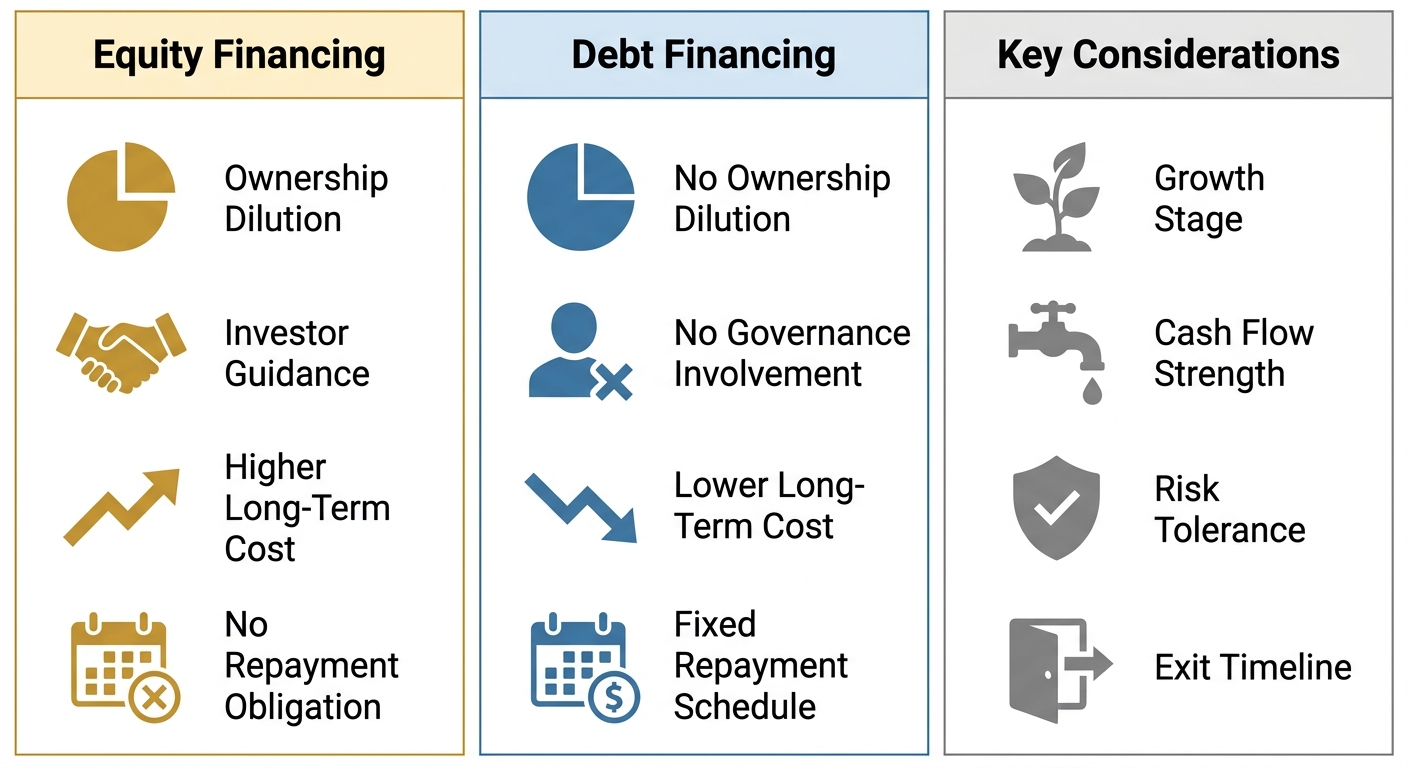
Equity vs Debt Financing: Key differences and considerations for capital strategy.
At Zaidwood Capital, we help founders assess their capital needs and craft a balanced funding strategy that incorporates the right mix of equity and debt. For expert guidance, partner with a boutique investment bank like Zaidwood Capital to navigate these funding decisions.
Once you understand the trade-offs, the next section explores the specific funding sources available to you.
Prepare an Investor-Ready Pitch Deck
To attract the right capital, prepare a deck tailored for a lower middle market investment bank. Understanding how to raise capital for a business starts with a compelling story.
Begin with a concise executive summary defining the opportunity and the capital ask, followed by a problem slide that quantifies the market gap using verifiable data.
The solution slide showcases your business model and proprietary advantages, while the market opportunity slide details TAM/SAM/SOM, citing industry data from the Securities Industry and Financial Markets Association (SIFMA) to establish credibility with venture capital and private equity investors.
Include a three- to five-year financial projection with key metrics and assumptions, then end with a clear use-of-funds breakdown allocating capital to growth, operations, and advisory fees.
A polished deck positions you to engage investors through our network.
Disclosures: Securities are offered through Finalis Securities LLC; Zaidwood Capital is not a registered broker-dealer.
Build Comprehensive Financial Projections
An essential step in how to raise capital for a business is building comprehensive financial projections that withstand the scrutiny of venture capital and private equity investors. At Zaidwood Capital in West Palm Beach, Florida, our Precision Catalyst methodology treats these projections as the foundation of a credible growth narrative.
For enterprise AI capital raising, models must detail three revenue streams–subscription tiers, API usage, and professional services–alongside AI-specific costs like cloud compute, model training, data licensing, and specialized talent. We include a sensitivity analysis varying customer acquisition cost and annual churn by ±20% to test resilience. We anchor growth assumptions in industry benchmarks, including SIFMA data on revenue multiples for comparable public AI/SaaS firms, avoiding unsupported optimism. We structure projections over a three- to five-year horizon, with monthly detail in year one and annual summaries thereafter, clearly articulating key drivers like customer acquisition rate and average revenue per account.
Well-crafted projections bridge strategic planning and investor-ready pitch materials, accelerating your path to a successful raise.
Identify and Target the Right Investors
Once your business is ready to seek funding, how to raise capital for a business depends heavily on identifying and targeting investors who align with your stage and sector. Deliberate investor selection ensures every conversation moves you closer to the right capital partner.
Segment investors by stage: angels for seed and pre-revenue, venture capital for high-growth Series A and beyond, and private equity for profitable expansion or buyouts. Filter by minimum check size, sector preference, and geographic focus. According to SIFMA, the institutional investor landscape is highly segmented; targeting the wrong segment wastes time and momentum.
At Zaidwood Capital, our Sovereign Data Nexus enables data-driven screening across a proprietary database of 4,000+ institutional investors, while our Precision Catalyst platform uses what is gen ai to analyze your business profile and surface the most compatible investors.
Target no more than 20-30 investors per round to ensure meaningful engagement. After you’ve built a focused list, the next step is crafting a pitch that resonates with your shortlist.
Navigate the Due Diligence Process
When learning how to raise capital for a business, understanding due diligence is essential. Whether you pursue venture capital or private equity funding, investors will scrutinize every aspect of your company.
Due diligence covers three primary areas: financial (historical statements, projections, cap table), legal (incorporation documents, IP, contracts, regulatory compliance), and operational (team, technology, customer agreements, market position). A typical process spans 4-8 weeks and demands a well-organized data room. Our Sovereign Data Nexus platform streamlines secure document sharing, ensuring readiness for investor review. Companies should prepare audited financials, tax returns, due diligence questionnaires, and risk disclosures in advance.
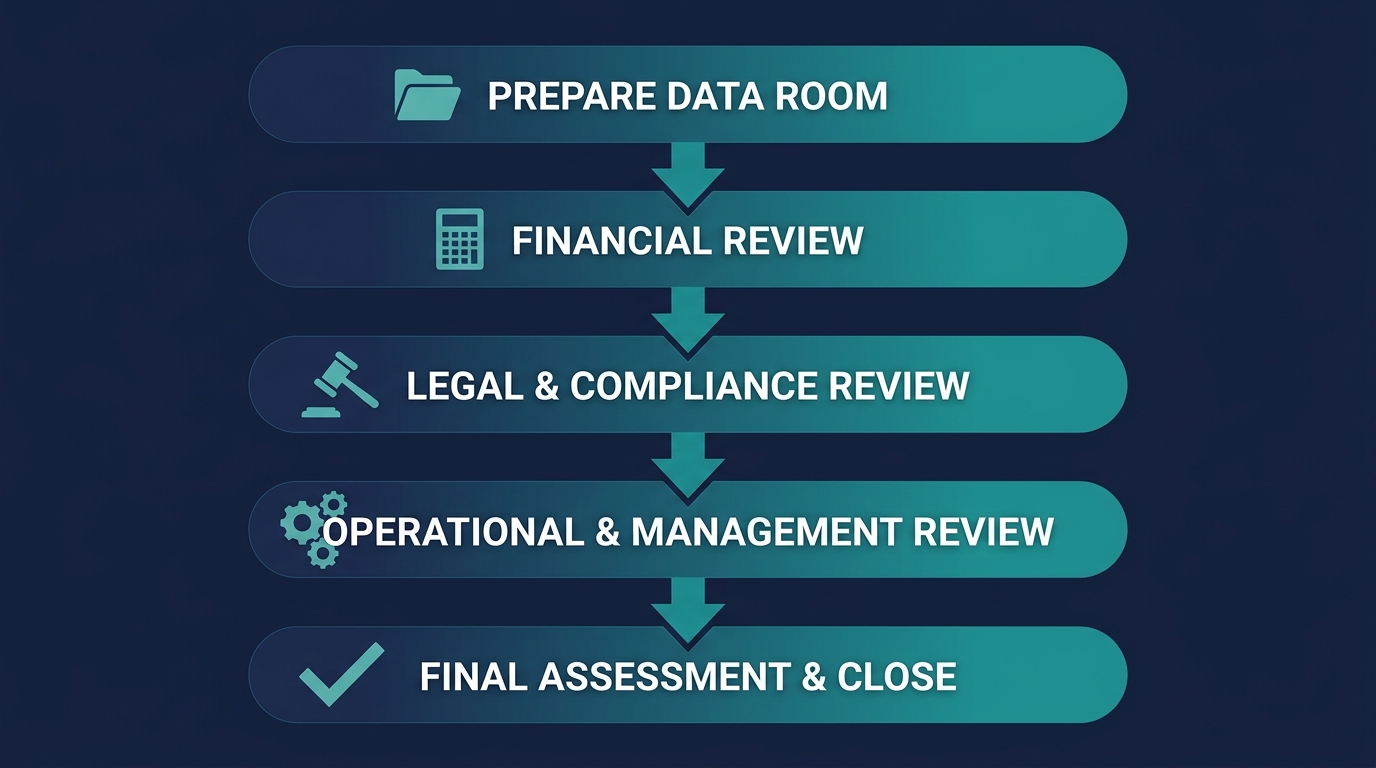
Due diligence process flow for capital advisory firms
FINRA’s due-diligence rules apply to broker-dealers, not to advisory firms. Securities are offered through Finalis Securities LLC; Zaidwood Capital is not a registered broker-dealer.
Our team at Zaidwood Capital guides you through each due diligence stage, leveraging our Sovereign Data Nexus platform to maintain data integrity and accelerate investor review. Once due diligence is passed, your business is ready for the final steps of the investment process.
Negotiate Terms and Structure the Deal
Once valuation and potential investors are identified, the next critical phase of how to raise capital for a business is negotiating terms and structuring the deal. We guide founders through term-sheet creation, optimizing key components–liquidation preference, anti-dilution protections, and board representation–to align investor and founder interests. Liquidation preference determines payout priority on exit, anti-dilution clauses safeguard share value in subsequent rounds, and board seats shape governance and strategic oversight. Understanding how to raise capital for a business means navigating these trade-offs with careful expertise. Throughout this phase, we adhere to the Financial Industry Regulatory Authority (FINRA)’s fair-dealing standard, ensuring full disclosure and suitability in every private placement. Our proprietary Velocity Matrix framework accelerates the negotiation timeline while maintaining rigorous compliance and thorough consideration of each deal term. For transactions structured as venture capital rounds or through private equity arrangements, our process ensures the term sheet reflects the company’s growth objectives without over-committing on governance or exit provisions. After the term sheet is finalized, the focus shifts to due diligence and closing.
Close the Transaction and Maintain Investor Relations
Once terms are agreed upon and investors are committed, the closing process begins. For those exploring how to raise capital for a business, the final steps require meticulous coordination of legal documentation, fund transfers, and regulatory compliance. In keeping with FINRA’s regulatory standards, we manage the closing timeline, coordinate with legal counsel, and resolve last-minute issues to ensure a smooth transfer of ownership or investment.
Post-close, we sustain trust by implementing structured investor relations. Through scheduled updates, transparent financial reporting, and proactive dialogue with venture capital and private equity partners, we keep stakeholders informed. Our Precision Catalyst platform powers secure, ongoing digital engagement, enabling efficient distribution of quarterly reports and meeting materials.
This post-transaction stewardship aligns with our Full-Cycle M&A approach at Zaidwood Capital, a Boutique M&A and Capital Advisory Firm. By treating every closing as the start of a long-term partnership, we help business owners foster referrals and unlock future funding rounds or M&A opportunities–turning successful transactions into enduring, growth-oriented relationships.
Overcoming Common Capital Raising Challenges
For any business leader, understanding how to raise capital for a business in West Palm Beach or across the national market means confronting regulatory, relational, and strategic hurdles that can stall even the most promising opportunities. Even experienced owners can underestimate the complexities of navigating securities regulations, identifying aligned investors, and reaching a fair valuation–all while managing day-to-day operations.
Regulatory complexity is often the first obstacle. FINRA’s Rule 506 of Regulation D, enforced by the Financial Industry Regulatory Authority, imposes strict requirements on general solicitation and investor accreditation that can delay or derail a private placement. Boutique advisory firms like Zaidwood Capital help businesses structure compliant offerings that meet these regulatory standards without sacrificing momentum, so founders can focus on growth rather than legal pitfalls.
Equally challenging is finding investors who are both interested and qualified. When business owners pursue venture capital or private equity investments, they frequently encounter valuation disagreements that stall negotiations. Our Sovereign Data Nexus and Precision Catalyst tools match companies to institutional investors from our 4,000+ pre-vetted relationships, ensuring each conversation targets firms whose criteria align with the company’s stage and sector. We also integrate third-party business valuations and market data to ground discussions in objective metrics, helping bridge the gap between founder expectations and investor demands.
By anticipating these hurdles, Zaidwood’s structured process helps clients move from challenge to close more efficiently. Our Velocity Matrix framework accelerates timelines through structured milestones, while our deep network of institutional investors reduces trust friction because all parties expect rigorous due diligence. While these tools help mitigate common obstacles, all capital raising carries risk, and outcomes are never guaranteed.
Your Path to Successful Capital Formation
Every business exploring how to raise capital for a business faces a complex journey. Zaidwood Capital guides you through a proven capital formation process–from initial strategy and investor targeting to data-driven matching, due diligence support, and closing coordination.
Our proprietary Sovereign Data Nexus platform sources actionable investor intelligence, while Precision Catalyst’s AI-driven matching identifies the right institutional partners across venture capital and private equity channels. Through a network of over 4,000 investors, we facilitate targeted introductions. Our Full-Cycle M&A methodology and Velocity Matrix accelerate execution, but we never guarantee specific results. According to SIFMA, U.S. capital markets facilitate trillions of dollars in capital formation annually, and we navigate a process compliant with FINRA’s private placement rules.
With a clear path to capital, the next step is evaluating the right financial structure for your growth. This information does not constitute an offer or solicitation. Securities are offered through Finalis Securities LLC; Zaidwood Capital is not a registered broker-dealer.
Resources


