


How To Raise Venture Capital
Table of Contents
The Venture Capital Fundraising Journey
Understanding how to raise venture capital means mastering the Venture Capital Fundraising journey–a structured progression from preparation to closing.
The journey typically unfolds in five phases:
Preparation and Readiness: We guide companies to evaluate financials, build a secure data room, and refine the business plan, ensuring they are investor-ready.
Investor Targeting and Outreach: Leveraging our extensive investor network, we help identify and engage the right partners. The journey often accelerates during Series A fundraising, when institutional investors scrutinize traction and unit economics.
Pitch and Due Diligence: We assist in presenting the opportunity and managing the diligence process with transparency, building trust with potential investors.
Term Sheet Negotiation: We help clients evaluate a venture capital term sheet, weighing valuation, liquidation preferences, and board composition to secure favorable terms.
Closing and Beyond: After closing, we provide post-fundraising strategic support to ensure long-term success and growth.
Throughout this journey, we bring deep market knowledge and a structured process to accelerate your capital-raising efforts.
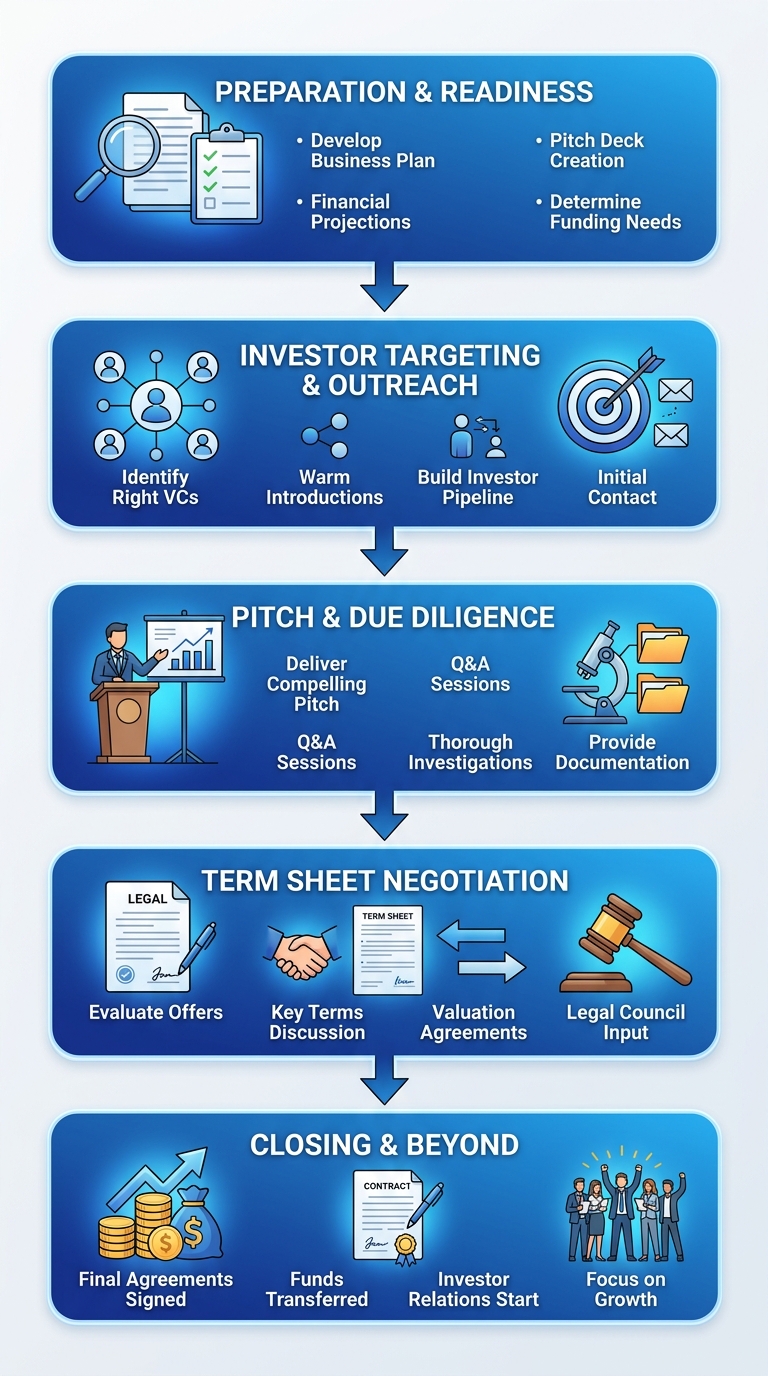
Venture capital fundraising journey process flow
As a Boutique M&A and Capital Advisory Firm, Zaidwood Capital ensures each phase of the fundraising journey is navigated with confidence and clarity.
Essential Preparation for Your Fundraising Campaign
Understanding how to raise venture capital begins with thorough preparation. A disciplined approach not only builds credibility but can significantly improve your chances of securing favorable terms. For a complete overview of the startup funding process, refer to our guide on Raising Venture Capital For Startups.
Below are the five essential steps we recommend:
- Finalize a comprehensive business plan with three-to-five-year financial projections. The U.S. Small Business Administration’s planning resources are an excellent starting point for building these projections.
- Create a compelling pitch deck that clearly communicates the problem, solution, market size, traction, and team. Ensure it tells a story that resonates with venture investors.
- Research target VC firms by stage, sector, and check size. For Series A fundraising, investors will scrutinize unit economics and growth metrics, so tailor your outreach accordingly.
- Assemble due diligence materials: a clean cap table, audited financials, and all legal documents. Understand the venture capital term sheet’s key components–valuation, liquidation preference, and board composition.
- Practice your pitch relentlessly with mentors, advisors, or our Precision Catalyst methodology to refine messaging and anticipate tough questions. This step builds confidence and sharpens your delivery.
By systematically addressing each of these areas, you position your startup for a more efficient and successful fundraise. Our next section covers the execution process in detail.
Assessing Your Startup’s Readiness for Venture Capital
Understanding how to raise venture capital starts with an honest assessment of your startup’s traction, team, and market position. Use this checklist to gauge your readiness for venture funding:
- Revenue traction: At least $1M ARR and 20% month-over-month growth, with gross margins above 60%.
- Unit economics: Clear CAC and LTV, and a payback period under 12 months.
- Founding team: Domain expertise, prior exits, or deep industry experience that inspires investor confidence.
- Market size: A TAM exceeding $1B and a defensible competitive moat (IP, network effects).
- Financial discipline and go-to-market proof: A clean cap table, realistic burn rates, a draft venture capital term sheet, and a repeatable sales motion–essential for Series A fundraising.
If your startup falls short on these metrics, bootstrapping or seed funding may be more appropriate. Once you confirm readiness, our boutique M&A and capital advisory firm can refine your materials and position you for a successful raise.
Determining the Right Amount to Raise
After mastering how to raise venture capital in West Palm Beach, founders must decide exactly how much to seek. The target amount defines operating runway, dilution, and the milestones achievable before the next round.
A prudent framework: fund 18-24 months of burn rate plus a buffer for market shifts and allow for contingency runway planning. In a Series A fundraising, investors expect a detailed use-of-funds plan linking capital to product, user growth, or revenue. Over-raising dilutes founders; under-raising risks a down round. Our approach uses a rigorous valuation analysis–relying on our business valuation services to align the ask with investor expectations.
Once the amount is set, founders negotiate a venture capital term sheet reflecting a fair pre-money valuation. With the ask defined, building a compelling pitch deck and financial projections becomes the next logical step.
Building a Compelling Pitch Deck and Data Room
For startups learning how to raise venture capital, a compelling pitch deck and a comprehensive data room are essential. We advise founders to craft materials that tell a data-driven story and provide transparent due diligence documents.
A strong Series A fundraising pitch deck concisely covers problem, solution, market size, business model, traction, competitive advantage, team, and the ask. We recommend under 15 slides, with graphs for metrics and a clean design. Tailor content: emphasize product vision for angel rounds, unit economics and traction for Series A. Cross-reference every number with data room documents to maintain credibility.
A secure data room organizes essential due diligence files: charter documents, cap table, financials, IP filings, customer contracts, and investor correspondence. When aligned with the pitch deck, this repository accelerates the process and leads to a venture capital term sheet. With these materials prepared, you can approach investors confidently.
The infographic below highlights the critical components of both deliverables.
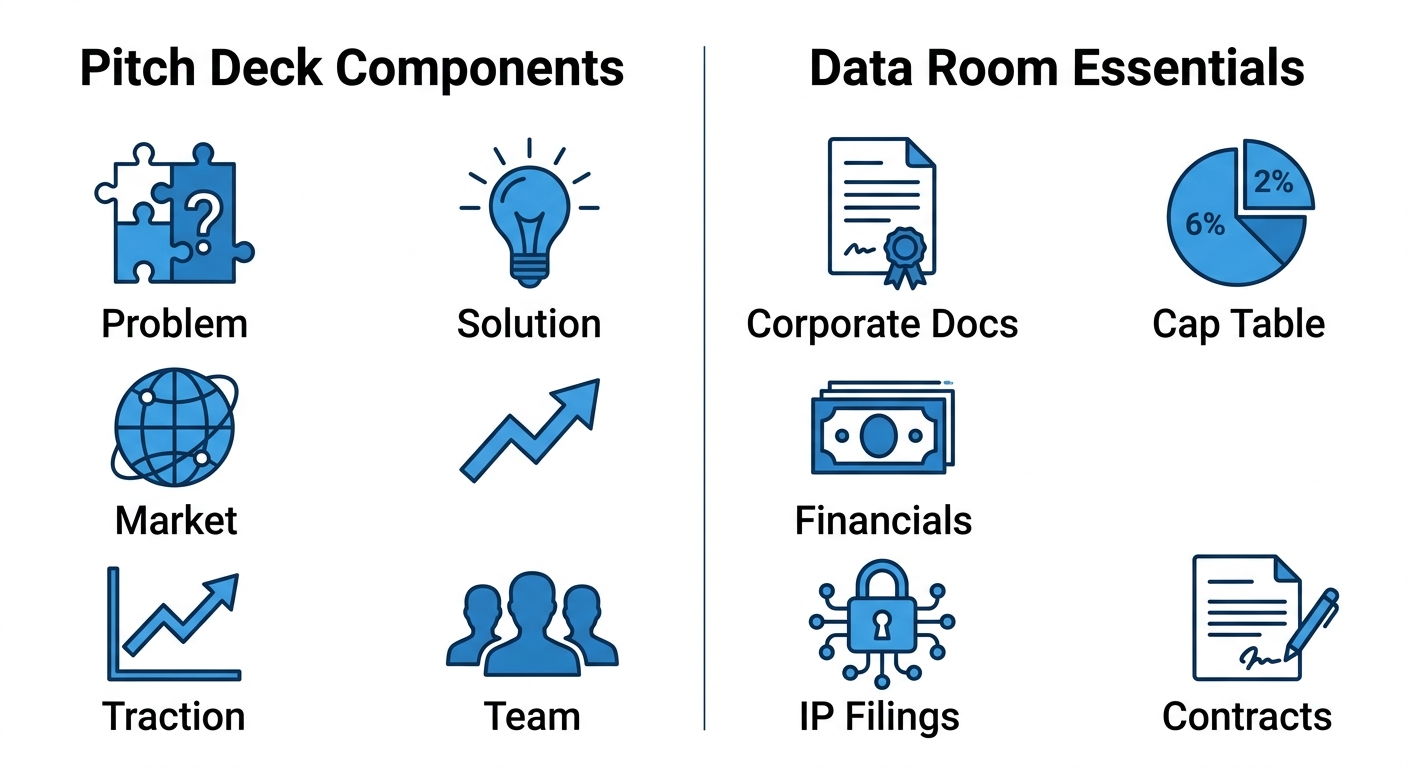
Pitch deck and data room essentials for fundraising success
Targeting the Right Venture Capital Investors
Once you understand the fundraising landscape, mastering how to raise venture capital begins with targeting investors whose stage, sector, and geography align with your startup.
Start by filtering for investors active in your current round–for example, Series A fundraising requires backers who specialize in growth-stage deals. Verify their sector expertise by reviewing investment thesis language on their websites. Geography also matters: many VCs concentrate in hubs like Silicon Valley, New York, or in West Palm Beach; confirm their regional preferences before engaging. Avoid broad, untargeted outreach; instead, use professional databases like PitchBook and Crunchbase to cross-reference portfolio companies and deal sizes. To streamline this effort, our Venture Capital Fundraising advisory, part of our Boutique M&A and Capital Advisory Firm, harnesses the Precision Catalyst platform, which matches your profile against a network of over 4,000 investors representing $15B+ in capital–helping you focus on the highest-fit leads.
With the right targets identified, you can now tailor your approach and materials to each investor.
Navigating the Term Sheet and Negotiation Process
After investor interest is confirmed, understanding how to raise venture capital means navigating the term sheet. A venture capital term sheet is a non-binding summary of key terms like valuation, investment amount, liquidation preference, board seats, and anti-dilution. Valuation and liquidation preference are often the most contested points, so founders must model dilution scenarios and control implications before negotiations. For Series A fundraising, the term sheet frequently includes a 1x non-participating liquidation preference, which strongly affects founder returns. Part of how to raise venture capital involves scrutinizing term sheet provisions for hidden economic and control traps. Founders should prioritize understanding economic dilution over percentage ownership and seek advice from experienced capital advisors early.
The U.S. Securities and Exchange Commission’s Regulation D (Rule 506) mandates accredited investor verification for exempt offerings. We recommend engaging an experienced M&A and capital advisory firm like Zaidwood Capital, which provides critical negotiation support without offering legal advice. With the term sheet negotiated, you’re ready to move toward definitive agreements and closing.
Managing Due Diligence and Investor Communications
Mastering how to raise venture capital requires navigating due diligence with precision. During Series A fundraising, due diligence is a critical gate–we guide founders in preparing financial statements, customer concentration analyses, intellectual property records, and compliance documentation. A virtual data room organized by financials, legal, operations, and cap table speeds investor review, and our Sovereign Data Nexus platform streamlines it.
Learning how to raise venture capital also means establishing a disciplined communication cadence: respond within 24 hours, send weekly updates, and keep a shared Q&A log. Address common concerns–market size, competitive moat, unit economics–with transparency, never promising guaranteed returns. Understanding the venture capital term sheet helps you anticipate investor questions. Our Precision Catalyst AI tool can then model investor-specific messaging, tailoring outreach for institutional or angel investors.
As a Boutique M&A and Capital Advisory Firm in West Palm Beach, we apply Full-Cycle M&A principles–from diligence to closing–without acting as a broker-dealer. With due diligence managed efficiently, you can advance confidently to finalize your round.
Closing the Deal and Building Long-Term Investor Relationships
Learning how to raise venture capital extends beyond the pitch; closing the round and nurturing investor relationships matter just as much. Once a verbal commitment is secured, expect a venture capital term sheet negotiation lasting one to three weeks. Key provisions include valuation, board seats, liquidation preference, and anti-dilution. We always recommend independent legal review; we do not offer legal advice. Final due diligence covers financial, legal, and operational checks; thereafter, definitive agreements are signed, funds transferred, and shares issued. After closing, regular communication is vital. Establish a monthly or quarterly update cadence that transparently shares wins and challenges to build trust and position investors as strategic allies. Strong relationships often yield warm introductions for future Series A fundraising or follow-on capital, though no investor is obligated. Where appropriate, Zaidwood Capital’s Full-Cycle M&A and Sovereign Data Nexus platform can support ongoing investor reporting.
Overcoming Common Fundraising Challenges
Even with a clear strategy, learning how to raise venture capital often reveals persistent obstacles that can derail even promising companies. One of the most frequent issues during Series A fundraising is valuation misalignment between founders and investors. We have found that defensible, market-based benchmarks are critical in bridging this gap; our Sovereign Data Nexus platform aggregates comparable transaction data to help clients anchor negotiations in empirical evidence rather than speculation.
Another common bottleneck is the protracted due diligence process, which is often worsened by poor investor targeting. Our Precision Catalyst AI platform addresses this by identifying and prioritizing compatible capital partners, dramatically reducing the time leadership spends on mismatched leads. According to the U.S. Securities and Exchange Commission (SEC), regulatory compliance — especially navigating private placement exemptions — adds another layer of complexity to the capital-raising process. Experienced advisors can help interpret these requirements, ensuring that companies remain compliant without promising assured legal outcomes.
Once interest is secured, the venture capital term sheet becomes the center of intense negotiation over economic and control terms. Founders often face difficult trade-offs around liquidation preferences, board composition, and protective provisions. A clear understanding of these components and their long-term implications is essential to maintaining alignment with incoming partners. The structured, data-driven approach of a boutique M&A advisory firm like Zaidwood Capital effectively helps management teams navigate these hurdles while preserving founder value and deal momentum.
Launching Your Venture Capital Fundraising with Confidence
Confidence in fundraising stems from preparation, strategic alignment, and the right network. At Zaidwood Capital, learning how to raise venture capital begins with our Velocity Matrix framework, a proven methodology that de-risks your timeline and clarifies each stage.
For a successful Series A fundraising campaign, strategic investor engagement is essential. Our AI-powered Precision Catalyst platform accelerates the entire enterprise ai capital raising process, using data-driven matchmaking to connect you with investors from our network of over 4,000 global partners. This approach reflects our full-cycle boutique advisory model, where technology and deep institutional relationships converge.
Understanding every clause in a venture capital term sheet is crucial to negotiating from a position of strength, and as part of our commitment to confident fundraising, we guide you through the details. With the right preparation and data-driven strategy, your capital raising journey becomes a decisive step forward. Next, we’ll help you prepare a compelling pitch and master the term sheet negotiation.
Resources


