



Merchant Account Provider
Table of Contents
The Strategic Role of Merchant Account Providers in M&A Preparation
Extending beyond daily operations, a well-chosen merchant account provider plays a strategic role in preparing a business for a transaction. At Zaidwood Capital, our experience confirms that a transparent payment processing infrastructure directly strengthens M&A readiness by ensuring accurate revenue data, operational maturity, and reduced integration uncertainty — critical factors buyers scrutinize closely during initial evaluations. A clear payment history allows acquirers to trace top-line revenue back to individual transactions, accelerating the confidence-building phase of due diligence, which often proves decisive in competitive sale processes. Moreover, this transparency feeds directly into investor pitch decks, reinforcing the narrative of a well-run, investable enterprise. In short, the payment system acts as an operational backbone that directly feeds deal momentum.
Sophisticated payment processing solutions represent a hallmark of operational excellence. Buyers navigating due diligence rely on clean transaction records to verify financial performance; a well-managed payment trail accelerates this validation, often cutting weeks from the diligence timeline. For companies in high-risk industries, a partner offering high risk credit card processing demonstrates robust fraud and chargeback management, reducing perceived risk exposure. This proactive stance often results in lower payment processing reserves and fewer funding holds, further stabilizing cash flow during the diligence period. Similarly, enterprises engaged in complex B2B transactions should collaborate with a provider skilled in B2B payment processing, which streamlines reconciliation and signals financial discipline. In our boutique M&A practice, we’ve observed that companies with well-documented payment histories often enter discussions with stronger negotiating positions. A scalable payment architecture also assures buyers that the business can handle post-close volume spikes without disruption, further minimizing transitional risk. Together, these elements lower the buyer’s operational uncertainty, positioning the seller for more productive valuation conversations.
Proactive selection of a merchant account provider tailored to your transaction profile can reduce diligence friction and elevate deal appeal. By treating payment processing as a strategic asset, businesses embed exit readiness into daily operations — an approach that resonates with institutional buyers. As a Boutique M&A and Capital Advisory Firm, we guide clients to prioritize payment infrastructure early in the exit planning lifecycle, ensuring that this foundation supports the Velocity Matrix and accelerates deal momentum. We view this as a critical component of the Velocity Matrix, enabling faster, more efficient deal execution. Ultimately, a well-orchestrated payment ecosystem serves as both a defensive safeguard and an offensive advantage in M&A, bridging into the next phase of provider selection criteria.
Merchant Account Fundamentals for Growth Companies
A merchant account is a specialized bank account that allows businesses to accept credit and debit card payments, distinct from a standard business checking account. For growth companies scaling their revenue, choosing the right merchant account provider is a strategic decision that directly affects cash flow, financial reporting, and eventual transaction readiness. This becomes particularly important when a business operates in sectors–such as e-commerce, subscription services, or B2B–that processors often classify as high risk, triggering more rigorous underwriting and ongoing reserve requirements.
Not all merchant accounts are created equal–especially when growth companies operate in industries that payment processors label as high risk. The table below compares the core features of standard and high-risk merchant accounts, highlighting the structural differences that influence everything from day-to-day operations to long-term exit planning.
| Feature | Standard Merchant Account | High-Risk Merchant Account |
|---|---|---|
| Account Structure | Aggregate (pooled) or dedicated; low reserve holdback | Typically dedicated with higher reserve requirements (10-15%) |
| Underwriting Process | Streamlined; credit score + basic business documents | Extended; requires financial statements, processing history, and business plan |
| Reserve Requirements | Low or no rolling reserve; 5-7% holdback for 90 days | Rolling reserve of 10-15% for 180 days; fixed reserve possible |
| Approval Timeline | 24-72 hours | 1-4 weeks |
| Typical Fees | Interchange + 0.25-0.50%; monthly minimum $10-25 | Interchange + 0.75-1.50%; monthly minimum $25-50; application fee often applies |
The higher reserve ratios and extended approval timelines inherent in high risk credit card processing arrangements directly constrain a company’s accessible cash and can delay revenue recognition. For growth companies that rely on predictable cash conversion, these mechanics introduce complexity into financial reporting–especially when preparing for a transaction. Similarly, firms engaged in B2B payment processing often face these hurdles because processors view large-ticket, recurring, or cross-border transactions as riskier, even if the underlying business is fundamentally sound.
From an M&A diligence perspective, the structure of a merchant account becomes a focal point for acquirers and investors. High-reserve accounts not only tie up working capital but also require detailed reconciliation of rolling reserves, chargeback histories, and processor holdbacks. Companies that proactively organize their underwriting documentation–such as processing statements, chargeback ratios, and reserve release schedules–are better positioned to streamline the diligence process. As a Boutique M&A and Capital Advisory Firm, we help growth companies understand how merchant account fundamentals influence transaction timelines and guide them in preparing the documentation that buyers and capital providers expect. Growth companies that proactively optimize their merchant account structure can accelerate the due diligence phase–learn more about our M&A due diligence services.
Understanding these fundamentals is the first step; next, we examine how merchant account attributes become diligence items in your transaction.
M&A Implications of Merchant Account Structures
Beyond day-to-day operations, a company’s merchant account structure significantly influences M&A outcomes. A misaligned setup can hinder due diligence, which is why businesses often engage experienced energy mergers and acquisitions advisory to address these complexities.
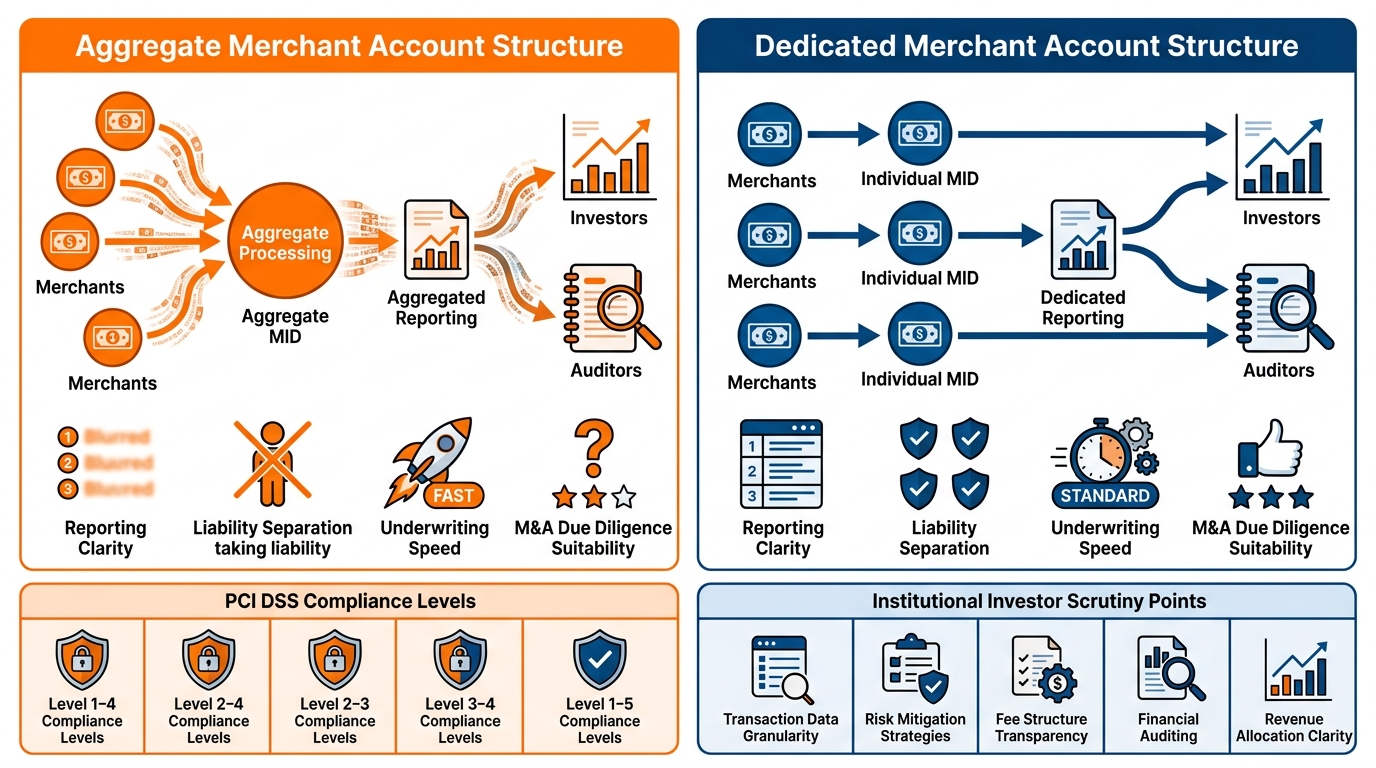
Merchant account structure comparison for M&A due diligence
For acquirers and investors, the distinction between pooled and segregated payment accounts can make or break a quality-of-earnings analysis.
Aggregate vs. Dedicated Merchant Accounts
When evaluating a merchant account provider, CFOs must consider how account architecture affects M&A readiness. Aggregate accounts, where multiple merchants share a single MID, offer fast onboarding but pool transaction data across unrelated businesses. This makes it nearly impossible for an acquirer to isolate the target’s true revenue stability or chargeback ratios. Dedicated accounts, by contrast, issue a unique MID, providing transparent settlement reports that satisfy institutional investor diligence requirements. Chargeback liability in aggregate structures is often shared across the pool, whereas dedicated accounts isolate exposure to the individual merchant — a critical distinction for companies in high risk credit card processing sectors, where precise risk assessment matters.
The choice between aggregate and dedicated accounts has direct implications for financial reporting and investor diligence.
| Feature | Aggregate Account | Dedicated Account |
|---|---|---|
| Account Structure | Multiple merchants share a single merchant ID (MID) | Merchant receives its own unique MID |
| Underwriting | Light; based on aggregator’s master application | Full; based on the business’s own financials and risk profile |
| Reserve Requirements | Lower; reserves held at aggregator level | Higher; reserves tailored to the merchant’s risk level |
| Approval Speed | Fast (hours to 2 days) | Slower (1-4 weeks) |
| Best For | Low-volume, low-risk startups testing payment models | Medium to high-volume growth companies and those preparing for M&A due diligence |
A dedicated MID gives acquirers the granularity to verify cash-flow consistency and uncover anomalies that would be invisible in a pooled environment. For sellers, making the switch well before a transaction strengthens the narrative of a stable, auditable revenue stream — a vital element of any credible data room.
Underwriting Changes During Capital Formation
As a company raises capital, merchant underwriting requirements intensify. Underwriters typically request updated financials, background checks on new investors, and may impose higher reserve levels, adding weeks to the timeline. A change of control — which often occurs during a majority investment or acquisition — triggers full re-underwriting by the acquiring processor, potentially halting payment processing for one to four weeks. At Zaidwood Capital, we advise clients to engage their processor early in capital discussions and build these underwriting lags into the deal schedule. Without proactive planning, the sudden disruption of incoming payments can create liquidity pressures that threaten closing.
PCI Compliance and Security Standards for Institutional Investors
Institutional investors treat PCI DSS compliance as a proxy for operational maturity. The standard defines four merchant levels based on annual volume; Level 1 (over 6 million transactions) requires an annual onsite audit, while Levels 2-4 require an annual SAQ. Demonstrating Level 1 or consistent Level 2 compliance signals rigorous data-security governance. For businesses involved in B2B payment processing — where transactions are large and sensitive — this scrutiny is especially acute. A compliant infrastructure reduces fraud risk and removes a common diligence objection, but it is not a guarantee of deal success. We recommend that companies maintain current SAQ documentation and, where volume warrants, pursue Level 1 certification ahead of a sale process to accelerate investor confidence.
Best Practices for Merchant Account Selection and B2B Payment Integration
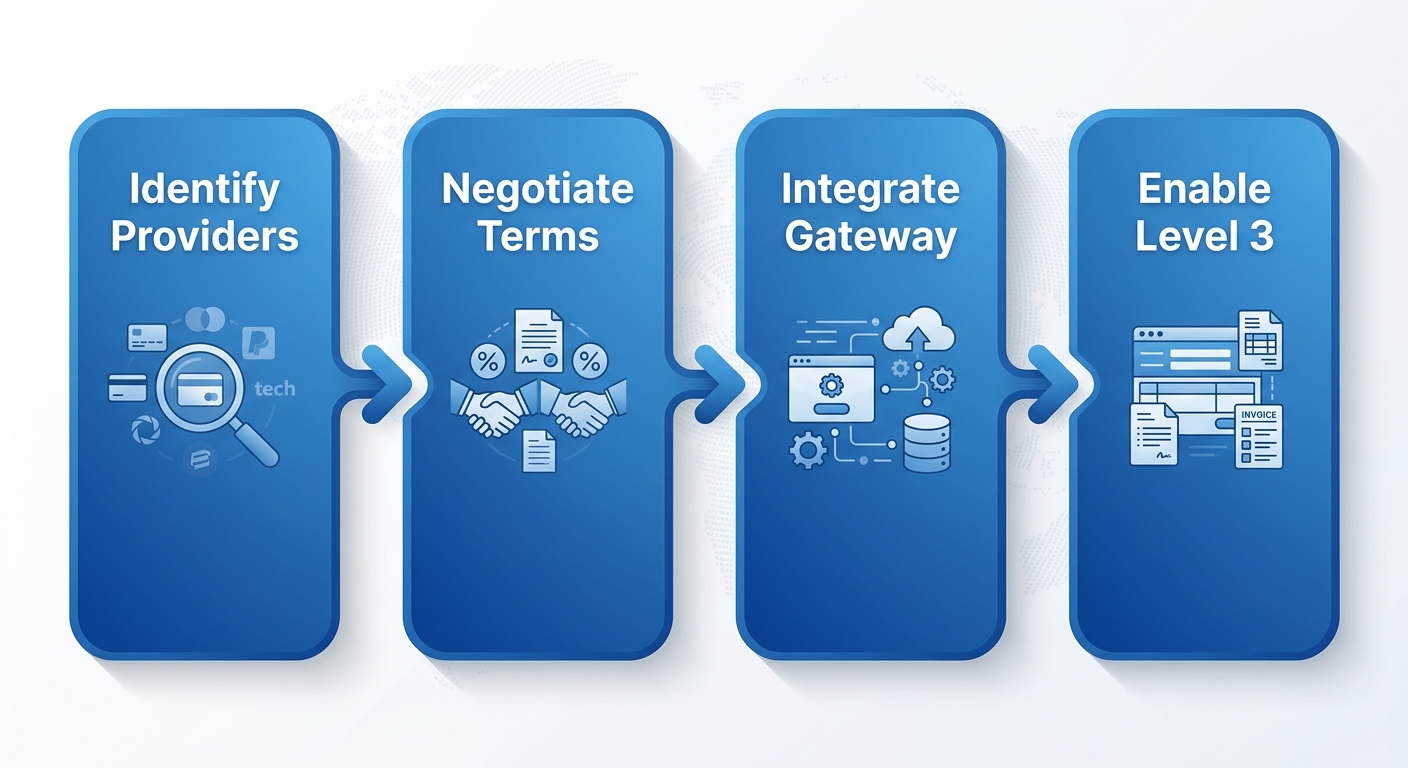
Selecting the right merchant account provider is a foundational step for any enterprise, yet the evaluation process becomes significantly more complex for high-risk industries such as energy, commodities, or international trade. A misaligned processing partner can lead to frozen funds, unpredictable reserve requirements, and operational friction that directly undermines growth. In our experience advising growth-stage and mid-market firms, we have observed that a structured, criteria-driven approach to provider selection, combined with deep integration and optimized data handling, transforms payment processing from a cost center into a strategic asset. We recommend a systematic evaluation across three dimensions: risk compatibility, ERP integration capability, and support for Level 3 data optimization.
Four-step process for merchant account selection and payment integration
Navigating High-Risk Processing Requirements
For businesses operating in sectors frequently categorized as high-risk, finding a qualified processor requires more than comparing rates. We advise starting with a diagnostic framework that probes a provider’s client retention metrics and the transparency of their reserve policies. Red flags include an unwillingness to discuss rolling reserve structures in writing, limited experience with your specific business model, or a history of abrupt account terminations. Effective negotiation for high risk credit card processing terms centers on presenting a compelling, data-backed case for minimizing holdback percentages. We recommend compiling historical chargeback ratios well below industry thresholds, certified financial statements demonstrating operational stability, and a clear narrative explaining transaction flows. A processor that genuinely understands your business model recognizes that arbitrary freezes or excessive reserves stifle your working capital rather than simply mitigating their risk. We prioritize providers who demonstrate sector-specific expertise and offer graduated reserve reductions tied to processing history milestones.
Integrating Payment Processing with ERP Systems
Modern B2B payment processing should function as a seamless extension of your financial infrastructure, not a disconnected workflow requiring manual intervention. When evaluating a provider’s integration capabilities, we focus on the availability of robust APIs that synchronize settlement data directly with enterprise resource planning (ERP) platforms such as NetSuite, QuickBooks Enterprise, or SAP. The primary objective is to automate reconciliation, eliminating the labor-intensive process of matching batch settlement reports against open invoices. We look for gateways that deliver real-time cash flow visibility by posting authorized transactions, settlements, and chargebacks into the general ledger as they occur. During the selection process, we recommend requesting a technical discovery session to assess the provider’s existing native integrations and the responsiveness of their API documentation. Key evaluation criteria include support for automated clearing house (ACH) and wire settlement file formats compatible with your ERP’s import modules, the ability to map custom transaction fields to your chart of accounts, and the availability of sandbox environments for testing. A well-integrated gateway reduces period-end close timelines and provides controllers with a continuously accurate picture of liquidity.
Optimizing Cash Flow with Level 3 B2B Processing
Level 3 processing offers substantial interchange fee reductions for qualifying B2B and business-to-government transactions by transmitting enriched line-item detail through the payment network. To qualify, you must be a business accepting corporate, purchasing, or government cards and your processing system must capture and pass additional data elements including item descriptions, quantities, unit prices, freight amounts, and duty or tax values at the point of sale. We recommend implementing Level 3 processing through a systematic checklist: first, confirm that your ERP or sales platform can export the required line-item fields; second, verify that your payment gateway maps these fields to the correct interchange message specifications; third, perform test transactions with a small subset of corporate cards to validate that the enhanced data is being recognized and the reduced interchange rates applied. The interchange savings, often between 0.5 and 1.0 percent below standard rates for qualified transactions, compound significantly for businesses with high average transaction values.
| Feature | Standard Merchant Account | High-Risk Merchant Account |
|---|---|---|
| Account Structure | Aggregate (pooled) or dedicated; low reserve holdback | Typically dedicated with higher reserve requirements (10-15%) |
| Underwriting Process | Streamlined; credit score + basic business documents | Extended; requires financial statements, processing history, and business plan |
| Reserve Requirements | Low or no rolling reserve; 5-7% holdback for 90 days | Rolling reserve of 10-15% for 180 days; fixed reserve possible |
| Approval Timeline | 24-72 hours | 1-4 weeks |
| Typical Fees | Interchange + 0.25-0.50%; monthly minimum $10-25 | Interchange + 0.75-1.50%; monthly minimum $25-50; application fee often applies |
Beyond the direct cost savings, the granular data captured through Level 3 processing materially strengthens financial reporting and forecasting. Automated reconciliation with line-item matching accelerates month-end close and provides treasury teams with precise, real-time visibility into cash inflows categorized by customer, product, or region. This level of financial clarity and control makes a company significantly more attractive to acquirers and investors. When we engage on energy mergers and acquisitions advisory assignments, the quality of a target’s financial operations data directly influences valuation. Companies that have invested in optimized B2B payment processing infrastructure, including Level 3 data capture, present cleaner, more auditable financials that withstand diligence scrutiny and justify premium valuations. We encourage management teams to view payment optimization not merely as an operational efficiency project but as a value-creation initiative with measurable M&A upside. This material is for informational purposes only and does not constitute an offer or solicitation.
Advanced Payment Infrastructure Considerations for Institutional Investors
Building on our Full-Cycle M&A framework, we now turn to the specific payment infrastructure considerations that institutional investors must evaluate. For institutional investors, selecting a merchant account provider that supports high-volume B2B payment processing is critical–particularly when deals span borders, currencies, and complex regulatory regimes. Whereas traditional institutions–best understood by asking what is an investment bank–often rely on legacy payment rails, Zaidwood Capital provides technology-driven solutions tailored to institutional demands.
Our Sovereign Data Nexus establishes a secure, transparent data environment that underpins payment verification and audit trails during M&A engagements. It integrates directly with transaction flows, giving investors and their compliance teams real-time visibility into capital movements. This architecture ensures that every payment instruction is logged, reconciled, and readily accessible for regulatory review–a critical capability when deploying significant capital across multiple jurisdictions.
Precision Catalyst further enhances payment infrastructure by connecting our engagement platform with leading merchant account providers and payment gateways. This integration streamlines the commitment-to-funding transition: once an investor signals intent, the system orchestrates capital flows with minimal friction. It supports high risk credit card processing and B2B payment processing through robust compliance protocols, allowing institutional investors to manage transaction risk without sacrificing speed.
Finally, the Velocity Matrix accelerates settlement cycles for high-risk and B2B payment flows, reducing the days required to close critical transactions. By optimizing routing and leveraging our private server infrastructure, it cuts through the latency that often plagues cross-border capital deployments. This capability is especially valuable when time-sensitive deal execution demands near-instantaneous fund availability.
These payment capabilities, paired with our Sovereign Data Nexus and Precision Catalyst, create a seamless capital deployment cycle–a theme we explore further in client outcomes.
Disclaimer: This website is for informational purposes only and is not an offer, solicitation, recommendation, or commitment to buy or sell any security. Securities are offered through Finalis Securities LLC; Zaidwood Capital is not a registered broker-dealer. Investments involve risk and are not guaranteed to appreciate; investors may lose all or part of their investment. Consult with legal, tax, and financial advisors or a registered representative before making investment decisions. Past performance does not guarantee future results.
Frequently Asked Questions About Merchant Accounts in M&A Contexts
Below are answers to frequently asked questions about merchant accounts in M&A transactions.
What happens to a merchant account when the business is sold? A merchant account is generally not an asset that automatically transfers with a sale. Buyers should coordinate with the existing merchant account provider–or a new merchant services provider–to establish their own processing relationship post-close.
How does M&A due diligence evaluate high-risk credit card processing agreements? When a target operates in a high-risk credit card processing setup, due diligence examines processing history, chargeback ratios, and reserve requirements. High-risk accounts often require re-underwriting if control changes, as an acquiring bank reassesses the risk profile of the new ownership.
Can B2B payment processing terms change after a merger? Yes. In a B2B payment processing environment, a merger can trigger contract reviews. Processors frequently require renegotiation or a new application for business-to-business processing services because terms were originally underwritten against the pre-merger entity.
Building M&A-Ready Payment Infrastructure
We consider partnering with a merchant account provider that offers compliant and scalable payment processing as a concrete step toward an M&A-ready business. Features like real-time transaction reporting and automated reconciliation prepare the finance function for rigorous due diligence. For companies in high-risk industries, high risk credit card processing underscores regulatory maturity and stability. We note that scalable B2B payment processing capabilities, including recurring billing and enterprise invoicing, demonstrate operational sophistication that acquirers value. In our experience, an integrated payment infrastructure reduces buyer risk, streamlines post-merger integration, and can meaningfully increase a company’s valuation.


