



Point Of Sale Systems
Table of Contents
Point of Sale Systems and M&A Valuation
In M&A valuation, point of sale systems have evolved from simple transaction recorders into strategic assets that directly influence how acquirers price a deal. We view a modern, cloud based POS as compelling evidence of operational maturity that can justify a premium valuation.
A cloud-based platform provides real-time sales data that reduces revenue uncertainty, allowing our team to build more accurate discounted cash flow models. This analytical precision is further enhanced when the POS is integrated with robust inventory management software, such as NetSuite, which provides granular data on turnover and shrinkage, strengthening asset valuations. Additionally, verified sales data from the POS system streamlines B2B payment processing, enabling buyers to quickly confirm revenue and substantially reduce perceived transaction risk.
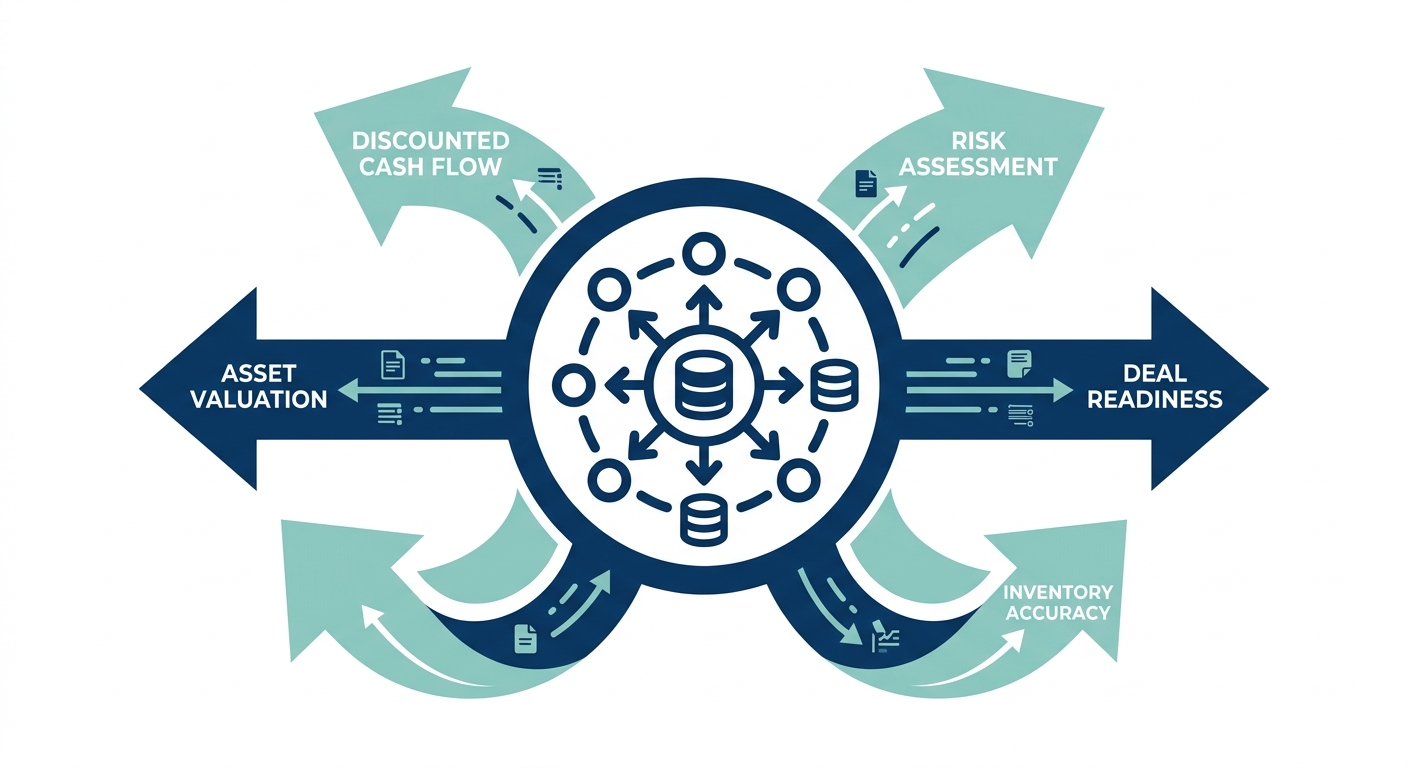
Cloud POS data streams powering M&A financial valuations
An acquirer interprets this integrated data environment as a sign of a well-managed, transparent business. For companies preparing for an exit, the quality of POS data is therefore a foundational component of deal readiness, directly linking operational technology to a more confident and efficient M&A process.
Square
Unlike traditional systems, Square’s cloud-based model reduces costs and simplifies expansion.
Overview
When assessing retail acquisition targets, we examine point of sale systems like Square. Its cloud-based POS architecture supports scalable growth with minimal upfront costs–a key due-diligence factor for tech mergers and acquisitions.
Features
For M&A due diligence, key Square features include:
- Multi-location reporting consolidating sales into a unified P&L view.
- Direct integration with accounting software like QuickBooks for audit-ready records.
- Real-time sales data accessible anywhere for on-the-spot performance checks.
- Inventory sync powered by inventory management software ensuring stock accuracy.
- Offline transaction processing, capturing sales when connectivity fails.
Pricing
Square’s pricing combines per-transaction fees and optional monthly plans. This creates predictable recurring revenue, a positive signal in our acquisition analysis and financial modeling.
Pros/Cons
From an acquirer’s perspective, Square offers notable advantages and limitations:
Pros
- Scalability: easily add locations without heavy infrastructure costs.
- Offline mode: transactions continue without internet, syncing later.
- Ecosystem: all-in-one hardware, payments, and analytics integration.
Cons
- Transaction fees can be high for high-volume businesses, compressing margins.
- Limited advanced inventory features such as BOM or lot tracking.
We weigh these trade-offs during target evaluation.
Best For
Square is ideal for small to mid-size retailers with one to a moderate number of locations. Its affordable, cloud-first POS delivers an all-in-one solution that scales with growth. This aligns well with many targets we evaluate.
While Square suits growing retailers, larger enterprises may need a more robust platform.
Shopify POS
Overview
Shopify POS is a cloud-based omnichannel point of sale solution that unifies online and in-store sales for retail businesses. Its adoption streamlines operations and is a key consideration in M&A due diligence. We evaluate such systems for operational efficiency and scalability.
Features
As a cloud based pos, Shopify POS offers real-time inventory sync and detailed customer profiles, crucial for due diligence. Integration with inventory management software and ERP systems like Microsoft Dynamics 365 Business Central, a leading solution per Microsoft, streamlines operations. This enables seamless data flow, reduces manual errors, and supports accurate financial forecasting during M&A evaluations. It also offers customizable reporting, vital for assessing a target’s operational readiness.
Pricing
Pricing comprises monthly tiers (Basic $39, Retail $89, Advanced $399) and processing fees, affecting a target’s cost structure and due diligence assessments.
Pros/Cons
Pros include a robust ecosystem, scalability, and strong reporting that aid informed M&A decisions. Cons include platform dependency and extra costs for premium features. Shopify POS is a robust system that scales with growing retail operations, making it a frequent consideration in tech mergers and acquisitions. It remains a prominent choice among point of sale systems for due diligence. However, businesses should weigh these trade-offs carefully.
Best For
Best suited for mid-market retailers already on Shopify e-commerce, seeking seamless omnichannel and multi-store management. We recommend assessing its fit with a target’s existing tech stack and growth plans during due diligence. This ensures alignment with operational needs and transaction objectives.
Lightspeed Retail
Overview
As a leading cloud-based point of sale system, Lightspeed Retail serves mid-market specialty retailers across 50,000+ locations. In healthcare mergers and acquisitions, POS data reliability drives due diligence; Lightspeed’s reporting provides necessary detail (securities offered through Finalis Securities LLC, Zaidwood Capital not a registered broker-dealer).
Features
Lightspeed’s advanced inventory management software, uncommon among point of sale systems, provides real-time stock counts across multiple locations, reducing the need for manual adjustments in pro forma financials and improving EBITDA accuracy. Supplier management with purchase order automation streamlines cost tracking, delivering cleaner expense data for margin analysis. Additionally, multi-location analytics, covering sales performance by store and employee, enable acquirers to benchmark operational efficiency and identify underperforming units, which can materially affect valuation models.
Pricing
Lightspeed’s Starter, Standard, and Advanced tiers run $69-$259/month, plus payment processing and hardware; add-ons drive total cost significantly, requiring careful EBITDA forecasts.
Pros/Cons
On the plus side, Lightspeed provides granular inventory control with real-time lot and serial number tracking, strong multi-store support via a unified dashboard and cross-location transfers, and an open API for custom integrations. However, the full feature set comes at a higher cost than entry-level POS systems, and its deep configuration options create a steeper learning curve for staff, potentially increasing training time.
Best For
Lightspeed best fits mid-market retailers with 5+ locations, complex inventory (apparel, sporting goods), and $2M+ revenue, not single stores or large enterprises. While excellent for this niche, smaller operators may need simpler solutions, which we examine next.
Comparing POS Systems for M&A Due Diligence
To evaluate which POS system best supports due diligence, we compare three major cloud-based point of sale systems–Square, Shopify POS, and Lightspeed Retail–across features critical for acquisition assessments. The table below contrasts these platforms on cloud architecture, multi-location support, inventory depth, offline mode, pricing, and ERP integration, factors that directly influence data reliability.
| Feature | Square | Shopify POS | Lightspeed Retail |
|---|---|---|---|
| Cloud-Based | Yes | Yes | Yes |
| Multi-Location Support | Limited (advanced paid add-on) | Yes (per location fee) | Yes (included) |
| Inventory Management Depth | Basic | Moderate | Advanced |
| Offline Mode | Yes (basic) | Yes (limited) | Yes (full) |
| Pricing Model | Per-transaction + monthly options | Monthly subscription + processing fees | Monthly subscription (tiered) |
| Integration with Accounting/ERP | Yes (QuickBooks, Xero) | Yes (QuickBooks, NetSuite via apps) | Yes (QuickBooks, NetSuite native) |
Square’s multi-location support requires a paid add-on, potentially complicating data aggregation for multi-unit acquisitions. All three are cloud based pos systems, ensuring centralized access, but offline capabilities vary: Lightspeed’s full offline mode provides more complete sales records during connectivity interruptions than Shopify’s limited mode. For inventory valuation, Lightspeed’s advanced inventory management software offers granular product-level data that acquirers can rely on. According to Oracle NetSuite’s documentation, Lightspeed Retail integrates natively, streamlining financial data extraction, while Shopify relies on third-party apps for connectivity with enterprise systems like Microsoft Dynamics 365 Business Central, adding an extra verification step.
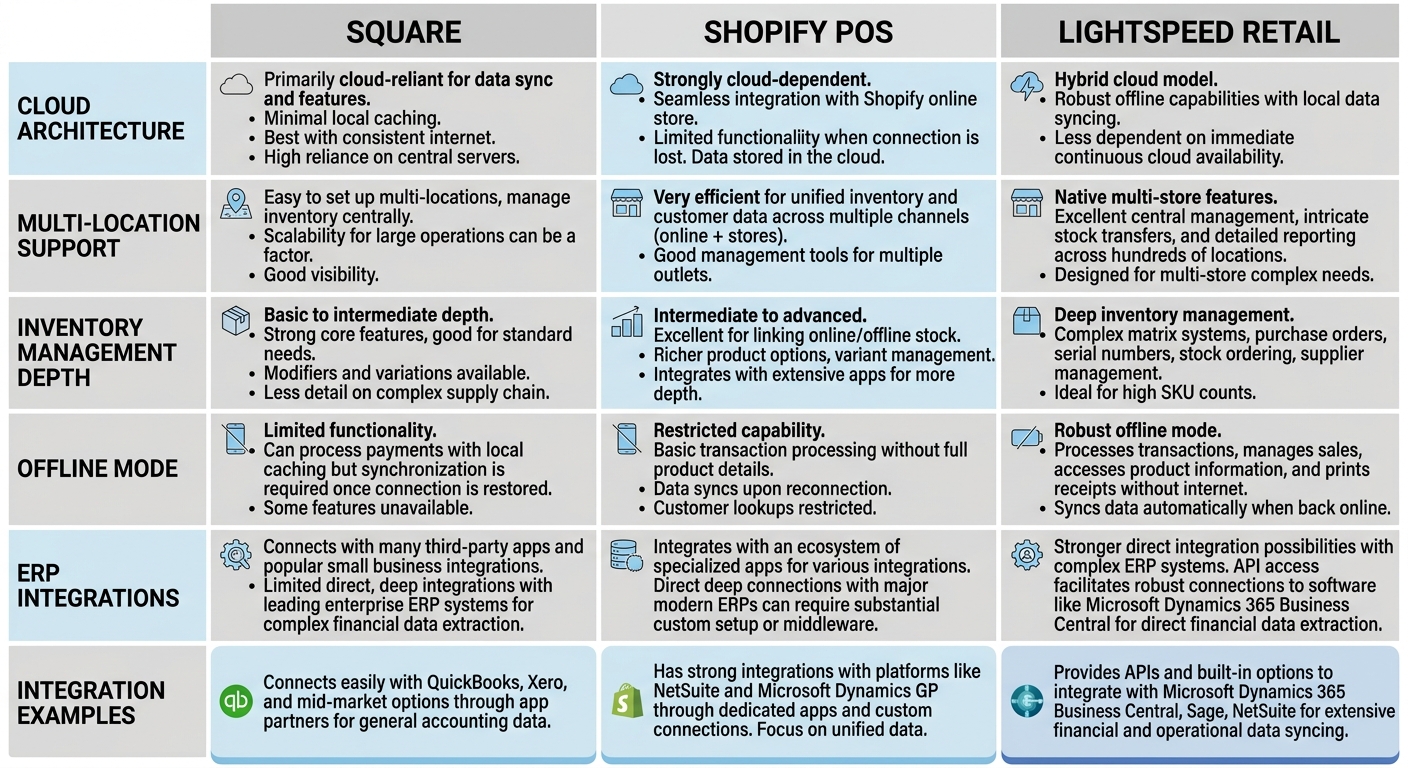
Three-column POS comparison for M&A due diligence analysis
For firms in the energy sector, our energy mergers and acquisitions advisory provides specialized support in evaluating POS data during due diligence. This comparison provides a framework for assessing data reliability; the following section details how to extract and verify POS data for valuation purposes.
Leveraging POS Data in Acquisition Transactions
Beyond high-level digital trends, a rich data source resides in the point of sale systems of target businesses. In M&A due diligence, POS data offers transaction-level visibility that independently verifies seller-reported financials, providing acquirers with confidence in revenue quality.
Modern cloud based pos platforms capture granular sales data, customer histories, and real-time inventory movement. Combined with inventory management software, the resulting metrics reveal turnover rates and demand patterns essential for operational due diligence. Bepbackoffice confirms these systems centralize transaction and SKU data, while payment processors like Stellar Payments provide settlement streams that independently corroborate revenue claims. POS data is increasingly scrutinized in healthcare mergers and acquisitions, where revenue cycle accuracy is critical.
At Zaidwood Capital, our Sovereign Data Nexus methodology processes POS datasets to validate revenue streams and uncover operational risks before they surface in negotiations. This granular analysis feeds directly into the valuation frameworks our team deploys throughout the transaction lifecycle.
Resources


