


Sell Side Investment Bank
Table of Contents
Unlocking Value Through Sell Side Investment Banking
When it comes to selling a business, a sell side investment bank can unlock significant value by representing owners throughout the transaction. To fully appreciate what a sell-side advisor does, it is helpful to first understand what is an investment bank.
Preparation often begins with a quality of earnings report to validate financials, ensuring the numbers withstand buyer scrutiny. A sell-side engagement then focuses on strategy, valuation, buyer targeting, and negotiation, unlocking value through competitive bidding, accelerated timelines, and minimized risk. As Bonadio Group, a professional CPA firm, explains, the process coordinates the investment banker, CPA, and legal counsel to present a comprehensive financial and operational package to prospective buyers.
We at Zaidwood Capital orchestrate the full cycle with a boutique approach. Specializing in middle market M&A advisory, our team uses proprietary tools–Sovereign Data Nexus and Precision Catalyst–to surface hidden buyers and institutional investors. With access to 4,000+ investors and $15B+ in committed capital, we accelerate deal closure and maximize exit value for business owners.
By partnering with a specialist sell-side advisor, owners gain a structured, high-touch process that reduces risk and enhances valuation. Understanding how we orchestrate this for business owners unlocks the full benefit of a full-cycle sell-side engagement.
The Sell Side Investment Banking Process and Key Roles
A core service we offer is Sell Side Advisory. When a business owner decides to exit, engaging a sell side investment bank or advisory firm can streamline the entire transaction and help maximize value. At Zaidwood Capital, we guide middle-market companies through a structured sell-side process that encompasses preparation, buyer outreach, auction management, and negotiation to close. With deep experience in private-company M&A, our team acts as a trusted advisor from initial valuation to final execution.
The sell-side process unfolds in several distinct phases. We begin with thorough preparation, building a detailed financial model and normalizing earnings to present the company in its best light. A quality of earnings report is often commissioned during this stage to substantiate adjusted EBITDA and give prospective buyers confidence. For middle market M&A advisory engagements, we tailor marketing materials to highlight the company’s unique value proposition. Next, we confidentially solicit interest from a curated list of strategic and financial buyers, leveraging our extensive network. We then manage a competitive auction to drive valuation and select the strongest suitor. Throughout negotiation and closing, we advocate for optimal structure and terms while coordinating legal and diligence workflows.
As a sell-side advisor, our team serves as the quarterback of the transaction, coordinating due diligence, advising on valuation, and maintaining strict confidentiality. We interface with legal counsel, accountants, and tax advisors to keep the deal on track. We also leverage our proprietary data platform, Sovereign Data Nexus, to deliver granular market insights. Importantly, Zaidwood Capital is not a registered broker-dealer. Any securities transactions are facilitated through Finalis Securities LLC, an independent registered broker-dealer. Our role is purely advisory, focused on strategy and negotiation, not on executing securities trades.
The following table highlights the fundamental differences between sell-side and buy-side investment banking.
| Aspect | Sell Side | Buy Side |
|---|---|---|
| Primary Client | Company owner, founder, or seller | Acquirer, private equity, or corporate buyer |
| Objective | Maximize sale price, find ideal buyer, achieve optimal terms | Acquire target at best value, execute investment thesis |
| Key Activities | Seller preparation, buyer outreach, auction management, negotiation | Target sourcing, due diligence, valuation, financing, integration |
| Buyer / Target Pool | Strategic buyers, financial sponsors, family offices | Any company meeting acquisition criteria |
| Advisor Compensation | Typically a retainer + success fee upon closing | Retainer + success fee or hourly (varies widely) |
In our sell-side engagements, we exclusively represent the seller, managing every phase to secure optimal terms while minimizing disruption to the business. This distinction underscores the specialized expertise required to navigate either path. Our team’s deep experience in seller-side transactions ensures we can anticipate buyer concerns and craft persuasive narratives that maximize enterprise value.
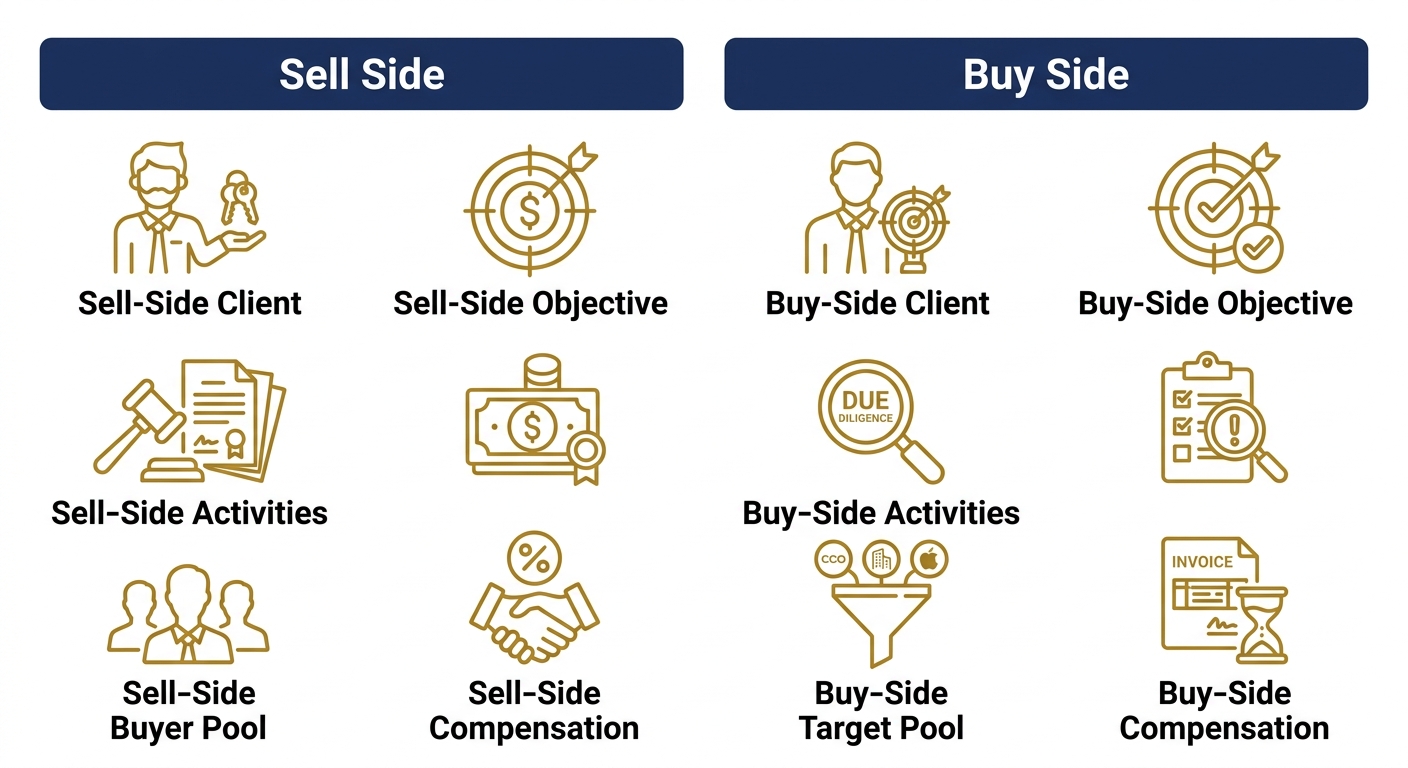
Sell-side vs buy-side investment banking roles comparison
Maximizing Valuation Through Sell Side Strategies
Building on our sell-side advisory approach, we now detail specific strategies to maximize valuation. For owners considering a sale, understanding what is an investment bank and how a sell side investment bank operates is the first step toward realizing optimal value. Our Sell-Side Advisory enhances value through rigorous preparation and strategic buyer outreach.
Valuation Drivers in Sell Side M&A
Maximizing valuation begins with a clear understanding of the financial and strategic factors that influence EBITDA multiples. Several adjustments can meaningfully increase normalized EBITDA and enterprise value.
- Normalizing EBITDA: Common add-backs include owner compensation above market, non-recurring legal or consulting fees, and discretionary expenses, reflecting the business’s true earnings power.
- Revenue diversification: According to Voisard Group, companies with a diversified customer base command higher multiples than those reliant on a few accounts, ideally with no single customer representing more than 15-20% of revenue.
- Growth narrative: A compelling growth story and defensible market position justify a premium valuation, especially when backed by robust financial projections.
Intangible assets such as proprietary technology and strong customer contracts also add significant value. Prior to marketing, we help owners prepare audited financial statements that substantiate the normalized earnings. These financial enhancements, synthesized into a confidential information memorandum, tend to increase final transaction value when paired with a strategic buyer-sourcing process.
Strategic vs. Financial Buyer Sourcing
To achieve the highest possible transaction value, we expand the buyer universe through a competitive auction process that targets both strategic and financial acquirers. Strategic buyers — typically seeking operational synergies — often pay 10-20% higher multiples than financial buyers. Drawing on our middle market M&A advisory expertise, we design a multi-channel outreach that includes direct solicitation, curated lists, and cross-border introductions. This competitive dynamic is the primary mechanism for maximizing buyer interest and deal terms. Financial buyers focus on cash-flow stability; we market to sponsors with sector-specific expertise to heighten competition. Cross-border outreach opens the door to international acquirers who often assign a higher strategic premium. By creating a controlled auction environment with multiple bidders, we generate negotiating leverage and tension. To support this process, we coordinate a secure data room and manage buyer inquiries, ensuring only qualified parties advance. This structured approach is designed to maximize value for our clients.
The Role of the Quality of Earnings Report
A quality of earnings report is a critical tool in the sell-side process, providing third-party validation of a company’s financial performance and strengthening buyer confidence. Prepared by an independent CPA firm — not the sell-side advisor — the QoE report ensures objectivity and typically covers three years of financial statements along with a trailing twelve-month analysis. As outlined by B Demerson, it identifies normalized EBITDA adjustments, analyzes working capital trends, and confirms the sustainability of earnings. The report acts as a bridge between the seller’s adjusted EBITDA and the buyer’s perception of sustainable earnings, providing a factual foundation for price negotiations. By addressing potential concerns before due diligence begins, the report can accelerate the timeline and support a higher valuation. Commissioning a quality of earnings report early is designed to maximize credibility with prospective buyers. This independent validation also streamlines the due diligence process, saving time and reducing closing risk. For middle-market companies, a QoE can be the difference between a smooth transaction and a failed deal. As a Boutique M&A and Capital Advisory Firm, we recommend early QoE engagement to uncover and fix gaps.
These strategies form the foundation of a successful sell-side process, which we execute through our full-cycle M&A framework.
Preparing for a Sell Side Engagement: Documents, Timelines, and Buyer Outreach
Preparing for a sell side investment bank engagement requires meticulous organization. Our Sell Side Advisory Services provide a dedicated partner to coordinate every aspect–from document assembly to buyer outreach–demystifying the complexity into a clear, actionable roadmap.
Key Documents for Sell Side Preparedness
A successful sell-side engagement relies on a comprehensive suite of materials that present the company’s financial health, operations, and growth potential. We work with clients to compile and refine the following critical documents:
- Confidential Information Memorandum (CIM): The primary marketing document detailing the company’s history, market positioning, competitive advantages, strategy, and historical financial performance–captivating both strategic and financial buyers.
- Quality of Earnings Report: An independent examination, usually conducted by an outside accounting firm, that normalizes EBITDA and validates the sustainability of recurring profits. We coordinate the quality of earnings report’s preparation and weave its findings into the investment thesis.
- Audited and Projected Financials: Three to five years of audited statements plus forward-looking management projections that give buyers confidence in past trends and future assumptions.
- Management Presentation: A concise slide deck highlighting the company’s investment merits, operational metrics, and strategic roadmap, designed for in-person and virtual buyer meetings.
- Virtual Data Room: A secured digital hub for all due diligence materials–contracts, IP, compliance records–configured with role-based access to maintain confidentiality throughout the diligence phase.
These materials form a credible, buyer-ready narrative that accelerates serious engagement.
Timeline and Milestones in a Sell Side Process
Most middle-market sell-side engagements span approximately four to six months, a range supported by industry benchmarking data from Firmex. We break the process into four structured phases, with weekly status calls to maintain alignment and address issues proactively.
- Preparation (4-6 weeks): Assemble all documents, finalize the CIM, coordinate the QofE review, and configure the data room. Our team ensures every element is ready for launch.
- Marketing (4-8 weeks): Execute targeted outreach via our proprietary platforms, distribute the CIM under NDA, and manage initial buyer inquiries. We filter responses to identify the most promising leads.
- Negotiation & Letters of Intent (2-4 weeks): Field indicative offers, narrow the buyer pool, and negotiate key terms including price, structure, and exclusivity before signing an LOI.
- Due Diligence & Closing (4-8 weeks): Facilitate the buyer’s confirmatory diligence, coordinate legal and accounting workstreams, and finalize the purchase agreement. Actual duration depends on deal complexity and regulatory requirements.
Throughout each phase, our disciplined cadence of communication keeps stakeholders informed and decisions aligned, transforming what can be a tense sell side investment banking process into a collaborative, well-orchestrated journey.
Sourcing and Engaging Potential Buyers
Effective buyer outreach demands a structured, intelligence-led approach. We categorize potential acquirers into three primary groups to tailor our messaging and maximize competitive tension.
- Strategic buyers: Industry competitors or adjacent players seeking synergies, market expansion, or new capabilities. Our outreach emphasizes strategic fit without revealing sensitive details early.
- Financial sponsors: Private equity firms, family offices, and other institutional investors focused on value creation. Our middle market M&A advisory expertise ensures the financial buyer pool is meticulously targeted and investment theses align with company characteristics.
- Cross-border acquirers: International firms aiming for US market entry or geographic diversification. Navigating cultural and regulatory nuances requires a globally connected advisor.
As a Boutique M&A and Capital Advisory Firm, we leverage our proprietary Sovereign Data Nexus platform and Precision Catalyst engine to identify the most synergistic acquirers, while controlled data room access preserves confidentiality. Only serious, qualified parties advance to detailed discussions.
Once the stage is set with complete documents and an engaged buyer pool, the next critical step is determining the appropriate valuation threshold.
Advanced Strategies: Leveraging Proprietary Platforms for Sell Side Success
Moving beyond conventional approaches, a sell side investment bank today harnesses proprietary platforms to differentiate its advisory services. At Zaidwood Capital, we pair decades of transactional experience with data intelligence and AI to deliver faster, more targeted outcomes for middle-market business owners. This fusion of technology and expertise transforms the traditional sell-side M&A process into a more competitive and transparent engagement.
Our proprietary platforms–Sovereign Data Nexus, Precision Catalyst, and Velocity Matrix–form the core of our advanced sell-side advisory.
- Sovereign Data Nexus aggregates and analyzes intelligence on over 4,000 institutional investors, enabling us to identify the most likely acquirers for a given middle-market company based on corporate development criteria, sector interest, and past transaction behavior.
- Precision Catalyst applies AI-driven matchmaking to connect sell-side companies with the most compatible investors, streamlining outreach and dramatically increasing the probability of competitive tension.
- Velocity Matrix is a rapid-execution framework that compresses the typical 12-18 month sell-side timeline into a structured, accelerated process without sacrificing due diligence rigor.
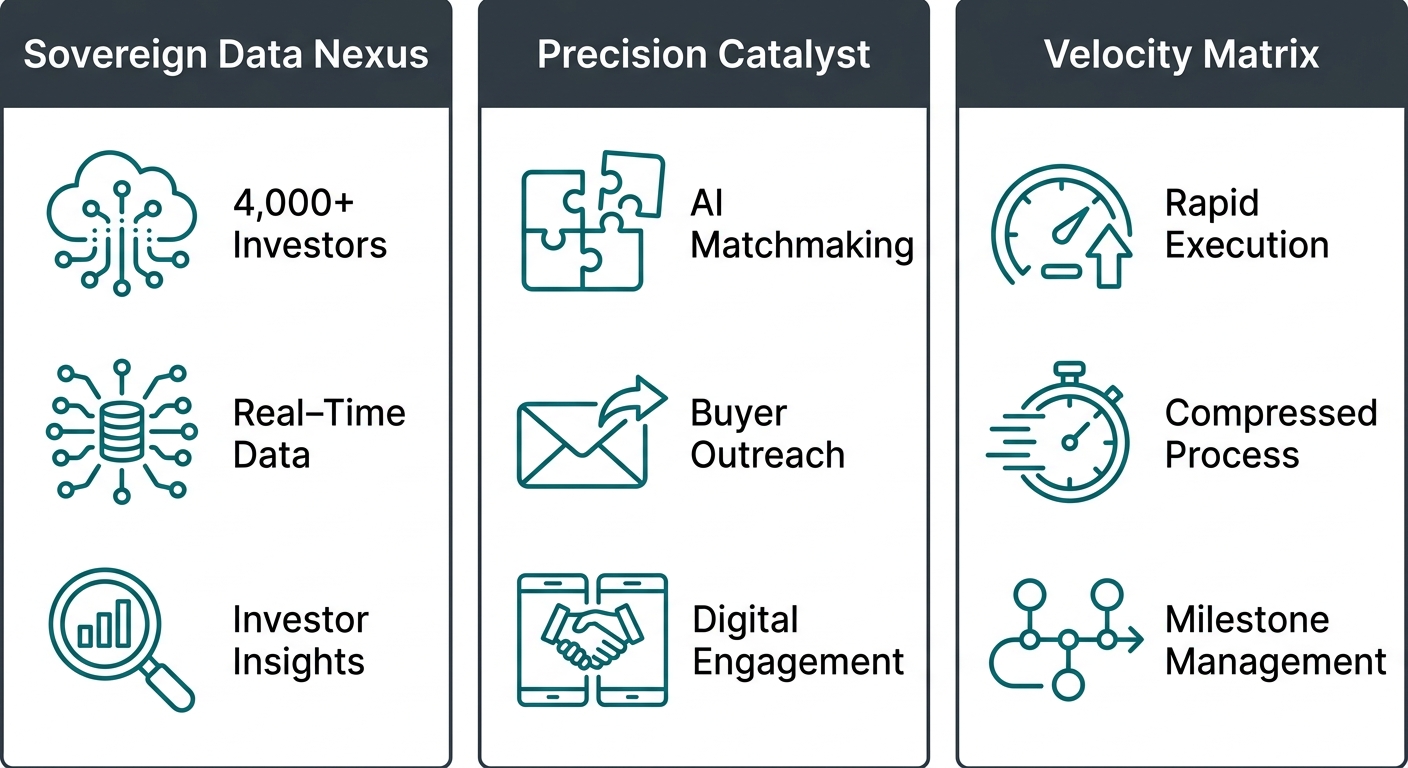
Zaidwood Capital proprietary platforms for accelerated sell-side execution.
By integrating these platforms, a sell side investment bank can provide clients with a data-enriched buyer universe and a streamlined execution path. In middle market M&A advisory, this combination often translates into stronger valuations, reduced time to close, and a more predictable process. Moreover, advanced preparation facilitated by our tools allows sellers to compile a quality of earnings report early–a critical due diligence document that reassures buyers and strengthens negotiation positioning.
As industry guidance from the Bonadio Group outlines, successful sell-side engagements rely on a coordinated team of investment bankers, accountants, and legal counsel. Our proprietary platforms complement, rather than replace, these traditional advisory roles. We equip the entire deal team with real-time data and analytics, empowering informed decisions at every stage. By leveraging our ecosystem, we also help sellers anticipate the motivations of buy-side M&A teams, fostering alignment from initial interest to closing.
In an increasingly competitive M&A environment, Zaidwood Capital’s technology-driven approach elevates sell-side advisory to a new standard, combining human judgment with data precision to deliver superior outcomes for our clients.
Frequently Asked Questions About Sell Side Investment Banking
Refer to the FAQ below for common questions.
What is a sell side investment bank?
A sell side investment bank advises companies selling their business. It manages the sale process to secure optimal terms. Learn more in what is an investment bank.
How does the sell side process work?
A sell side investment bank guides sellers through preparation, marketing, due diligence (including a quality of earnings report), and negotiation through closing. We follow a disciplined methodology without guaranteeing specific outcomes or timelines.
Who typically hires a sell side investment bank?
Middle-market companies seeking maximum sale value engage us. Our middle market M&A advisory expertise helps founders navigate complex transactions and tap into our global investor network.
Partnering with a Boutique Sell Side Advisor
At Zaidwood Capital, our approach as a boutique sell-side investment bank puts senior-level attention and flexible deal design at the core.
Our middle market M&A advisory practice leverages proprietary platforms–Sovereign Data Nexus, Precision Catalyst, Velocity Matrix–for precise valuations and rapid execution.
Our analysts conduct thorough quality of earnings report reviews to de-risk due diligence.
With access to 4,000+ institutional investors and $15B+ committed capital, we match you with the right buyers.
From initial strategy through close, we deliver full-cycle, tech-enabled, boutique advisory support.
Resources


