
Table of Contents
Evaluating Venture Debt for Your Startup
Once you understand the types of venture debt, the next step is evaluating which option fits your startup. We guide founders through a structured assessment of venture debt providers, focusing on their track record with companies at your stage and in your sector.
A detailed review of the venture debt term sheet is essential. We help you compare interest rate structures, repayment schedules, and any equity components like warrants. Our team also evaluates loan covenants, prepayment flexibility, and the added value a lender brings, such as investor introductions or the ability to support future equity rounds. We also help tailor terms to your business model.
Engaging experienced venture capital consultants provides the analytical rigor needed to navigate these complex decisions. After evaluating your options, preparing a strong application is critical to securing the right partner.
Essential Preparations Before Raising Venture Debt
Before engaging with lenders, we recommend ensuring your company is fully prepared to raise venture debt. This form of financing requires careful financial and legal groundwork to instill confidence in potential partners.
We advise our clients to assemble the following key items before initiating discussions:
- Audited Financial Statements: Prepare audited P&L, balance sheet, and cash flow statements for the past 2–3 years, plus the current interim period.
- Debt Service Capacity: Calculate a clear Debt Service Coverage Ratio (DSCR) to demonstrate your ability to comfortably cover interest payments.
- Internal Data Room: Compile a secure repository of legal documents, including your charter, bylaws, cap table, and IP assignments.
- Governance Review: Examine potential personal guarantees and confirm the board approval process required for new debt.
- Term Education: Understand that a venture debt term sheet will differ from equity; it avoids dilution but often includes warrants and financial covenants.
- Strategic Plan: Finalize your existing debt schedule, a detailed use-of-funds plan, and growth projections with sensitivity analysis.
Rushing into the process with incomplete records or an unclear plan for the capital significantly reduces lender confidence. Engaging experienced venture capital consultants can help streamline this preparation, ensuring your narrative and numbers are aligned before you approach venture debt providers.
Step 1: Assess Your Startup’s Readiness for Venture Debt
Determining whether your company qualifies for venture debt is a critical first step. As a capital solution, venture debt can extend your runway without further dilution, but lenders apply rigorous qualification standards. We focus on actionable, objective criteria to ensure you approach the process from a position of strength.
Primary readiness factors include reaching a minimum annual recurring revenue, typically $1M+ ARR, supported by positive gross margins and a clear use of proceeds. Strong year-over-year growth, often 30% or higher, and backing from an established institutional investor base are key indicators lenders evaluate. You should also review existing debt obligations to confirm there are no restrictive covenants that could conflict with new financing, and develop a detailed cash flow forecast demonstrating your ability to service the debt.
Once you have assessed your fundamental readiness, the next step is to evaluate potential venture debt providers and their term sheets. For a thorough, data-driven readiness analysis, consider engaging Zaidwood Capital’s debt advisory services.
Step 2: Understand Venture Debt Fundamentals
Once you have assessed your capital needs, the next step is to understand the fundamentals of venture debt. Venture debt is a form of debt financing provided to venture-backed companies by specialized lenders, often structured with warrants or interest-only periods. We advise clients that it is most suitable for high-growth startups needing non-dilutive capital for working capital, equipment, or bridging to an equity round without significantly diluting shareholders.
Unlike traditional bank loans, venture debt providers underwrite based on investor quality and growth trajectory rather than current cash flow or collateral. A typical venture debt term sheet we see includes a 3–4 year maturity, 5–20% warrant coverage, and covenants like minimum cash balances. Providers include banks and specialty finance companies. For regulatory guidance, refer to the SEC small business capital raising resources. Understanding these fundamentals prepares you to evaluate specific venture debt offers and proceed with structuring your debt package.
Step 3: Compare Venture Debt and Equity Financing
With a clear understanding of venture debt, the next step is to compare it against equity financing. In venture debt financing, founders retain full ownership but take on fixed repayment obligations, whereas equity financing dilutes founder stakes in exchange for permanent growth capital without mandatory repayment. For many growth-stage companies, the decision hinges on a trade-off between long-term cost and near-term flexibility.
Equity investors typically require board seats and governance rights that can reshape strategic decisions. Venture debt providers, in contrast, rarely seek board representation, leaving founders with greater operational autonomy. The cost of equity can become substantial over time through carried interest and dilution, while venture debt carries interest and fees but preserves equity upside for existing shareholders.
The chief risk of venture debt lies in fixed payment schedules that may strain cash flow if revenue projections miss their targets. Equity financing avoids repayment pressure but permanently reduces founders’ share of future returns. Companies often use venture debt to extend runway between equity rounds or to finance specific assets, while equity is sought for foundational, long-term growth. We advise clients to review the venture debt term sheet carefully for repayment terms and covenants before committing.
For additional resources on comparing financing options, consult the SEC small business capital formation advocate. Once you determine the right fit, proceed to evaluate the venture debt term sheet and negotiate terms that align with your capital strategy.
This content is for informational purposes and does not constitute investment advice.
Step 4: Research Venture Debt Providers in the US
With your venture debt strategy in place, the next critical step is identifying the right provider. When evaluating venture debt providers in the US, we recommend using a focused checklist to narrow your search:
- Track record: Does the lender have experience with startups at your stage, particularly if you are pre-revenue?
- Industry focus: Is there a specialization in your sector or business model?
- Loan size and flexibility: Do their typical facilities match your capital needs, and what is their reputation for supporting portfolio companies during downturns?
- Terms review: Always request a sample venture debt term sheet from each shortlisted firm and scrutinize the key economic and legal provisions.
For a deeper look into how financial firms are regulated, explore the FINRA investor resources and insights page. This helps you independently verify the background of any registered entity you are considering, though Zaidwood Capital is not a registered broker-dealer.
At Zaidwood Capital, we can assist with introductions to our network of venture debt providers and support the review of term sheets, but we do not lend directly or act as a broker-dealer. Once you have shortlisted and received term sheets from two to three aligned providers, you are ready to negotiate key terms.
Step 5: Structure the Venture Debt Term Sheet
Once you have identified potential venture debt providers, the next step is to structure the venture debt term sheet with precision. A well-organized term sheet signals sophistication to lenders and accelerates the path to closing. At Zaidwood Capital, we focus on clarity around every core component to ensure your company enters negotiations from a position of strength. The key elements we always emphasize in a venture debt term sheet include:
- Interest rate (floating or fixed), typically based on a margin over a reference benchmark
- Maturity period of 3 to 4 years, aligned with your cash flow projections
- Amortization schedule that may include an interest-only period for early-stage flexibility
- Prepayment flexibility, with penalties structured only for very early exits
- Warrant coverage capped as a percentage of the loan amount to minimize equity dilution
- Financial covenants such as liquidity tests rather than restrictive EBITDA minimums
- Change-of-control provisions that protect both parties in a future sale or merger
We advise clients to tailor these terms to their growth stage. Early-stage startups benefit most when we push for lower warrants and longer interest-only periods, preserving runway. Growth-stage companies, on the other hand, often prioritize generous covenant headroom and prepayment options that support refinancing flexibility. For all borrowers, we negotiate dilution-minimizing features like milestone-based tranches that match capital deployment to actual needs, and we frequently include a most-favored-nation clause to adjust terms if your risk profile improves. Using a clean, LSTA-style format reduces ambiguity and speeds up legal drafting. With a well-structured term sheet in hand, you are ready to engage in final negotiations.
Step 6: Negotiate Covenants and Key Terms
Once the optimal lender and structure are identified, the final step is negotiating the covenants and key terms. For companies exploring venture debt, this phase determines whether a term sheet becomes a strategic asset or a constraint that limits financial maneuverability.
We work to secure terms that align with the client’s long-term financial strategy and operational flexibility. The negotiation focuses on financial covenants such as debt service coverage and loan-to-value ratios, along with reporting requirements that are common in venture debt term sheets. Lenders routinely request affirmative, negative, and financial covenants, but overly restrictive clauses can impede growth initiatives or future M&A activity.
As the client’s advisor, Zaidwood Capital drafts markups, models the impact of each covenant under various operating scenarios, and negotiates directly with venture debt providers on the client’s behalf. Our role is to protect the business from conditions that could constrain liquidity or investment capacity while preserving a competitive cost of capital.
Step 7: Close the Venture Debt Transaction
Closing a venture debt transaction marks the culmination of our structured advisory process. Once all conditions are met, the transaction moves to closing where we coordinate venture debt providers, legal counsel, and your team to execute final documents and disburse funds efficiently.
Final credit approval from the lender committee triggers the closing sequence. The venture debt term sheet becomes the binding commitment document at signing, followed by satisfaction of conditions precedent—including board resolutions, a legal opinion letter, collateral perfection filings, and insurance certificates. Borrower’s legal counsel reviews all documentation prepared by the lender’s outside counsel. At closing, origination fees, legal fees, and third-party costs are settled as negotiated in the engagement letter, and funds transfer via wire to your account according to the agreed draw schedule.
Securities transactions are executed through Finalis Securities LLC, a registered broker-dealer. Post-closing, we ensure delivery of executed promissory notes, security agreements, and closing certificates.
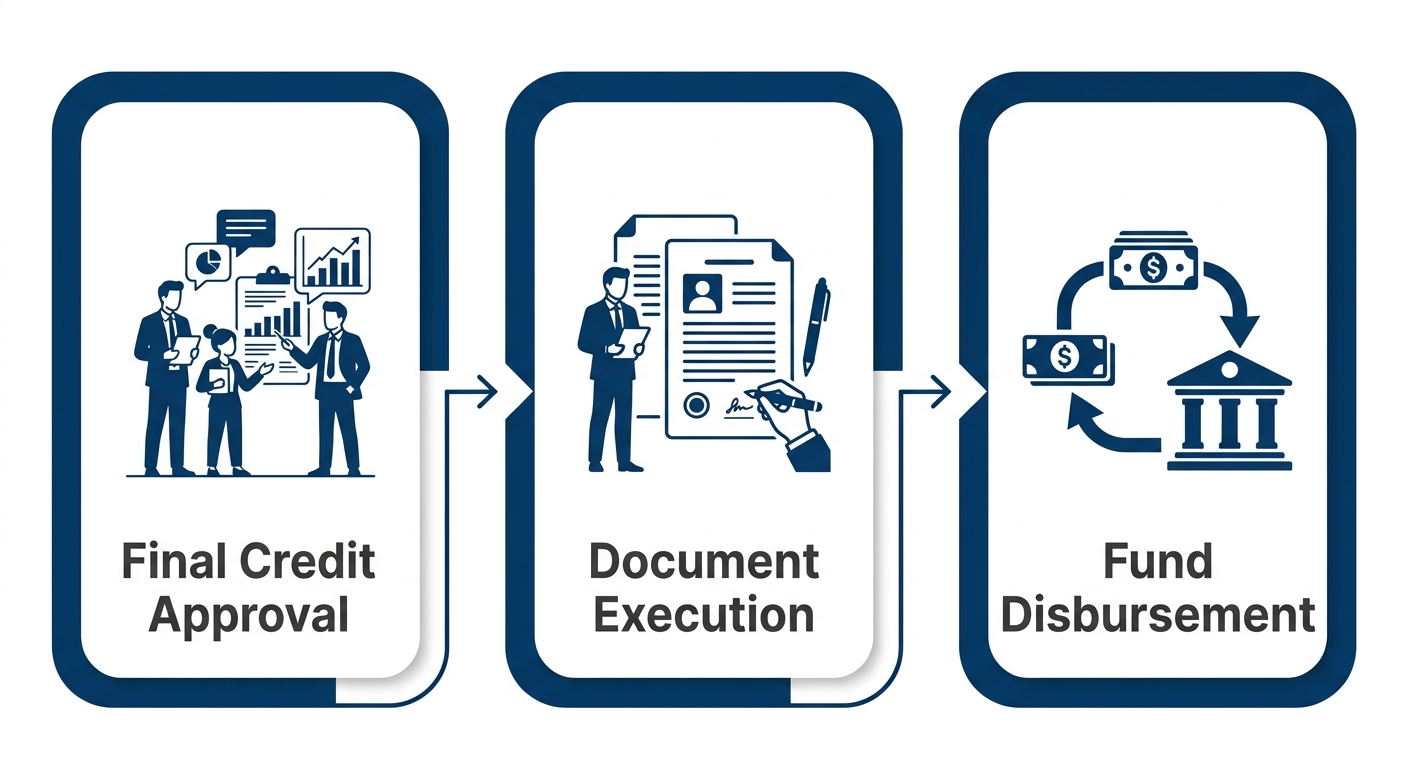
Horizontal flow visualizing the venture debt closing process.
To explore how our debt advisory team can streamline your financing, Book A Call with Zaidwood Capital today.
Troubleshooting Common Venture Debt Challenges
While venture debt can be a strategic tool for growth-stage companies, it introduces operational complexities that demand disciplined oversight and proactive management. Drawing on our advisory work at Zaidwood Capital, we outline common pitfalls and practical solutions to help companies maintain covenant compliance and lender alignment.
Covenant monitoring is essential. Typical venture debt agreements may include minimum cash balances, financial reporting requirements, or EBITDA targets. We recommend establishing a monthly review cycle to track these metrics against your loan covenants, using dashboards that pull real-time data from your accounting system. Early detection of a potential breach allows time to renegotiate terms or secure a waiver before default occurs.
Cash-flow timing remains a persistent challenge—debt service often begins before new revenue materializes. Solutions such as interest-only periods, payment deferrals, or sculpted repayment schedules can bridge this gap if negotiated upfront. Review your venture debt term sheet carefully for prepayment penalties and amortization triggers, as these can limit your flexibility. The U.S. Securities and Exchange Commission provides guidance on structuring debt instruments that we find useful for understanding regulatory boundaries.
Lender alignment is often overlooked. Not all venture debt providers offer the same degree of sector expertise or willingness to accommodate covenant adjustments. FINRA emphasizes illiquidity and leverage risks in its investor insights, reinforcing the importance of vetting lenders for experience with your industry and growth trajectory.
A final caution: guard against over-leveraging and dilution-creep. Warrants embedded in venture debt can subtly erode founder equity, especially if multiple rounds of debt are layered. We help companies model the long-term capital-structure impact of warrants and principal obligations.
This content is for informational purposes only and does not constitute financial or legal advice. Consult your advisors for your specific situation.
Making Strategic Capital Decisions with Venture Debt
Venture debt can serve as a powerful complement to equity financing for growth-stage companies that already have venture capital backing or strong revenue trajectories. Unlike traditional bank loans, venture debt financing offers a non-dilutive way to extend cash runway and bridge to critical milestones—allowing founders to preserve ownership while accelerating growth.
When evaluating a venture debt term sheet, our team helps clients assess core variables such as interest rate, warrant coverage, maturity period, prepayment penalties, and financial covenants. We also bring access to a curated network of venture debt providers—including more than 4,000 institutional and private investors—to help structure, negotiate, and place the right venture debt solution for each client’s unique situation. However, venture debt is typically used alongside equity, not as a replacement, and all investments involve risk.
Securities are offered through Finalis Securities LLC; Zaidwood Capital is not a registered broker-dealer. Past performance does not guarantee future results.
Resources
- Find Top Venture Capital Consultants for Capital Formation
- Optimize Venture Capital Fundraising with Consulting Experts
- Secure Custom Debt Financing from Experienced Advisors
- Discover Promising M&A Opportunities in Emerging Markets
- Overcome Capital Formation Hurdles in Emerging Markets
- Identify Key Drivers for M&A in Emerging Markets
- Implement Successful M&A Strategies in Emerging Markets
- Access SEC Capital Raising Resources for Small Businesses
- Access SEC Advocate for Small Business Capital Formation
- Discover FINRA Investor Insights and Educational Tools