


What is Series D Funding
Table of Contents
Understanding Series D Funding for Growth-Stage Companies
What is Series D funding? It is a late-stage venture capital round that growth-stage companies use to raise expansion capital, enter new markets, or prepare for a public offering.
Companies often pursue Series D as pre-IPO financing to solidify financials and demonstrate institutional conviction. This round gives firms the runway to accelerate growth, make strategic acquisitions, or invest in product development before going public. The presence of seasoned institutional investors–such as growth-equity funds, sovereign wealth funds, and hedge funds–validates the company’s business model and market opportunity. For companies that have already raised significant Series C capital, Series D can bridge the gap to an IPO or a strategic exit. Series D can also serve as a defensive move, allowing companies to raise capital on favorable terms before market conditions shift. Late-stage venture capital rounds like Series D provide the scale of capital needed to compete at a global level and attract top-tier talent.
Series D differs from earlier rounds in several ways. Series A-C typically focus on proving product-market fit, building early teams, and achieving initial growth. By the time a company reaches Series D, it has demonstrated consistent revenue, strong unit economics, and a clear path to liquidity. As a result, the round size is significantly larger, and investors are more focused on risk mitigation and pre-IPO positioning. Additionally, Series D investors often take board seats and provide strategic guidance to help companies navigate the pre-IPO landscape.
We at Zaidwood Capital guide growth-stage companies through the capital formation process for Series D and beyond.
The Core Purpose of Series D Funding
For growth-stage companies, the funding journey from seed to late-stage can be complex. Series D Funding emerges as a pivotal round, typically serving as a pre-IPO bridge, facilitating liquidity events, or funding strategic acquisitions. Unlike earlier rounds that focus on proving product-market fit and scaling revenue, Series D channels substantial capital into mature companies preparing for public markets. This round often represents the final private-market capital raise before an IPO, attracting sophisticated institutional investors.
To understand Series D’s unique positioning, it’s helpful to review the progression from Series A through C. The following infographic summarizes the key characteristics of those earlier funding rounds.
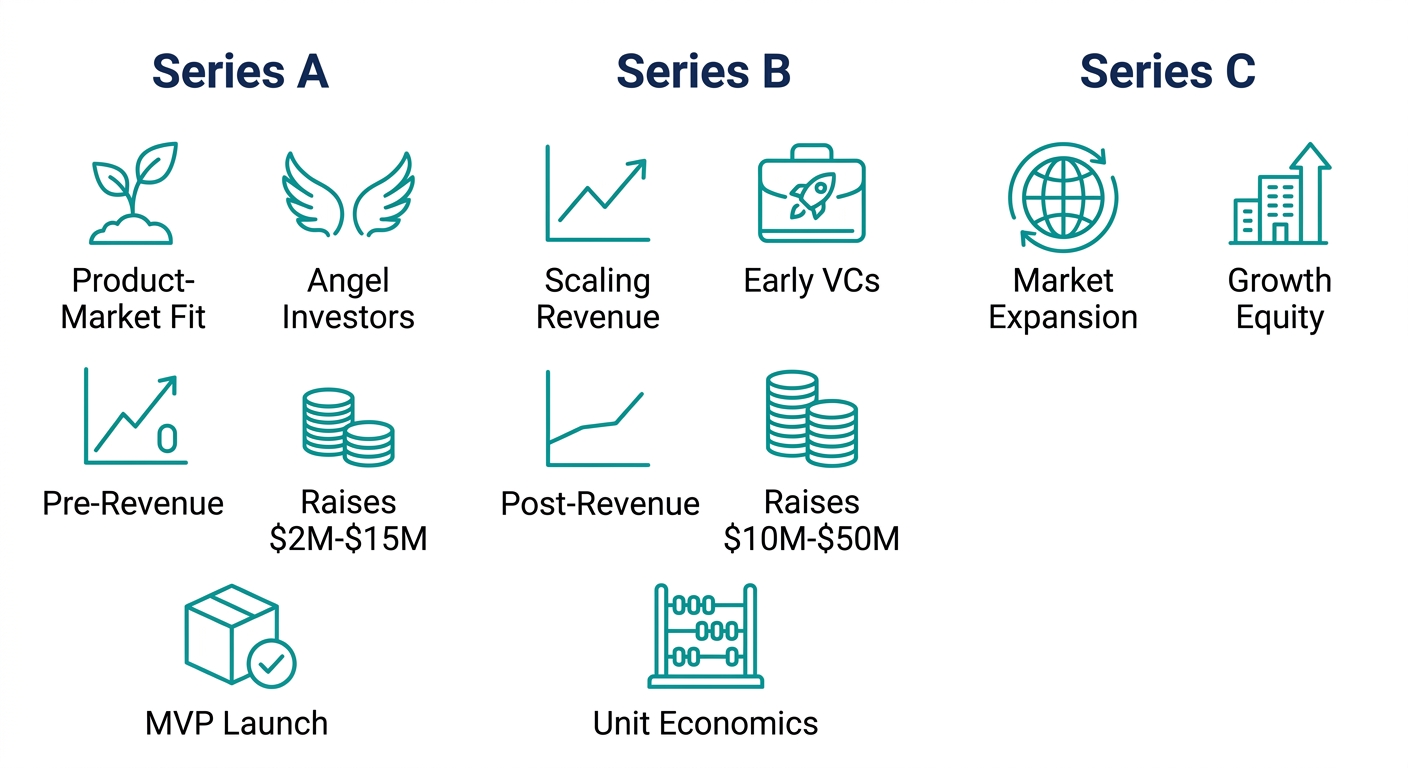
Comparison of Series A, B, and C funding stages with key characteristics
Building on that foundation, Series D emerges for companies that have already achieved product-market fit and are generating consistent revenue. The table below, drawing on benchmarks from SIFMA and PitchBook, compares Series D with earlier rounds across critical aspects.
Table 1: Series D vs. Earlier Rounds at a Glance
| Aspect | Series A | Series B | Series C | Series D |
|---|---|---|---|---|
| Purpose | Product‑market fit, initial growth | Scaling user base, revenue growth | Market expansion, new products | Pre‑IPO bridge, liquidity, acquisitions |
| Typical Investors | Angel, seed funds, early‑stage VCs | Early‑stage VCs, some growth funds | Growth equity, late‑stage VCs, crossover funds | Late‑stage VCs, institutional investors, sovereign wealth funds |
| Valuation Stage | Pre‑revenue / early revenue | Post‑revenue, modest traction | Strong revenue growth, path to profitability | Mature revenue, near‑public metrics |
| Amount Raised | $2M-$15M | $10M-$50M | $30M-$100M+ | $50M-$300M+ |
| Key Milestones | MVP, product launch | Revenue , unit economics | Market share, profitability progress | IPO readiness, strategic M&A |
As the table illustrates, Series D is distinguished by its orientation toward public-market readiness, the involvement of institutional investors, and significantly larger capital raises.
Data based on industry benchmarks from PitchBook and SIFMA.
Whereas earlier rounds emphasize growth and market capture, Series D capital is deployed for strategic purposes: funding a pre-IPO runway, enabling founder and early-investor liquidity through secondary sales, or executing transformative acquisitions. Investors in Series D rounds are typically late-stage venture capital firms, sovereign wealth funds, and large institutional allocators who seek lower risk and clear paths to exit. Valuations reflect mature revenue streams and near-public metrics, often surpassing the benchmarks of earlier rounds. While Series C rounds may raise $30 million to $100 million, Series D rounds routinely exceed $50 million and can top $300 million, providing the financial muscle for substantial market moves. By this stage, the critical milestone shifts from securing product-market fit to demonstrating IPO readiness and the ability to manage complex M&A transactions with disciplined financial controls.
This unique purpose influences every dimension of a Series D raise, from investor negotiations to due diligence complexity. For management teams, the decision to pursue Series D involves weighing the benefits of accelerated growth and partial liquidity against the demands of public-market readiness. In the next section, we’ll delve into the specific mechanics of Series D rounds. At Zaidwood Capital, we deploy our Precision Catalyst framework to help clients structure late-stage fundraising that aligns with long-term strategic goals.
How Series D Differs from Earlier Funding Rounds and Pre-IPO Financing
Understanding what is series d funding requires comparing it to the rounds that precede it and the financing that immediately precedes an initial public offering. While Series D represents a logical next stage in a company’s growth, it differs significantly from Series A, B, and C rounds and from the funding that comes just before an IPO in terms of purpose, timing, and investor dynamics. At Zaidwood Capital, we help clients navigate these distinctions to craft the right capital-formation narrative.
Series D vs. Earlier Rounds: Key Differences
Unlike series a funding, where companies typically seek product-market fit and early growth, Series D serves as a bridge to an IPO. Series B rounds fund market expansion and building sales teams, while Series C capital fuels rapid scaling, often into new geographies or product lines. By contrast, a Series D round is designed to strengthen the balance sheet, finance acquisitions, or provide a final cash runway ahead of a public listing. Typically occurring 12 to 24 months before a planned IPO, Series D rounds use valuation methods based on revenue multiples and comparable public company analysis. According to the Securities Industry and Financial Markets Association (SIFMA), this stage dilutes existing shareholders by 10 to 25 percent, signaling to public market investors that the company has reached a level of maturity and governance readiness. We at Zaidwood Capital often see companies use a D round to round out their executive team or to make a transformative acquisition that enhances their public-market story.
The Role of Late-Stage Venture Capital and Pre-IPO Financing
Pre-IPO financing operates on a different timeline and serves a distinct function. While Series D can occur well over a year before an IPO, pre-IPO financing happens immediately before or during the IPO process. Pre-IPO rounds are often led by anchor investors who commit to buying large blocks of shares, helping to stabilize the offering price and signal confidence to the broader market. The table below summarizes the key structural differences:
| Aspect | Series D | Pre‑IPO Financing |
|---|---|---|
| Timing | Typically 12-24 months before planned IPO | Immediately before or during IPO process |
| Purpose | Bridge funding, acquisitions, balance sheet strengthening | Anchor investor commitments, price stabilization, insider participation |
| Investor Type | Late‑stage VCs, growth equity, institutional investors | Anchor investors, mutual funds, sovereign funds, existing backers |
| Valuation Basis | Revenue multiples, comparable public comps | IPO price range, underwriter estimates |
| Dilution | Moderate (10‑25% of company) | Typically lower (5‑15%) |
SIFMA and Crunchbase data confirm these patterns, though actual rounds vary by market conditions. Late-stage venture capital plays a critical role in these preparatory stages, often providing both capital and strategic guidance. We at Zaidwood Capital advise clients to view Series D and pre-IPO rounds as complementary steps that together build a strong foundation for the public markets.
Investor Dynamics and Valuation in Series D
Series D rounds attract a different investor profile than earlier stages. Late-stage venture capital firms, growth equity shops, and institutional investors–such as mutual funds and sovereign wealth funds–commonly participate. These investors are less focused on moonshot returns and more on de-risked, predictable growth paths. Valuation is derived from revenue multiples and comparisons to publicly traded peers, a shift away from the top-line growth emphasis of Series A and B. SIFMA data confirms that dilution at this stage tends to be moderate, typically between 10 and 25 percent, which is higher than pre-IPO financing’s 5 to 15 percent but acceptable given the closer path to liquidity. Late-stage venture capital can also bring operational expertise and help refine the equity story for the public market.
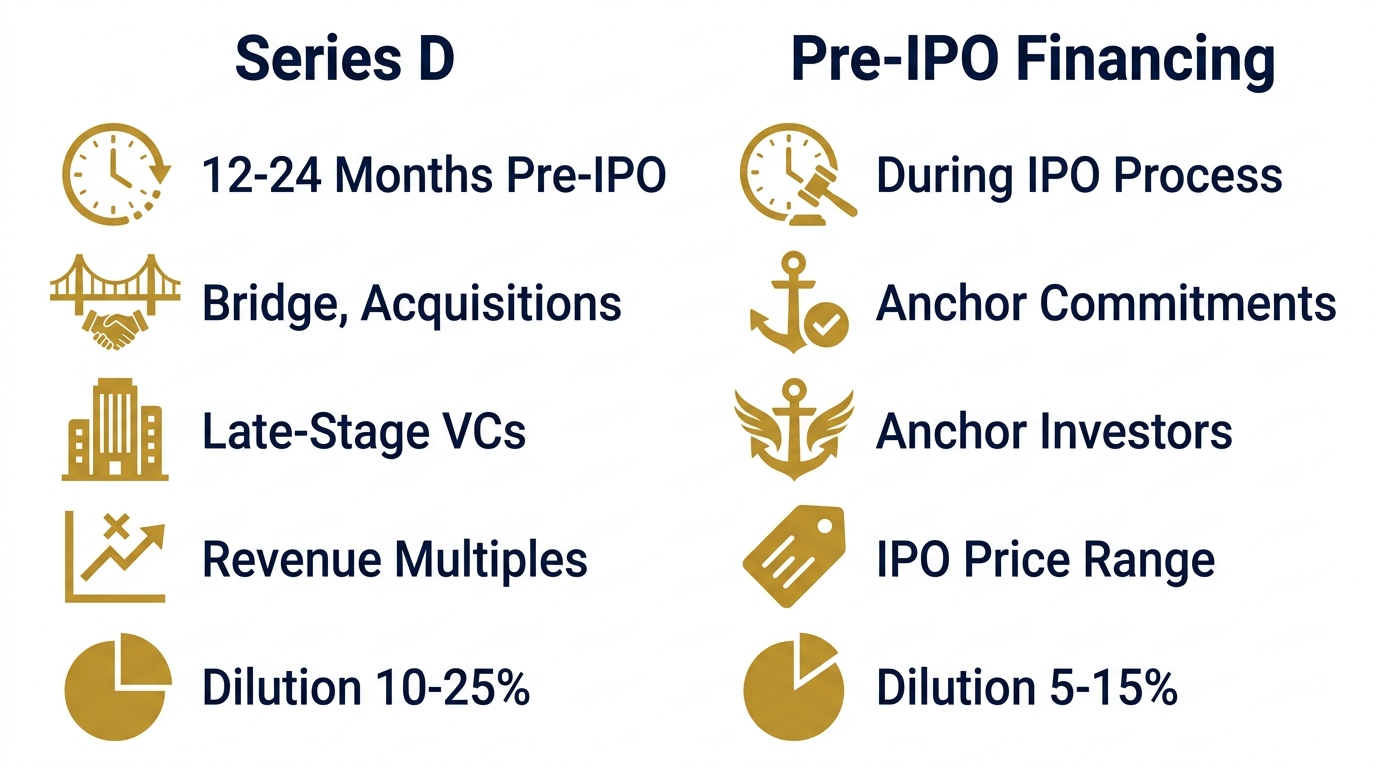
Two-column infographic compares Series D and Pre-IPO financing stages.
By clarifying these investor dynamics and valuation frameworks, companies can better negotiate terms and align stakeholder expectations. Understanding these differences is crucial before exploring how to secure Series D funding.
Preparing for a Series D Round: Milestones and Investor Positioning
To answer what is series d funding, we first look at the milestones and operational rigor a company must demonstrate before this kind of raise. Series D is not merely another funding event; it is a late-stage validation point where institutional investors expect proof of market leadership, scalable economics, and a near-term path to an exit or a pre-IPO financing trajectory. At Zaidwood Capital, we guide founders through this critical phase, ensuring that every quantitative and qualitative benchmark is met before a conversation with investors begins.
Common Milestones Before Seeking Series D
While every business is unique, we observe a consistent set of operational and financial milestones that signal readiness for a Series D. These benchmarks help a company stand out in a competitive late-stage environment. For a refresher on earlier-stage benchmarks, see our guide on series a funding.
- Annual Recurring Revenue (ARR): We look for ARR typically exceeding $50 million, demonstrating that the business has achieved meaningful scale.
- Revenue Growth Rate: A year-over-year growth of 30-50% remains attractive, showing that momentum is intact even at a larger revenue base.
- Clear Path to Profitability: A defined, credible trajectory to profitability within 12-18 months is essential. Late-stage investors in late-stage venture capital circles are increasingly focused on capital efficiency.
- Gross Margin: A gross margin above 60% indicates strong unit economics, which is critical when the business is expected to generate sustainable returns.
- Customer Concentration: No single customer should represent more than 20% of revenue, mitigating concentration risk and making the business more defensible.
- Basic Data Room Readiness: Foundational financials, a clean cap table, and organized legal documents that facilitate efficient initial due diligence are expected.
These metrics represent commonly observed benchmarks for Series D level companies, not a guarantee of a successful raise. Actual thresholds shift by sector, growth story, and prevailing market conditions.
The following table contrasts these milestones with the heightened bar we encounter among the most discriminating late-stage investors.
| Milestone | Typical Series D Requirement | Late‑Stage VC Expectation |
|---|---|---|
| Annual Recurring Revenue (ARR) | >$50M | >$100M |
| Revenue Growth Rate | 30‑50% YoY | >20% YoY (but with larger base) |
| Profitability Path | Clear path to profitability within 12‑18 months | Often profitable or near‑profitable |
| Gross Margin | >60% | >70% |
| Customer Concentration | No single customer >20% of revenue | No single customer >10% of revenue |
| Data Room Preparedness | Standard financials, cap table, legal docs | Advanced due diligence materials, third‑party audits |
Late-stage venture capital firms raising large funds require a higher degree of operating predictability. While a Series D round might accommodate a clear path to profitability, many top-tier investors today seek companies that are already profitable or within quarters of turning profitable. The jump from $50 million ARR to $100 million ARR as a baseline is the difference between being a promising player and a category winner.
Disclaimer: These are illustrative benchmarks based on typical patterns observed in late-stage capital raises; individual investor requirements will vary by industry, market cycle, and specific fund mandate.
Positioning Your Company for Late-Stage Investors
With these milestones in hand, you can now focus on building a compelling narrative for late-stage venture capital investors. Positioning is not just about hitting the numbers; it is about shaping a story that connects operational performance to a clear vision of market leadership and returns. Our team at Zaidwood Capital uses a suite of proprietary tools to transform raw metrics into a persuasive investor thesis.
We leverage Sovereign Data Nexus, our proprietary data platform, to systematically identify and rank investors whose past activity and mandate align with your sector, stage, and transaction size. Instead of spraying broadly, you gain access to a precision-targeted universe of capital partners. To further sharpen your narrative, Precision Catalyst deploys AI-driven engagement strategies that refine how your outreach is received, making every introductory conversation more relevant and impactful. Finally, our Velocity Matrix process framework compresses the fundraising timeline without sacrificing preparation depth, helping you avoid the deal-fatigue that can arise in a prolonged raise.
By the time we introduce a founder to our network of 4,000+ global investors and institutions representing over $15 billion in committed capital, every facet of the story–from unit economics to total addressable market–has been pressure-tested. This approach creates the confidence investors need to move forward in a competitive, pre-IPO financing environment.
Data Room Readiness and Due Diligence Preparation
A polished data room reinforces your positioning and signals operational maturity to potential investors. Modern late-stage due diligence is exhaustive, and a disorganized data room will inevitably slow momentum. We advise companies to prepare a secure virtual data room well in advance of any investor outreach, placing quality ahead of quantity.
The following specific documents are expected in a Series-D-grade data room:
- Audited financials covering at least the last three full fiscal years.
- A capitalization table that is clean, fully diluted, and updated.
- Key contracts including top customer agreements, vendor partnerships, and strategic alliance documents.
- Comprehensive intellectual property details: patents, trademarks, and licensing agreements.
- Board presentations and investor updates from recent quarters, offering a transparent view of strategic priorities.
- Third-party audits, where applicable, including technology reviews, security certifications, or market sizing studies.
Our advisory approach can help position your company by organizing these materials through a streamlined, secure platform designed to facilitate efficient investor review. When a diligence committee can quickly locate audited financials, verify IP ownership, and assess customer diversification, the entire process moves faster and maintains stronger negotiating tension. We work alongside your finance and legal teams to ensure that what an investor sees reflects the caliber of the business you have built.
Advanced Considerations in Series D Valuation and Terms
To understand advanced considerations in Series D valuation and terms, it helps to first grasp what is series d funding and how terms evolve toward an IPO. Building on the core concepts, we now focus on contractual provisions that distinguish Series D from earlier rounds and from pre-IPO financing.
The table below highlights typical term differences between Series D and pre-IPO financing. These norms reflect aggregated data from Zaidwood Capital’s 350+ closed deals and align with industry benchmarking from the Securities Industry and Financial Markets Association (SIFMA).
| Term | Series D | Pre‑IPO Financing |
|---|---|---|
| Liquidation Preference | 1x non‑participating (common) | 1x non‑participating or participating (often capped) |
| Anti‑Dilution | Weighted average (broad‑based) | Weighted average or full ratchet in rare cases |
| Board Representation | 1‑2 board seats for lead investor | Board observer rights common |
| Information Rights | Monthly/quarterly financials, annual budget | Quarterly financials, IPOâ€related disclosures |
| Drag‑Along/Tag‑Along | Standard provisions for both | Heavily negotiated to protect pre‑IPO placement |
In Series D, the 1x non-participating liquidation preference remains the most common structure, ensuring investors recoup their investment before common holders without double-dipping. Pre-IPO financing sometimes introduces participating preferences–capped to balance late-stage venture capital protections with founder upside. Anti-dilution protection typically relies on broad-based weighted average calculations, which moderate dilution from down rounds. Full ratchet provisions appear only in rare, heavily negotiated pre-IPO scenarios to shield late-stage venture capital investors; this distinction reflects their heightened concern for downside protection.
In our experience across 350+ transactions, lead Series D investors generally secure one to two board seats, whereas pre-IPO rounds often limit additional directors and instead grant board observer rights to keep governance streamlined. Information rights follow a similar pattern: Series D investors demand monthly or quarterly financials plus annual budgets, while pre-IPO investors focus on quarterly financials and IPO-related disclosures such as registration statements. Drag-along and tag-along rights are standard in both stages, but pre-IPO agreements involve more intense negotiation to ensure the placement group holds together until the offering closes, preventing holdout risks.
Understanding these advanced contractual nuances is critical as companies prepare for the eventual IPO or exit. For a thorough analysis of transaction economics, see our FAQ on tech M&A advisory fees. This article is for informational purposes only and is not an offer or recommendation.
Frequently Asked Questions About Series D Funding
What is series D funding?
Series D funding is a late-stage venture capital round that typically occurs when a company is preparing for an IPO or needs additional growth capital. It involves larger institutional investors and often serves as pre-IPO financing. Unlike earlier rounds focused on product-market fit, Series D targets scaling into profitability.
How does series D funding differ from Series A, B, and C rounds?
Series A-C rounds focus on product-market fit and market traction, while late-stage venture capital like Series D centers on scaling and revenue maturity. At this stage, investors such as private equity firms and hedge funds replace early-stage VCs, expecting a clear IPO path. Series D isn’t mandatory; some firms go directly from Series C to public markets.
Why do companies engage M&A advisors for Series D?
Many founders engage a Boutique M&A and Capital Advisory Firm to manage complex negotiations, structure transactions, and conduct due diligence. Our team provides transparent M&A advisory fee structures to support your Series D planning, helping you align with the right institutional partners without guaranteeing specific outcomes.
Navigating Series D with Zaidwood Capital
To understand what is series d funding, one must first recognize its role as late-stage growth capital, typically deployed by mature startups to scale operations, enter new markets, fund acquisitions, or serve as a pre-IPO financing bridge. This round, a hallmark of late-stage venture capital, often attracts crossover investors alongside traditional venture firms. At Zaidwood Capital, we increase the probability of success by combining our Sovereign Data Nexus for real-time market intelligence and Precision Catalyst for AI-driven investor matchmaking, all within a full-cycle advisory that can later support an IPO or strategic sale.
Resources


