



What is Series E Funding
Table of Contents
Understanding Series E Funding as a Pre-IPO Capital Strategy
Building on the overview of capital formation stages, what is Series E funding and why does it matter as a pre-IPO strategy? It represents the final private capital raise–often pursued by companies already profitable or near profitability–to bridge the gap to a public offering. Series E serves as a pre-IPO funding mechanism, bringing in institutional investors seeking a final private entry point before a liquidity event.
The typical Series E round involves larger check sizes and extended negotiation timelines, often structured with liquidation preferences and anti-dilution protections. Investors–including hedge funds, mutual funds, sovereign wealth funds, and private equity firms–participate in late-stage venture capital financing to gain exposure to vetted companies at a controlled valuation. According to the Securities Industry and Financial Markets Association (SIFMA), late-stage private financings have grown in prevalence as companies delay their IPOs, making Series E an increasingly common capital-market lever.
Unlike Series A, B, or C rounds that fund early innovation and product-market fit, Series E is a pre-IPO bridge. It buys time for market conditions to improve, funds large acquisitions, or satisfies post-IPO capital requirements. At Zaidwood Capital, we guide companies through these complex late-stage transactions, leveraging our institutional network and the Precision Catalyst platform to connect issuers with qualified investors. Our team’s experience across hundreds of capital events ensures founders navigate Series E with the strategic rigor needed for a successful transition to the public markets.
Fundamentals of Series E Funding
To answer the question “what is series e funding,” we must examine the final private fundraising stage before a company goes public. A Series E round typically occurs when a mature, high-growth company needs one last injection of pre-IPO funding to solidify its market position or extend its runway. This section explains where Series E fits in the venture capital lifecycle, who invests, and how it differs from earlier rounds.
Where Series E Fits in the Venture Capital Lifecycle
Series E is the penultimate stage in the venture funding timeline, sitting after Series D and directly before an initial public offering (IPO) or other exit. It is reserved for late-stage venture capital companies that have proven their business model and achieved substantial scale, yet require one final private capital infusion to optimise their financials, expand into new markets, or make strategic acquisitions. Because these companies are often considered “too big to fail” in the private market, a Series E round signals strong validation and a well-defined path to liquidity. At this point, the company has navigated through multiple venture rounds, demonstrating strong revenue growth and a clear roadmap to profitability.
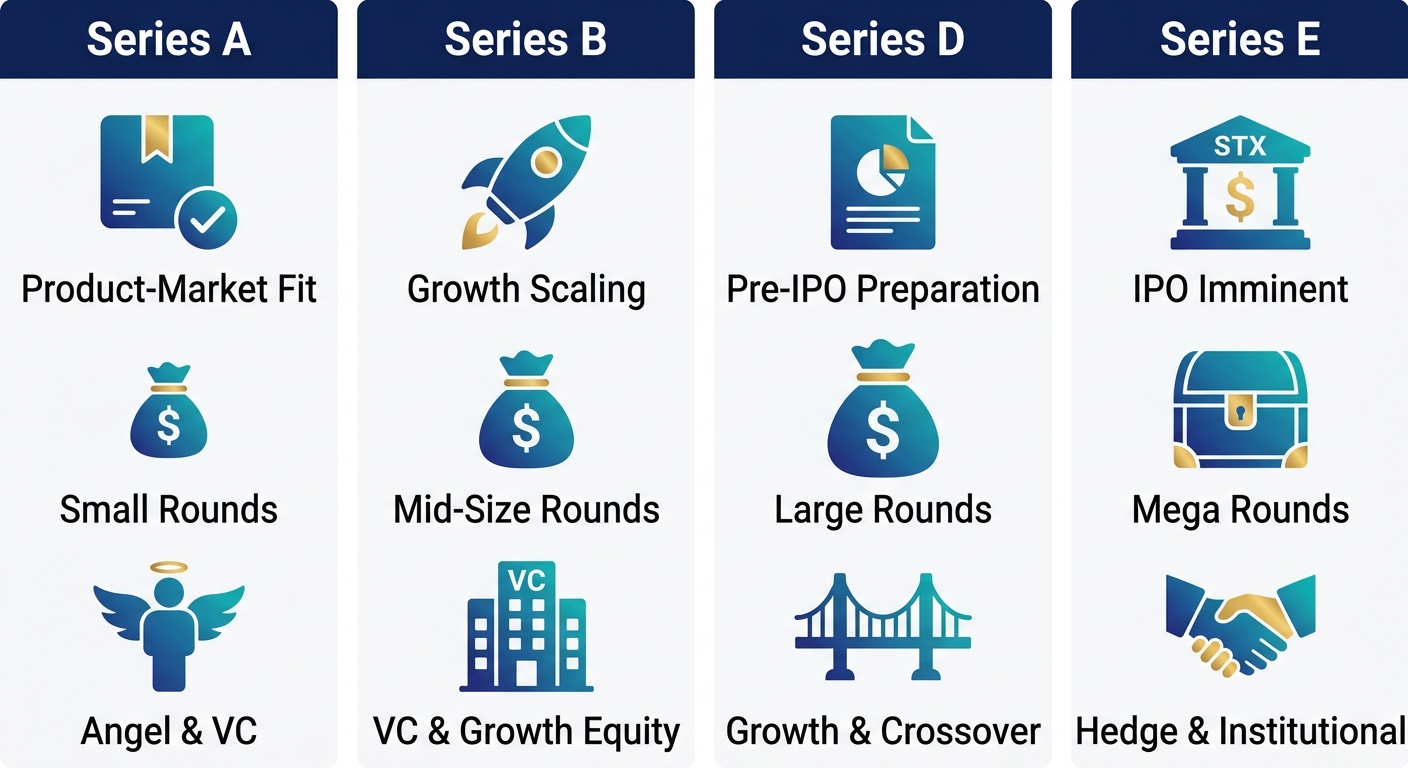
Funding round progression from Series A to Series E with key characteristics
Who Invests in Series E and Why
Series E rounds attract a distinct group of investors: crossover funds (such as mutual funds and hedge funds), large institutional investors, and sometimes sovereign wealth funds. Unlike early-stage venture capitalists who bet on potential, these participants seek near-term liquidity events and require robust financial metrics. They invest when a company is already demonstrating significant revenue, positive EBITDA, or a clear path to profitability. To structure the round, companies often consult an investment bank such as what is an investment bank.
How Series E Differs from Earlier Rounds (A, B, C, D)
Series E fundraising stands apart from earlier venture rounds in cheque size, due diligence, and deal complexity. While Series A raises $2M-$15M to prove product-market fit, Series E cheques can exceed $500M. Investors now scrutinize revenue growth, EBITDA margins, and unit economics instead of vision. Term sheets often include participating preferred stock and anti-dilution protections, reflecting the lower risk tolerance of pre-IPO capital providers. The table below summarizes these differences across key rounds.
Comparison Table: Funding Rounds at a Glance
| Round | Typical Company Stage | Average Round Size | Investor Profile |
|---|---|---|---|
| Series A | Early-stage product-market fit | $2M-$15M | VC firms, angel syndicates |
| Series B | Growth-stage scaling | $10M-$50M | VC, growth equity |
| Series D | Late-stage, pre-IPO preparation | $50M-$200M+ | Growth equity, crossover funds |
| Series E | Mature private company, IPO imminent | $100M-$500M+ | Crossover funds, hedge funds, institutional investors |
Data sourced from SIFMA industry statistics.
Understanding these fundamentals sets the stage for evaluating how Series E valuations are determined and what terms to expect.
How Series E Funding Differs from Earlier Rounds and IPO
Now let’s examine how Series E stands apart. To understand what series e funding is, we contrast the metrics and terms of late-stage funding. Series E Funding differs fundamentally from earlier rounds and an IPO.
Financial Metrics That Matter in Series E
In late-stage venture capital, investors shift their focus from team and product-market fit to rigorous financial performance. We see that revenue growth of 20-50% year-over-year, gross margins above 60% (common in SaaS), and unit economics with a lifetime value-to-customer acquisition cost ratio exceeding 3:1 are now table stakes. The burn multiple should remain below 2x recent funding, and no single customer should represent more than 20% of revenue. Market leadership–ranking among the top three in the segment–signals durability. These benchmarks replace earlier emphasis on traction and vision, as investors demand proven scalability and capital efficiency. Series E investors scrutinize these metrics to ensure the company can withstand competitive pressures and generate attractive returns on the significant capital deployed. Healthy unit economics and low customer concentration mitigate revenue risk, making the company more resilient. A strong market share combined with efficient unit economics reassures investors that the business model can sustain growth without excessive cash burn.
Deal Terms and Valuation Mechanics
Series E term sheets introduce complex provisions designed to protect large investments. Preferred stock with 1x to 2x liquidation preferences, weighted-average or full-ratchet anti-dilution, and drag-along rights are standard. The lead investor typically secures a board seat and veto rights over major corporate decisions. Valuation methods reflect the company’s maturity: discounted cash flow analysis with a 20-30% discount rate and comparable company revenue multiples of 8x-15x for late-stage tech firms. These terms, far more detailed than those in Series A or B, ensure alignment between founders and deep-pocketed crossover investors. In our advisory work, we see that deal structures also include information rights and redemption clauses, giving investors significant influence over exit timing. Such provisions reflect the capital scale–often $100 million or more–and the need for robust governance. The use of multiple liquidation preferences ensures investors recover capital before common shareholders, a critical consideration in downside scenarios.
Series E vs IPO: Strategic Considerations
When evaluating pre-IPO funding versus Series E, companies weigh valuation and control. Delaying an IPO 12-18 months can boost valuation 30-50% while the company refines EBITDA margins and executes acquisitions away from public scrutiny. Series E capital funds M&A and allows early investors liquidity through secondary sales–often up to 20% of the round–without quarterly earnings pressure or Sarbanes-Oxley compliance. The investor base also shifts: crossover firms like Tiger Global and hedge funds dominate Series E, unlike the institutional funds typical of pre-IPO mezzanine. This investor profile supports higher growth ambitions.
Comparison: Series E vs Pre-IPO (Mezzanine) Funding
The following table contrasts Series E and pre-IPO mezzanine financing to assist founders in evaluating their path.
| Feature | Series E | Pre-IPO (Mezzanine) |
|---|---|---|
| Primary Goal | Growth / M&A / Liquidity | Stabilisation / IPO bridge |
| Typical Size | $100M-$500M+ | $50M-$200M |
| Investor Type | Crossover funds, hedge funds | Institutional funds, strategic investors |
| Conversion | Common / Preferred | Convertible debt with price floor |
| Dilution | 10-25% | 5-15% (lower if convertible) |
| CEO Control | Moderate (board seat likely) | High (fewer governance changes) |
According to SIFMA, typical Series E rounds exceed $100 million, while pre-IPO mezzanine rounds range from $50 million to $200 million.
Understanding these distinctions is critical for late-stage founders. The decision between Series E and pre-IPO funding shapes valuation, governance, and future exit options. In the next section, we explore how Zaidwood Capital’s boutique M&A and capital advisory expertise helps companies structure and close Series E rounds on optimal terms, leveraging our global investor network and proprietary data platform. Our team’s deep experience in late-stage venture capital ensures we navigate the complexities of Series E term sheets and valuation dynamics for our clients.
Practical Steps for Securing Series E Funding
Having explored the mechanics of Series E rounds, many founders ask what is series e funding in practical terms: it is a late-stage venture capital round that frequently functions as pre-IPO funding for mature companies preparing to go public. The following steps outline how to secure this capital efficiently.
Preparing the Financial Story for Series E Investors
Before engaging any late-stage investor, your company must craft a defensible financial narrative. We recommend building a three-year projection anchored on verifiable data. Key components include:
- Revenue breakdown by product line or geography
- Gross margin trends over the preceding quarters
- Cohort retention rates that demonstrate customer stickiness
- Unit economics (LTV/CAC, payback period)
- Burn multiple reflecting capital efficiency
- EBITDA or adjusted EBITDA trajectory
Each assumption should be backed by auditable evidence. In our experience, engaging professional business valuation advisory early in the process adds a layer of credibility that late-stage investors demand, turning raw metrics into a compelling, defensible valuation story.
Targeting and Engaging the Right Series E Investors
Once your financials are airtight, the next step is to target the right investor. Late-stage rounds attract four primary investor types, each with distinct expectations. According to SIFMA industry statistics and market observations, the following profiles dominate Series E and pre-IPO financings.
Investor Type Comparison Table
| Investor Type | Investment Horizon | Minimum Check Size | Primary Focus Metrics | Typical Deal Terms |
|---|---|---|---|---|
| Crossover Funds | 12-24 months | $50M+ | Revenue growth, market share, path to profitability | Participating preferred, board seat |
| Hedge Funds | 6-18 months | $25M+ | Near-term liquidity, valuation discount | Anti-dilution, information rights |
| Institutional Investors | 2-5 years | $100M+ | EBITDA margins, defensible moat | Convertible debt, liquidity preference |
| Sovereign Wealth Funds | 5-10 years | $200M+ | Strategic alignment, long-term returns | Custom, often non-dilutive |
We build a target list using Precision Catalyst, our AI-driven investor matchmaking platform, to analyze each fund’s historical check size, sector preferences, and decision timelines. For example, crossover funds in our network typically move within 12-24 months and require a visible path to profitability, while sovereign wealth funds focus on long-term strategic fit with minimum checks exceeding $200M. Warm introductions through a capital advisory firm like ours significantly increase response rates compared to cold outreach.
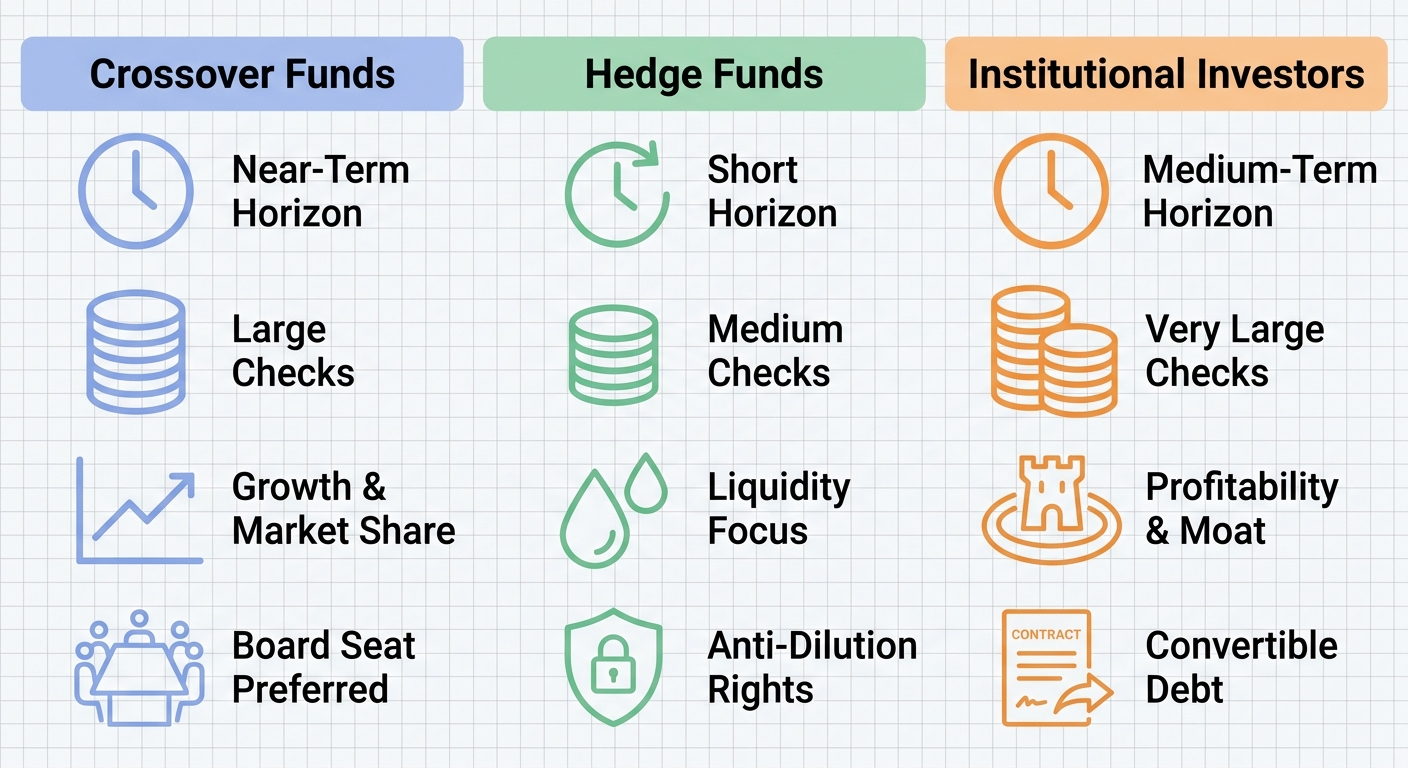
Investor type comparison table for Series E funding with horizon, check size, metrics, and terms.
With a refined target list in hand, the real work begins with the due diligence process.
Navigating Due Diligence From Teaser to Closing
A disciplined process minimizes friction and maximizes negotiating leverage. The typical due diligence timeline for a Series E round unfolds as follows:
- Teaser: Confidential two-pager highlighting key metrics and growth thesis
- NDA execution: Enables deeper data sharing
- Data room: Secure repository of financials, legal documents, and customer contracts
- Management meetings: In-depth Q&A sessions with the C-suite
- Reference calls: Investors validate claims with customers and partners
- Term sheet: Outlines valuation, structure, and key terms
- Definitive agreement & investor rights agreement: Final legal documents
- Closing: Funds transfer and governance handover
Common pitfalls we help founders avoid include premature data sharing before an NDA is signed, running sequential rather than parallel processes that drag out timelines, and engaging investors whose focus metrics don’t align with the company’s stage. As a Boutique M&A and Capital Advisory Firm, we manage these stages end-to-end, ensuring founders stay focused on running the business. After closing, attention shifts to post-funding governance and strategic milestones.
Advanced Considerations in Late-Stage Capital Formation
While understanding what is series e funding is foundational, advanced considerations such as valuation dynamics, dilution trade-offs, and strategic alternatives shape the path to an IPO. Founders and CFOs must navigate these factors to optimize outcomes and protect stakeholder value.
Valuation Dynamics: How Series E Affects IPO Pricing
Series E up-rounds signal valuation momentum to IPO investors, often establishing a valuation cushion that sets a floor for public market pricing. In contrast, a flat round may suggest stagnant growth, dampening enthusiasm. Aggressive terms — particularly elevated liquidation preferences — can complicate IPO pricing and reduce investor appetite. We help companies navigate these dynamics with independent business valuation advisory, leveraging our proprietary data to stress-test how late-stage terms will be perceived in public markets.
Dilution and Secondary Liquidity in Late-Stage Rounds
Dilution in late-stage venture capital rounds stems from several factors:
- Participating preferred structures that grant investors multiple returns before common shareholders.
- Expanded option pools that dilute existing equity to attract top talent.
- Insider participation that can concentrate ownership if not balanced.
Secondary sales offer a path to provide liquidity to early investors and employees without introducing new dilution. Our capital advisory team structures the round to minimize founder and employee dilution while satisfying institutional requirements — optimizing the cap table for a clean IPO.
Strategic Alternatives: Series E, Mezzanine, and Direct Listing
Companies approaching the public market can choose between a traditional Series E, a pre-IPO mezzanine, or a direct listing, each carrying distinct trade-offs in dilution, time, and investor profile. For AI-focused companies, the emergence of enterprise ai capital raising has become a notable trend in late-stage rounds. The table below outlines the primary differences.
Comparison Table: Late-Stage Financing Alternatives
| Financing Path | Key Investors | Typical Use | Dilution Risk | Time to IPO |
|---|---|---|---|---|
| Traditional Series E | Crossover funds, hedge funds | Growth & M&A | 10-25% | 12-24 months |
| Pre-IPO Mezzanine | Institutional investors, family offices | IPO bridge | 5-15% | 6-12 months |
| Direct Listing Preparation | No new fundraise (secondary market) | Liquidity without dilution | 0% | 3-6 months |
Series E suits companies needing growth capital, mezzanine fits those close to an IPO, and direct listing is ideal for mature businesses seeking liquidity without dilution. According to SIFMA market reports and Zaidwood Capital’s aggregated experience, the path chosen heavily influences the speed and cost of reaching public markets.
These advanced considerations equip founders with the insight needed to choose the most suitable late-stage path — a decision that Zaidwood Capital’s full-cycle advisory can help navigate.
Frequently Asked Questions About Series E Funding
Below, we answer common questions about Series E funding.
What Is Series E Funding?
Series E funding is the fifth major institutional equity round for mature startups, following Series D. As a late-stage venture capital round, it provides capital for aggressive growth, acquisitions, or IPO readiness, enabling companies to scale and prepare for public markets.
How Does Series E Funding Differ from Earlier Rounds?
Earlier rounds (Series A-D) fund product development and early market entry. Series E is a pre-IPO funding round focused on scaling infrastructure, capturing market share, and strengthening financials for a public offering. Investors prioritize near-term profitability and clear exit paths.
Who Invests in Series E Rounds?
Large institutional investors, private equity firms, hedge funds, and corporate strategic investors typically lead Series E rounds. SIFMA industry statistics confirm robust late-stage capital market activity. At Zaidwood Capital, we advise growth-stage companies on navigating these complex pre-IPO financings and securing optimal terms.
Series E Funding as a Strategic Capital Formation Milestone
Series E funding marks the final private financing stage for revenue-positive companies preparing for an IPO or acquisition. We view this round as a strategic bridge between late-stage venture capital and the public markets. Proceeds typically scale operations, strengthen balance sheets, or fund strategic tech mergers and acquisitions. Institutional investors–private equity, sovereign wealth funds–dominate these rounds, signaling a shift to pre-IPO funding. Industry data from SIFMA confirms that Series E funding is a critical precursor to public markets.
Resources


